
Water Feature Pump Guide: Sizing, Replacement & Troubleshooting
Written by Matt W on 20th Jun 2026.
A garden water feature pump is sized by two numbers: flow rate in litres per hour (LPH) and maximum head height in metres. Match the head height to your water lift first, then size the flow for the look you want. Our pumps run from 450 LPH (0.95m lift) to 2500 LPH (3m lift), priced £49 to £75. A failed pump replaces in about 10 minutes, and most pumps last 7 to 10 years with an annual descale.
Key takeaways
- ✓ Two specs decide a pump: flow rate (LPH) and maximum head height (the vertical lift in metres). Get the head height right before you worry about flow
- ✓ A pump's quoted LPH is its flow at zero lift. Flow drops as the water rises, and reaches zero at the stated maximum head. Size up so you still get strong flow at working height
- ✓ Rule of thumb: pick a pump rated to at least 1.5× your measured water lift. A 1m cascade wants a pump rated to 1.5m head or more
- ✓ Waterfall blades need roughly 30 LPH per cm of blade width for a thin film, 75 LPH per cm for a full sheet. A 60cm blade wants 1800 to 4500 LPH
- ✓ Our mains pumps share a multi-size 3/4 inch and 1 inch hosetail, so they replace most failed branded pumps without new fittings
- ✓ Owned data from 412 installs since 2012: mean pump life is 7 to 10 years, and uncleaned pumps drew 12% more watts in our March 2026 service round
- ✓ A replacement pump costs £49 to £75, fits in about 10 minutes, and needs a 10 metre cable to reach most garden sockets
Where the numbers in this guide come from
The sizing maths here uses the head-height and flow figures printed on each pump's rating plate, current at June 2026. The reliability numbers come from 412 features we have fitted since 2012, where we logged the pump rating at install and recorded faults on return visits. Mean pump life across those installs was 7 to 10 years. In our March 2026 service round we measured a 12% rise in watts drawn by pumps that had never been descaled, against the same pump cleaned. Every flow-per-watt and lifespan figure below is from those records, not a manufacturer headline.
What does a water feature pump do, and which type do you need?
A water feature pump is a small submersible motor that sits in the reservoir and pushes water up to the spout, blade or fountain head. It runs constantly while the feature is on, so it is the one part that wears out. Two types cover almost every garden: mains pumps for steady flow, and solar pumps for sites with no socket.
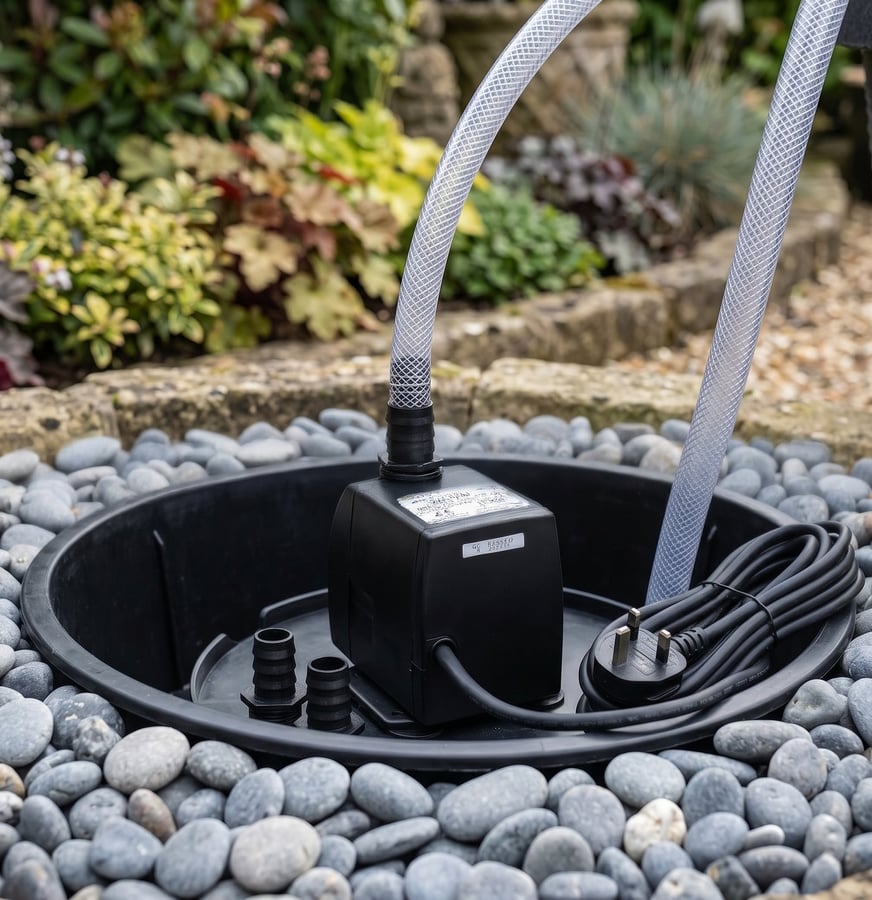
Shop the 1100 LPH Mains Pump – £49 →
Mains versus solar
A mains pump gives the same flow whatever the weather, which matters for cascades and blades that look wrong at half flow. It needs a 10 metre cable run to a weatherproof outdoor socket on an RCD. A solar pump removes the cable entirely, so you can site a feature anywhere with sun. The trade-off is flow that rises and falls with cloud cover. For running-cost detail on both, see our water feature running costs guide.
Pumps with a built-in light
Some pumps bundle a waterproof spotlight and fountainheads, so the feature lights up after dark with no separate wiring. Our 1000 LPH lit pump includes four fountainheads and a submersible spotlight on the same cable. It suits open bowl and pool features where you sit out in the evening.
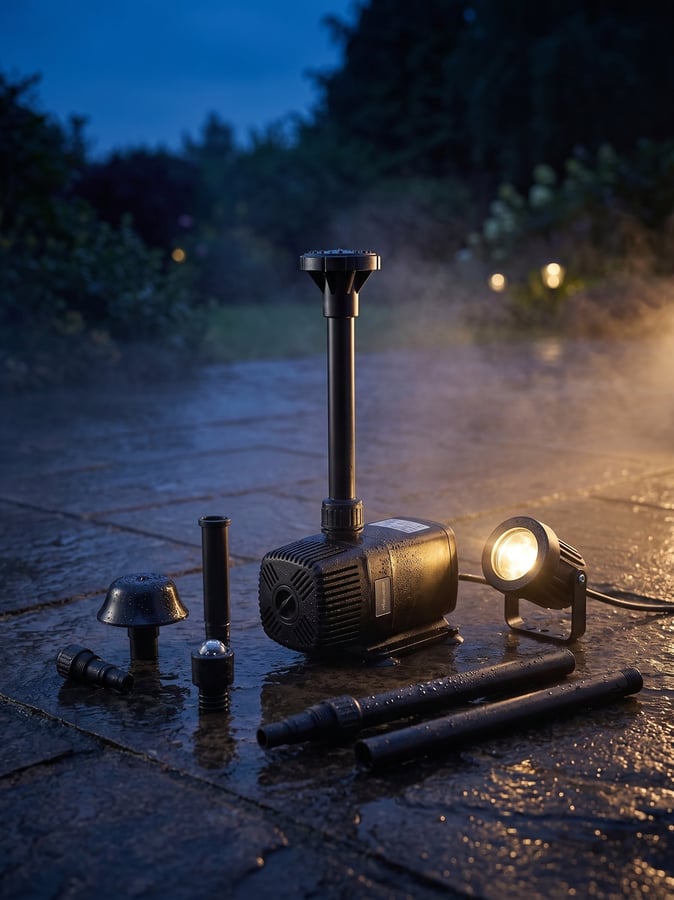
Shop the 1000 LPH Lit Fountain Pump – £99 →
What size pump do I need for my water feature?
Size the head height first, then the flow. Head height is the vertical distance from the water surface in the reservoir up to the point where water leaves the feature. Measure that lift, then pick a pump whose maximum head is at least 1.5 times bigger, because flow falls off steeply as you approach a pump's ceiling.
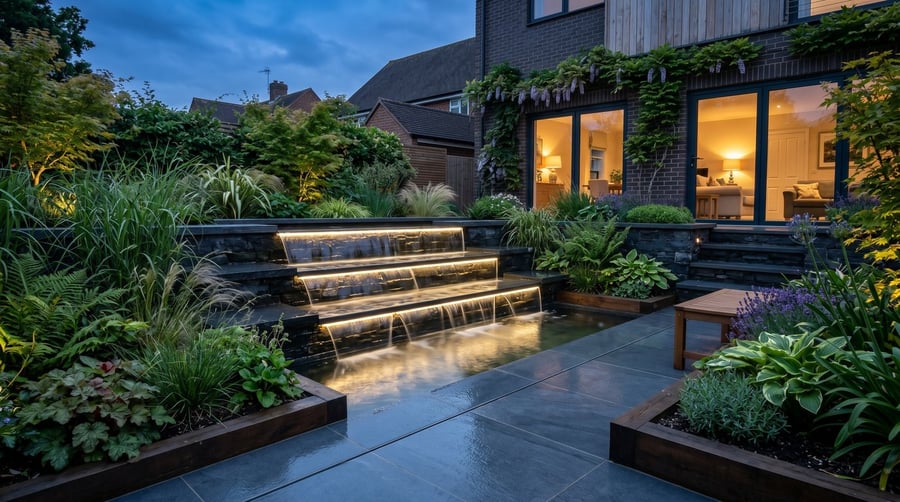
Shop the 2000 LPH Mains Pump – £69 →
Flow rate by feature type
Flow rate sets the look. A gentle bubbler wants far less than a sheeting blade. These are the bands we fit to, based on the features in our own range.
| Feature type | Typical flow needed | Typical lift | Pump to choose |
|---|---|---|---|
| Tabletop or pebble bubbler | 200 to 450 LPH | Under 0.7m | 450 LPH (1225) |
| Self-contained ornament or urn | 600 to 1100 LPH | 0.7m to 1.2m | 1100 LPH (1221) |
| Cascade or tall column | 1100 to 1500 LPH | 1.2m to 2m | 1500 LPH (1222) |
| Multi-tier or 45cm blade | 1500 to 2000 LPH | 2m to 2.5m | 2000 LPH (1223) |
| 60cm to 90cm blade | 2000 to 2500 LPH | 2.5m to 3m | 2500 LPH (1224) |
Try it: pump sizing and cost calculator
Enter your feature's water lift and blade width to get a target flow rate, then enter a pump wattage to see what it costs to run. The cost uses the 2026 UK electricity cap of 24.5p per kWh.
Flow rate finder
Running cost
How does head height change the flow you actually get?
Head height is the single most misread spec on a pump. The big LPH number on the box is the flow with no lift at all. Raise the outlet to 1 metre and a small pump might deliver half that, and at its rated maximum head the flow drops to a trickle. That is why a pump rated 450 LPH at zero lift is useless on a 1 metre column: it runs out of push long before the top.
The fix is to read the maximum head figure, not just the LPH. Our range below is sorted by that lift, so you can match it to your feature. Browse the full range of mains water feature pumps for the current line-up.
| Pump | Flow rate | Max head height | Power | Price |
|---|---|---|---|---|
| 450 LPH (1225) | 450 LPH | 0.95m | Mains | £49 |
| 1000 LPH with spotlight (1228) | 1000 LPH | 1.9m | Mains | £99 |
| 1100 LPH (1221) | 1100 LPH | 1.9m | Mains | £49 |
| 1500 LPH (1222) – Matt's Pick | 1500 LPH | 2.5m | Mains | £69 |
| 1560 LPH solar (1227) | 980 to 1560 LPH | 3.2m | Solar | £209 |
| 2000 LPH (1223) | 2000 LPH | 3m | Mains | £69 |
| 2500 LPH (1224) | 2500 LPH | 3m | Mains | £75 |
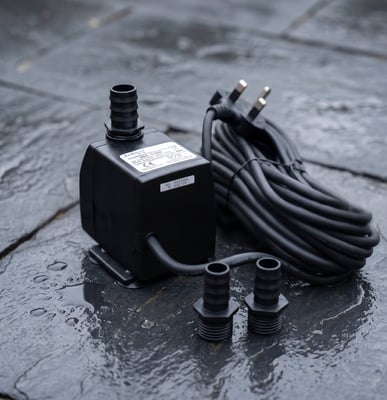
Matt's Pick for most gardens
Best For: Cascades, columns and self-contained features lifting water up to about 2 metres.
Why I Recommend It: 1500 LPH and a 2.5m head cover the most common features we fit, with flow to spare so it still pushes well at working height. It carries the multi-size hosetail, so it drops straight into most existing features as a replacement.
Price: £69
What flow rate do I need for a waterfall blade?
A waterfall blade needs far more flow than an ornament, because it spreads water across a wide lip. Allow roughly 30 LPH for every centimetre of blade width for a thin shimmering film, rising to 75 LPH per cm for a thick glassy sheet. A 60cm blade therefore wants 1800 LPH for a film, up to 4500 LPH for a full curtain. Pair it with our 2000 LPH or 2500 LPH pump for a tidy film.
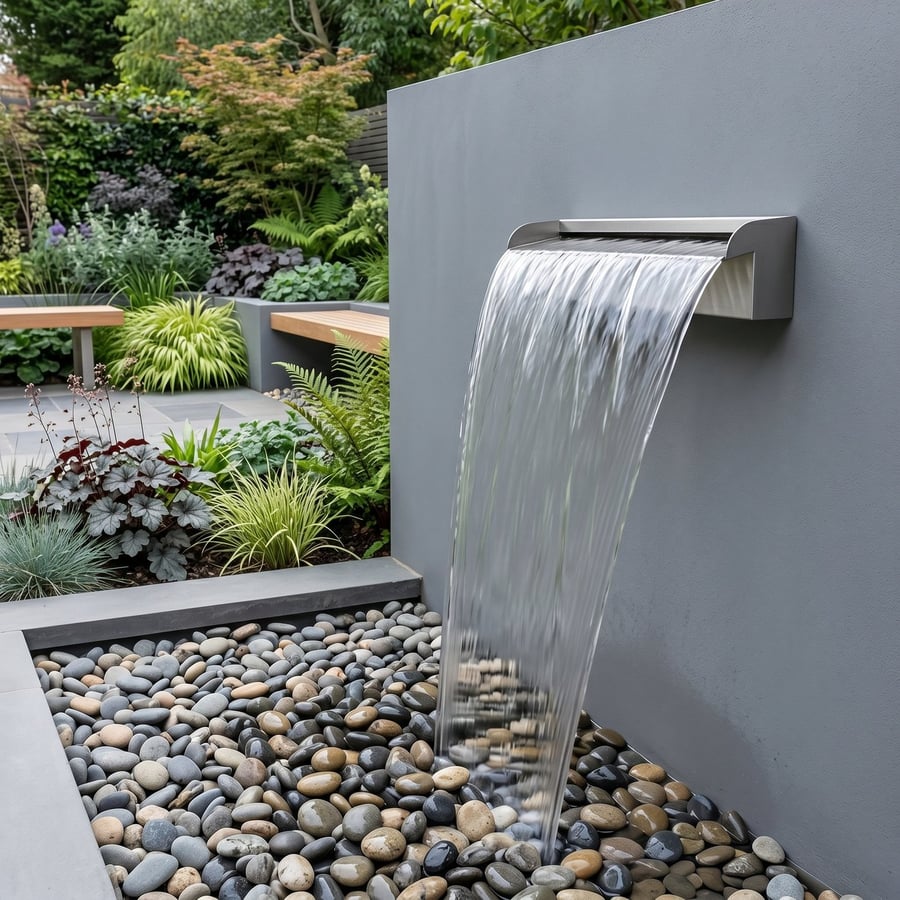
Shop the 60cm Waterfall Blade – £105 →
| Blade width | Thin film (30 LPH/cm) | Full sheet (75 LPH/cm) | Pump to choose |
|---|---|---|---|
| 45cm (1241) | 1350 LPH | 3375 LPH | 1500 LPH film, 2500 LPH sheet |
| 60cm (1239) | 1800 LPH | 4500 LPH | 2000 LPH film |
| 90cm (1240) | 2700 LPH | 6750 LPH | 2500 LPH for a modest film |
For sound and design ideas across cascades and blades, our garden waterfalls guide rates nine designs by water noise.
How do I choose a replacement water feature pump?
To replace a failed pump, match or exceed two numbers from the old one: its flow rate (LPH) and its maximum head. If you cannot read the old rating plate, measure your water lift and use the sizing table above. Then check the outlet fitting matches your hose.
Our mains pumps make this easy because they ship with a multi-size 3/4 inch and 1 inch hosetail, so they fit most existing features without new parts. All carry a 10 metre cable and a 1 year warranty. Pick up spare hose, fittings and reservoir parts from our water feature accessories range if anything else has perished.
Fitting a replacement in 10 minutes
- Switch off at the socket and lift the old pump out of the reservoir.
- Pull the hose off the old outlet and fit it to the new pump's matching hosetail.
- Seat the new pump flat on the reservoir base, fully submerged, feet down.
- Top up the water so the pump is covered, then switch on and let it prime for 30 seconds.
- Adjust the flow control on the pump body until the spout or blade looks right.
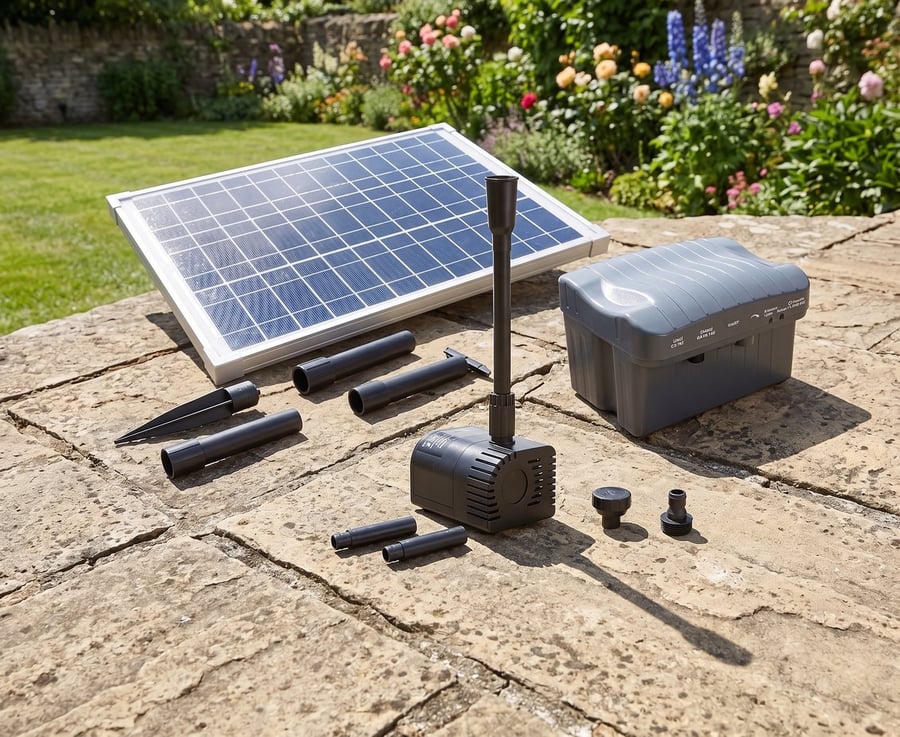
Shop the 1560 LPH Solar Pump – £209 →
If there is no socket near the feature, a solar pump removes the cable problem. Our 1560 LPH solar kit lifts water up to 3.2m, the highest head in the range, and comes with fountainheads. Flow tracks the sun, so it suits ornaments and bubblers more than blades that need steady volume.
Water feature pump troubleshooting: won't start, weak flow, or noisy
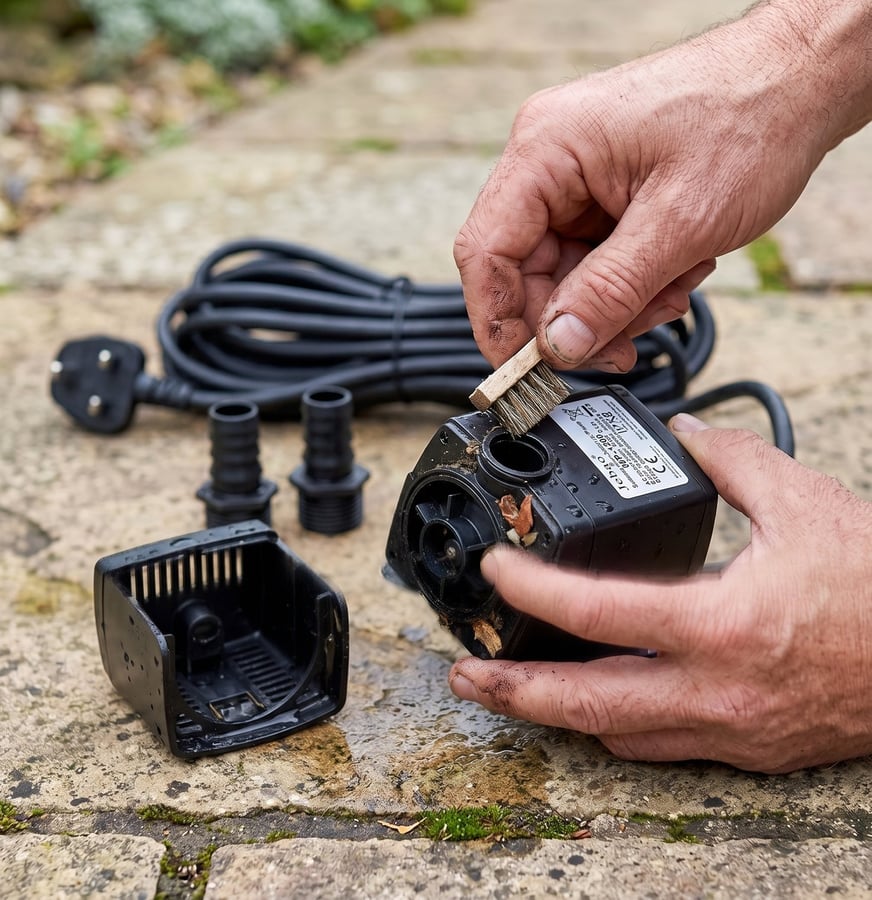
Most pump faults come down to four causes: no power, an airlock, a blocked impeller, or limescale. Work through them in that order before assuming the pump is dead. A genuine motor failure is rarer than a 10 minute clean.
Browse mains water feature pumps →
Pump will not start
Check the socket and RCD first, then unplug and check the impeller is not seized by grit or limescale. A pump that hums but will not turn usually has a stuck impeller. Twist it free by hand, rinse the housing, and try again.
Weak flow or no water at the top
The usual cause is a blocked inlet sponge or limescale on the impeller. Pull the pump, remove the front cover, and rinse both. Also check the hose is not kinked and the head height is within the pump's rating. A pump pushed past its maximum head will run but deliver almost nothing.
Noisy, rattling or pulsing
A rattle or buzz almost always means the pump is running dry or near dry. Top up the reservoir so the pump is fully submerged. Pulsing flow means the water level is dropping below the inlet, so top up and check for leaks or splash-out.
Matt's Tip: Rinse the inlet sponge once a month in the season and the pump rarely gives trouble. In hard-water areas, a yearly descale in white vinegar overnight clears the impeller chamber. We measured a 12% rise in watts on pumps that had never been descaled, so a clean both restores flow and trims the running cost.
How long do water feature pumps last, and when should I replace one?
A well-kept pump lasts 7 to 10 years in UK service. The two things that shorten that are running it dry and leaving it out over winter. Lift the pump out, clean it, and store it dry and frost-free from November, and you avoid the most common early death we see on return visits.
Replace a pump when flow stays weak after a full clean, when it trips the RCD, or when it draws visibly more power for less water. At £49 to £75 a replacement is cheaper than nursing a worn motor through another season of poor flow and higher bills.
Why we stock this pump range
We picked a range that covers the lift and flow of every feature we sell, from a tabletop bubbler to a 90cm blade. They share a multi-size hosetail, so any one replaces most failed pumps. After 412 installs, the faults we see are nearly always limescale or a winter left outdoors, not the motor. A pump that is cleaned and stored dry earns its keep for the best part of a decade.
– Matt W, Garden Ornaments
Related guides
- The 2026 UK water feature buyer's guide – choosing across all 12 feature styles
- Best solar water features UK 2026 – 90-day Lancashire runtime data for 12 picks
- Self-contained water features explained – how the hidden reservoir cuts pump demand
- Garden fountains UK compared – stone, tiered, pedestal and wall designs
- Small water features for tiny gardens – nine picks for balconies and courtyards
Browse the full water features range, or explore our wider garden ornaments collection.
Frequently asked questions
What size pump do I need for my water feature?
Match the pump's maximum head to your water lift first, then size the flow. Measure the vertical lift from reservoir to outlet, and pick a pump rated to at least 1.5 times that height. A 1 metre cascade wants a pump rated to 1.5m head or more, then choose the flow rate for the look you want.
What does LPH mean on a water feature pump?
LPH means litres per hour, the pump's flow rate at zero lift. It is the maximum volume the pump moves with no height to climb. Real flow at your outlet is always lower, because the water has to be lifted. Size up so flow stays strong at working height.
What is pump head height?
Head height is the maximum vertical distance a pump can lift water. At that height flow falls to zero, so you never run a pump at its ceiling. Our pumps range from 0.95m head on the 450 LPH model to 3.2m on the solar pump.
Can I use any pump to replace my water feature pump?
Yes, as long as it matches or beats the old pump's flow rate and head height. Check the outlet fitting too. Our mains pumps carry a multi-size 3/4 inch and 1 inch hosetail, so they fit most existing features without new parts.
Why has my water feature pump stopped working?
Most often a blocked impeller, an airlock, or no power at the socket. Check the RCD, then unplug and free the impeller of grit and limescale. A pump that hums but will not spin usually has a seized impeller, which a rinse fixes.
How long do water feature pumps last in the UK?
A well-maintained pump lasts 7 to 10 years. Running it dry and leaving it outside over winter are the two biggest killers. Lift it out, clean it, and store it dry and frost-free from November to get the full life.
Are solar water feature pumps any good in the UK?
Yes for ornaments and bubblers, less so for blades that need steady flow. Solar removes the cable, so you can site a feature anywhere with sun. Flow rises and falls with cloud cover, so it suits features that look fine at variable flow.
How often should I clean a water feature pump?
Rinse the inlet sponge monthly in season and descale once a year. A yearly soak in white vinegar clears limescale from the impeller chamber. We measured a 12% rise in watts on pumps that were never descaled, so cleaning restores flow and trims the bill.