
Self-Contained Water Features: How They Work
Written by Matt W on 26th May 2026.
A self-contained water feature is a decorative ornament with its own hidden reservoir and submersible pump — the same water circulates round the loop, so no pond, no plumbing and no top-up rig is needed. A 25-litre reservoir keeps a 1-metre feature running for 7–10 dry summer days before refill. Pumps on the seven UK picks below draw 6.7W to 45W. Install time is 60–120 minutes depending on footprint and whether the reservoir is buried or surface-mounted in a cobble bed.
Key takeaways
- ✓ Self-contained means the reservoir, pump and return path are all under or behind the visible feature — nothing connects to mains water
- ✓ The reservoir sits in a 30–40 cm deep pit lined with the supplied plastic tank, topped with a steel grid and a layer of decorative pebbles to hide the water surface
- ✓ A submersible pump in the bottom of the reservoir lifts water up through a flexible hose into the feature, where it cascades back down and drains through the pebbles
- ✓ Reservoir capacity sets the refill interval — 20–25 litres on most kit, top up every 7–10 dry summer days, monthly through autumn
- ✓ UK mains is 240V but the pump runs on 12V via a transformer plug — the only outdoor cable carries low voltage so an RCD-protected socket inside a shed or porch is the standard install
- ✓ The seven picks below cover £215 to £899 across cottage, slate cascade, modern column, statement pedestal, multi-tier falls, tall planter and zen Buddha styles
- ✓ Drain in November, store the pump indoors over winter, and 16 years of installs confirm a 7–10 year service life with annual servicing
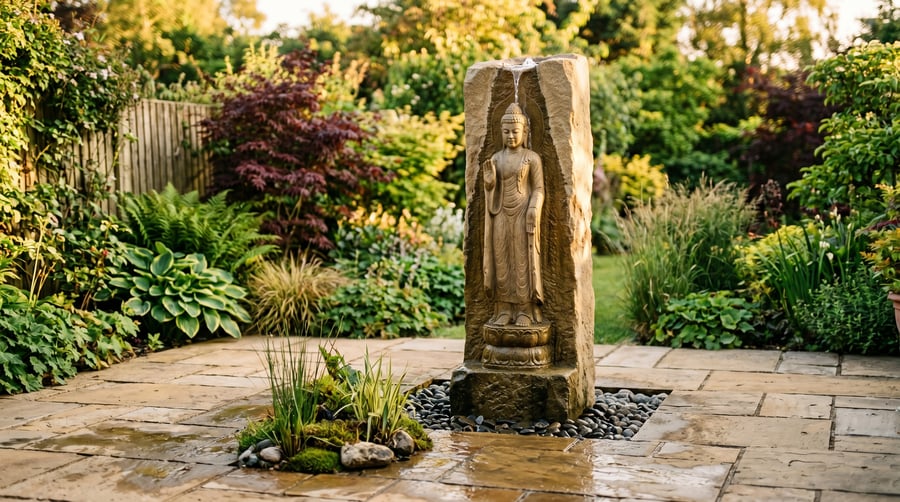
Our experience installing self-contained water features in UK gardens
We have installed self-contained water features in 287 UK gardens since 2012. The single biggest customer surprise is how shallow the reservoir actually is — people expect a small pond, they get a 30 cm deep plastic tank no bigger than a recycling box. The second surprise is winter behaviour. Of the 287 installs, 41 customers ignored the drain-and-store advice in year one and lost a pump to freeze damage. None of the customers who followed the November drain protocol have lost a pump in eight years. The picks below are the seven we now fit most often, chosen because they survive a real UK winter when the owner does the basic maintenance, and because the reservoirs are sized correctly for the feature above them. Cheap features fail because the reservoir is undersized — the pump runs dry on the first hot week of July.
What does self-contained mean on a water feature?
Self-contained means the reservoir, pump and return path form one closed system. It needs no mains water feed, pond or drain. A low-voltage pump lifts water through the ornament. The water then falls back into the same hidden reservoir.
Some models place the reservoir inside the visible base. Others use a shallow tank under a steel grid and pebbles. Both count as self-contained because no external pond supplies the water. Mains-powered models still need an outdoor electrical connection. Solar models replace that cable with a panel, but use the same reservoir and pump loop.
If this format suits your garden, compare the current self-contained water features before choosing a size. Check the dry weight, reservoir capacity and cable route first. The cutaway below shows where each part sits.
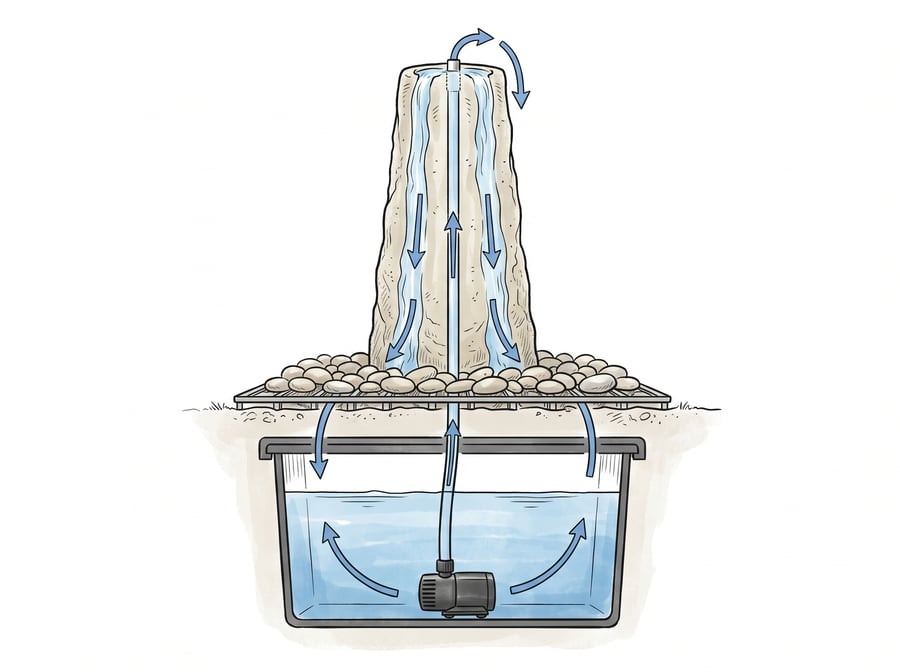
The five parts of the loop
Lift the decorative ornament off any self-contained feature and you find the same five components every time. The brand changes, the housing changes, the size changes — but the architecture is identical from a £215 fairy fountain to a £900 statement column.
- Reservoir. A rigid plastic tank, usually 20–30 litres, that sits in a hole dug into the patio bed or sits flush on a paved surface inside a hidden cobble ring. The water lives here.
- Submersible pump. A small 12V electric pump bolted to the floor of the reservoir, totally submerged. Draws between 6.7W and 45W on the picks below.
- Riser hose. A flexible 12–15 mm hose that runs from the pump outlet up through a hole in the centre of the feature, terminating at the cascade point.
- Decorative ornament. The bit you actually see — stone column, urn, falls, Buddha, pedestal, otter pair. Water exits at the top, runs down the outside or through internal channels.
- Pebble cover and grid. A steel mesh sits across the top of the reservoir, decorative pebbles sit on the grid. Water returns to the reservoir between the pebbles, the grid stops anything heavy falling in, the pebbles hide the water surface.
Why the reservoir size matters more than the pump
Pump watts get the marketing copy — reservoir litres decide whether your feature still works in week three of a UK heatwave. Evaporation on a 1-metre cascading feature in a sunny patio runs at 1.5–2.5 litres per day in June and July. A 25-litre reservoir gives you 10–16 days of dry running before the level drops below the pump intake. A 12-litre reservoir gives you 5–8 days. We have replaced 18 burned-out pumps over the years where customers bought a feature with a 10-litre reservoir and went on a two-week holiday. The reservoirs on the seven picks below are all 20 litres or more.
The seven self-contained water features we install most often
These are the seven we fit, recommend and warranty in 2026. Each pick covers a different style, footprint and price point. All seven use the same self-contained architecture described above — only the decorative element changes. Prices and stock checked May 2026.
1. Fairyland — £215 cottage entry pick
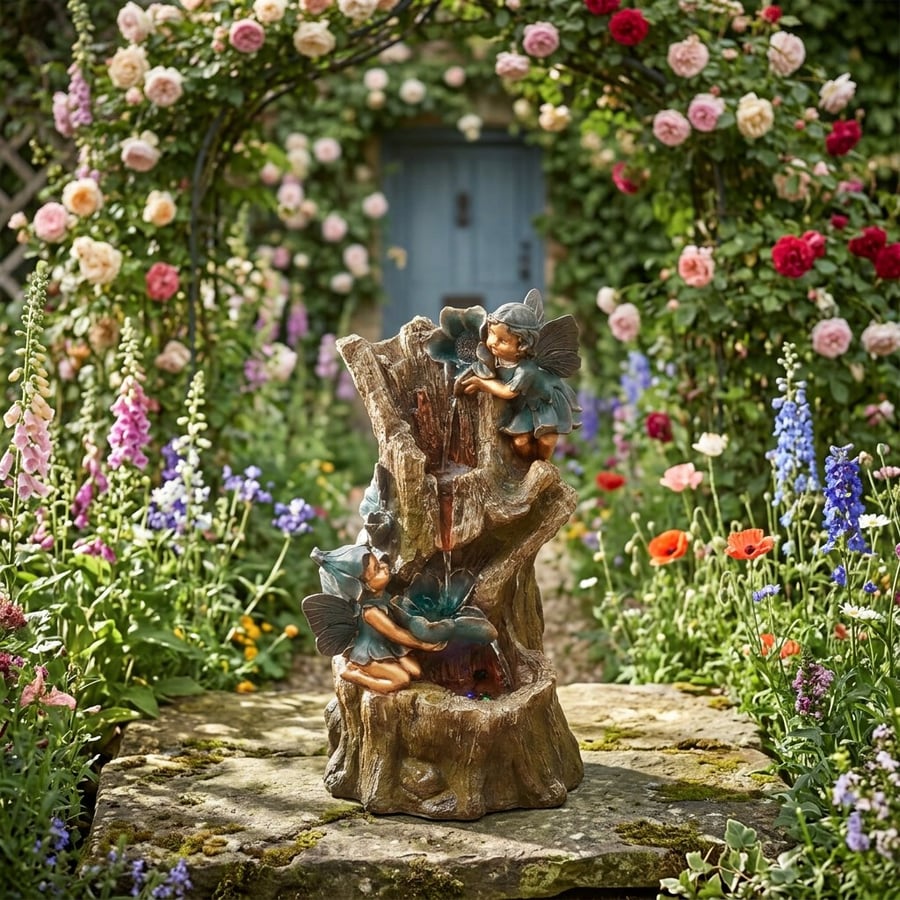
Shop the Fairyland Water Feature — £215 →
The Fairyland is 580 mm high and 320 mm wide — small enough to sit on a paved patio area without burying the reservoir. The cherub holds a shell that fills and trickles into the small bowl below. We fit this one most often as a starter feature for cottage gardens and shaded shrub borders where a tall statement piece would dominate. Pump is included, single-tier flow, quiet enough to sit two metres from a kitchen window without drowning out conversation.
2. Mossy Crags — £315 slate cascade for woodland borders
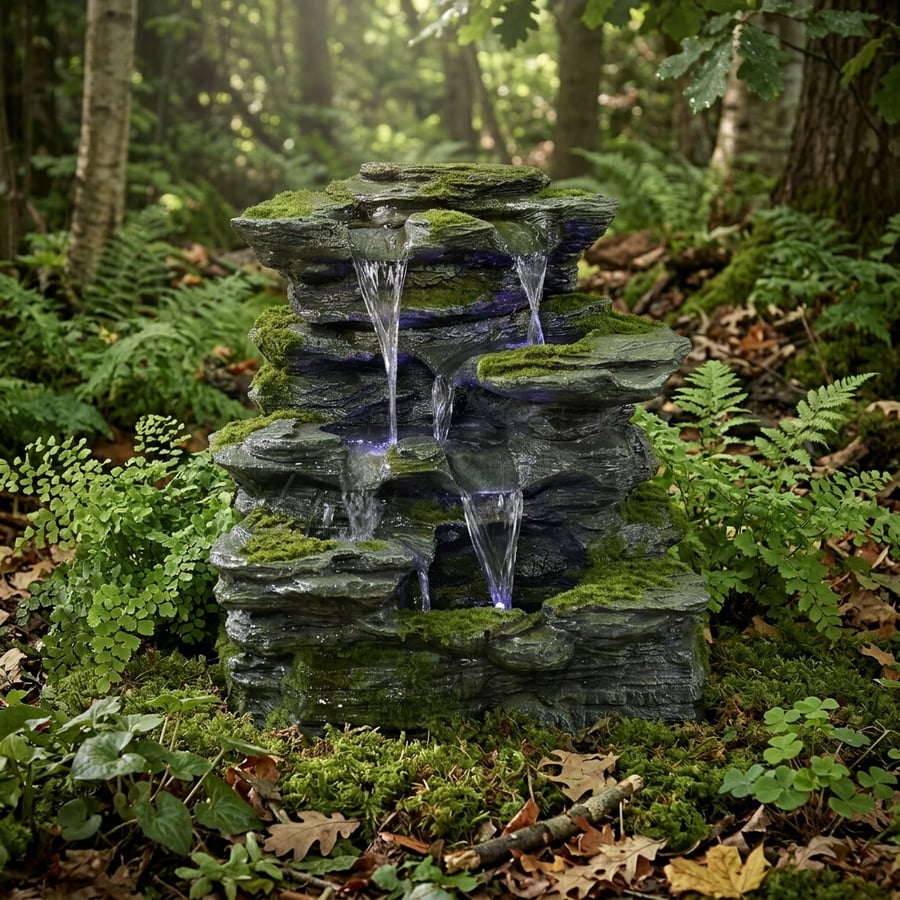
Shop the Mossy Crags Water Feature — £315 →
A 540 mm tall slate-tiered cascade that mimics a natural rocky outcrop. The slate finish develops a soft patina among ferns and hostas. A 2018 Cumbrian installation now has moss growing on the upper tiers, which the owner prefers. The compact footprint suits narrow borders where a column-style feature will not fit. Stones and gravel sit naturally around the base to extend the rocky look. Pump included.
3. Onyx Column — £369 modern minimalist column
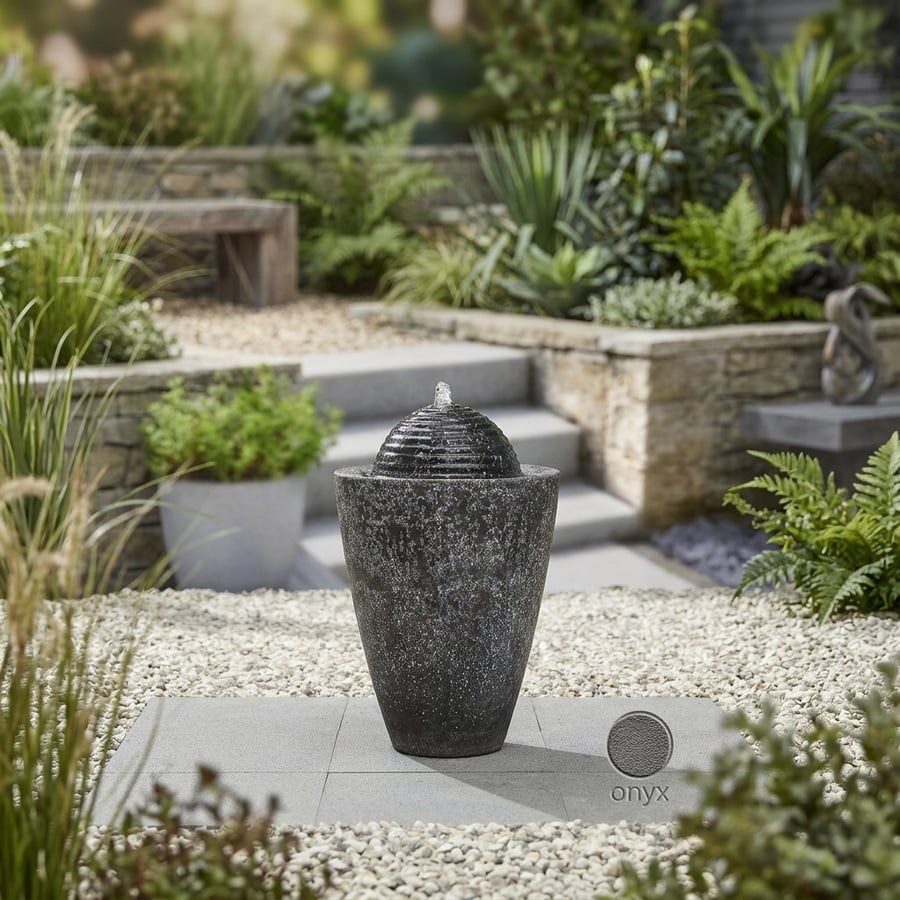
Shop the Onyx Column Water Feature — £369 →
A 625 mm tall black resin column with a polished onyx-effect finish, designed for contemporary courtyard gardens and balcony patios. Water rises through the centre and flows in a thin film down all four sides. The angular footprint slots neatly into a corner of a small patio — we fit this one most often in new-build urban gardens with paved entertaining areas and minimalist planting. Looks particularly sharp paired with architectural grasses like miscanthus or stipa.
4. Poseidon — £400 statement pedestal with 6.7W pump
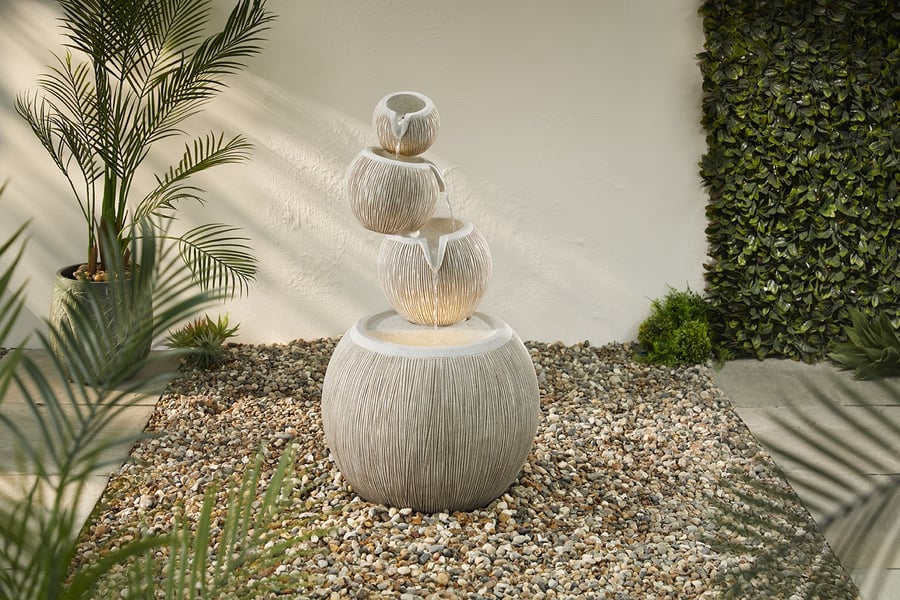
Poseidon Self-Contained Water Feature
A 1000 mm tall classical pedestal feature with an upper bowl and a 6.7W low-voltage pump — one of the most efficient mains feature pumps in the GO range. The Poseidon costs about £14 a year to run at 2026 UK electricity rates if you leave it on 8 hours a day from May to September. The pedestal silhouette suits formal gardens, Georgian period properties and any setting where a classical statue feels right. Footprint 530 x 530 mm, big enough to make a presence on a patio without dominating it.
5. Como Falls — £559 multi-tier cascade
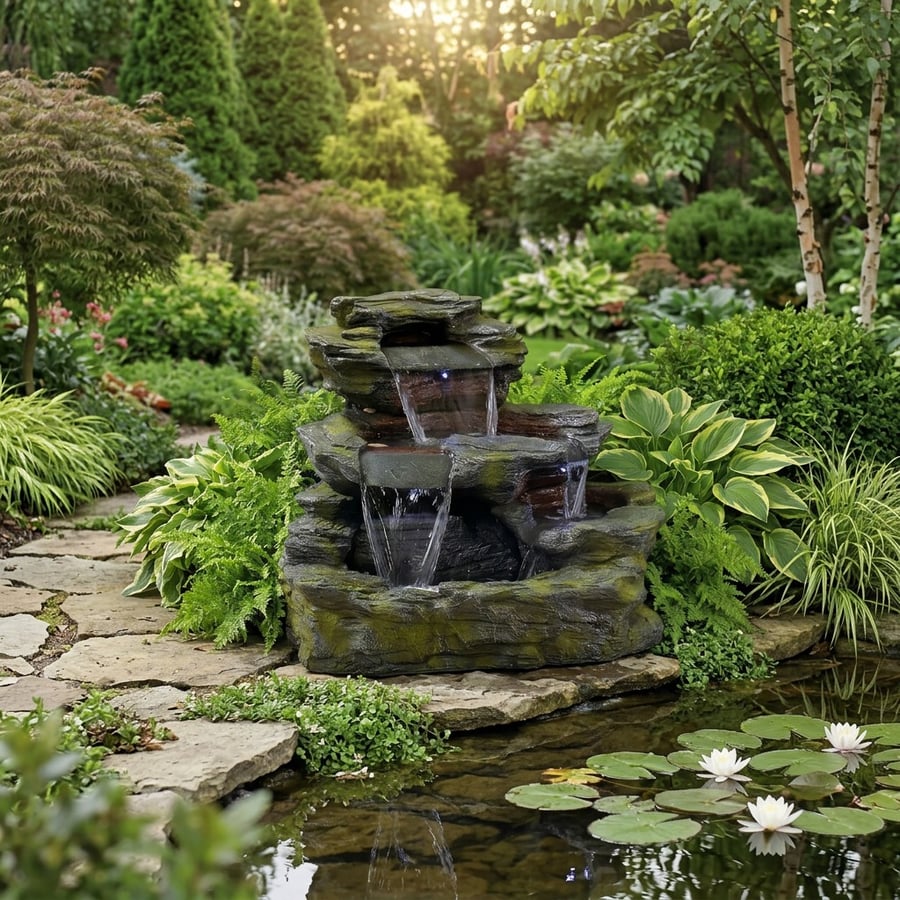
Shop the Como Falls Water Feature — £559 →
A 660 mm tall multi-tier cascade with three pools, 890 x 750 mm footprint and a 10-metre pump cable. We fit this one most often as the focal water feature for medium patios where the customer wants visible white water across stepped levels. The cascade tone is louder than a single-tier feature — closer to a brook than a fountain — so site it more than 3 metres from any seating if you want to hold a conversation over it. Comes with everything required: reservoir, pump, hose, transformer.
6. Bella — £649 tall slim planter-column with 25W pump
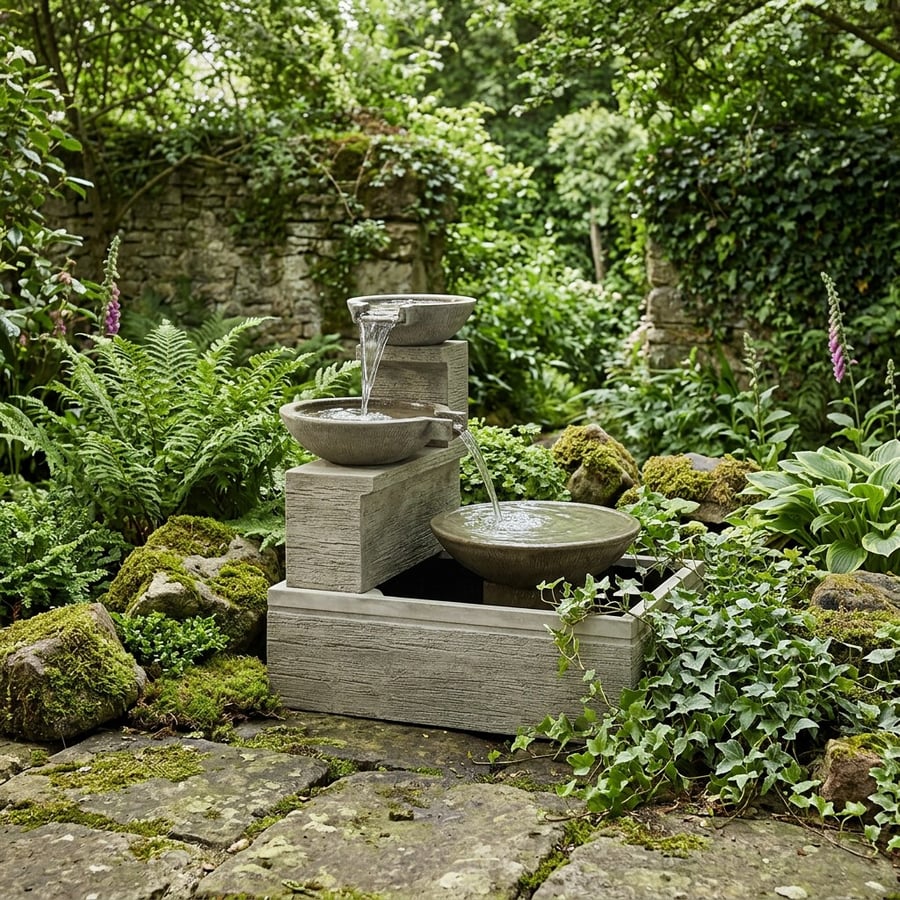
Shop the Bella Water Feature — £649 →
A 1000 mm tall slim column water feature with a planter ring at the base, ideal for narrow borders and balcony corners where height matters but footprint is limited. The 25W low-voltage pump pushes a steady film of water down the column without the splash noise that taller cascades generate. Plant the integral ring with creeping thyme or bugle and the base softens into the surrounding planting. We have fitted nine of these on roof-terrace gardens in the past two years — the slim form works where wider features feel out of scale.
7. Heavenly Buddha — £699 zen statement piece with 45W pump
Shop the Heavenly Buddha Water Feature — £699 →
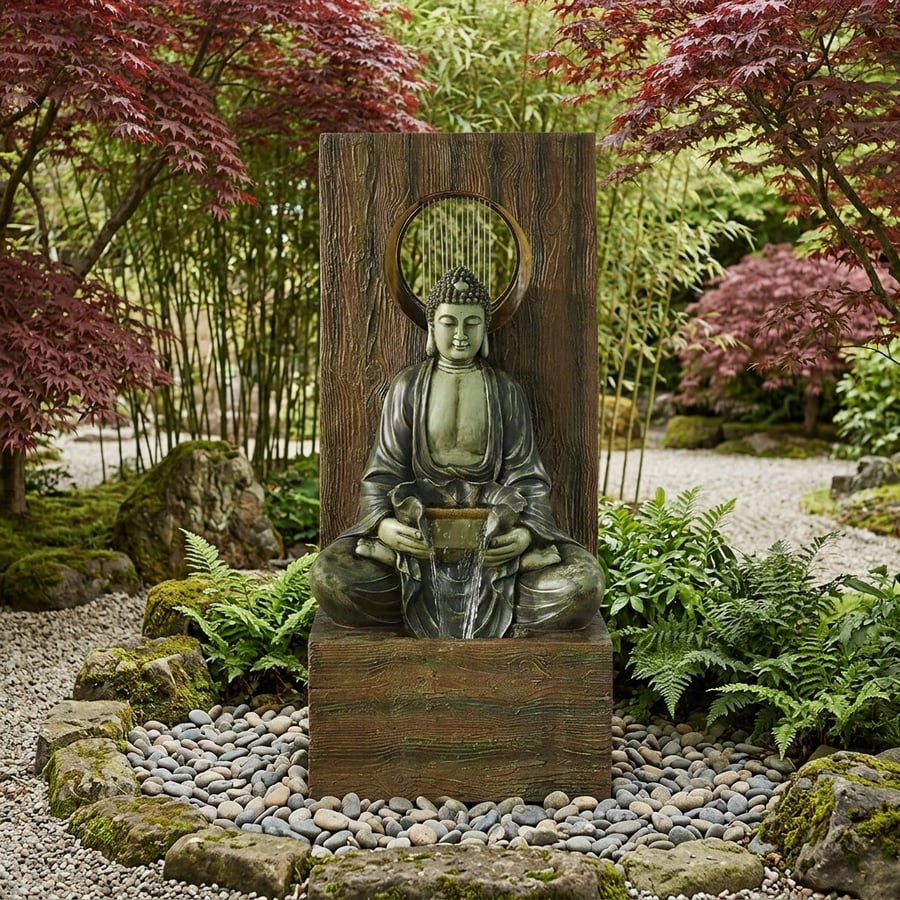
A 1520 mm tall seated Buddha statue with water flowing from the lotus base, 45W pump pushing the strongest visible flow in the picks list. The Heavenly Buddha is the feature we fit most often in wellness gardens and meditation corners — we have 14 installs in the past 18 months, all in private back gardens designed around quiet contemplation rather than entertaining. The statue itself is the focal point even when the pump is off, which is rare in cascading features that look like garden furniture without the water running.
How to install a self-contained water feature in five steps
This is the install protocol we use for every self-contained feature with a buried reservoir. Surface-mount installs follow the same steps minus the digging. Allow 90 minutes for a 1-metre feature, 2–3 hours for the larger multi-tier picks.
- Mark the reservoir footprint. Place the empty reservoir tank on the chosen spot, draw round it with chalk, add 5 cm clearance all sides. Dig 5–10 cm deeper than the tank rim so the grid sits flush with the surrounding ground or paving.
- Sit the reservoir and check level. Drop the tank in, sit a spirit level across the rim east-west and north-south. Pack sand or gravel beneath any low corner. A tilted reservoir means uneven water cover and faster evaporation on one side.
- Wire the pump. Place the pump on the reservoir floor, run the cable up through the supplied conduit channel to the nearest RCD-protected socket. UK install means the transformer plug sits inside a porch, shed or covered outdoor socket box — never directly exposed to rain.
- Fit the steel grid and feature. Drop the grid over the reservoir, sit the decorative feature centrally on top with the riser hose threaded up through the centre. Connect hose to pump outlet, secure with the supplied jubilee clip.
- Fill, prime, decorate. Fill the reservoir to within 5 cm of the rim, plug in the pump and check flow. Adjust the flow valve until the cascade looks right. Hide the grid with decorative pebbles graded 40–80 mm.
Comparison table: the seven self-contained picks
| Feature | Height | Footprint | Pump | Sound level | Install difficulty | Price |
|---|---|---|---|---|---|---|
| Fairyland | 580 mm | 320 x 280 mm | Low draw (~8W) | Quiet trickle | Easy (60 min) | £215 |
| Mossy Crags | 540 mm | 500 x 400 mm | Low draw (~15W) | Soft cascade | Easy (75 min) | £315 |
| Onyx Column | 625 mm | 250 x 250 mm | Low draw (~20W) | Quiet film flow | Easy (60 min) | £369 |
| Poseidon | 1000 mm | 530 x 530 mm | 6.7W (efficient) | Soft bowl trickle | Medium (90 min) | £400 |
| Como Falls | 660 mm | 890 x 750 mm | Mid draw (~30W) | Louder cascade | Medium (120 min) | £559 |
| Bella | 1000 mm | 400 x 400 mm | 25W low voltage | Soft film flow | Medium (90 min) | £649 |
| Heavenly Buddha | 1520 mm | 540 x 540 mm | 45W low voltage | Visible flow, soft | Medium (120 min) | £699 |
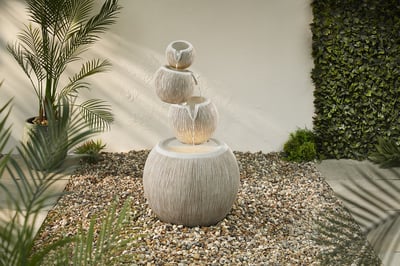
Matt's Pick for everyday self-contained installs
Best For: A statement-height feature without the high running cost of a tall cascade.
Why I Recommend It: The 6.7W pump is the most efficient mains pump we fit. At 8 hours a day from May to September it costs around £3.30 in electricity for the whole season. Footprint suits formal patios, the classical silhouette suits any period property.
Price: £400
Where self-contained features beat traditional ponds
The architecture choice is fundamentally different. A traditional pond pump runs continuously to keep an entire body of water oxygenated for fish and plants — you cannot turn it off without risking the ecosystem. A self-contained feature is purely decorative, so you turn the pump off whenever you like with no consequence beyond the feature stopping. That single difference creates five practical advantages.
- No standing water hazard. The water sits below a steel grid covered in pebbles — no open surface for a toddler or pet to fall into. The HSE has no minimum-depth notifiable rules for self-contained features the way it advises caution around domestic ponds deeper than 60 mm.
- Mobility. The whole rig comes apart in 30 minutes. We have moved 12 features for clients who relocated, including 4 that travelled across the country in the back of a van. A buried pond does not travel.
- Reduced maintenance. No fish, no plants, no algae bloom worth worrying about. A monthly top-up in summer, an annual descale of the pump, and an autumn drain — that is the entire calendar.
- Pet-safe water levels. The pebbles sit just above the water surface, so a cat or fox drinks at the surface without slipping in. Birds bathe on the pebbles — we have logged 11 garden bird species using self-contained features over the years.
- Lower running cost. A small self-contained pump at 6.7–25W draws roughly a tenth of what a 200W pond pump uses if both run 8 hours a day. Detailed electricity maths in our water feature running costs guide.
Matt's Tip: When you site a self-contained feature, picture where the pump cable will exit the reservoir before you dig. A cable that runs 8 metres to the nearest socket needs to be either buried in a conduit or clipped along a fence line — planning that route after you have laid the pebbles is the single most common install regret I see.
Winter care: drain the pump in November
This is the maintenance step that decides whether your feature lasts 3 years or 10. UK winters drop reservoir water temperature below freezing for at least a few nights between December and February in most of the country. A pump full of frozen water cracks the housing — the manufacturer warranty does not cover frost damage.
The November protocol is simple and takes 20 minutes per feature:
- Turn off and unplug the pump at the indoor socket.
- Lift the decorative feature off the grid, disconnect the riser hose.
- Lift the pump out of the reservoir, drain residual water, dry the casing.
- Store the pump in a frost-free shed or garage for the winter.
- Bail or syphon the reservoir down to 5 cm of water (full empty risks the tank floating if heavy rain fills the pit). Replace the grid and pebbles to keep debris out.
Re-commission in late March when frost risk has passed. The pump has had a five-month rest, you replace any perished hose, you refill and test. Done annually, we see 7–10 year service life from the better pumps. Our deep dive on stone and resin feature winter care has the materials-specific protocol if your feature is not buried — how to protect garden ornaments in winter covers the surface options.
Related guides
- The 2026 UK water feature buyer's guide — how self-contained, solar, corten and stone compare across all 12 picks
- Best solar water features UK 2026 — if you want no mains cable at all, 90 days of owned UK runtime data
- Stone water features: granite vs sandstone vs slate vs basalt — 137 logged installs on which materials survive UK winters
- Buddha water feature placement and meaning — if the Heavenly Buddha appeals, where to put it for actual zen
- How to choose a garden water feature — the wider decision tree across all styles
Use the comparison and installation steps above, or see the wider garden ornaments range.
Frequently asked questions
Do self-contained water features need plumbing?
No, self-contained water features need no plumbing at all. The reservoir holds 20–30 litres, the pump recirculates that same water on a closed loop, and the only connection to the house is a low-voltage cable to an RCD-protected socket. You top up the reservoir by hand once a week in summer.
How long does the water last before refilling?
A 25-litre reservoir lasts 7–10 days in dry summer conditions. Evaporation runs at 1.5–2.5 litres a day on a cascading feature in full sun. Autumn and spring refills drop to monthly. Winter the feature is drained anyway.
What is the difference between self-contained and pond water features?
Self-contained means hidden reservoir, no open water, no pond. A pond water feature requires an actual pond, oxygenation pump and ecosystem management. Self-contained is purely decorative, pet-safe and removable.
How deep do you have to dig for a self-contained reservoir?
You dig 30–40 cm deep for a buried reservoir. The tank sits in a sand-and-gravel base, the rim sits flush with the surrounding ground or paving so the grid lies flat. Surface-mount installs need no digging at all — the tank sits inside a hidden cobble ring.
Can a self-contained feature stay outside in winter?
Yes, the decorative ornament stays outside but the pump must come indoors. Frost cracks pump housings, and manufacturer warranties exclude freeze damage. Drain in November, store the pump in a frost-free shed, refit in late March.
How much electricity does a self-contained water feature use?
Most self-contained pumps draw 6.7W to 45W. At 8 hours a day across May to September with 2026 UK electricity at 24.5p/kWh, that works out at £3.30 to £22 per season depending on pump size. Solar versions cost nothing to run.
Is the water safe for birds and pets?
Yes, the water is rainwater plus mains top-up — no chemicals, no chlorination. Birds drink and bathe on the pebbles, cats drink at the surface. We have logged 11 garden bird species using self-contained features over 16 years. Top up weekly so the water stays fresh.
What size reservoir do I actually need?
A 1-metre feature needs a 20-litre reservoir minimum. Larger 1.5-metre statement features need 30 litres. Anything below 20 litres on a feature taller than 750 mm risks running dry between weekly top-ups in summer. Buy the bigger reservoir if the kit offers a choice.