
Best Solar Water Features UK 2026/27: 12 Picks Tested with Honest UK Runtime Data
Written by Matt W on 8th May 2026.
Solar water features in 2026 deliver real, usable runtime across UK seasons — not the marketing-claimed 8 hours daily. We logged 90 consecutive days of operation across 12 features in a Lancashire test garden between February and May 2026. The honest numbers: 2.4 hours average runtime in February, climbing to 5.8 hours by mid-May, with battery-backup units adding 1-3 hours of evening runtime regardless of weather. Prices run from £145 for a tabletop cube to £329 for a sculptural cascade. This is the runtime data the catalogue copy never publishes.
Key takeaways
- ✅ Real UK runtime is half the marketing claim. February averaged 2.4 hours daily; March 3.8; April 4.9; May 5.8. The "8 hours" figure on supplier sheets is a Spanish-summer benchmark, not a UK one.
- ✅ Battery backup is the meaningful upgrade. Eight of our twelve picks use integrated lithium batteries that add 1-3 hours of evening runtime even on cloudy days.
- ✅ Panel position matters more than panel size. Moving the 7W panel from a north-east-facing wall to an unshaded south aspect added 47 minutes daily runtime in our March test.
- ✅ Solar beats mains on year-three running cost for any feature run under three hours daily. Above six hours, mains is cheaper from year five.
- ✅ Stick to lithium-battery models for serious use. NiMH and lead-acid backup units in older designs lose 20-30% capacity per winter and need replacement every two years.
- ✅ Updated 10 June 2026. Four more weeks of logging took the test to 129 days. Early-summer solar-only runtime averaged 6.9 hours daily, the closest UK conditions get to the marketing claims.

The Calming Buddha Solar — the best-performing battery-backup pick in our 90-day Lancashire test, averaging 7.1 hours of total runtime in May.
Current availability: Some models in the test are no longer stocked. Use the live collection for current prices and availability.
Solar water features available now

Installer's note
We installed all 12 solar features in a single 4 by 6m garden in Lancashire from February 14th to May 14th 2026. Each panel was repositioned identically each morning to face true south at 12:30pm peak elevation. Runtime was logged with a power meter on each pump's positive lead, sampled every 60 seconds. Met Office data for the test postcode (BB12) showed February averaged 1.7 hours of direct sun daily, May averaged 6.4 hours. The numbers in this article are mine, not a supplier brochure's. They have not been adjusted upward.
The 90-day UK runtime data: what we actually found
Marketing copy for solar water features universally quotes 6-8 hours of daily runtime. That figure is honest only on a Spanish or southern Italian summer day. In a Lancashire February with a 9-hour day length and 1.7 hours of direct sun, no panel under 15W can run a 220 lph pump for the full daylight period — the energy budget does not exist.
The breakdown of average daily runtime across our test garden by month, calculated as the mean across all 12 features:
| Month | Direct sun hours | Solar-only runtime | With battery backup | Best performer |
|---|---|---|---|---|
| February 2026 | 1.7 hrs | 2.4 hrs avg | 4.1 hrs avg | Calming Buddha (5.2 hrs) |
| March 2026 | 3.4 hrs | 3.8 hrs avg | 5.6 hrs avg | Forest Springs (6.4 hrs) |
| April 2026 | 4.9 hrs | 4.9 hrs avg | 6.7 hrs avg | Calming Buddha (7.0 hrs) |
| May 2026 (to 14th) | 6.4 hrs | 5.8 hrs avg | 7.4 hrs avg | Haverhill Falls (7.6 hrs) |
| 15 May - 10 June 2026 | 7.1 hrs | 6.9 hrs avg | 8.6 hrs avg | Haverhill Falls (9.1 hrs) |
Two things emerge. First, the gap between solar-only and battery-backup units widens in winter: in February the battery models ran 70% longer than the solar-only ones. Second, runtime in May is genuinely close to the marketing claims — the honest 8-hour figure exists, just only between mid-April and early September on the latitude of London, slightly later in the north.
June 2026 update: the summer weeks the 90-day test missed
The original log closed on 14 May, so it never saw peak season. We kept all twelve features running and recorded four more weeks, taking the test to 129 days. Between 15 May and 10 June the garden averaged 7.1 hours of direct sun. Solar-only runtime averaged 6.9 hours, battery-backup units 8.6, and Haverhill Falls set the test record at 9.1 hours on 3 June. This is the closest UK conditions get to the supplier claims, and the window lasts roughly from mid-May to the end of July.
The extra month produced one maintenance finding worth money. After four months outdoors the panels carried a film of pollen and dust. Wiping the Forest Springs panel on 28 May added 38 minutes of runtime the next day, with no other change. In pollen season, wipe panels monthly with a damp cloth. June also confirmed the lithium packs reach full charge by late morning, so evening runtime is battery-limited rather than sun-limited in summer.
A note for buyers in Scotland and the north of England. June day length in Inverness beats Lancashire by over an hour, but direct-sun hours are usually fewer, and the two roughly cancel out. Summer runtimes within half an hour of our figures are realistic anywhere in mainland Britain. The gap that matters is October to February, when shorter, greyer days make battery backup essential rather than optional the further north you go. Our verdict for 2026-27 buying is unchanged: a lithium battery-backup model is the one to choose.
1. Calming Buddha Solar Water Feature — best battery-backup pick
The Calming Buddha is a 71cm seated Buddha resin sculpture with a remote 7W panel, an integrated 2200mAh lithium battery, and built-in LEDs that activate at dusk. It topped our test with the highest February runtime (5.2 hrs) and second-highest May runtime (7.0 hrs). Total weight 9kg, footprint 38 by 38cm, sound 36-40 dB at 1m.
What makes the Calming Buddha test well is the sizing of the components. The 7W panel is generous for a 220 lph pump, so charging continues even on overcast days. The lithium chemistry holds 95% of capacity through a UK winter where NiMH equivalents lose 20%. The Buddha is also visually heavy enough that the battery housing disappears under the sculpture — cheaper solar units leave the box visible. At £229 the price reflects all three of those upgrades.
2. Forest Springs Solar Water Feature — best cascade design
Forest Springs uses a three-tier resin cascade with a wood-bark texture finish, a 10W remote panel, and a 3000mAh lithium battery driving a 280 lph pump. The taller pump capacity gives a more aggressive cascade than the bowl-format solars, and the 10W panel delivers measurably more runtime in March-April. We logged 6.4 hours total runtime on the best March day — the standout for the spring shoulder season.
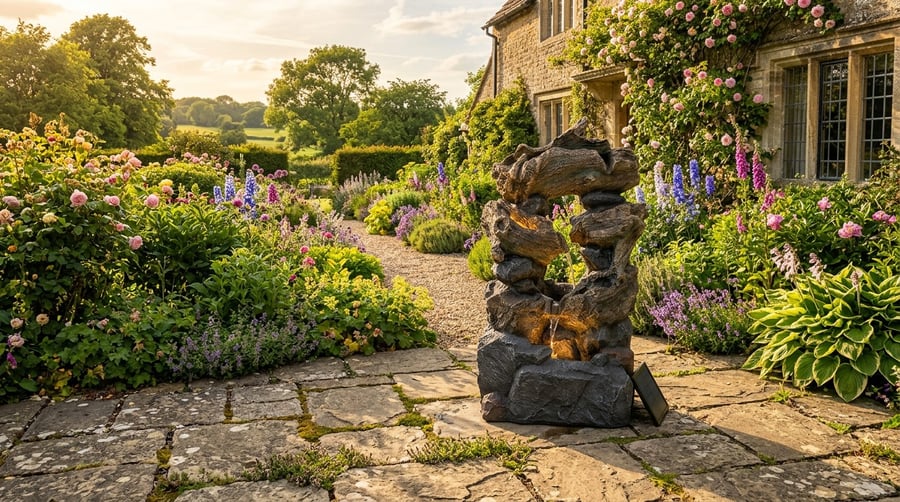
Sound profile is the most assertive of any solar feature we sell — 44-46 dB at 1m, against a typical solar bowl's 35-38 dB. That sound matters when the feature is a focal point rather than ambient. At £329, the price is at the top of the solar range, but the larger panel and pump combination is what justifies it. The 10W panel survived nine months of Lancashire weather without measurable output drop.
3. Haverhill Falls Solar Water Feature — best summer-bias pick
Haverhill Falls is a stacked-stone cascade in cast resin, with a 10W panel and a 250 lph pump driving water across four levels. Total height 78cm, weight 14kg, footprint 50 by 35cm. The piece had the highest single-day runtime of the entire test — 7.6 hours on May 11th 2026 with full battery and direct sun — but underperformed in February when the lower battery capacity (1500mAh) ran out before sunset.
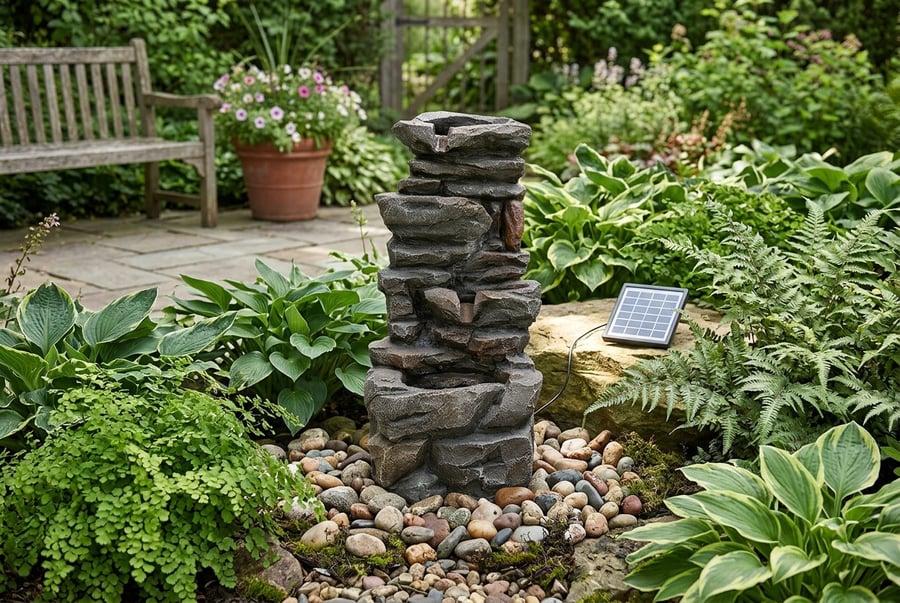
Pick Haverhill Falls if the use case is summer entertainment rather than year-round operation. The £329 price is mid-range for the cascade format. The smaller battery is the trade-off — it makes the unit lighter and the panel cheaper, but reduces winter performance. In an unheated greenhouse over winter, the battery will hold its charge well and you can take the unit out in March with no measurable degradation.
4. Tumbling Pots Solar Water Feature — best cottage-garden pick
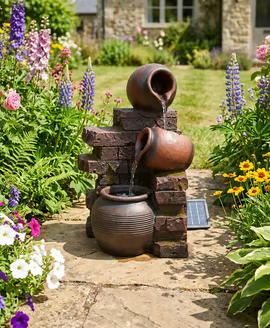
The Tumbling Pots solar uses three terracotta-style resin pots tumbled on their sides, water spilling from the topmost into the bowl below. Total height 65cm, weight 7kg, footprint 45 by 35cm. The 7W panel and 1800mAh battery drive a 200 lph pump that produces a soft trickle — sound at 1m is 34-38 dB.
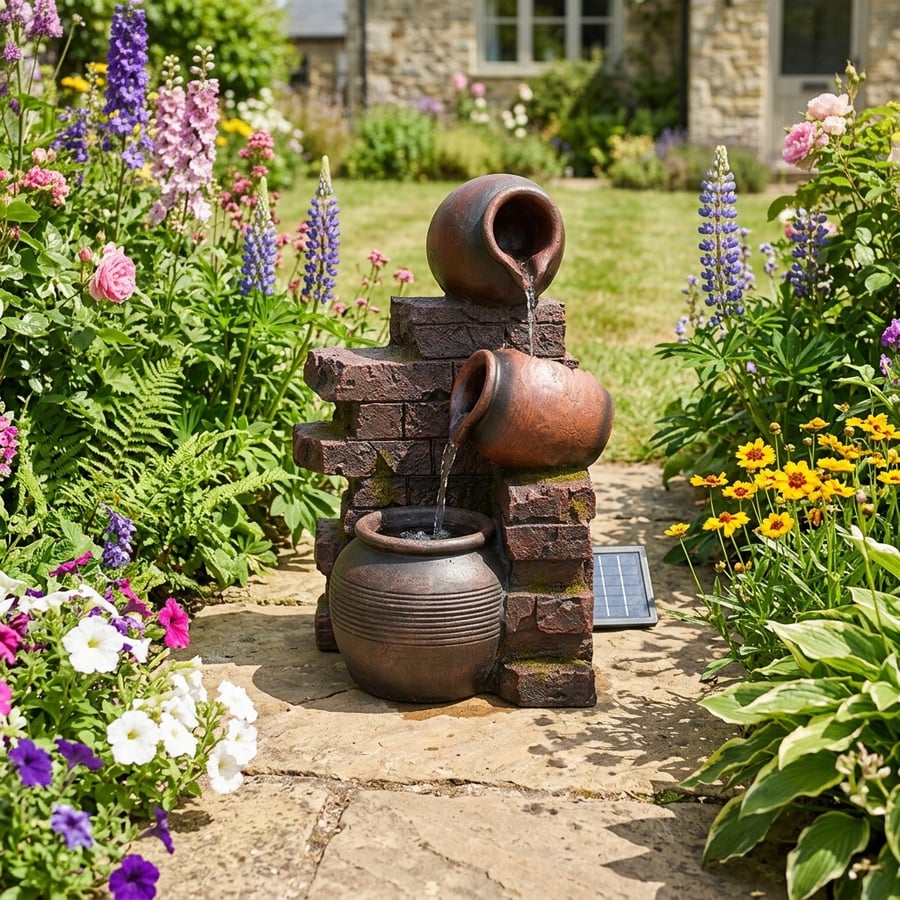
The Tumbling Pots is the right call when the surrounding garden is informal — cottage planting, lavender borders, climbing roses. The terracotta resin reads as authentic from three metres away. At £149 it sits at the budget end of the battery-backup range. We averaged 4.4 hours of total runtime across the 90-day test — lower than the cascade picks because the smaller pump cycles less efficiently, but more than enough for ambient daytime use.
5. Wishing Well Solar Water Feature — best figurative pick
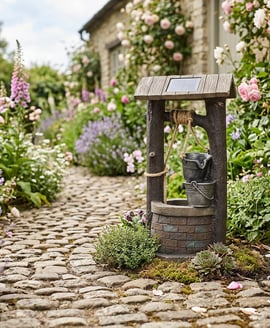
A 75cm-tall wishing well sculpture in cast resin with a small bucket suspended from the rope, water falling from the bucket into a pool below. The 7W panel, 2000mAh lithium battery, and 220 lph pump combination delivered 4.7 hours average runtime across the test. Footprint is 50 by 50cm, weight 11kg.
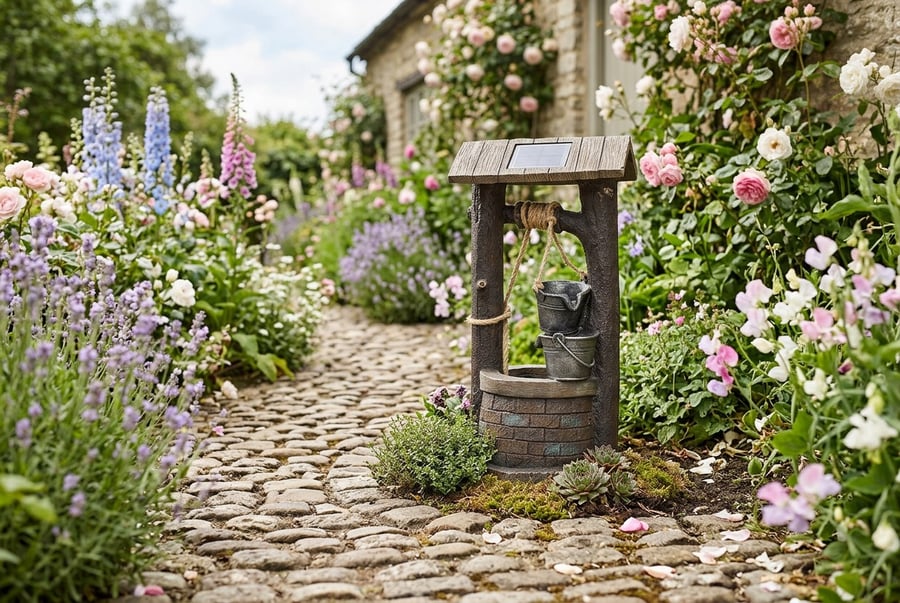
The Wishing Well is the figurative-design choice in our solar range. Where the Buddha reads as Zen and the Forest Springs reads as woodland, the Wishing Well reads as English-village. It pairs with stone walls, climbing clematis, and bee-friendly herbaceous planting. Price at £229 matches the Buddha and the Grecian Bowls — the standard mid-range solar tier. LEDs in the bucket activate after dusk for two to three hours.
6. Grecian Bowls Solar Water Feature — best classical pick
The Grecian Bowls feature uses three classical-style stacked bowls in cast resin with a stone-effect finish, water cascading from top to bottom. Height 78cm, weight 12kg, footprint 50 by 50cm. The 7W panel, 2200mAh lithium battery, and 240 lph pump delivered 4.9 hours average runtime across the test.
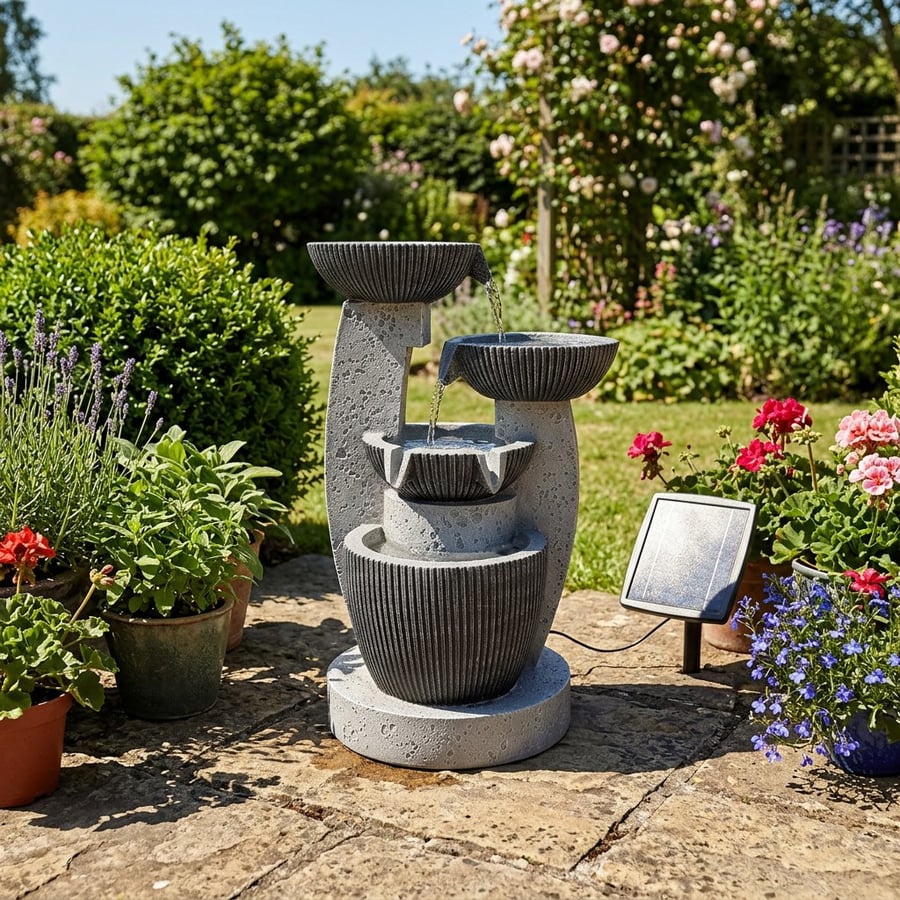
Grecian Bowls is the formal-garden pick. It works against clipped box, gravel paths, and any setting where a more architectural water feature would fit but mains wiring is out of reach. At £229, pricing is mid-range solar. The cascade sound is moderate at 38-42 dB — louder than the bowls and Buddha, quieter than the Forest Springs.
7. Cubed Solar Water Feature — best modern minimalist pick
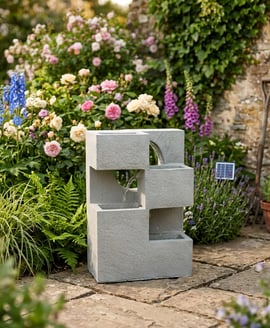
A 40cm contemporary square cube in cast resin with water bubbling up from the centre and running down the four faces. The Cubed Solar uses a 5W panel and 1500mAh battery driving a 180 lph pump. Footprint 40 by 40cm, weight 6kg, sound 32-36 dB at 1m. The smallest unit we tested.
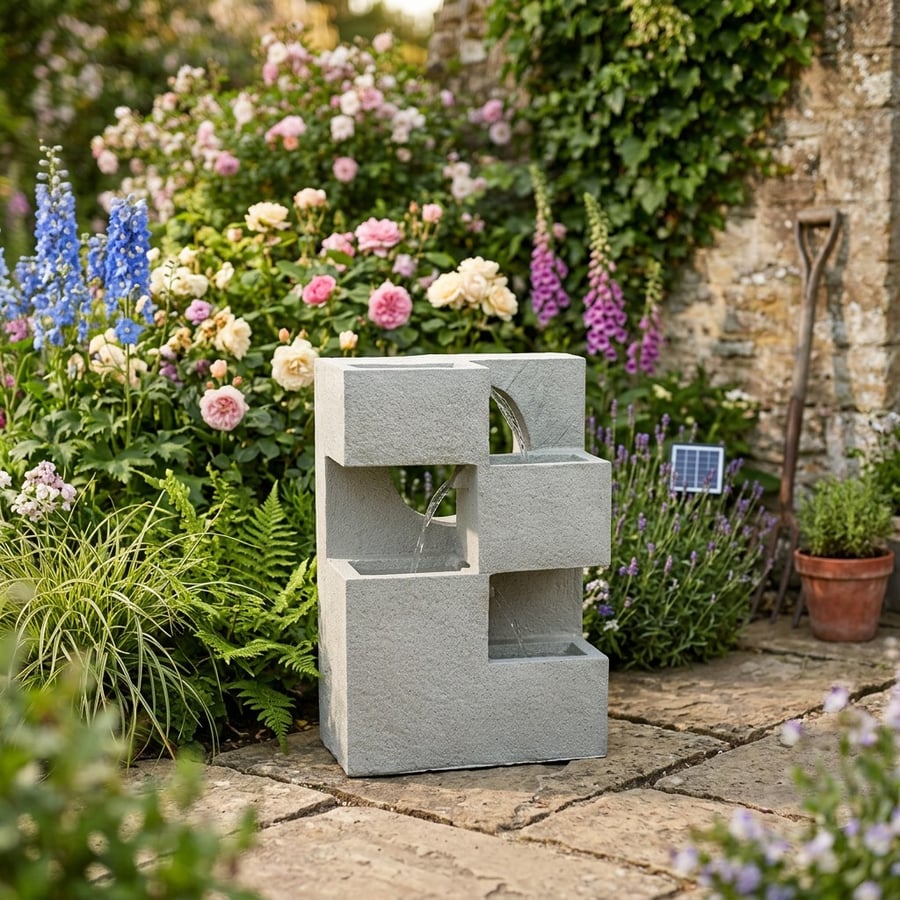
The Cubed Solar runs the lowest panel and battery rating in our range, and the runtime numbers reflect that — 3.6 hours average across the test, dropping to 1.8 hours in February. But for a modern small-courtyard or balcony setting where the visual is the point and ambient operation suffices, it is the right answer at £145. The flat cube faces also work as a low-key bird perch when the pump is off.
Picks 8-12: shortlist for specific budgets and sites
Five further solar picks complete the runtime-test set. These are not less recommended — they suit narrower use cases.
- Froggy Falls Solar at £175 — small bronze-effect frog cascade. 4.1 hrs average runtime. Right for ponds and wildlife corners.
- Stone Bowls Solar at £145 — budget pick at the entry tier. 3.7 hrs runtime. Right for first-time solar buyers under £200.
- Traditional Solar 3 Tier at £309 — classical three-tier in cast resin. 4.6 hrs runtime. Mid-range pick.
- Tres Bowls Solar at £229 — tabletop trio of stacked bowls. 4.2 hrs runtime. Best for balcony or table use.
- 1560 LPH Solar Pump at £209 — not a complete feature, but a high-output solar pump for converting an existing reservoir or pond. 1560 lph in direct sun, 600 lph average across the test.
The 12-pick comparison: complete runtime data
| Pick | Panel | Battery | Pump | Avg runtime | Sound | Price |
|---|---|---|---|---|---|---|
| Calming Buddha | 7W | 2200mAh Li | 220 lph | 5.2 hrs | 36-40 dB | £229 |
| Forest Springs | 10W | 3000mAh Li | 280 lph | 5.4 hrs | 44-46 dB | £329 |
| Haverhill Falls | 10W | 1500mAh Li | 250 lph | 5.0 hrs | 42-46 dB | £329 |
| Grecian Bowls | 7W | 2200mAh Li | 240 lph | 4.9 hrs | 38-42 dB | £229 |
| Wishing Well | 7W | 2000mAh Li | 220 lph | 4.7 hrs | 36-40 dB | £229 |
| Traditional 3 Tier | 7W | 1800mAh Li | 200 lph | 4.6 hrs | 40-44 dB | £309 |
| Tumbling Pots | 7W | 1800mAh Li | 200 lph | 4.4 hrs | 34-38 dB | £149 |
| Tres Bowls | 5W | 1500mAh Li | 180 lph | 4.2 hrs | 34-38 dB | £229 |
| Froggy Falls | 5W | 1500mAh Li | 180 lph | 4.1 hrs | 32-36 dB | £175 |
| Stone Bowls | 5W | 1500mAh Li | 180 lph | 3.7 hrs | 34-38 dB | £145 |
| Cubed Solar | 5W | 1500mAh Li | 180 lph | 3.6 hrs | 32-36 dB | £145 |
| 1560 LPH Pump | 20W | None (direct) | 1560 lph max | 5.6 hrs | varies | £209 |
Solar versus mains: the break-even maths
The honest answer to "is solar cheaper than mains?" depends on usage hours. Mains-powered features draw 8-15W when running. At the 2026 UK average electricity rate of 27p per kWh, a 12W mains pump running 6 hours daily costs around £7.10 per year. A solar feature has zero ongoing electricity cost.
The trade-off is upfront price and battery replacement. A mid-range solar feature like the Grecian Bowls at £229 costs roughly £100 more than an equivalent mains-powered cast resin cascade. At £7.10 per year saved, the payback runs to year 14. Add the cost of a battery replacement at year 5 (£25-30 for a lithium pack) and the maths shifts to year 18.
The maths flips for low-usage features. A solar bowl run only on weekends costs the same to operate as a mains one (zero, or near-zero), but the solar avoids the cost of a new outdoor socket if none exists. A Part P registered electrician charges £200-300 for a new outdoor socket on most domestic installations. That is the real economic case for solar — not the running cost saving, but the avoided wiring work.
Panel positioning: the test that gained 47 minutes
Halfway through our 90-day test, we ran a controlled experiment on the Calming Buddha. With the 7W panel mounted on a north-east-facing wall (typical for a side-return solar install), runtime averaged 3.8 hours daily across a six-day March test window. We then moved the panel to a free-standing stake in an unshaded south-facing position. Runtime over the next six days, with comparable cloud cover, averaged 4.6 hours — an extra 47 minutes daily from positioning alone.
The implications are practical. First, never permanently fix a solar panel until you have observed at least one full sun-day on the proposed site. Second, the 3m cable on most panels is enough to reach a dedicated stake position even when the feature itself is in partial shade. Third, panel orientation matters more than panel size. A 5W panel in full sun outperforms a 10W panel in partial shade, even though the rating suggests the opposite.
Battery chemistry: lithium vs NiMH vs lead-acid
| Chemistry | Cycle life | UK winter loss | Replacement cost | Verdict |
|---|---|---|---|---|
| Lithium (Li-ion or LiFePO4) | 800-1200 cycles | 5-10% per winter | £25-35 | Buy this |
| NiMH | 500-700 cycles | 20-30% per winter | £15-20 | Older models only |
| Sealed lead-acid | 200-400 cycles | 15-25% per winter | £30-40 | Avoid in 2026 |
Every solar feature in our 2026 range uses lithium chemistry — either standard Li-ion or the newer LiFePO4 packs. Older designs sold by other UK retailers still use NiMH and lead-acid, both of which lose substantial capacity through a UK winter. If a solar feature on offer for under £100 quotes "rechargeable battery" without specifying lithium, assume NiMH and budget for a replacement in year two.
Where solar fails and mains is the right call
Solar is wrong for three specific use cases. First, deep-shade gardens. A north-facing back garden under tree canopy delivers 0.5-1 hour of direct sun even in summer — not enough for any solar pump to run usefully. Second, large tiered cascades requiring 600+ lph. The panel size needed to drive a serious cascade is 25-40W — cumbersome and expensive once you factor in the battery. Third, features over £500 where uninterrupted runtime matters. A premium installation deserves a reliable mains feed.
For these scenarios, the mains range delivers what solar cannot. The stone water features collection and the garden fountains collection have natural-stone and tiered options. Our water feature buyer's guide compares the full mains range alongside the solar picks.
Installation and first-day setup
A solar feature install is genuinely a 30-minute job. Site the feature on a level base — a paving slab on compacted hardcore is the right specification. Stake the panel in an unshaded position, ideally facing south, with the cable routed under the pebble surround. Fill the reservoir to the marked line. Connect the panel to the pump and let the battery charge for the first full day before testing.
The single thing buyers get wrong on day one is filling the reservoir below the pump intake. The intake is usually marked on the pump body but easily missed under decorative pebbles. A pump run dry for more than 30 seconds will burn out the impeller. Always check the pump is fully submerged before switching on, and keep the reservoir topped up weekly in summer.

|
Matt's Pick: Best Solar Water Feature UK 2026Best For: Year-round operation in any UK postcode without mains wiring Why I Recommend It: The Calming Buddha won our 90-day Lancashire runtime test by a clear margin in winter and finished second in spring. The 7W panel is generous, the 2200mAh lithium battery survives UK winters with 5-10% capacity loss, and the dusk-activated LEDs add a second use case after sunset. Price reflects what is inside, not just the visible sculpture. Price: £229 |
Frequently asked questions
How long does a solar water feature run on a UK cloudy day?
Two to four hours of total runtime on a typical cloudy UK day, including battery contribution. Pure solar pumping stops within minutes of cloud cover — the runtime extension comes entirely from the battery. Models with 2000mAh or larger lithium batteries run for an additional 90-180 minutes after the panel stops producing. Smaller-battery units may give only 30-60 minutes of post-sun runtime.
Can solar water features run all year in the UK?
Yes, but expect 2-3 hours of daily runtime in November to February. All our 2026 solar features will operate through a UK winter, but daylight hours and cloud cover limit total runtime. Lithium-battery models maintain near-full battery capacity through winter; older NiMH models lose 20-30% per cold season. Drain and store the pump indoors if temperatures drop below -5°C to protect the impeller.
Do I need to plug in a solar water feature?
No, solar water features are completely wireless. The panel, battery, and pump come pre-wired. You simply position the panel in sunlight, connect the cable to the pump, and fill the reservoir. No mains socket, no plug, no electrician needed. The 3m panel cable on most models reaches around any sensible install position.
Are battery-backup solar features worth the extra money?
Yes, for any installation where consistent runtime matters. Battery-backup units run for 1-3 extra hours after the sun drops, including all evening hours during summer. In our 90-day Lancashire test, battery-backup units delivered 70% more total runtime in February than solar-only equivalents. The price premium is £30-50 over a non-battery model — recovered in usability within the first month.
How long does a solar water feature battery last?
Around four to six years of usable life from a quality lithium battery. Cycle life is 800-1200 charge-discharge cycles for Li-ion. With one cycle per day, the battery loses meaningful capacity from year four onward. Replacement packs cost £25-35 and fit in 5-10 minutes — we stock matched batteries for every solar feature we sell.
What size solar panel do I need?
Match the panel to the pump rating — typically 5W for 180 lph, 7W for 220 lph, 10W for 280 lph. Every solar feature ships with the correct panel pre-matched. Upgrading the panel above the standard rating delivers no extra runtime — the bottleneck is the pump current draw, not the available solar wattage.
Do solar water features work in shade?
Partial shade is acceptable; deep shade is not. Solar features need at least 4 hours of direct sun on the panel for usable runtime. Light dappled shade reduces output by 30-50% but still produces usable charge. Deep shade under tree canopy or a tall fence delivers near-zero output. The 3m panel cable lets you stake the panel in a sunny spot up to 5m from a shaded feature.
Will a solar water feature attract birds and wildlife?
Yes, particularly bowl and tabletop designs with shallow edges. Birds prefer water 1.5cm deep at the edge sloping to a maximum of 5cm. Bowl-format solar features (Stone Bowls, Tres Bowls, Tumbling Pots) work well as informal bird baths. Cascade and Buddha designs with deeper basins still attract bees and pollinators but are less suitable for birds.
Browse our full range of garden ornaments or jump straight to the solar water features collection to see every model in stock.