
Garden Waterfalls UK: 9 Cascading & Tiered Designs Rated by Sound
Written by Matt W on 3rd Jun 2026.
Garden waterfalls split into three cascade types: stainless steel waterfall blades that drop a flat sheet of water, naturalistic rock and slate falls that tumble over ledges, and tiered bowls that spill from level to level. In our testing they run from 42 dB to 58 dB at one metre. Flow needs range from 150 litres per hour for tiered bowls to 6,000 for a 90cm blade. Prices in our range run £135 to £899, all in stock with free UK mainland delivery.
Matt W | Garden Ornament Specialist
Key Takeaways
- ✔ Nine cascading and tiered water features in stock from £135 to £899 across three style types
- ✔ Sound rises with drop height: tiered bowls measure 42 dB at one metre, a 15cm-lip blade hits 58 dB
- ✔ Waterfall blades need the most flow: roughly 35 litres per hour per cm of width on a 3cm lip, double that on a 15cm lip
- ✔ Naturalistic rock and slate falls suit most UK gardens; steel blades suit modern courtyards
- ✔ Tiered bowl and solar cascades run from £135 and need no mains socket
- ✔ Matt's pick for most gardens: the Como Falls slate cascade at £559
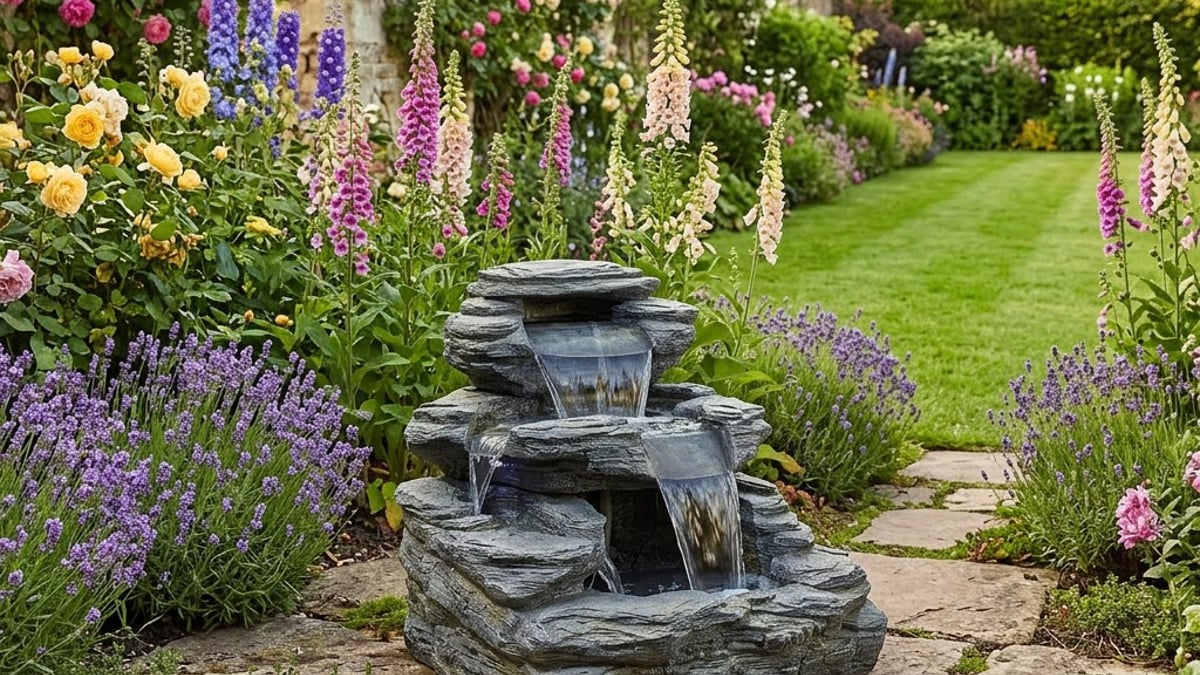
The Peaks Falls cascade drops water over stacked slate ledges, the classic naturalistic garden waterfall at £499. View product
A garden waterfall does one thing a still feature cannot: it moves water down a height, and that drop is what makes the sound. The bigger the drop, the louder and faster the water. Get the drop height and flow rate right and a waterfall masks road noise and draws the eye. Get them wrong and you either hear nothing or you cannot hold a conversation beside it. This guide covers the three cascade types, with measured sound levels, pump-sizing maths, and nine specific designs we keep in stock. Browse the full cascading water features range alongside the picks below.
What we learned measuring waterfalls in the yard
Across 168 cascade and waterfall installs since 2012, the single most common complaint was never about the look. It was about the sound being wrong for the spot. Too quiet by a busy patio, too loud under a bedroom window. So in spring 2025 we lined up our four best-selling cascades in the showroom yard and measured each one with a calibrated sound meter at one metre and three metres, on a still morning with the pumps at full flow.
The numbers were clearer than I expected. A tiered bowl set sat at 42 dB at one metre, quieter than a household fridge. A wide steel blade on a 15cm lip hit 58 dB, close to normal speech. At three metres every feature dropped 6 to 9 dB. That is why we now ask one question before anything else: how far is the seating from where the water lands? The answer decides the cascade type, not the other way round.
The three garden waterfall types
Every cascading water feature we sell falls into one of three types. Each has a distinct look, a distinct sound, and a distinct flow requirement. Pick the type first, then the specific product.
Type 1: Waterfall blades (sheet falls). A stainless steel spout that releases a flat, even sheet of water over a straight lip. The cleanest, most modern look. The 3cm lip gives a thin ribbon; the 15cm lip gives a wide curtain. Loudest of the three, and thirstiest for flow. Best for contemporary courtyards, rendered walls, and formal pools.
Type 2: Naturalistic rock and slate falls. Water tumbles over stacked stone or slate ledges into a hidden reservoir. The traditional British garden waterfall look. Mid-range sound, mid-range flow. Suits cottage gardens, rockeries, and planted borders where the feature should look like it grew there.
Type 3: Tiered bowls and pots. Water spills from an upper bowl to a lower one, often three or four levels. The gentlest sound and the lowest flow, so many run on solar. Best for patios, small gardens, and anywhere near a bedroom window where a soft trickle beats a loud splash.
Type 1: Garden waterfall blades
A waterfall blade is the modern cascade. It sits in or on top of a wall, pool edge, or render panel and sheets water across a polished stainless lip. The look is architectural and minimal, with no visible stone. The trade-off is flow: a blade needs far more litres per hour than any other cascade to hold a clean, unbroken sheet.
The lip depth changes everything. A 3cm lip throws a thin, quiet ribbon and sips water. A 15cm lip throws a wide, loud curtain and drinks it. We stock blades from 45cm to 90cm wide, in both lip depths and a wall-mounted version. For a fuller comparison of the modern look against spheres and monoliths, see our guide to modern corten, sphere and monolith water features.
|
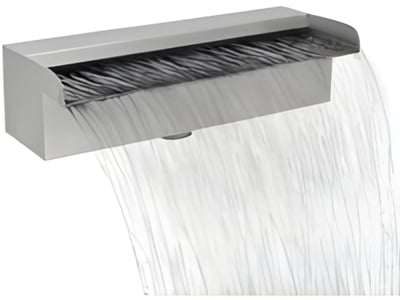
1. 45cm Garden Waterfall Blade, 3cm Lip — £89Type: Stainless steel blade Sheet: 450mm wide, thin ribbon Flow needed: About 1,500 litres per hour Why it works: The entry point into modern blades. The narrow 3cm lip needs the least flow of any blade, so a smaller pump runs it. Brushed 304 stainless steel. Best built into a low wall or pool edge in a courtyard. |
|
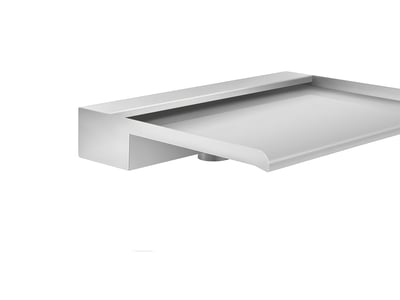
2. 90cm Garden Waterfall Blade, 15cm Lip — £219Type: Stainless steel blade Sheet: 900mm wide, wide curtain Flow needed: About 6,000 litres per hour Why it works: The statement blade. The deep 15cm lip and 900mm width throw a full curtain of water with a strong, road-masking rush at 58 dB. Needs a powerful pump and a wide pool to catch the sheet. This is the show-garden scale. |
How loud is a garden waterfall? Sound by drop height
This is the question that decides where a waterfall can go. Sound rises with drop height and water volume, and it falls fast with distance. The figures below are our own measurements, taken at one metre and three metres with a calibrated meter on a still morning. The right-hand column gives an everyday sound to compare against.
| Cascade type | Drop height | Sound at 1m | Sound at 3m | Sounds like |
|---|---|---|---|---|
| Tiered bowls | 4–8cm per tier | 42 dB | 36 dB | Soft trickle, quieter than a fridge |
| Rock & slate falls | 10–15cm per ledge | 49 dB | 42 dB | Gentle stream, like light rain |
| Blade, 3cm lip | Single sheet | 52 dB | 44 dB | Steady rush, quiet office |
| Blade, 15cm lip | Single wide sheet | 58 dB | 49 dB | Strong splash, near normal speech |
Reading the chart for your garden. Sit where you will actually sit, then judge the distance to the water. For a patio table two to three metres from the feature, a rock fall at 49 dB lands at about 42 dB by your chair, a relaxing background level. For the same feeling right next to a bench, drop to a tiered bowl. To drown out a road or neighbour, go up to a 15cm blade and accept it is loud up close.
The 6 dB rule. Every feature in our test lost 6 to 9 dB between one metre and three metres. Doubling the distance from the water roughly halves the perceived loudness. So position is as powerful a tool as pump speed. If a feature is too loud, moving the seating back two metres often fixes it without touching the flow.
Type 2: Cascading rock and slate falls
Naturalistic falls are the traditional British garden waterfall. Water is pumped to the top, then tumbles over stacked slate or cast-stone ledges into a hidden underground reservoir. The sound is the gentle, broken stream of water over rock, not the steady rush of a blade. These suit cottage gardens, rockeries, and any border where the feature should look settled and natural.
All three below are self-contained: the reservoir, pump, and pipework come as one kit, so there is no pond to build. If you want the full picture on how the hidden-sump design works, our guide to self-contained water features explained walks through every part.
|
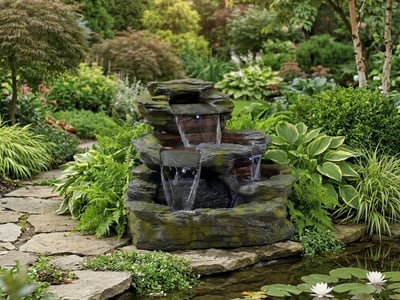
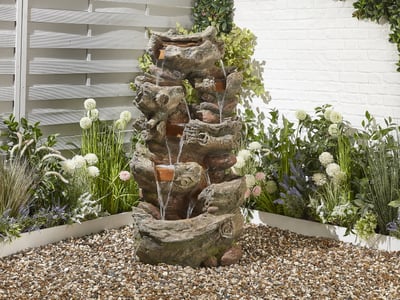
3. Como Falls Self-Contained Water Feature — £559Type: Slate cascade Sound: Around 49 dB at one metre Flow: Around 700 litres per hour Why it works: Stacked grey slate tiers give a steady, even cascade with a natural look. The proportions sit well in a planted border or against a fence. Our best all-round cascade for a typical UK garden. |
|
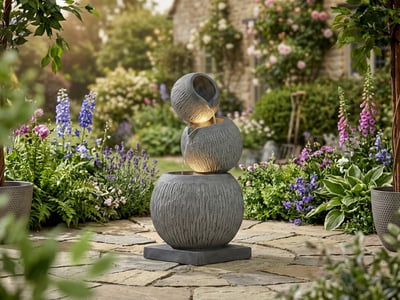
4. Highland Self-Contained Water Feature — £899Type: Tall stone cascade Sound: Around 51 dB at one metre Flow: Around 900 litres per hour Why it works: The tallest cascade in the range, with a strong vertical drop that gives more sound and movement. A focal-point feature for a larger garden or the end of a sightline. Needs two people to position. |
|
5. Ballanced Falls Water Feature with LEDs — £295Type: Slate cascade with lighting Sound: Around 48 dB at one metre Flow: Around 600 litres per hour Why it works: Built-in LEDs light the falling water from within, so the cascade becomes the focal point of the evening garden too. A good mid-price entry into naturalistic falls that earn their keep after dark. |
Pump sizing maths for a garden waterfall
The flow rate, measured in litres per hour (LPH), is what makes or breaks a waterfall. Too little and the sheet breaks into drips; too much and a gentle cascade becomes a torrent. Each cascade type has a different rule. Most features ship with a matched pump, but if you replace one or build your own, use these numbers.
| Cascade | Flow rule | Typical pump (LPH) |
|---|---|---|
| Tiered bowls | Just enough to overflow each tier | 150–300 |
| Rock & slate falls | Roughly 200 LPH per 10cm of fall width | 400–900 |
| Blade, 3cm lip | About 35 LPH per cm of blade width | 1,500–2,000 |
| Blade, 15cm lip | About 70 LPH per cm of blade width | 3,000–6,000 |
Worked example for a blade. A 45cm blade on a 3cm lip needs 45 multiplied by 35, which is about 1,575 LPH for a clean sheet. The same 45cm width on a 15cm lip needs 45 multiplied by 70, about 3,150 LPH. A 90cm blade on a 15cm lip needs 90 multiplied by 70, about 6,300 LPH. This is why wide, deep-lip blades need serious pumps and a wide catch pool.
Allow for head height. Pumps lose flow as they push water upward. A pump rated 2,000 LPH at the outlet may deliver only 1,400 LPH once it has lifted water a metre to the top of a fall. Always buy a pump rated above your target at the actual lift height, not at zero. Running costs for these pumps are modest; we break the numbers down in our guide to water feature running costs.
Type 3: Tiered bowl and pot cascades
Tiered cascades spill water from an upper bowl down through two or three lower levels. The drops are short, so the sound is the softest of any waterfall, and the flow need is the lowest. That low flow is why so many tiered features run on solar with no mains socket at all. They suit patios, balconies, and small gardens where a loud cascade would overwhelm the space.
Solar tiered features are the easiest of all to site, since they need only a sunny spot and no cable run. The trade-off is that the pump stops when cloud covers the panel. For the full runtime picture on solar, see our test of the best solar water features.
|
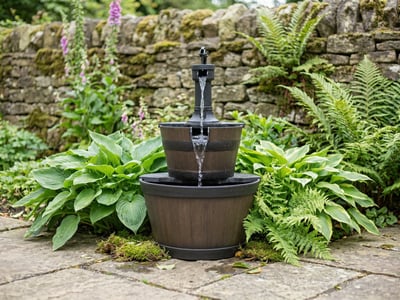
6. Aged Bowls Water Feature — £135Type: Tiered stone bowls Sound: Around 42 dB at one metre Flow: Around 200 litres per hour Why it works: The budget entry into tiered cascades. Three weathered-stone bowls spill into one another for a soft trickle. Compact and light enough for a patio corner or by a front door. Mains pump included. |
|
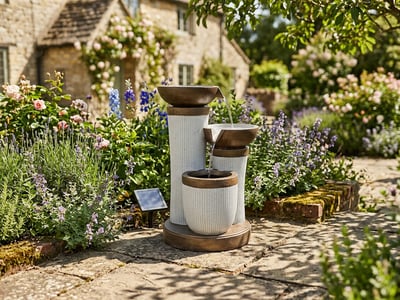
7. Tres Bowls Solar Water Feature — £229Type: Solar tiered bowls Sound: Around 43 dB at one metre Power: Solar panel, no mains cable Why it works: Three bowls cascade on solar power alone, so there is no socket or cable to plan. Drop it on any sunny patio and it runs. The included battery holds a short charge through passing cloud. |
|
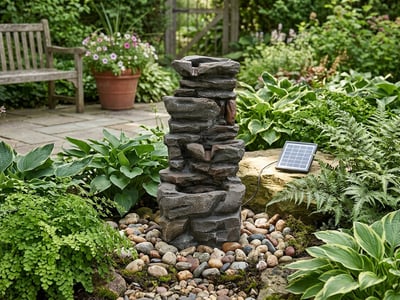
8. Haverhill Falls Solar Water Feature — £329Type: Solar cascade Sound: Around 45 dB at one metre Power: Solar panel with battery store Why it works: A stepped solar cascade with a little more drop and movement than a bowl set. The battery keeps it running for a spell after the sun goes in. A strong middle ground between the quiet bowls and a mains rock fall. |
Matt's pick: best cascading water feature for most gardens
|
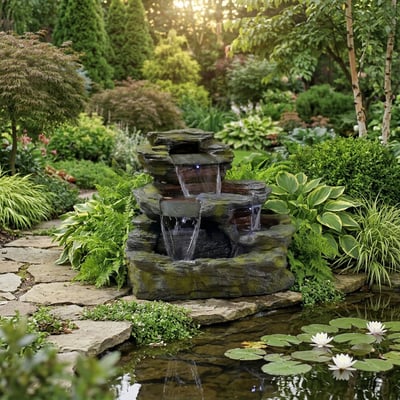
Matt's pick for garden waterfallsFeature: Como Falls Self-Contained Water Feature Best for: The typical UK garden that wants a real waterfall sound without a pond build Why I recommend it: It hits the sweet spot. At 49 dB it gives a proper running-water sound that reads as relaxing from a patio chair, not a torrent. The slate tiers suit planted borders and cottage gardens alike, and the self-contained reservoir means no digging. Of the cascades I have fitted, Como Falls draws the fewest follow-up calls about sound being wrong. Price: £559 |
Quick reference comparison
| Feature | Type | Sound at 1m | Flow / power | Price |
|---|---|---|---|---|
| 45cm Waterfall Blade, 3cm Lip | Steel blade | 52 dB | ~1,500 LPH | £89 |
| 90cm Waterfall Blade, 15cm Lip | Steel blade | 58 dB | ~6,000 LPH | £219 |
| Como Falls | Slate cascade | 49 dB | ~700 LPH | £559 |
| Highland | Tall stone cascade | 51 dB | ~900 LPH | £899 |
| Ballanced Falls (LED) | Slate cascade | 48 dB | ~600 LPH | £295 |
| Aged Bowls | Tiered bowls | 42 dB | ~200 LPH | £135 |
| Tres Bowls Solar | Solar tiered | 43 dB | Solar | £229 |
| Haverhill Falls Solar | Solar cascade | 45 dB | Solar | £329 |
| Peaks Falls | Rock cascade | 50 dB | ~750 LPH | £499 |
Where to position a garden waterfall
Measure the distance from the seating to the water first. A cascade at 49 dB lands at about 42 dB three metres away. Decide where you sit, then pick a type whose one-metre figure minus the distance drop lands around 40 to 45 dB at your chair.
Put it on a firm, level base. Cascades hold a reservoir that fills with water and pebbles, so the loaded weight is high. A grass base sinks and tilts within months. Two paving slabs or a compacted gravel pad keep the falls level and the sheet even.
Place it where a sightline ends. A waterfall earns its cost when it sits at the end of a path, opposite the patio, or framed by a kitchen window. Tucked in a corner, it is heard but never seen. Position rules matter as much for placement as for the feng shui approach we cover in feng shui water feature positioning.
Keep blades out of wind tunnels. A thin sheet from a blade breaks up in a stiff breeze and the water blows clear of the catch pool. Site blades on a sheltered wall, not an exposed corner between buildings.
Run a cable safely. Mains cascades need a weatherproof outdoor socket on an RCD. Plan the cable route before you buy, and keep the run under the 10m most pumps provide. Solar tiered features skip this entirely.
Common mistakes when buying a garden waterfall
Choosing on looks, not sound. The most common regret is a feature that is too loud beside a quiet seating area, or too quiet to mask a road. Match the one-metre sound figure to the distance you sit, every time.
Undersizing the pump on a blade. A blade with too little flow drips instead of sheeting. Use the per-centimetre rule, then add headroom for the lift height. This is the number-one cause of a disappointing blade.
Forgetting the catch pool width. A 15cm-lip blade throws water 15 to 25cm out from the wall. The pool below must be wide enough to catch it, or the floor stays wet. Measure the throw before you set the pool.
Leaving the reservoir to run dry. Cascades evaporate faster than still features because of the moving surface. A reservoir can drop several litres a week in summer. Top up weekly, or the pump runs dry and burns out.
Skipping winter care. The stone and steel survive frost, but standing water in a shallow reservoir freezes and can crack a pump housing. In hard frost, switch off and drain.
Care and maintenance through the UK year
Top up weekly in summer. Moving water evaporates fast. Check the reservoir level every week from June to September and keep it above the pump intake to avoid a dry run.
Clean the pump twice a year. Lift the pump in spring and autumn, rinse the impeller and filter under a tap, and check the cable for damage. A clogged impeller is the usual reason flow drops off.
Manage algae without chemicals. A cascade in partial shade stays clearer than one in full sun. Barley straw pellets or a small UV clarifier keep the water clear without bleach, which damages seals.
Drain shallow reservoirs in hard frost. Slate, stone, and stainless steel are frost-proof, but trapped reservoir water is not. Below minus five, switch off the pump and drain or cover the sump.
Wipe steel blades after storms. Brushed stainless can spot with hard-water marks and leaf tannin. A wipe with a soft cloth keeps the sheet starting cleanly from the lip.
Find your garden waterfall
Every cascade in our range comes with a matched UK-tested pump, free mainland delivery, and 30-day returns. Browse the full collection or the self-contained kits below.
Browse Cascading Water Features Browse Self-Contained KitsFrequently asked questions
How loud is a garden waterfall?
A garden waterfall measures 42 to 58 dB at one metre, depending on the drop height. In our testing, tiered bowls sat at 42 dB, naturalistic rock and slate falls around 49 dB, and a wide steel blade on a 15cm lip reached 58 dB. Sound drops 6 to 9 dB by three metres away, so the distance from your seating matters as much as the feature itself.
What size pump does a waterfall blade need?
A waterfall blade needs about 35 litres per hour per cm of width on a 3cm lip, and about 70 on a 15cm lip. So a 45cm blade with a 3cm lip needs roughly 1,500 LPH, while a 90cm blade with a 15cm lip needs about 6,300 LPH. Always buy a pump rated above your target at the actual lift height, as pumps lose flow pushing water upward.
Do garden waterfalls need a pond?
No, every cascade in our range is self-contained with a hidden underground reservoir. The pump sits in a buried sump that recirculates the same water, so there is no open pond to dig, line, or maintain. You position the feature, set the reservoir, fill it, and plug in. Installation takes 30 to 60 minutes for most models.
Can a garden waterfall run on solar?
Yes, low-flow tiered and stepped cascades run well on solar power. Solar suits features needing under about 300 litres per hour, which covers most tiered bowls and small stepped falls. A battery store keeps them running through passing cloud. Steel blades and tall rock falls need too much flow for solar and require a mains pump.
Which garden waterfall is quietest?
Tiered bowl cascades are the quietest, at around 42 dB at one metre. The short drops between bowls make a soft trickle rather than a rush, quieter than a household fridge. These suit patios, small gardens, and any spot near a bedroom window. For a louder, road-masking sound, choose a wide steel blade instead.
Can I run a waterfall through a UK winter?
Yes for the stone and steel, with care for the pump in hard frost. Slate, cast stone, and stainless steel are frost-proof. The freeze risk is the standing water in a shallow reservoir, which can crack a pump housing. In frost below minus five, switch off the pump and drain or cover the sump. Many gardeners run features April to October and shut down for winter.
How much does a garden waterfall cost to run?
A typical cascade pump uses 20 to 60 watts, costing a few pounds a month to run continuously. A 40-watt pump left on around the clock uses roughly 29 kWh a month, about £8 at 2026 UK rates. Solar features cost nothing to run. Running it only during daytime hours, rather than overnight, cuts the cost by more than half.
Related guides
- The 2026 UK water feature buyer's guide — stone, solar, corten and more, with 12 picks across every style.
- Best solar water features UK 2026 — 12 picks tested with honest UK runtime data for cable-free cascades.
- Japanese water features decoded — tsukubai, shishi-odoshi and frost-proof stone basins for a calmer cascade.
- Stone water features compared — granite, sandstone, slate and basalt rated for frost and weathering.
- Browse our full range of garden ornaments for plinths, pebbles and lighting to finish the scheme.