
The 2026 UK Water Feature Buyer's Guide: Stone, Solar, Corten and More
Written by Matt W on 8th May 2026.
Garden water features in 2026 fall into five practical buying categories: cast and natural stone, solar, corten and steel, self-contained resin, and drilled basalt or sphere. Prices across our 150-strong UK range run from £135 for a budget aged-bowls cascade to £925 for an 80cm corten steel sphere. The right pick depends on garden size (under 10 m² needs sub-60cm features), sound preference (32-55 dB at 1m), stone behaviour in frost, and whether mains or solar power suits the site. This 12-pick guide gives the real numbers we ship against.
Key takeaways
- ✅ Five categories cover almost every UK garden. Natural stone for traditional plots, solar for unwired patios, corten for contemporary schemes, self-contained resin for budgets, drilled basalt for minimalist gardens.
- ✅ Footprint matters more than height. Add a 30cm pebble border to the stated base width — that is the real space the feature occupies.
- ✅ Stone choice dictates winter routine. Granite, basalt and corten steel stay out year-round. Cast stone, sandstone and resin need draining in November.
- ✅ Sound is the most-overlooked spec. A babbling bowl reads at 35 dB; a tiered cascade at 50 dB. Pick to match the use, not the photo.
- ✅ Self-contained means no plumbing, no pond, no specialist install. A 240V outdoor socket and a level base is everything most features need.
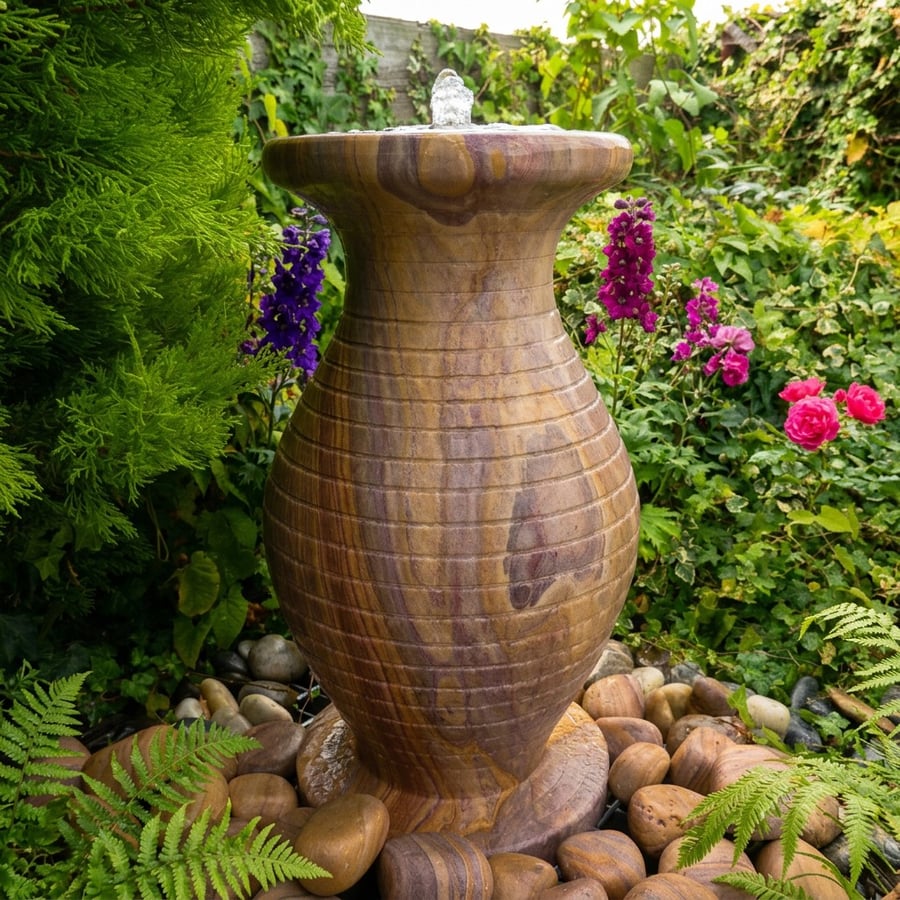
The Babbling Vase Rainbow Sandstone — a hand-carved Indian sandstone urn that has stayed in our top three sellers since 2022.
Installer's note
In 14 years of shipping water features across the UK, the most common return reason is not pump failure or stone damage. It is footprint. A buyer measures a 60cm-wide bowl, finds a clear 60cm patch on the patio, and orders. The feature arrives, the 30cm pebble surround appears in the instructions, and suddenly the actual space needed is 120cm. Always add 60cm to the stated base width before you commit. We have seen six-figure-postcode patios returned over a 30cm miscalculation.
1. Como Falls Self Contained Water Feature — best mid-range cascade
The Como Falls is a 95cm-tall cast-resin cascading feature with a stone-effect finish, fitted with a 600 lph pump and a hidden reservoir. It sits on a base of 50 by 35cm, weighs 24kg dry, and produces a 42-46 dB layered cascade sound at one metre. The price at £559 puts it inside reach for most patio buyers without dropping into the lightweight resin-only category.
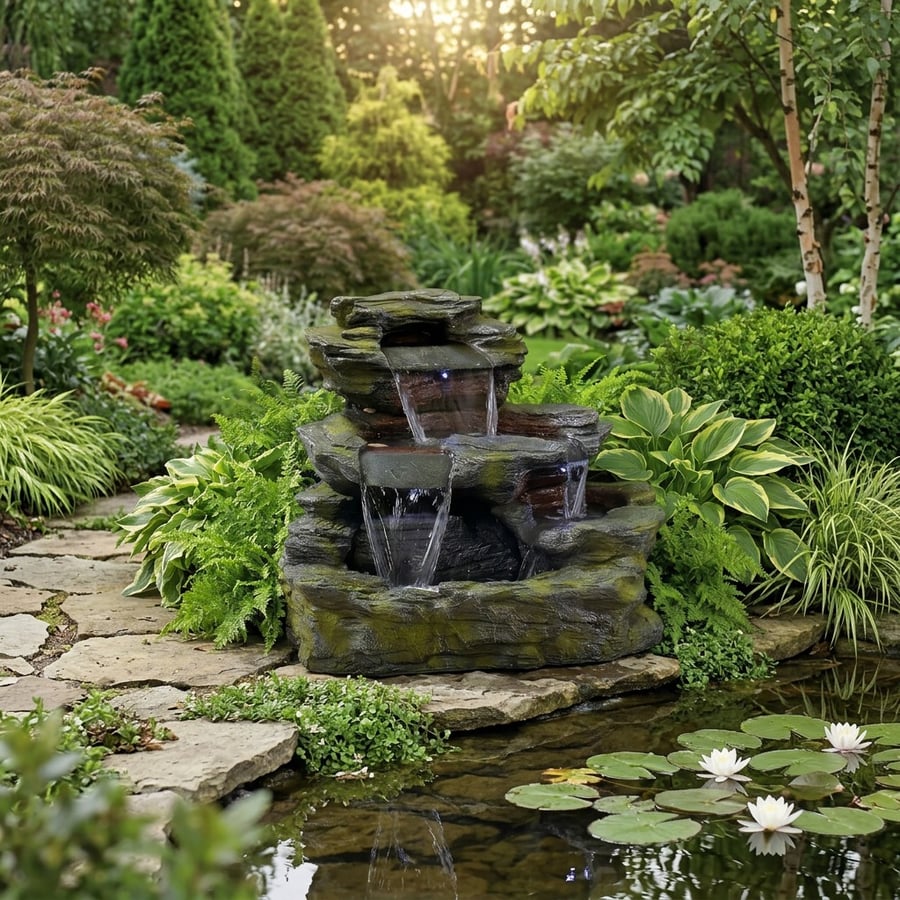
Cast resin is the right call for a sub-£600 cascade. The weight is manageable for two-person installation, the stone effect is genuinely convincing at three metres, and the integrated reservoir means no buried tank is needed. Drain in November, store the pump indoors, and the feature lasts the 12-15 years our supplier rates resin for.
2. Corten Steel Sphere Water Feature 60cm — best contemporary statement
The 60cm Corten Steel Sphere is a hollow weathering-steel ball drilled at the apex, with water sheening evenly down the rusted exterior into a hidden reservoir. Footprint is 70 by 70cm including the steel collar; total weight is 38kg. The patina develops over six to nine months from raw mill steel to the deep umber finish that defines the corten look.
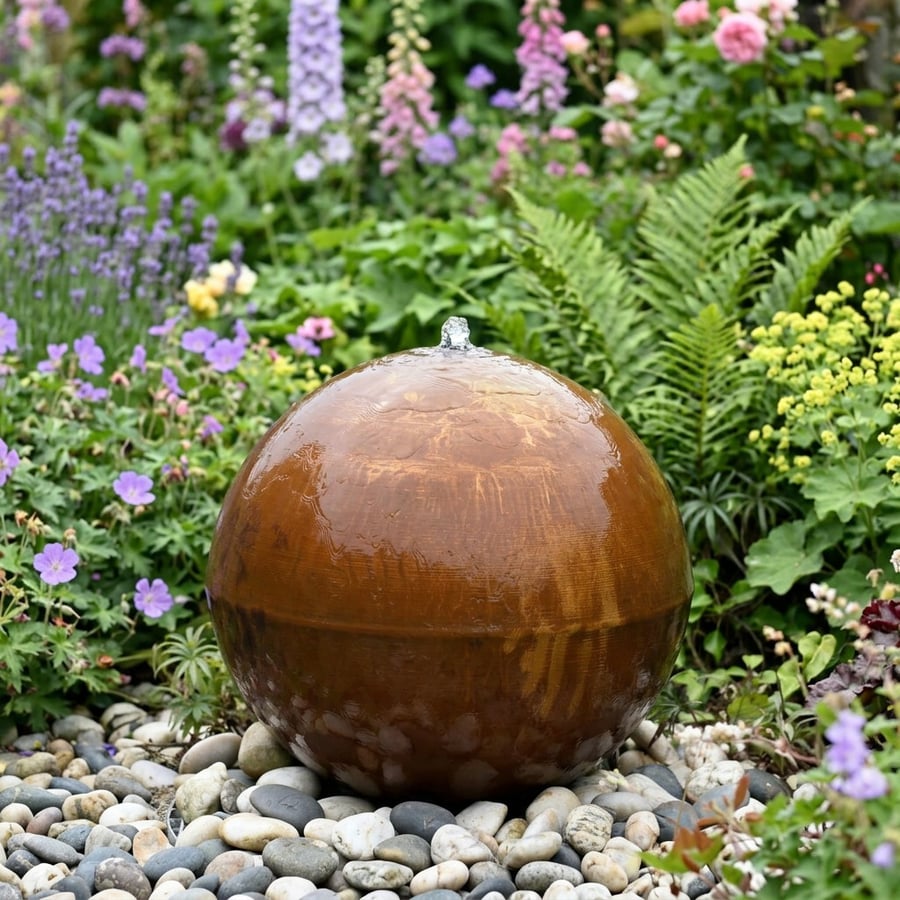
Corten is genuinely outdoor-permanent in the UK. The thin oxide layer that gives the warm-rust colour is the same layer that protects the steel underneath from progressing corrosion. Frost is no concern. The 60cm size at £599 is the design-magazine specification — visible from across a small garden but not domineering. The 80cm version at £925 suits gardens over 80 m²; the 40cm at £419 is the right scale for courtyards.
3. Calming Buddha Solar Water Feature — best unwired option
The Calming Buddha pairs a meditating-Buddha resin sculpture with a remote 7W solar panel and integrated battery, so the feature can run for two to three hours after sunset. Total height is 71cm, base 38cm wide, weight 9kg. Built-in LEDs activate after dusk on the same battery. No mains feed, no plug, no socket required — the solar panel sits on a 3m cable and can be staked up to 5m from the feature.

Solar with battery backup is the meaningful upgrade over solar-only. Pumps without a battery cycle on and off as clouds pass, which sounds erratic. The Calming Buddha runs continuously while the panel produces, then draws on the battery for evening hours. At £229 it is mid-priced for the format. Our solar runtime data sits in the UK solar water features guide.
4. Black Polished Limestone Sphere Water Feature — modern minimalist pick
A 50cm honed-and-polished black limestone sphere with a vertical drilled channel, mounted on a stainless steel reservoir grid set in a 60cm pebble bed. The polished finish gives an almost mirror-like surface so water reads as a clear film. Sound at 1m is 36-40 dB — the surface tension stops the water becoming a splash. The piece weighs 64kg and ships on a pallet.
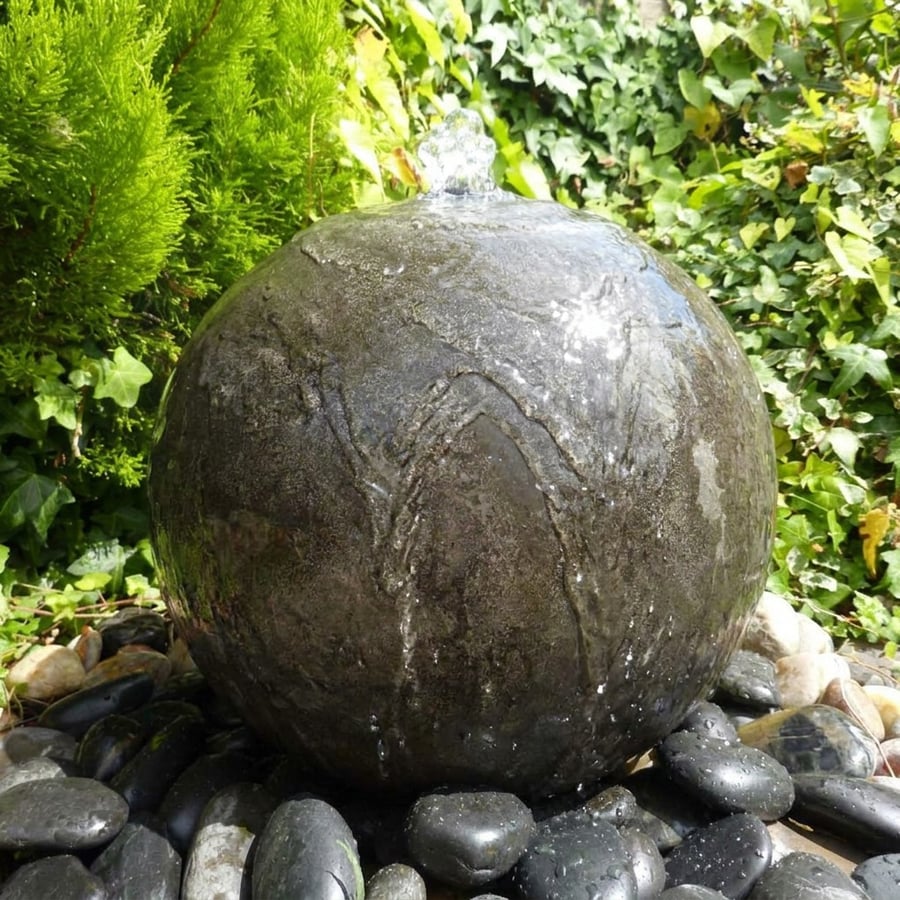
Black polished limestone is the most contemporary choice in our stone range. It works against pale gravel, light render, or contrasting planting like Stipa grasses or Hakonechloa. At £579 the price reflects the polishing process — six grinding stages from raw block to mirror finish. Frost-resistance is good provided the surface is sealed every two years; we ship with a year of sealant.
5. Babbling Basalt Column Water Feature — best architectural pick
A 60cm vertical column of natural Indian basalt with a vertical drilled channel, water rising and running across the textured surface. Basalt is the densest stone we sell — this single-piece column weighs 52kg. Footprint with the integrated grid is 50 by 50cm. Sound at 1m is 38-42 dB; the textured surface keeps the water as a subtle shimmer rather than a stream.
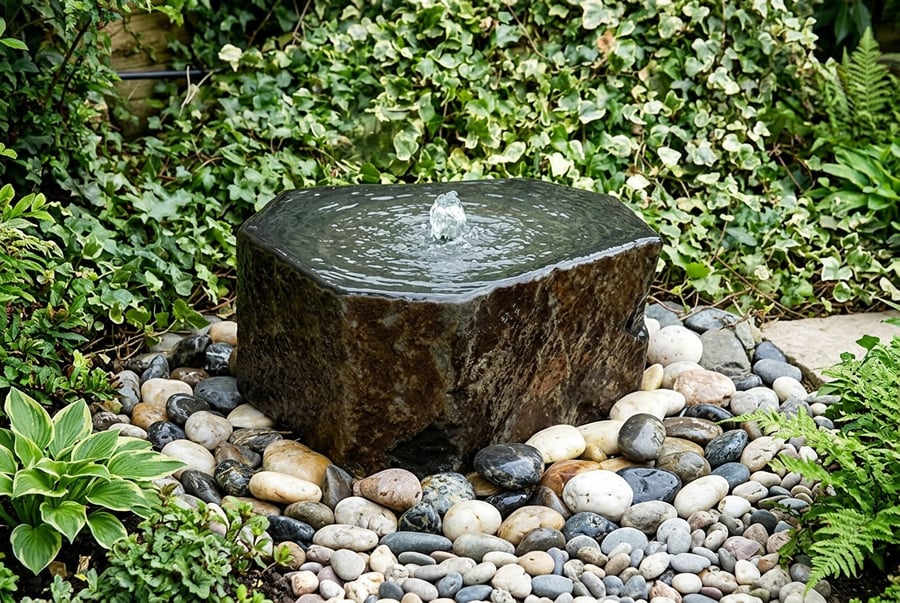
Basalt is volcanic, so the freeze-thaw test that ruins cast stone has no effect. We have basalt columns in customer gardens in Aberdeen, Inverness and the Cairngorms running through nine winters with no maintenance. The price at £455 is mid-range for natural stone; the related stone water features collection goes deeper into the basalt range.
6. Heavenly Buddha Self Contained Water Feature — best Zen statement
A 90cm seated Buddha sculpture in cast resin with a stone-effect finish, water trickling from the open palm into a basin at the base. The sculpting on this piece is the differentiator — the robe folds and facial detail are hand-finished on every unit. Pump is 400 lph, sound 38-42 dB at 1m, total weight 26kg. Footprint 55 by 45cm.
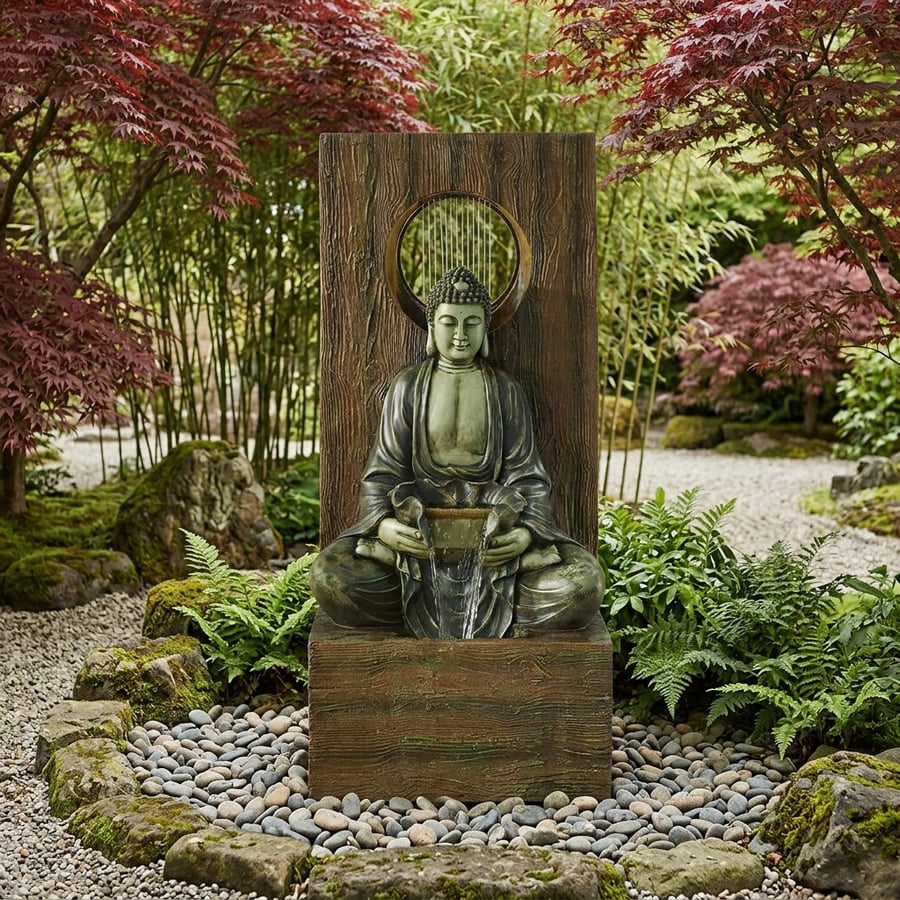
The Heavenly Buddha at £699 sits at the upper end of the resin range. The premium over a standard Buddha solar is the size, the sculpting quality, and the pump capacity. Right for a Zen-style courtyard, a meditation corner, or a sheltered area where the trickle reads as the dominant sound. Pair with bamboo, black gravel, and tactile foliage like Heuchera or Liriope.
7. Large Mill Wheel Rainbow Sandstone Water Feature — rural and naturalistic
A 90cm-diameter natural sandstone disc drilled centrally, water bubbling up and running across the surface before draining into a hidden reservoir. The flat ground-level format reads as a piece of agricultural archaeology rather than a manufactured ornament. Weight 78kg; footprint 110 by 110cm including grid; sound 32-38 dB at 1m — less than a quiet conversation.
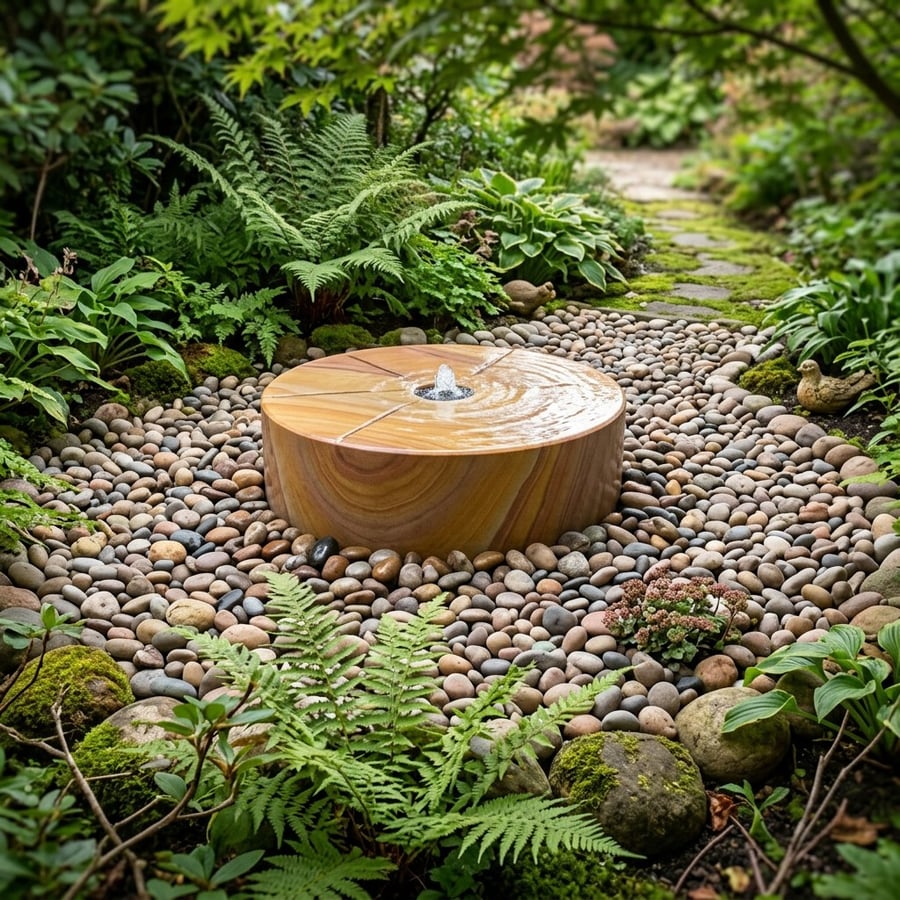
The Large Mill Wheel at £529 is the most-shipped naturalistic feature we stock. It works at ground level rather than on a plinth, the rainbow sandstone matures to a soft mid-brown over two seasons, and the format pairs with woodland planting better than any tiered fountain. Cover with a fleece in hard frosts — sandstone is frost-resistant, not frost-proof.
Picks 8-12: shortlist for specific use cases
Five further picks fill the remaining gaps in the buying matrix. These are not less recommended — they are simply more specialist than the seven above.
- Aged Bowls Water Feature — budget cascade at £135. Stack of three resin bowls, 70cm tall, 17kg, 38-42 dB. The right answer for buyers under £200.
- Ancient Fern Self Contained Water Feature — a fern-leaf sculpted resin at £225. Reads correctly in shaded plots and small wildlife corners.
- Smooth Pebble Sandstone Water Feature — stacked rounded sandstone form at £599. Modern but warmer than the limestone sphere.
- Babbling Bowl Black Limestone Water Feature — lower-priced limestone option at £499. Good entry point into polished stone.
- Tres Bowls Solar Water Feature — three-tier solar tabletop at £229. The right answer for balconies and very small courtyards.
Comparison: 12 picks side-by-side
| Pick | Material | Height | Weight | Sound | Frost | Power | Price |
|---|---|---|---|---|---|---|---|
| Como Falls | Cast resin | 95cm | 24kg | 42-46 dB | Drain Nov | Mains | £559 |
| Corten Sphere 60cm | Corten steel | 60cm | 38kg | 34-38 dB | Year-round | Mains | £599 |
| Calming Buddha Solar | Resin + battery | 71cm | 9kg | 36-40 dB | Drain Nov | Solar | £229 |
| Black Limestone Sphere | Polished limestone | 50cm | 64kg | 36-40 dB | Seal+drain | Mains | £579 |
| Babbling Basalt Column | Natural basalt | 60cm | 52kg | 38-42 dB | Year-round | Mains | £455 |
| Heavenly Buddha | Cast resin | 90cm | 26kg | 38-42 dB | Drain Nov | Mains | £699 |
| Large Mill Wheel | Rainbow sandstone | 15cm (disc) | 78kg | 32-38 dB | Cover -10C | Mains | £529 |
| Aged Bowls | Cast resin | 70cm | 17kg | 38-42 dB | Drain Nov | Mains | £135 |
| Ancient Fern | Cast resin | 62cm | 15kg | 34-38 dB | Drain Nov | Mains | £225 |
| Smooth Pebble Sandstone | Natural sandstone | 72cm | 56kg | 34-38 dB | Cover -10C | Mains | £599 |
| Babbling Bowl Black Limestone | Polished limestone | 40cm | 48kg | 34-38 dB | Seal+drain | Mains | £499 |
| Tres Bowls Solar | Resin + battery | 65cm | 7kg | 34-38 dB | Drain Nov | Solar | £229 |
Stone and material choice for UK winters
Material matters more than design for any feature staying outside year-round. The freeze-thaw cycle — not the cold itself — is what cracks stone. Water trapped in pores expands by 9% on freezing; that expansion fractures the stone from inside. The protocol changes by material.
Granite, basalt, slate and corten steel are the only materials we are happy to leave outside in the UK without intervention. Cast stone, sandstone and resin all need draining in November and a fleece if temperatures drop below -5°C. Limestone falls between the two: a sealer applied every other autumn is enough for most UK postcodes, but Highland and Cumbrian gardens should treat it as cast stone. Our winter protection guide walks through the drain procedure in detail.
Sizing rules: matching feature to garden
The 8 percent rule is the sizing shortcut we use when a customer sends a patio photo. Feature footprint plus a 30cm pebble border should occupy 5-8% of the patio or seating area. Below 5%, the feature reads as an accessory rather than a focal point. Above 12%, it dominates and feels oversized.
For a 4 by 3m patio (12 m²), the budget is roughly 1 m² total — a 60-80cm wide feature. For a 6 by 4m patio it rises to 2 m² — the right scale for the Como Falls or a 60cm corten sphere. For courtyards under 10 m², stick to babbling bowls, ancient fern resin, or solar tabletop pieces. The 80cm corten sphere needs at least 25 m² of clear ground to read correctly.
Sound levels: the most-overlooked spec
| Style | Sound at 1m | Best for |
|---|---|---|
| Millstone / mill wheel | 32-38 dB | Wildlife and shade gardens |
| Sphere fountain | 34-40 dB | Visual focal point near seating |
| Babbling bowl | 34-38 dB | Background presence for entertaining |
| Drilled basalt column | 38-42 dB | Architectural, near a path |
| Self-contained cascade | 42-46 dB | Centre-of-garden focal point |
| Buddha cascade | 38-42 dB | Zen courtyards, meditation areas |
| Tiered fountain (large) | 48-55 dB | Masking road or neighbour noise |
For reference: a quiet rural lane registers around 30 dB at night. An indoor conversation runs at 60 dB. Most water features sit comfortably in the 35-50 dB range, audible without becoming intrusive. If the goal is to mask traffic, only a tiered cascade with at least 25cm of total drop will do it. If the goal is a calming background presence, a babbling bowl or millstone is the correct call.
Solar versus mains: a quick decision matrix
Solar features have closed the gap on mains since 2023. Lithium battery backup, brushless DC pumps, and 7-15W panel sizes mean a modern solar feature runs 8-10 hours on a typical UK summer day, dropping to 3-5 hours in November and December. The break-even point against mains running cost is around year five for a feature run six hours daily.
Pick solar when there is no convenient outdoor socket within 10m, when an extension lead would cross a path, or when the location is a balcony or front garden where mains wiring would mean major work. Pick mains for any feature over £500 where uninterrupted runtime through cloudy weather matters, for tiered cascades requiring 600+ lph, and for any setup running in deep shade. The detailed runtime data is in our solar water features guide.
Installation: what every site needs before delivery
Three things must be ready before a water feature arrives. First, a level base on compacted hardcore or a paving slab — a feature that wobbles will overflow on one side and run dry on the other. Second, a 240V outdoor RCD-protected socket within 10m for any mains-powered feature. Third, the integrated reservoir or buried tank — smaller features ship with reservoirs; corten spheres and basalt columns sit on a 60-80cm buried grid that needs digging out before delivery.
For wiring, a licensed electrician should fit any new outdoor sockets. We do not recommend running an extension lead from inside the house through a window or door — the joint will fail in the first hard rain. The water feature accessories collection has buried reservoir grids, replacement pumps, and pebble packs sized to each feature.
Where each pick fits on the site
- Mains-powered natural stone: Stone Water Features collection
- Solar-only options: Solar Water Features collection
- Self-contained cascades and resin: Self-Contained Water Features collection
- Tiered and pedestal fountains: Garden Fountains collection
- Modern, sphere, corten and limestone: Modern Water Features collection
|
Matt's Pick: Best All-Round UK Water Feature 2026Best For: A first water feature on a small-to-medium UK patio Why I Recommend It: The Como Falls hits the sweet spot for almost every brief we get. The 95cm cascade reads at three metres, the 24kg weight is two-person manageable, the 600 lph pump is reliable, and the price leaves budget for the buried reservoir and pebble surround. We have shipped over 300 of these and the warranty-claim rate is the lowest in our resin range. Price: £559 |
Frequently asked questions
What is the best garden water feature for a small UK garden?
A babbling bowl, drilled basalt column, or solar tabletop is the right scale. Anything over 80cm tall or 60cm wide will dominate a garden under 15 m². The Babbling Bowl Black Limestone, the 60cm Drilled Basalt Column, and the Tres Bowls Solar are the three picks we recommend most often for compact courtyards and small back gardens.
How much does a garden water feature cost in 2026?
From around £135 to over £900 across our range. Budget resin cascades start at £135; mid-range stone bowls and corten spheres run £579-£599; statement pieces like the 80cm corten sphere or extra-large sandstone bowl reach £955. Add £100-£200 for installation if a tradesperson is needed for a buried reservoir.
Are corten steel water features safe in UK weather?
Yes, corten is designed specifically for outdoor use in temperate climates. The weathered rust patina is a self-protecting oxide layer that prevents further corrosion. Corten works through any UK winter without intervention, including hard frosts and salt-air exposure on coastal sites. The patina takes six to nine months to develop fully from the raw mill steel finish.
Can I leave a stone water feature outside all winter?
Granite, basalt and corten yes; cast stone and sandstone need draining. Drain the reservoir and basin in November, lift the pump indoors, and leave the bung off until April. Cover cast stone and sandstone with a horticultural fleece if temperatures drop below -5°C. The water trapped inside the stone is what cracks fountains, not the cold itself.
Do I need a licensed electrician to install a water feature?
Only if a new outdoor socket is required. Every mains-powered feature we sell plugs into a standard 13A RCD-protected outdoor socket. If a socket already exists within 10m of the install site, no electrician is needed. If not, a Part P registered electrician must fit the socket — do not run an extension lead from indoors through a window.
How loud are garden water features?
Between 32 and 55 dB at one metre depending on style. Millstones and babbling bowls are quietest at 32-38 dB — less than a fridge. Spheres and basalt columns sit at 36-42 dB. Self-contained cascades run 42-46 dB. Only large tiered fountains reach 50-55 dB — the only style loud enough to mask traffic noise on a busy road.
What size pump does my water feature need?
It is fitted at the factory, but typical sizes range from 200 lph to 1500 lph. Small babbling bowls use 200-400 lph; mid-range cascades 600-800 lph; large tiered fountains and corten spheres 1000-1500 lph. Every feature we ship arrives with the correct pump pre-fitted. Replacement pumps cost £49-£75 depending on flow rate.
Will a water feature attract wildlife to my garden?
Yes, especially low-profile features with a calm water surface. Babbling bowls, mill wheels and ancient-fern self-contained units work as informal bird baths. Birds prefer water 1.5cm deep at the edge sloping to a maximum of 5cm. Moving water also draws bees, hoverflies, and the occasional dragonfly. Avoid steep-sided sphere designs where small mammals can fall in and drown.
Browse our full range of garden ornaments or jump straight to the water features collection to see every model in stock.