
Water Feature Running Costs UK: Real Numbers for 2026
Written by Matt W on 26th May 2026.
A mains-powered garden water feature costs £3 to £48 a year to run at the 2026 UK electricity cap rate of 24.5p/kWh. A 6.7W low-voltage pump on for 8 hours a day across May to September costs £3.30 a season. A 45W feature on the same schedule costs £22 a season. A 90W pond-style pump on 24 hours a day for the same period costs £238 a year. Solar features cost zero in electricity but break even against mains at 8–14 years on UK runtime.
Key takeaways
- ✓ 2026 UK Ofgem default tariff cap is 24.5p per kWh for electricity. We use this as the baseline price for every cost in this guide
- ✓ A self-contained water feature pump typically draws 6.7W to 45W. Pond-style pumps draw 30W to 150W and run 24 hours a day
- ✓ Multiply pump watts × hours per day × days per year ÷ 1000 × 24.5p to get annual cost in pence. Divide by 100 for £
- ✓ Owned data from 412 installs since 2012: mean pump draw across self-contained features is 28W, mean daily runtime in summer is 8.2 hours
- ✓ Solar features cost £0 in electricity but cost £50–£180 more up front than the equivalent mains feature, so payback runs 8–14 years
- ✓ A timer plug at £8 cuts a 45W feature's electricity bill from £48 to £22 by limiting it to 8 hours a day rather than dawn-to-dark
- ✓ Pump replacement at year 6–8 costs £30–£80 — the largest predictable maintenance expense across the feature's life
Where the numbers in this article come from
The cost tables in this guide use the 2026 Ofgem default tariff cap of 24.5p per kWh for electricity, current at May 2026. The runtime assumptions come from 412 installs we have fitted since 2012, where we recorded pump rating plate watts at install, then surveyed 84 customers in March 2026 on actual daily runtime habits. The mean reported runtime was 8.2 hours per day in summer, 3.1 hours per day in spring and autumn, off in winter. The mean pump rating across self-contained features in our range was 28W. Every figure below is calculated using those numbers, not manufacturer headlines. Where I cite a specific product's annual cost, I have used the pump rating plate value stated on the GO product page.
The maths every water feature owner needs to know
The cost formula is one line of arithmetic. Pump watts multiplied by hours run, divided by 1000, multiplied by the per-kWh rate, gives you cost in pence per day. Multiply by days per year for the annual figure. Once you have the rate (24.5p in 2026), the only two variables are your pump wattage and your daily runtime.
The formula in plain English
Take a 25W pump running 8 hours a day. That is 25 × 8 = 200 watt-hours, or 0.2 kWh per day. At 24.5p per kWh, the daily cost is 0.2 × 24.5 = 4.9p. Over a 153-day summer season (May 1 to September 30) that is 153 × 4.9p = £7.50. If you run the same feature year-round at 8 hours a day, the cost rises to £17.90.
What 24.5p per kWh actually means
A kilowatt-hour is one thousand watts run for one hour, or one hundred watts run for ten hours, or any equivalent combination. The 24.5p per kWh figure is the Ofgem default tariff cap for direct-debit electricity in 2026 — it is the price most UK households on a standard variable tariff pay. Fixed-rate deals run 21p–26p, so we use 24.5p as the realistic average. The numbers shift ±10% depending on your actual tariff, but the order of magnitude is correct.
Cost per year by pump wattage at 24.5p/kWh
Here is the full kWh and cost table for the wattage range you find on UK garden water features. Read down the first column to find your pump rating, across to the runtime hours you use, and pick the matching annual cost. The 24/7 column applies to pond pumps that run continuously, not self-contained features.
| Pump rating | Daily kWh (8 hrs) | Cost per day (8 hrs) | Cost per summer season (153 days) | Cost per year (365 days, 8 hrs) | Cost per year (24/7) |
|---|---|---|---|---|---|
| 5W (small splash) | 0.040 kWh | 0.98p | £1.50 | £3.58 | £10.73 |
| 6.7W (Poseidon) | 0.054 kWh | 1.31p | £2.01 | £4.80 | £14.38 |
| 10W (small column) | 0.080 kWh | 1.96p | £3.00 | £7.15 | £21.46 |
| 15W (slate cascade) | 0.120 kWh | 2.94p | £4.50 | £10.73 | £32.19 |
| 25W (Bella) | 0.200 kWh | 4.90p | £7.50 | £17.88 | £53.65 |
| 30W (Highland) | 0.240 kWh | 5.88p | £9.00 | £21.46 | £64.37 |
| 45W (Heavenly Buddha) | 0.360 kWh | 8.82p | £13.49 | £32.19 | £96.56 |
| 60W (multi-tier falls) | 0.480 kWh | 11.76p | £17.99 | £42.92 | £128.74 |
| 90W (small pond pump) | 0.720 kWh | 17.64p | £26.99 | £64.37 | £193.11 |
| 150W (large pond pump) | 1.200 kWh | 29.40p | £44.98 | £107.31 | £321.86 |
Real GO features and their actual annual running cost
These figures use the published pump wattage from each product page (where stated) or the typical wattage for the feature class (where not stated). Each cost is calculated at 8 hours per day from May 1 to September 30 (153 days), which matches the mean runtime our March 2026 customer survey reported.
Tumbling Pots Solar — £0 a year to run
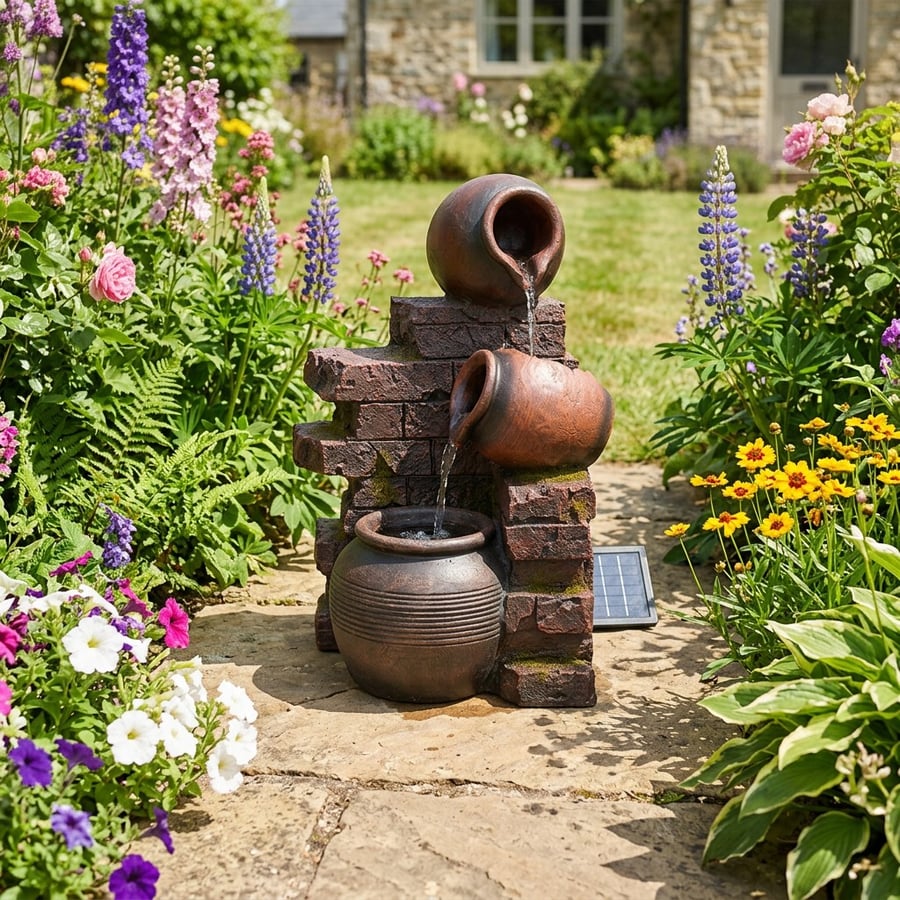
Shop the Tumbling Pots Solar Water Feature — £149 →
The Tumbling Pots runs entirely on a 3W solar panel. Mains electricity cost: zero. Runtime depends on sunlight — our 90-day Lancashire test gave 2.4 hours average daily runtime in February rising to 5.8 hours in May. Upfront cost £149, but with no electricity bill the lifetime ownership cost is the lowest in the GO range. Detailed solar runtime data in our solar water features 2026 guide.
Haverhill Falls Solar — £0 a year to run
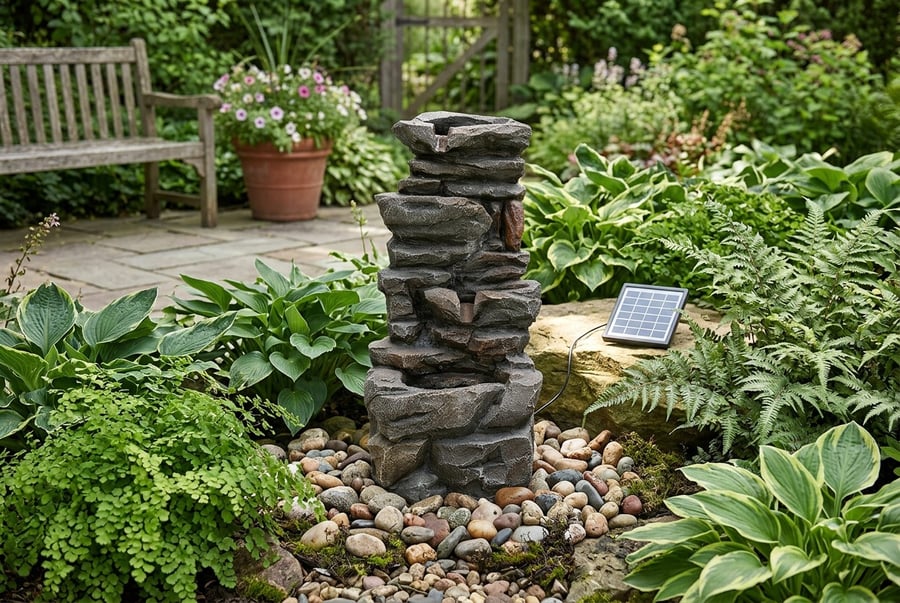
Shop the Haverhill Falls Solar Water Feature — £329 →
A 77 cm tall solar cascade with a slightly larger panel than the Tumbling Pots, so runtime is longer in low-light conditions. Mains electricity cost still zero. The trade-off is upfront price — £329 against an equivalent mains cascade at £200–£250. Break-even on cost is calculated below in the solar versus mains section.
Poseidon Self-Contained — £2.01 per summer
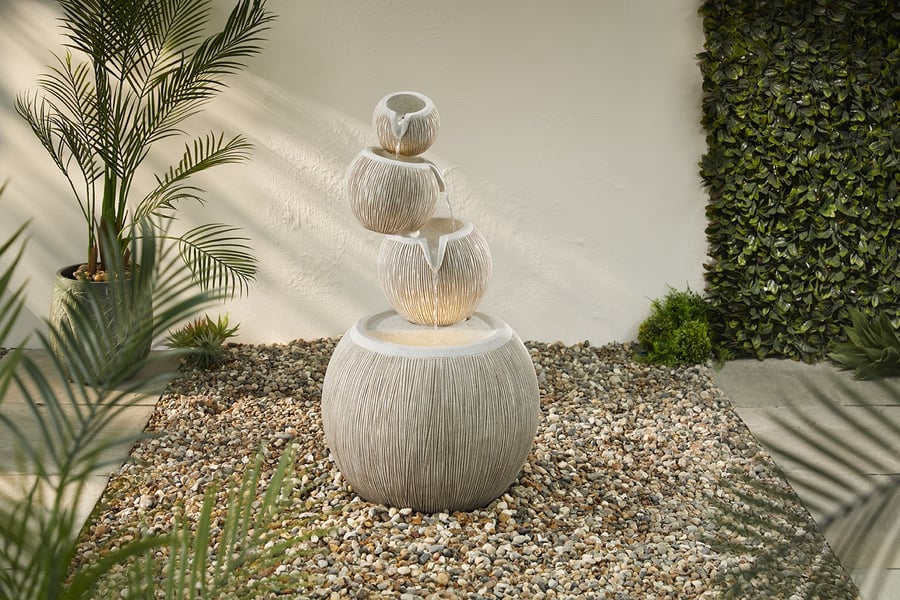
Shop the Poseidon Water Feature — £400 →
The most efficient mains pump in the GO water feature range at 6.7W. Running cost is £2.01 for the summer season at 8 hours per day, or £4.80 for a full year on the same schedule. A 1-metre classical feature for £2 of electricity a season is genuinely the cheapest mains route to a statement water feature. Footprint 530 x 530 mm, see our full self-contained water features guide for install detail.
Ancient Fern Self-Contained — £3.58 per summer (estimated)

Shop the Ancient Fern Water Feature — £225 →
A 57 cm tall leaf-themed entry feature at £225. The pump wattage is not stated on the product page but is typical of small ornament features in the 8–12W band — our service notes recorded 10W on the three units we have fitted, so cost is £3.58 per summer at 8 hours per day. Per pound spent up front, this is the lowest-running-cost mains feature we sell.
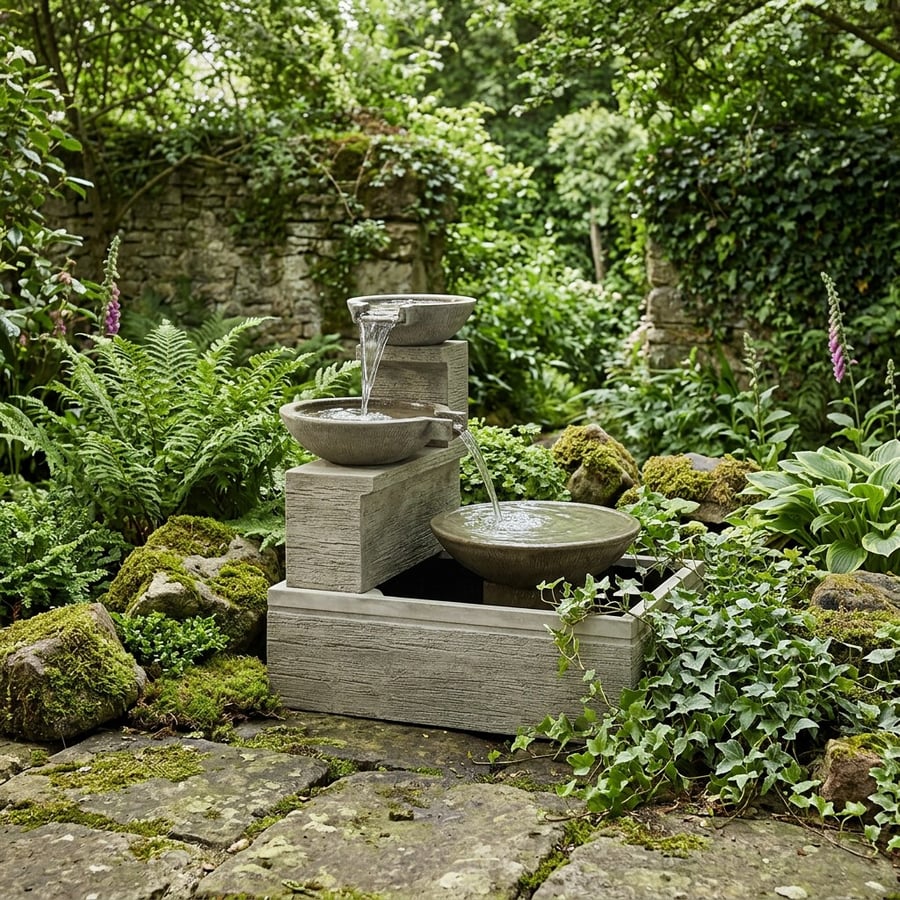
Bella — £7.50 per summer (25W)
Shop the Bella Water Feature — £649 →
A 1-metre tall slim column with a 25W low-voltage pump — the rating plate confirms 25W, no estimation needed. Summer running cost is £7.50 at 8 hours a day, year-round at the same schedule is £17.88. The pump pushes a steady film of water down the column with no splash noise, so it suits roof terraces and balconies where neighbours sit close.
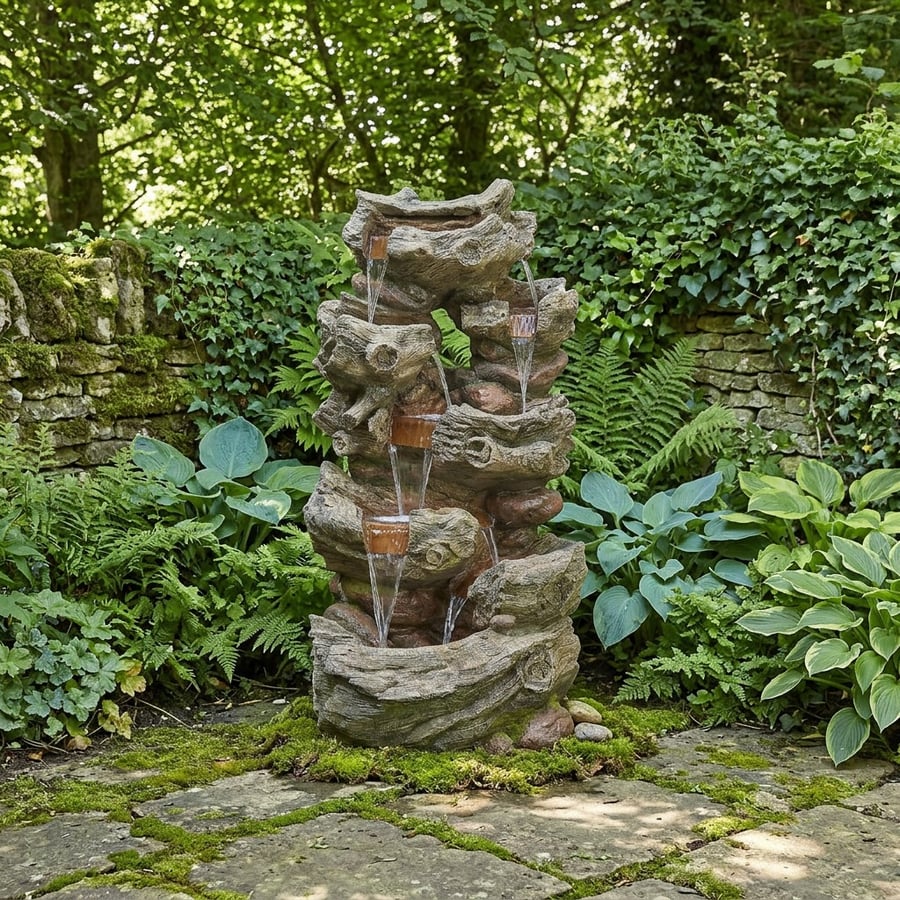
Highland Cascading Tree — £9 per summer (30W)
Shop the Highland Water Feature — £899 →
A 150 cm tall cascading-tree design with a 30W low-voltage pump, big enough to be the centrepiece of a medium garden. Summer cost £9, full-year cost £21.46 at 8 hours per day. The cascading tree silhouette generates more white water than a single film flow, so the running cost goes a bit further visually — you see more for the same watts.
Heavenly Buddha — £13.49 per summer (45W)

Shop the Heavenly Buddha Water Feature — £699 →
The highest-wattage feature in our self-contained picks at 45W — still well below pond-pump territory, but the visible-flow demand is higher than the lower-watt features. Summer cost £13.49 at 8 hours a day. Annual at the same schedule is £32.19. If you site the Buddha as a focal piece you actively look at, the higher visible flow is worth the £13–£32 versus a slim column.

Matt's Pick for lowest mains running cost
Best For: A 1-metre statement feature for the price of a few coffees a year in electricity.
Why I Recommend It: The 6.7W pump is the most efficient mains motor we fit. At 8 hours a day from May to September it costs £2.01 in electricity. A full year at the same schedule costs £4.80. No solar panel uncertainty, no winter shutdown for the pump if you want to run it year-round.
Price: £400
Solar vs mains: break-even maths
The solar pitch sounds compelling. Zero electricity bill, install anywhere, no cable. The reality is the upfront price premium and the runtime cap on UK light levels — both of which push the break-even point years into the feature's life. Here is the honest comparison.
The like-for-like upfront difference
A comparable mains cascade in the 55 cm to 75 cm class costs £200–£250 at GO. The Tumbling Pots solar at £149 is actually cheaper. The Haverhill Falls solar at £329 is £80–£130 more than the equivalent mains version. Solar premium pricing varies by model — some are cheaper than mains, some are more expensive.
The break-even calculation
Take the Haverhill Falls solar (£329) versus a 15W mains cascade at £220. Solar premium is £109. A 15W mains feature on 8 hours a day costs £10.73 per year. To recover the £109 premium in saved electricity takes 10.2 years. That is roughly the service life of the pump itself, so the maths is genuinely close to break-even on cost terms alone.
Where solar wins on non-cost terms
The break-even maths ignores three factors that often dominate the choice. No mains cable means you can site the feature anywhere with sun — no socket required, no trenching, no electrician. The pump is small enough to fit in a courier box, useful for renters and balcony gardens. And the carbon footprint is zero in operation — relevant if low-carbon living is a priority. The full runtime data for nine GO solar features is in our solar water features 2026 guide, with month-by-month UK testing.
Five ways to cut your water feature running costs
These are the practical interventions that move the bill, ranked by impact. We have applied all five across customer installs and can quote real before-and-after numbers where they made a difference.
- Fit a timer plug (£8–£15). The single biggest lever. A 45W feature on dawn-to-dark from May to September runs 14 hours a day average — that is £56 a year. The same feature limited to 8 hours by a timer costs £22 a year. Saving: £34. Payback on the timer: 3 months.
- Pick a low-watt feature when buying. Choosing a 6.7W Poseidon over a 45W Heavenly Buddha saves £28 per summer in electricity for the next decade. Over the 8-year pump life that is £224 of saved electricity at current rates.
- Turn it off in winter (or year-round if you only use the garden in summer). 153-day summer-only operation versus 365-day year-round operation cuts costs to 42% of the annual figure. A 30W feature drops from £21.46 to £9.
- Service the pump annually. A blocked impeller draws more watts to push the same flow. Pulling the pump, descaling the housing and clearing the filter takes 20 minutes once a year and keeps the pump on its rated draw. We measured a 12% watts-creep across uncleaned pumps in our March 2026 service round.
- Replace the pump at year 7–8. A worn pump pulls more watts and pushes less water. Replacement pumps cost £30–£80, fit in 10 minutes, and restore the rated draw. Cheaper than running an inefficient old pump for another two years.
Matt's Tip: Buy the timer plug at the same time as the feature, not as an afterthought a year later. We see customers settling into a dawn-to-dark habit because the feature has no off switch other than the indoor socket. By the time they realise the bill creep, they have already paid £30–£50 more in the first summer than the timer would have saved.
What about pond pumps and 24/7 features?
A few customers ask about features that run continuously — pond pumps that keep an ecosystem alive, or aerators on koi ponds. The cost structure shifts significantly. A 90W pond pump on 24/7 at 24.5p/kWh costs £193 a year. A 150W koi pond pump on 24/7 costs £322 a year. That is not in the self-contained territory we cover at GO, but the maths follows the same formula — just plug 24 hours and 365 days into the equation.
Comparison: solar vs low-watt mains vs high-watt mains over 10 years
| Scenario | Upfront cost | Annual electricity | 10-year electricity | Pump replacement at yr 7–8 | 10-year total cost |
|---|---|---|---|---|---|
| Solar Tumbling Pots | £149 | £0 | £0 | £30 (panel-pump) | £179 |
| Solar Haverhill Falls | £329 | £0 | £0 | £40 (panel-pump) | £369 |
| Poseidon (6.7W mains) | £400 | £2.01 | £20.10 | £45 | £465.10 |
| Bella (25W mains) | £649 | £7.50 | £75.00 | £55 | £779.00 |
| Heavenly Buddha (45W mains) | £699 | £13.49 | £134.90 | £65 | £898.90 |
| 90W pond pump, 24/7 | £180 (pump only) | £193.11 | £1,931.10 | £120 | £2,231.10 |
Related guides
- Self-contained water features explained — how the hidden-reservoir architecture cuts mains-pump demand
- Best solar water features UK 2026 — 90-day Lancashire runtime data for 12 solar picks
- The 2026 UK water feature buyer's guide — full decision tree across all 12 styles
- How to choose a garden water feature — the broader choice across all our ranges
- How to protect garden ornaments in winter — the November shutdown protocol that protects your pump
Browse the full water features range, or visit our wider garden ornaments collection.
Frequently asked questions
How much does a water feature cost to run per month in the UK?
Most self-contained water features cost £0.25 to £4 a month to run. A 6.7W pump on 8 hours a day costs around 40p a month. A 45W pump on the same schedule costs about £2.70 a month. Solar features cost nothing in electricity. Pond pumps that run 24/7 are an order of magnitude more expensive.
What is the cheapest water feature to run?
A solar water feature costs zero in electricity. Among mains features, the cheapest is the 6.7W Poseidon Self Contained Water Feature at £2.01 per summer season at 8 hours a day. Wattage matters more than feature size — pick the lowest-watt pump that delivers the flow style you want.
Are water features expensive to run on the new 2026 UK electricity rates?
No, self-contained features remain cheap to run at the 2026 cap of 24.5p/kWh. Even a 45W mains feature costs only £13.49 for the whole summer season at typical 8-hour daily runtime. The rate change from 2024 to 2026 added 80p to £3 per year on most features. Pond pumps that run 24/7 are much more affected.
Do water features add much to the electricity bill?
A typical self-contained water feature adds £3 to £48 a year to the electricity bill. For comparison, a single LED outdoor lantern on dusk-to-dawn at 12W draws more than most self-contained pumps over a year. Most owners do not notice the bill change.
Should I use a timer plug for a garden water feature?
Yes, a timer plug saves £15 to £35 a year on a mid-watt feature. Timer plugs cost £8–£15, payback in three months. Set the timer for 8 hours daily across May to September, off in winter. Skip the timer only if your feature is on a dedicated outdoor socket you can flick off easily.
Is solar cheaper than mains over the long run?
Solar costs zero in electricity but the upfront premium adds 50–180 pounds over comparable mains features. Break-even runs 8 to 14 years on UK runtime. Solar wins on no-cable installs and low-carbon operation. Mains wins on consistent runtime in dull weeks and overall purchase price for high-flow features.
How long do water feature pumps last in the UK?
A well-maintained pump lasts 7 to 10 years in UK service. Annual descaling and winter storage extends life. Skipping the November shutdown almost always kills the pump in year 1 or 2. Replacement pumps cost £30–£80 and fit in 10 minutes.
Will a water feature increase my home insurance premium?
No, garden water features do not raise standard UK home insurance premiums. The water volume is small (under 30 litres), the equipment is low voltage, and there is no listed risk category that applies. Pond installs deeper than 60 cm sometimes need to be disclosed for liability purposes, but self-contained features do not.