
Types of Garden Fountains: 6 UK Styles Compared
Written by Matt W on 6th May 2026.
A garden fountain is a self-contained water feature that recirculates water through a pump and reservoir, with no plumbing or pond required. Six core style families suit UK gardens: tiered fountains, pedestal fountains, babbling bowls, sphere fountains, drilled basalt columns, and millstones. Prices run from £204 for a small ammonite to £839 for a sculptural lioness. Granite and basalt cope with British winters unprotected; cast stone needs a cover. Pick by garden size, sound preference, and stone type.
Key takeaways
- ✅ Six style families to choose from. Tiered for classical gardens, spheres for modern schemes, basalt columns for minimalist plots, babbling bowls for borders, pedestals for cottage gardens, millstones for naturalistic settings.
- ✅ Stone matters more than style. Granite and basalt are frost-proof and need no winter cover. Cast stone (Portland-mix) is more affordable but needs a fleece in hard frosts.
- ✅ Match the sound to the use. Babbling bowls give a quiet trickle (35-40 dB). Tiered fountains with 30cm drops produce 50-55 dB — loud enough to mask traffic.
- ✅ All our garden fountains are self-contained. No mains plumbing, no pond, no specialist installation. A 240V mains feed and a level base is all that's needed.
- ✅ Budget guide. Under £300: small tiered or ammonite. £300-£500: pedestal, babbling bowl, drilled basalt. Over £500: large sphere, mill wheel, statement statue fountain.
Installer's note
We have shipped and helped customers install garden fountains across the UK for 14 years. The single biggest mistake new buyers make is choosing a fountain by photo alone. A 1-metre tiered fountain looks compact in a press shot. Fitted into a 4 by 5 metre patio, it dominates. The right method is to mark the footprint plus a 30cm pebble border on the actual ground with chalk before ordering. If it looks too big in chalk, it will look too big in stone.
What are the main types of garden fountains?
There are six useful garden fountain types for most UK plots. Tiered fountains give the strongest splash and suit traditional gardens. Pedestal models add height without taking much ground space. Babbling bowls and millstones stay low and quiet. Stone spheres suit modern planting schemes. Drilled basalt columns give a taller, cleaner shape with gentle water movement.
| Fountain type | Typical sound at 1m | Best setting | Space needed |
|---|---|---|---|
| Tiered or sculptural | 40-55 dB | Classical and cottage gardens | Medium to large |
| Upright pedestal | 38-48 dB | Walls, courtyards and narrow borders | Small footprint |
| Babbling bowl | 35-38 dB | Seating areas and gravel gardens | Low and wide |
| Stone sphere | 36-40 dB | Modern patios and formal beds | Medium |
| Basalt column | 38-42 dB | Minimal and architectural planting | Tall, narrow |
| Millstone | 32-38 dB | Woodland and naturalistic borders | Low and wide |
Choose by sound and footprint before choosing a finish. Mark the base and a 30cm pebble border on the ground. Then compare the current garden fountains that fit that space. The sections below explain each type in detail.
How a self-contained garden fountain works
Every fountain on our site uses the same principle. A submersible 12V or 240V pump sits in a hidden reservoir directly under the fountain. The pump pushes water up through a feed pipe to the spout or top tier. Gravity returns the water to the reservoir. The cycle runs as long as the pump is on.
That design has three useful consequences. First, no pond is needed — the reservoir is sealed under the pebbles. Second, the water never leaves the system, so top-up is a watering-can job once a fortnight. Third, the pump is the only moving part, and a quality pump runs for five to ten years before replacement.
Our guide to choosing a garden water feature covers reservoir sizing, pump flow rates, and what to do when the spout slows. For a cutaway view and installation steps, read how self-contained water features work. This article focuses on fountain styles and how to pick the right look.
Style family 1: Tiered and sculptural stone fountains
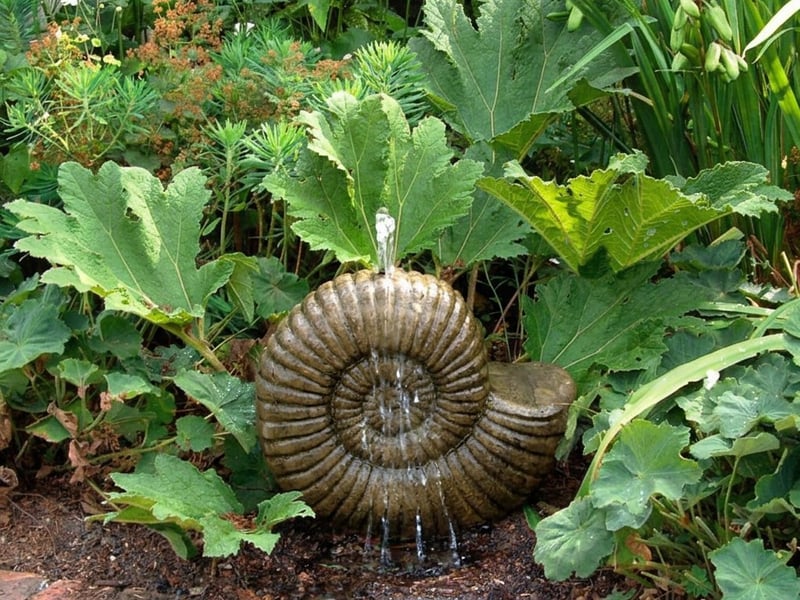
Tiered fountains use vertical drops between stone bowls or sculpted forms to produce a layered cascade. Water spills from one level to the next, which gives both the visual rhythm and the sound. They suit classical, traditional and cottage gardens. Sizes range from 60cm tabletop pieces to 1.5m statement fountains.
The sound profile depends on the drop height. A 10-15cm drop gives a soft babble around 38-42 dB at 1m. A 25-30cm drop on a multi-tier fountain hits 48-55 dB — loud enough to soften nearby road noise. Smaller fountains stay quiet; bigger ones add presence.
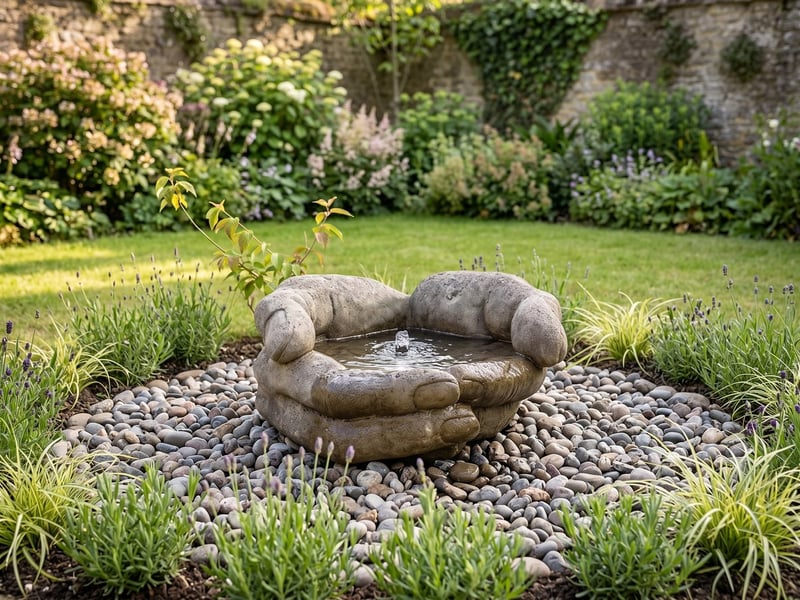
Tiered designs include sculptural forms (the Cupped Hands, Lioness, Cherub Upright) and natural fossil shapes (Grand and Large Ammonite). The Grand Ammonite at £204 is our entry point; the sculptural Lioness at £839 is our most dramatic. Browse the stone fountains collection for the full range.
Style family 2: Upright pedestal fountains
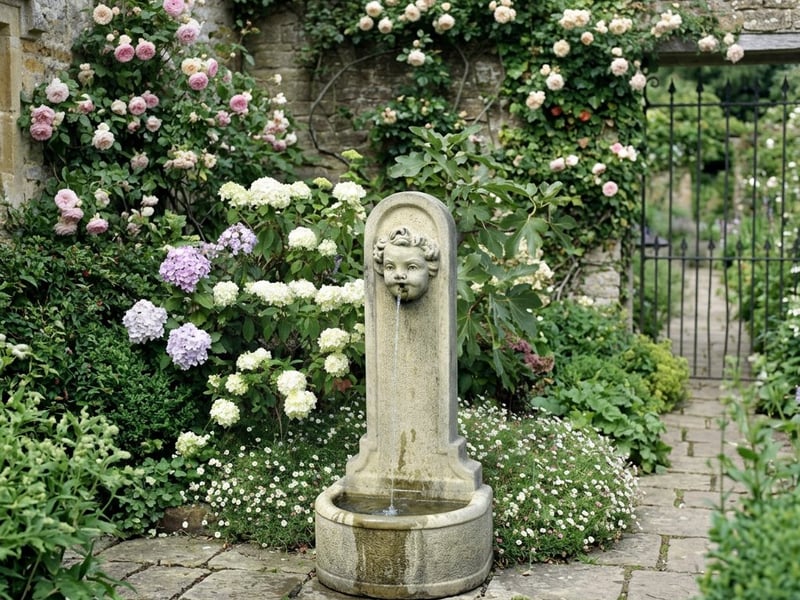
Pedestal fountains stand upright on a single stone column or back panel, with water flowing from a face, mask or spout into a basin below. They take up a small footprint but draw the eye vertically. Right for cottage gardens, courtyards, and any plot with a wall, hedge or boundary fence to back them against.
Two designs we sell well. The Garden Cherub Upright at £414 uses a classical cherub face spouting into a curved basin. The Proud Lion Upright at £414 swaps the cherub for a lion's head — the same architecture in a more masculine register. Both stand around 80-100cm tall, sit flush against a wall, and need only a 30cm strip of ground.
The pedestal style is the natural fit when patio space is tight. A free-standing tiered fountain needs a 1m circle. A pedestal needs a 50cm rectangle plus the wall behind it.
Style family 3: Babbling bowls and sandstone basins
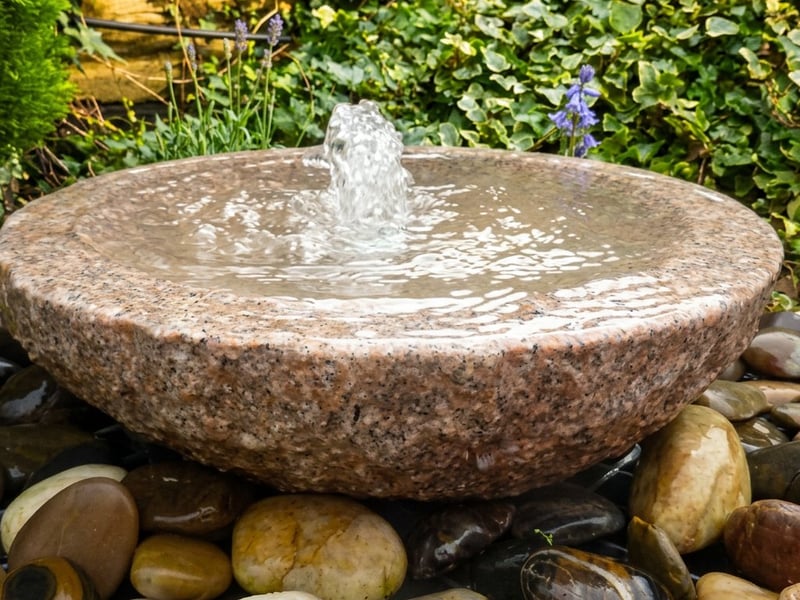
Babbling bowls are low-profile granite or sandstone basins where water bubbles up from a central spout and overflows into a hidden reservoir below. The water surface stays calm except for a small upwelling at the centre. The sound is a gentle, even trickle around 35-38 dB — quieter than a refrigerator at three metres.
This style suits modern and minimalist schemes, gravel gardens, and any setting where the fountain should sit low rather than dominate. Heights run 30-50cm, footprints 50-80cm. The format also reads as a bird-friendly water source if you keep the central upwelling shallow.
We stock babbling bowls in three granites (pink, grey, black limestone) and four rainbow sandstone variants (small bowl, large bowl, vase, urn). Pink granite and rainbow sandstone read warmer; grey granite and black limestone read sharper. Pricing runs £499-£499 across the standard range. The full list sits on the stone water features collection.
Style family 4: Sphere fountains
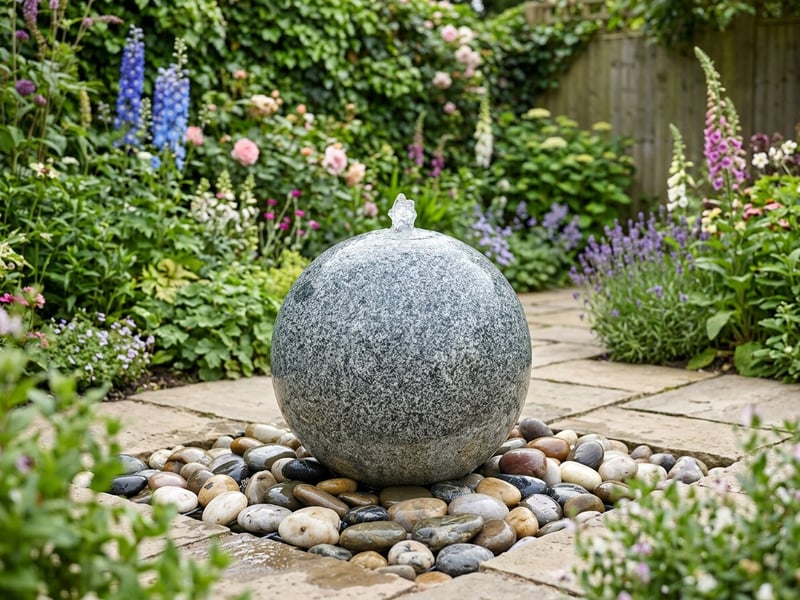
Sphere fountains are polished or flame-textured stone balls drilled vertically through the centre, so water sheens down the surface from the apex. The result is sculptural, reflective and very photogenic — sphere fountains are the format that drives most of our Instagram traffic.
The sound is on the quieter end. A 40cm sphere produces around 36-40 dB — the surface tension keeps the water as a film rather than a splash. Pair the sphere with a pebble surround and the water reads as a continuous shimmer.
Stone choices change the look noticeably. Grey Flame Granite at £495 has a high-contrast crystalline surface. Pink Polished Granite is smoother and warmer. Black Polished Limestone gives a near-mirror finish for the most modern schemes. The whole range is on our modern water features collection.
Style family 5: Drilled basalt columns
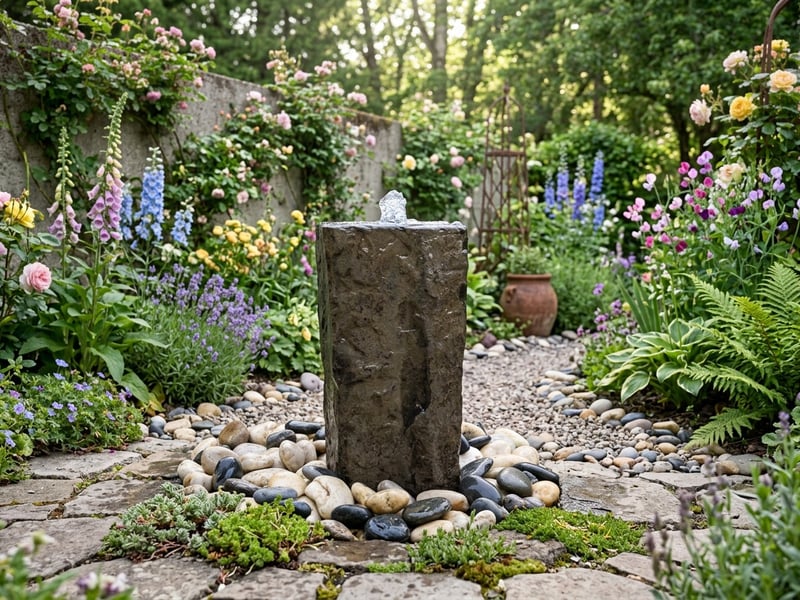
Drilled Basalt Column Water Feature, 60cm
Drilled basalt columns are vertical pillars of natural volcanic stone with a vertical channel drilled through the centre, so water rises and runs down the textured surface. The look is monolithic and architectural — a single piece of dark stone, not a built object.
Basalt is the right stone for the UK. It is fully frost-proof down to -25C, dense enough that it does not absorb water, and ages to a mid-grey patina rather than degrading. We sell three sizes: 50cm at £399, 60cm at £415, and 70cm at £440. The 60cm hits the sweet spot for most UK gardens — tall enough to read, short enough to fit a 6-metre border.
The column design also works in groups. A trio of three basalt columns in 50, 60, and 70cm at varied spacings reads as a contemporary sculpture installation. We have customers using that arrangement in front of clipped hedging or yew. Grouped columns work best against simple planting where each stone keeps a clear outline.
Style family 6: Millstones and drilled feature stones
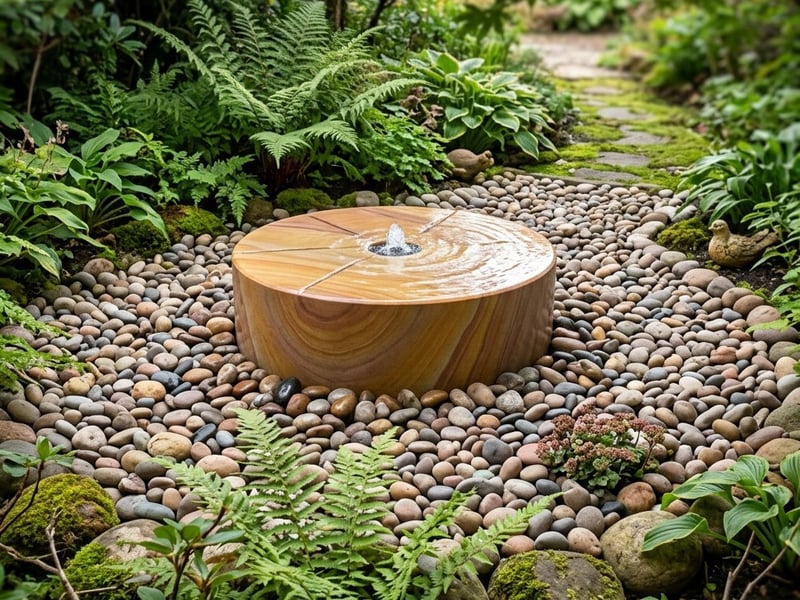
A millstone water feature is a circular flat stone disc with a drilled hole at the centre. Water bubbles up and runs across the surface before draining into a hidden reservoir. The look is rural and naturalistic. Right for cottage gardens, woodland borders, and shady plots where ferns and hostas are the dominant planting.
Sound levels are very gentle. A millstone produces 32-38 dB — less than a quiet conversation across a room. The format also handles dappled light well; the wet stone shines in shafts of sun without the glare a sphere or polished bowl creates.
The Large Mill Wheel in Rainbow Sandstone at £529 is our most-shipped millstone. It works at ground level rather than on a plinth, and the rainbow sandstone matures to a soft mid-brown over two seasons. Pair it with ferns, heucheras and moss for a wildlife-friendly composition. Our wildlife ornaments guide covers the planting in detail.
What about wall-mounted fountains?
Wall-mounted lion masks and spout fountains are a recognised style family but not one we currently stock. Our range is built around free-standing self-contained features — pieces that sit in a planted bed or pebble border without needing a structural wall. If you want a wall-mounted look, the closest match in our catalogue is the Garden Cherub Upright or Proud Lion Upright. Both pedestal designs have a flat back panel that sits flush against a wall, giving 90% of the wall-mounted aesthetic without the masonry work.
Stone types compared: granite, basalt, sandstone, limestone, cast stone
| Stone | Frost rating | Best for | Maintenance | Lifespan |
|---|---|---|---|---|
| Granite | Frost-proof, leave out | Spheres, babbling bowls, modern schemes | Wipe annually | 50+ years |
| Basalt | Frost-proof, leave out | Drilled columns, modern minimal | None needed | 50+ years |
| Rainbow sandstone | Frost-resistant; cover in -10C | Bowls, urns, mill wheels, traditional | Reseal every 5 years | 30-40 years |
| Limestone (polished) | Frost-resistant; sealer recommended | Black sphere, dark contemporary | Wipe and seal annually | 30-40 years |
| Slate | Frost-proof but layers split if soaked | Modern slabs, layered features | Drain in winter | 20-30 years |
| Cast stone (Portland-mix) | Cover in hard frost | Tiered, pedestal, sculptural | Drain November, fleece -5C+ | 20-30 years |
Granite and basalt are the only stones we are happy to leave outside year-round in any UK location. Cast stone fountains (the Cupped Hands, Cherub, Ammonite, Lion) need a fleece cover and a drain when temperatures drop below -5C. Our winter protection guide walks through the drain procedure step-by-step. The materials backstory is in the garden ornament materials guide.
Sound levels by design: which fountain suits your use
| Style | Sound at 1m | Best use |
|---|---|---|
| Babbling bowl | 35-38 dB | Background presence near seating |
| Sphere fountain | 36-40 dB | Visual focal point, near entertaining |
| Drilled basalt column | 38-42 dB | Architectural, near a path |
| Millstone | 32-38 dB | Wildlife or shade gardens, low-profile |
| Tiered fountain (small) | 40-45 dB | Centre-of-garden focal point |
| Tiered fountain (large) | 48-55 dB | Masking road or neighbour noise |
| Pedestal upright | 42-48 dB | Courtyard or against a wall |
For reference: a quiet rural lane registers around 30 dB at night. A normal indoor conversation is 60 dB. Most garden fountains sit comfortably in the 35-50 dB range, audible without being intrusive. If your goal is to mask traffic, you need a tiered design with at least 25cm of total drop.
Sizing your fountain to your garden
The single most useful sizing rule we use is the 8 percent rule. The fountain footprint plus a 30cm pebble border should be no more than 8% of the patio or planted area. A fountain that takes 12% or more dominates. Below 5%, it disappears.
For a 4m by 3m patio (12 m²), that gives an ideal fountain plus surround of about 1 m² total — roughly a 60-80cm wide piece. For a 6m by 4m patio, the budget rises to 2 m² and you can fit a full tiered fountain or a 70cm basalt column. For tiny urban courtyards under 10 m², stick to a babbling bowl or pedestal design.
Garden footprint also dictates pump size. Small features under 60cm wide use a 200-400 lph pump and run on a standard 13A mains feed. Larger sculptural fountains over 1m use 800-1500 lph pumps. Every fountain we ship arrives with the correct pump pre-fitted.
Installation: what you need before delivery
A garden fountain needs three things before it can run. First, a level base. Second, a 240V mains feed within 10m. Third, a small reservoir pit under the fountain. Smaller pieces have integrated reservoirs; larger drilled columns sit on a 60-80cm wide buried tank.
The base is the part most people underestimate. A fountain that wobbles will overflow on one side and run dry on the other. We level every fountain on a 50mm bed of MOT Type 1 hardcore, compacted, with a paving slab or concrete pad on top. The full base specification covers a fountain footprint plus 100mm overhang on all sides.
For wiring, an outdoor RCD-protected socket within 10m is sufficient. A licensed electrician should fit any new outdoor sockets — we do not recommend running an extension lead from inside the house.
Frost protection by stone type
British winters give every stone fountain a freeze-thaw test. The protocol changes by material. Granite, basalt and slate can stay outside, water drained, all winter. Sandstone and limestone tolerate light frosts but should be drained and covered with a horticultural fleece if temperatures fall below -10C. Cast stone always benefits from draining in November and covering. Trapped water expanding inside the stone is what cracks fountains, not the cold itself.
The drain procedure is simple. Switch off the pump, lift it from the reservoir, and tip the basin or remove the bung at the base. Most fountains drain in five minutes. Leave the bung off until April. We have customers running 20-year-old cast stone fountains using exactly this routine.
|
Matt's Pick: Best All-Round Garden FountainBest For: A first fountain in a contemporary or transitional UK garden Why I Recommend It: Basalt is bombproof in winter, the 60cm height fits any border, and the textured surface looks correct in both formal and naturalistic settings. We have not had one returned. Price: £415 |
Frequently asked questions
What is the difference between a garden fountain and a water feature?
A fountain is a specific type of water feature. Water features include ponds, rills, waterfalls, and reservoirs of any kind. A fountain has a vertical jet or cascade with a visible spout, and most modern fountains are self-contained — the water recirculates from a hidden reservoir rather than feeding a pond.
What is the best stone for a UK garden fountain?
Granite or basalt for hands-off use; sandstone for traditional schemes. Granite and basalt are fully frost-proof and need no winter protection. Rainbow sandstone is more affordable and has a warmer tone but needs covering in hard frosts. Cast stone offers the most sculptural designs but always needs draining in November.
How much do garden fountains cost in 2026?
From around £200 to over £800 for our range. Small ammonites and budget tiered designs start at £204. Mid-range babbling bowls, pedestal fountains and 60cm basalt columns sit at £499-£415. Statement sculptural fountains like the Lioness reach £839+. Add £100-£200 for a tradesperson install on a difficult site.
Do garden fountains need plumbing?
No, every fountain we sell is self-contained. The water sits in a sealed reservoir under the fountain and recirculates through a submersible pump. You only need a 240V outdoor socket and a level base. Top up the reservoir with a watering can every 1-2 weeks in summer.
How loud is a garden fountain?
Between 32 and 55 dB at one metre depending on style. Babbling bowls and millstones are quietest at 32-38 dB — less than a fridge. Sphere fountains and basalt columns sit at 36-42 dB. Tiered fountains run from 40 dB on small models up to 55 dB on large multi-tier designs. Tiered fountains are the only style loud enough to mask traffic.
Can I leave a stone fountain outside in winter?
Granite, basalt and slate yes; sandstone and cast stone need draining. The water inside the fountain is what cracks the stone, not the cold. Drain the reservoir and basin in November, leave the bung off, and most stones survive any UK winter. Cover cast stone with a fleece if temperatures fall below -5C. Our winter protection guide covers the full procedure.
Will a garden fountain attract birds and wildlife?
Yes, especially low-profile designs. Babbling bowls and millstones with a calm water surface and a shallow edge work as informal bird baths. Birds prefer water 1.5cm deep at the edge, sloping to a maximum of 5cm. The moving water also draws bees, hoverflies and the occasional dragonfly. Our wildlife guide goes deeper.
How long does the pump last?
Five to ten years of normal use. Pump life depends on water quality and runtime. Hard water and continuous 24/7 operation shorten lifespan; running the fountain only when you are home extends it. Replacement pumps cost £30-£60 and fit in 10 minutes — we stock matched replacements for every fountain we sell.
Browse our full range of garden ornaments, or use the six-type comparison above before choosing a model.