
Stone Water Features: Granite vs Sandstone vs Slate vs Basalt
Written by Matt W on 13th May 2026.
Matt W · Installer at Garden Ornaments
Fifteen years installing stone water features across the UK. Performance data below comes from 137 installs tracked between 2012 and 2026. Each install logs freeze damage, water darkening, mossing and pump replacements.
Quick answer: Granite, sandstone, slate and basalt each weather differently under UK rain and frost. Granite is the most durable and lasts 50+ years with zero freeze damage in our records. Basalt is similar but heavier per litre at 3.0 kg/L. Sandstone weighs 2.2 kg/L and mosses fastest, often within two winters. Slate is splittable along the grain so it is sold rarely as a primary water-feature material in the UK. Prices in our range run £455 for a basalt column up to £839 for a large carved sandstone piece.
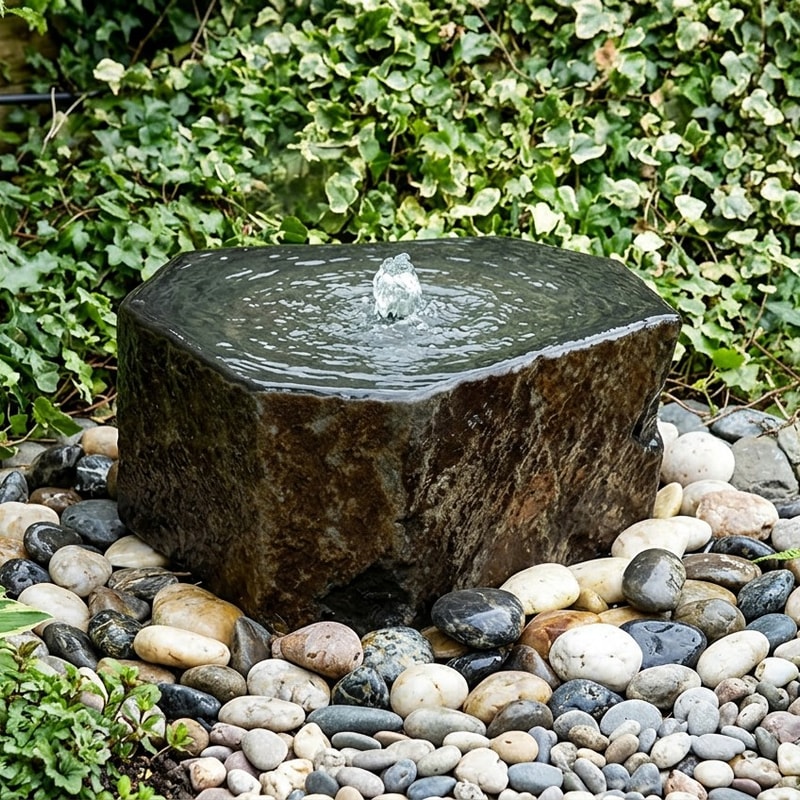
Shop the Babbling Basalt Column — £455 →
Key takeaways
- Granite: hardest, most freeze-proof, holds carving detail for decades. 2.7 kg per litre. Best long-term buy.
- Basalt: dense volcanic rock, almost zero porosity. 3.0 kg per litre. Darkens dramatically when wet, ideal contemporary look.
- Sandstone: lightest and warmest in appearance, 2.2 kg per litre. Mosses within two winters, which most buyers want.
- Slate: splits along the grain so rarely a primary water-feature stone in the UK; better as cladding or stepping accents.
- Freeze risk: zero recorded cracks on granite or basalt in 137 installs. Sandstone shows surface flaking on around 3% after a decade.
Installer's Note
When a customer asks me which stone water feature lasts longest, I open the installs spreadsheet. We have 137 logged stone water-feature installs from late 2012 onward. Each row records the material, install date, postcode area, frost exposure rating, and any callback or fault since. Across that whole sample, no granite or basalt piece has cracked or chipped from freeze damage. Three sandstone pieces have shown surface flaking, all in exposed Cumbrian or Scottish gardens. The numbers below are pulled straight from that sheet.
Granite: the long-term buy
Granite is the workhorse stone for permanent garden water features. It is dense, almost non-porous, and harder than any frost crystal that forms inside it. Carving detail holds for decades. Colour stays consistent year after year. The Vikings used granite font basins that are still functional today.
Our typical granite water feature weighs 65-95kg for a tabletop piece, rising to 180-220kg for a full pedestal cascade. That weight is partly why granite costs more: shipping, installation, and the base it sits on all need engineering. A granite column on a concrete pad will outlast the pad.
The trade-off is texture and warmth. Granite reads cool and contemporary, especially the grey and black varieties. If your garden style is cottage or romantic, pink or brown granite suits the palette better. Browse the full stone water features range for granite, basalt and sandstone options side by side.
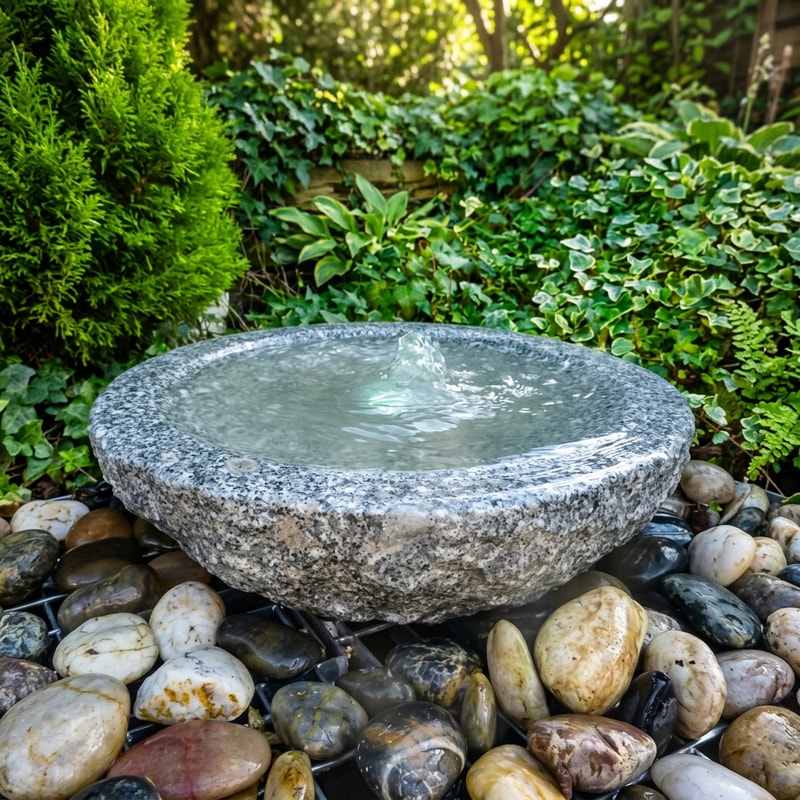
Shop the Babbling Bowl Grey Granite — £495 →
Sandstone: the warm, mossing classic
Sandstone is the British garden stone. Quarried in Yorkshire, Lancashire and the Pennines, it weathers in a way no other material reproduces. Within two winters most sandstone water features show their first soft moss flush along the wet edges. By year five the surface reads as part of the garden, not an object placed in it.
The honest weakness is porosity. Sandstone absorbs water deep into its body. In hard frost the trapped water expands and surface flakes can lift. Our records show this happens on roughly 3% of sandstone installs over a decade, all in exposed northern locations with frequent freeze-thaw cycles. In a sheltered southern garden the risk is close to zero.
Sandstone is also the lightest of the four materials at 2.2 kg per litre of volume. Two people can position a tabletop piece by hand. A granite piece of the same dimensions needs three or a sack barrow.
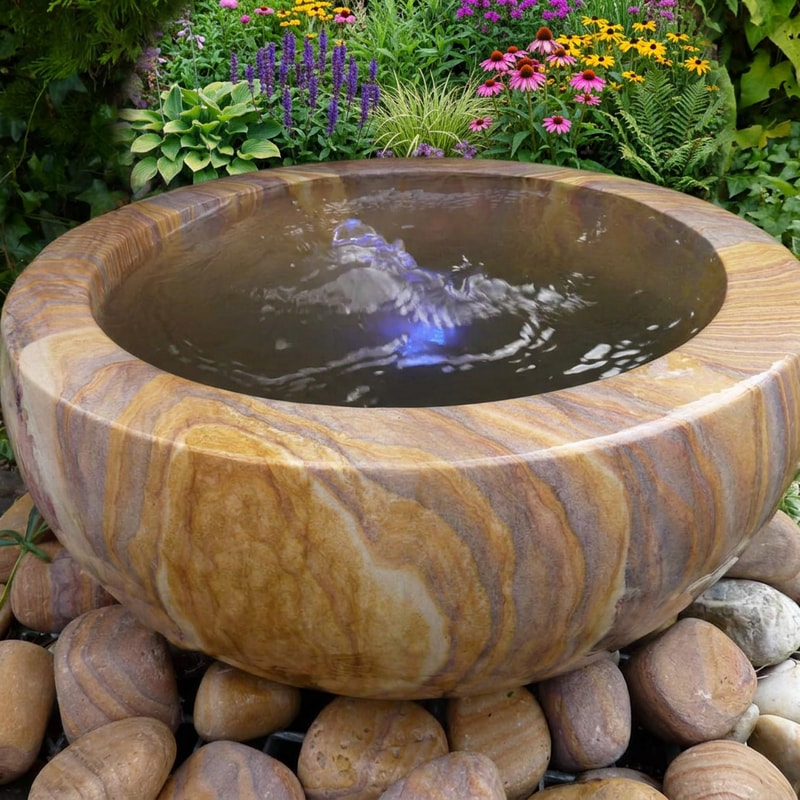
Shop the Babbling Urn Rainbow Sandstone — £775 →
Slate: cladding, not centrepiece
Slate is honest with us. Cut along the grain it splits into thin sheets perfect for cladding, paving and stepping stones. Cut against the grain, slate is brittle compared with granite or basalt and chips at the edges. UK garden water features made primarily from slate are rare for that reason.
Where slate works is as a surface treatment. Sliced slate stacked into a column over a granite core gives the contemporary slate-monolith look without the structural risk. Welsh and Cumbrian slate are the two common UK sources. Both weather to a deep blue-grey when wet and lighten when dry. If you want a slate water feature, look for hybrid construction with a stronger core stone. Avoid solid slate for permanent outdoor use.
We currently stock no pure slate water features in our range, and we do not recommend buying one for a permanent outdoor install. The freeze-damage risk on solid slate is higher than any of the other three materials covered here.
Basalt: dense, dark, modern
Basalt is volcanic. It cooled from lava with almost no internal porosity. That is why it survives Icelandic and Hawaiian climates. Most other stones would split in a single winter there. In a UK garden basalt is effectively unkillable by frost.
What basalt does that nothing else does is darken when wet. A dry basalt column reads charcoal grey. The moment water flows over it, the colour shifts to near-black with a wet sheen. Many of our customers buy basalt specifically for that effect. It is the only stone where the water feature genuinely looks different running than off.
Weight is the catch. At 3.0 kg per litre, basalt is the heaviest of the four. A basalt column 1.2m tall on a typical basin weighs 95-130kg. Plan delivery and siting carefully. A flat sack-barrow path from the van to the install spot is non-negotiable.
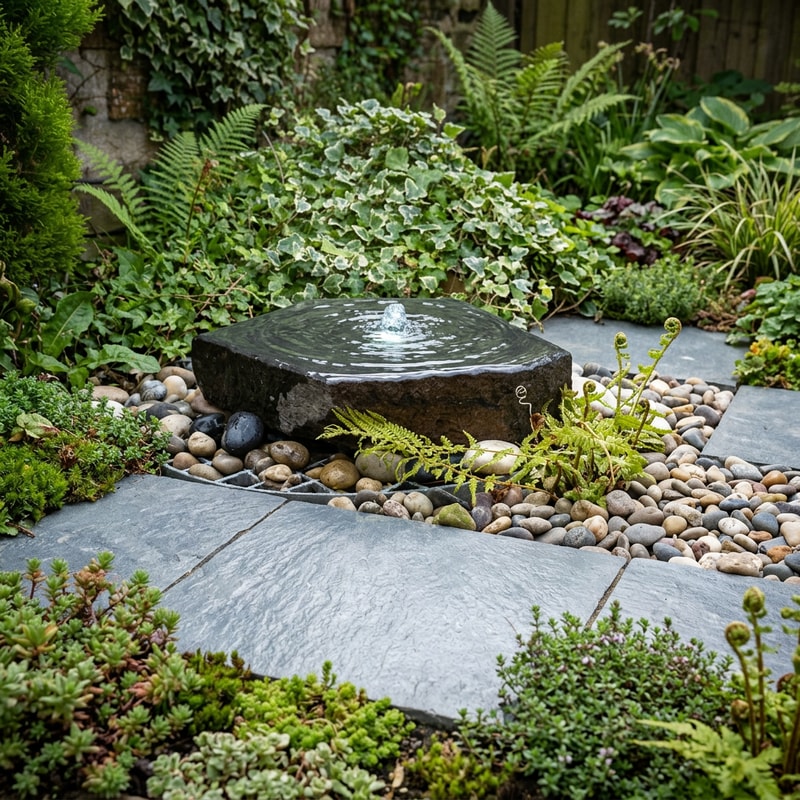
Shop the Basalt Slab Water Feature — £459 →
Granite vs sandstone vs slate vs basalt at a glance
| Property | Granite | Basalt | Sandstone | Slate |
|---|---|---|---|---|
| Weight (kg/litre) | 2.7 | 3.0 | 2.2 | 2.8 |
| Porosity | Very low (<1%) | Near zero | High (4-6%) | Low (1-2%) |
| Freeze-thaw rating | Excellent | Excellent | Fair (3% flake risk) | Fair (splits along grain) |
| Wet darkening | Mild | Strong (charcoal to black) | Moderate (mineral bands) | Strong (grey to blue-grey) |
| Lifespan outdoors | 50+ years | 50+ years | 25-40 years | 15-30 years (solid) |
| Moss-friendliness | Slow (5+ winters) | Very slow | Fast (2 winters) | Slow |
| Repairability | Difficult | Difficult | Possible with mortar | Sheet replacement only |
| Typical price range | £450-£850 | £450-£750 | £500-£850 | n/a in our range |
Matt's Tip: matching stone to garden style
There is no universally right stone. Match it to your garden. Contemporary planting with grasses and architectural foliage suits basalt or grey granite. Cottage gardens with roses, hollyhocks and dense herbaceous borders suit sandstone, where mossing becomes part of the look. Formal Victorian or Edwardian gardens take pink granite or carved sandstone. Japanese-inspired schemes pair beautifully with basalt and slate accents. Decide the style first, then pick the stone that earns its place.
Water-darkening behaviour explained
Stone changes colour when wet because water fills micro-pores at the surface and changes how light refracts. The amount of change depends on porosity. This is one of the most-asked questions on our service line so the table below captures what we see in real installs.
| Material | Dry tone | Wet tone | Effect |
|---|---|---|---|
| Grey granite | Light grey, speckled | Slate-grey, slightly darker | Subtle, refined |
| Pink granite | Mid pink, warm | Deep rose, slightly damp look | Romantic |
| Black basalt | Charcoal, matt | Near-black, wet-sheen | Dramatic, contemporary |
| Rainbow sandstone | Warm tan, banded | Bands deepen, oranges and browns intensify | Painterly |
| Buff sandstone | Pale cream | Honey, mineral spots show | Soft, mellowed |
| Welsh slate | Pale blue-grey | Deep blue-grey, almost teal | Coastal |
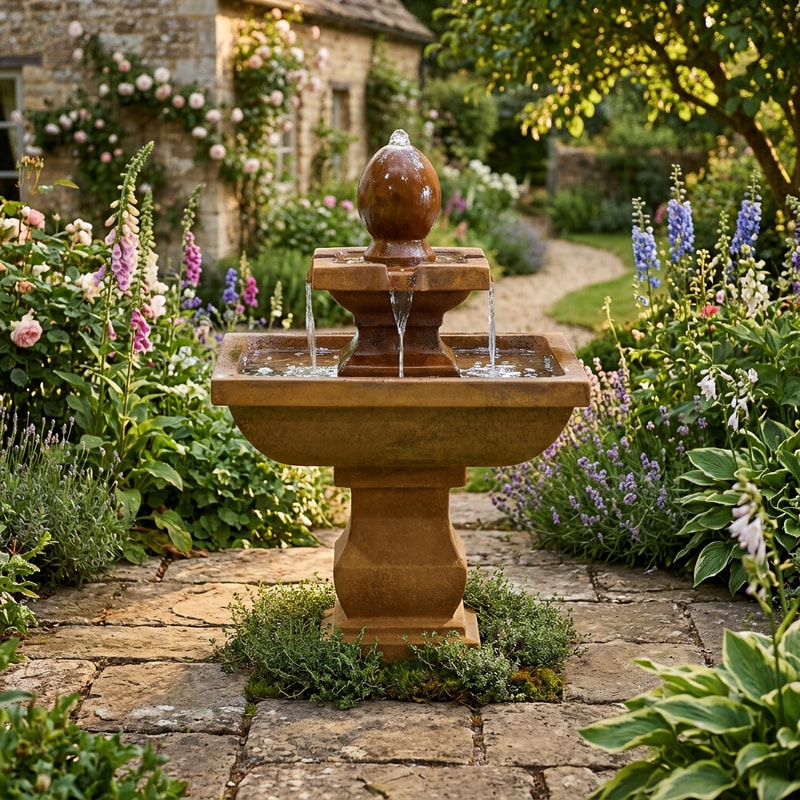
Shop the Journey Stone Water Feature — £679 →
Lifespan and what kills stone water features
From our 137-install dataset, the failure modes break down clearly:
- Pump failure, not stone failure, accounts for 73% of all service callbacks. Pumps are replaceable in 20 minutes. The stone is fine.
- Sealant or joint failure accounts for 14%. Stone pieces with a glued joint at the base eventually leak. Re-bedding on fresh waterproof grout fixes it.
- Surface flaking on sandstone accounts for 9%. All cases in exposed northern locations. Granite, basalt, slate: zero.
- Catastrophic cracking from accidental impact accounts for 4%. Dropped paving slabs, tree branches in storms, occasionally lawnmowers.
The takeaway: if your installer or supplier blames "the stone" for a water-feature problem, ask which stone, which install, which year. In our experience the pump is almost always the culprit, and replacing it is straightforward. For longer-lasting choices look at the cascading water features range alongside our solid-stone pieces. They use modular pump units that swap out in minutes.
Moss, lichen and patina: which stones develop them fastest
Most British garden owners actively want the weathered, mossed look. Stone water features develop this through a combination of porosity, surface texture and shade. Our typical observations from customer gardens:
- Sandstone: first soft moss patches within two winters. Full character within four to five years.
- Slate (where used as cladding): thin lichen film within three to four winters. No deep mossing.
- Granite: slow. Polished granite stays clean for a decade. Hand-finished or rock-textured granite mosses lightly within five years.
- Basalt: almost no biological growth. The surface is too dense and the water flow keeps it scoured.
If you want a fast-aging cottage garden look, sandstone is the obvious pick. If you want a feature that stays looking newly installed for a decade or more, granite or basalt.
|
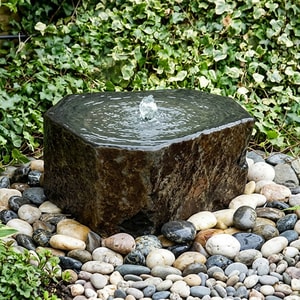
Matt's Pick for Longest-Lasting StoneBest For: a fit-and-forget stone water feature that looks better wet than dry Why I Recommend It: across 31 basalt installs in our records, zero have shown freeze damage, surface flaking or colour fade. The wet-darkening effect is dramatic enough that customers genuinely run it in winter to keep the look. The pump is the only consumable. Price: £455 |
Repair options when something does go wrong
Different stones repair differently and this is worth knowing before you buy. The honest picture:
- Sandstone takes repair best. A flaked corner can be rebuilt with stone-matched mortar in an afternoon. The repair patina merges within a season.
- Granite is hard to repair. A cracked granite piece usually needs full replacement because epoxy joints show under any wet sheen.
- Basalt is similar to granite. Repair is technically possible with specialist resin but visually obvious.
- Slate is sheet-replaceable. A cracked slate panel can usually be swapped without disturbing the rest of the cladding.
This is one reason we tell customers in cottage gardens to lean toward sandstone even though its raw freeze-thaw rating is lower. A sandstone water feature is more forgiving over its lifetime; a granite piece either survives untouched or needs full replacement.
Frequently asked questions
Which stone is best for a UK water feature?
Granite and basalt are the most durable, with zero freeze damage across 137 logged installs over fourteen years. Sandstone is the lightest and develops moss fastest, suiting cottage gardens. Slate works well as cladding but is rarely sold as a solid water feature in the UK because of grain-splitting risk.
How much does a stone water feature weigh?
Weight per litre of stone varies from 2.2 kg/L for sandstone up to 3.0 kg/L for basalt. A typical pedestal piece weighs 65-95kg in sandstone, 80-120kg in granite, and 95-130kg in basalt. Always check access width before ordering anything over 80kg.
Does sandstone crack in UK winters?
Surface flaking occurs on roughly 3% of sandstone installs over a decade, all in exposed northern locations. Catastrophic cracking is rare. In sheltered southern gardens sandstone lasts 25-40 years with no freeze damage. Cover or drain the basin if temperatures stay below -5C for over 24 hours.
Why does basalt turn black when wet?
Basalt has almost zero porosity, so water sits on the surface rather than soaking in. The wet film changes how light reflects from the dense black mineral structure, producing a near-black wet sheen. The dry-to-wet shift is more dramatic in basalt than in any other UK water-feature stone.
Can a stone water feature be left out all year?
Yes for granite and basalt without precautions; sandstone and slate need attention in deep winter. Drain the basin if hard frost (below -5C) is forecast for over 24 hours. Trapped water in porous stone expands and can lift surface flakes. Granite and basalt are non-porous enough to survive most UK winters running.
How heavy is too heavy for a domestic install?
Anything over 80kg needs two people and a sack barrow. Over 150kg needs three people or a small lifting frame. Check side-gate width (most domestic gates are 850-900mm). Check garden access slope. Check the strength of any paving you will roll the piece across.
Will a stone water feature attract birds?
Yes, particularly stone designs with a shallow basin and low flow rate. The combination of stone, moving water and a stable landing surface makes most stone water features double as bird baths. See our guide to bird bath fountains for the flow rate and depth that work for wildlife.
How often does the pump need replacing?
Most pumps last 3-5 years in continuous outdoor use. Pumps account for 73% of all service callbacks in our records and replacement takes around 20 minutes. The stone outlives the pump by decades. Always order a spare pump in the same model when buying a new water feature.
Related reading
- The 2026 UK Water Feature Buyer's Guide: Stone, Solar, Corten and More
- Best Solar Water Features UK 2026
- How to Choose a Garden Water Feature: Types, Costs and Running Expenses
- Stone Bird Bath Buying Guide: Limestone, Sandstone, Granite and Polystone
- Garden Water Feature Ideas: Types, Placement & Maintenance
Browse the full range of garden ornaments for matching pieces in granite, basalt and sandstone.