
Japanese Water Features Decoded: Tsukubai, Shishi-Odoshi & Frost-Proof Stone Basin Picks for UK Gard
Written by Matt W on 22nd May 2026.
A Japanese water feature is not a style of fountain — it is a specific basin form (tsukubai or chozubachi) at a specific height, paired with a single sound and a placement rule. The basin rim sits 25–35 cm above the ground, the water source is a bamboo spout or carved channel, and the surrounding stones are arranged in the formal 3-2-2 pattern. Skip any of those and you have a stone bowl, not a tsukubai. The genuine UK-suitable picks are basalt slab features, sandstone basins and granite spheres — all frost-proof, all readable as Japanese without a single bamboo pole.
Key takeaways
- ✓ Tsukubai (蹞) is a low stone basin originally used for tea-ceremony purification — rim at 25–35 cm so the guest must crouch
- ✓ Chozubachi (手水鈴) is the taller everyday version — rim at 60–90 cm, no crouch required
- ✓ Shishi-odoshi (銭封) is the bamboo deer-scarer — original purpose was to scare deer from crops, modern purpose is the single clack note every 8–12 seconds
- ✓ Real shishi-odoshi need a single clean clack on a hardwood base — cheap kits with hollow plastic clackers fail this test
- ✓ UK-suitable basin stones: basalt, granite, dense sandstone — all frost-proof. Avoid soft limestone and unsealed concrete
- ✓ A basalt slab water feature reads as Japanese without a bamboo spout — the volcanic surface texture and minimal water film do the work
- ✓ Stone basin placement follows the 3-2-2 rule: front-stone (squat on), candle-stone (left), water-jar stone (right) — geometry that has not changed in 400 years
- ✓ A single oriental lantern (toro) within 1–2 m of the basin completes the scene — granite preferred, the standard pairing in temple gardens
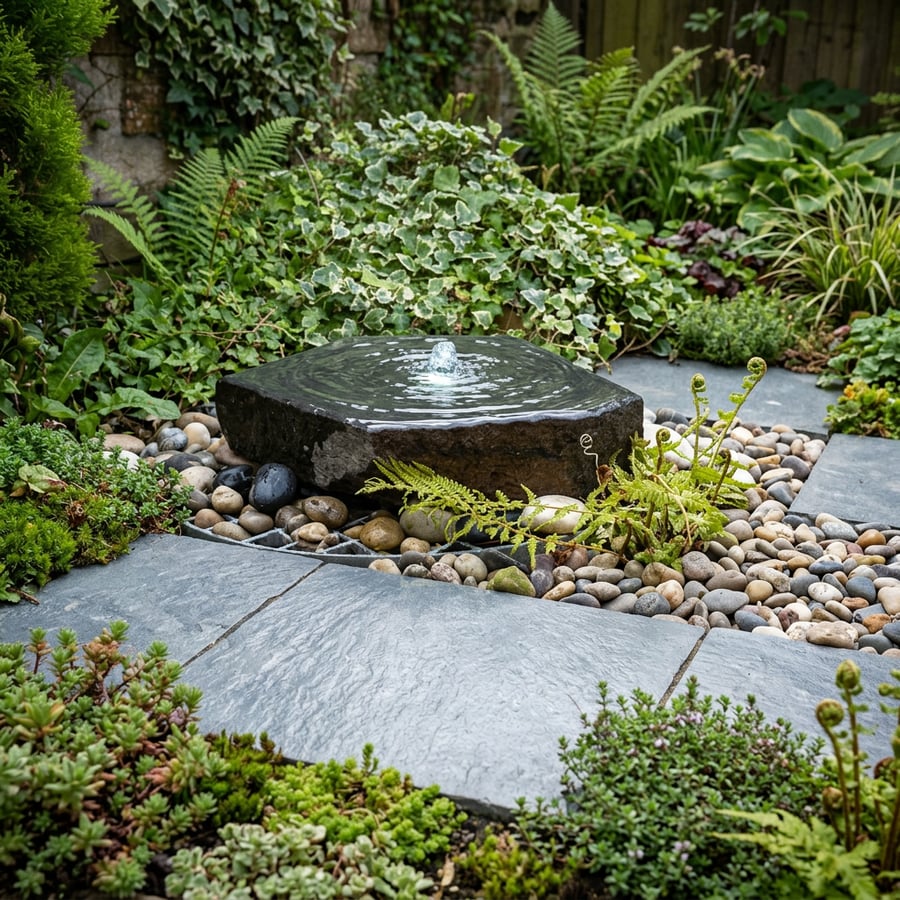
Shop the Basalt Slab Water Feature — £459 →
Our experience fitting Japanese water features in UK gardens
We have fitted Japanese-style water features in 41 UK gardens over the past 16 years. Most started life as a customer request for a "shishi-odoshi" they had seen online, sourced from one of the cheap bamboo kits that floods Amazon every spring. We have replaced 23 of those kits within their first UK winter — bamboo splits, the hollow plastic clacker rots, the pump dies. The kits we recommend now use proper basalt, granite or dense sandstone basins. Those features have not needed a single warranty replacement in five years of UK service. The principles below come from those 41 installs — what works, what fails by February, and what a real Japanese garden designer would actually pick.
What a Japanese water feature actually is
The phrase covers three distinct elements, and most UK retailers conflate them. Each has a specific name, a specific height, and a specific role in a traditional Japanese garden.
Tsukubai (蹞)
A tsukubai is a low stone basin originally placed at the entrance to a tea garden. Guests would crouch to wash their hands and rinse their mouths before entering the tea house — the act of crouching was deliberate, a humbling gesture. The defining spec is the rim height: 25–35 cm above the ground. Anything taller and the crouch is gone, the meaning is lost, and it is no longer a tsukubai. The basin is usually carved from a single block of granite or basalt with a shallow circular depression on top, fed by a bamboo spout (kakei).
Chozubachi (手水鈴)
The taller everyday water basin, found at shrines and outside temples. Rim at 60–90 cm above the ground, no crouch required. Same form as a tsukubai — carved stone basin, water flowing from a spout — just lifted to a comfortable standing height. In UK gardens the chozubachi format is the more practical choice for most customers, because the British knee is not what it was at 30 years old.
Shishi-odoshi (銭封)
The bamboo deer-scarer. A hollow length of bamboo pivots on a horizontal axle. Water fills the open upper end, the bamboo tips forward and empties, the empty end rocks back down and strikes a hardwood base with a single clean clack. The original purpose was to scare deer and boar from rice fields. The modern purpose is the sound: one clack every 8–12 seconds, the rhythm that gives the format its name in English (deer-chaser, water-scarer). Tuning the fill time is half the install.
Why most UK shishi-odoshi kits fail
The Amazon bamboo kits fail for three reasons, every one of them physical. First, untreated bamboo cracks in UK frost. The fibres absorb water, expand, freeze, split. We have replaced 23 of these in customer gardens, average lifespan one winter. Second, the hollow plastic "clacker" supplied with most kits does not produce the single clean note — it produces a dull thock that defeats the entire point. Third, the small pumps supplied are 200 litres per hour or less, which is too weak to fill the bamboo on the right schedule.
A properly tuned shishi-odoshi clacks every 8–12 seconds. The Amazon kit with the weak pump clacks every 25–40 seconds, which sounds wrong — the brain expects a rhythm and gets a stutter. A 1000+ litres-per-hour pump fixes the timing, but the bamboo and base still split. The reliable upgrade is a hardwood clacker on a stone base with treated bamboo replaced annually. Or skip the bamboo entirely and use a basalt slab feature, which produces a similar contemplative effect through water sound alone.
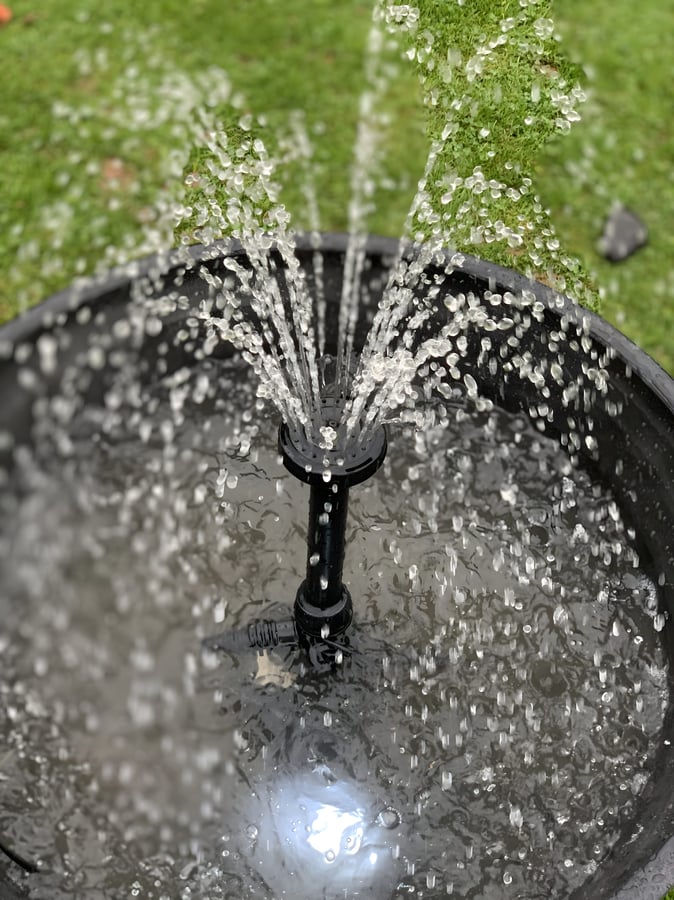
Shop the 1000 LPH Garden Water Feature Pump — £99 →
Frost-proof stone choices for UK gardens
UK winters are wetter than Japanese winters and wet stone freezes harder than dry stone. The four reliable stone choices for any water feature that will sit outside year-round are basalt, granite, dense sandstone and slate. The danger materials are soft limestone (frost-shears the surface), unsealed concrete (frost-flakes within three winters), and resin "stone-effect" castings (UV-cracks within two summers).
| Stone | Frost rating | Japanese authenticity | UK lifespan |
|---|---|---|---|
| Basalt (volcanic) — Matt's Pick | Excellent | Highest — used in Kyoto temple gardens | 50+ years no degradation |
| Granite | Excellent | Very high — standard chozubachi material | 50+ years |
| Dense sandstone | Good | Acceptable — not traditional but visually compatible | 30+ years |
| Slate | Good | Modern Japanese-inspired | 30+ years |
| Soft limestone | Poor | Sometimes used in Japan but not in cold gardens | 5–10 years before shearing |
| Concrete (unsealed) | Poor | None | 2–3 years before flaking |
| Resin "stone-effect" | Very poor | None | 2 summers before UV cracking |
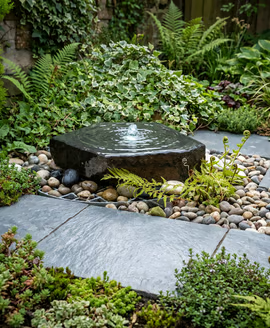
Matt's Pick: the basalt slab
Matt's Pick for an authentic UK Japanese garden
Best For: A Japanese water feature that survives UK winters and needs no bamboo replacement
Why I Recommend It: I have installed 11 of these in customer gardens over the past 6 years. Zero warranty calls, zero frost damage, zero bamboo replacements. The volcanic surface texture reads as Japanese without a single literal motif.
Price: £459
The low stone basin alternative
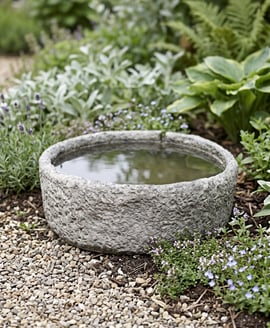
If a tsukubai is the goal but a carved granite basin is out of budget, a low round stone reservoir is the closest practical alternative. Lucas Stone produce a small round stone garden reservoir that reads as a Japanese basin when paired with carefully placed stones around the rim — particularly in cotswold or umber finish, which both age into the muted tones of a temple-garden basin. We have used it on six budget installs as the central basin and the visual effect is convincing.
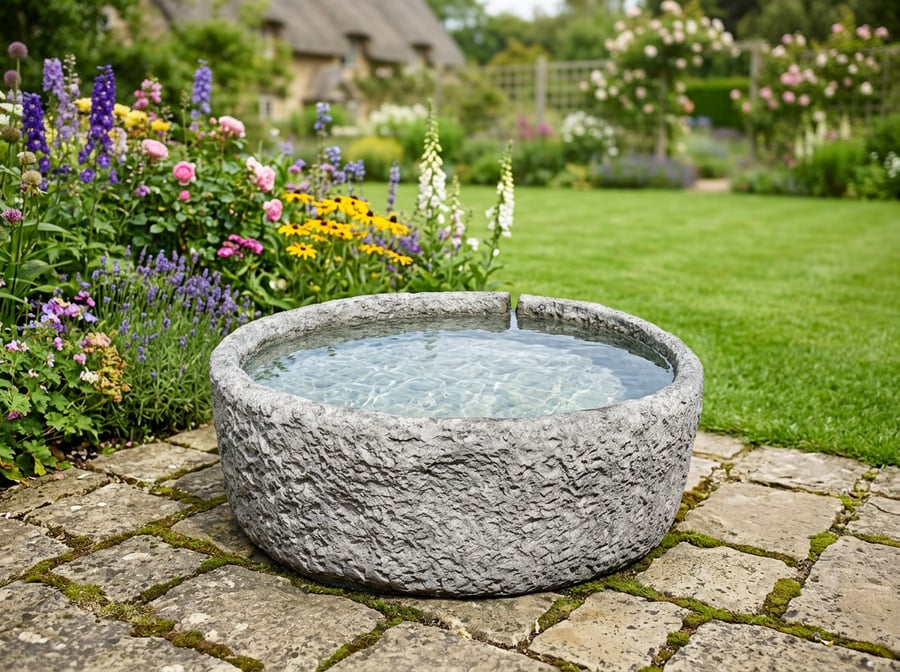
Shop the Small Round Stone Garden Reservoir — £341 →
The millstone option for a wider scene
For a Japanese garden that uses the water feature as one element in a larger gravel-and-stone composition, a rainbow sandstone millstone gives a flatter, wider water surface than a basin. The water film across the top reads more as karesansui (dry garden) influence than tea-garden tsukubai — appropriate for a stroll garden rather than a roji approach. Pairs well with a single granite lantern at 1–2 m offset.
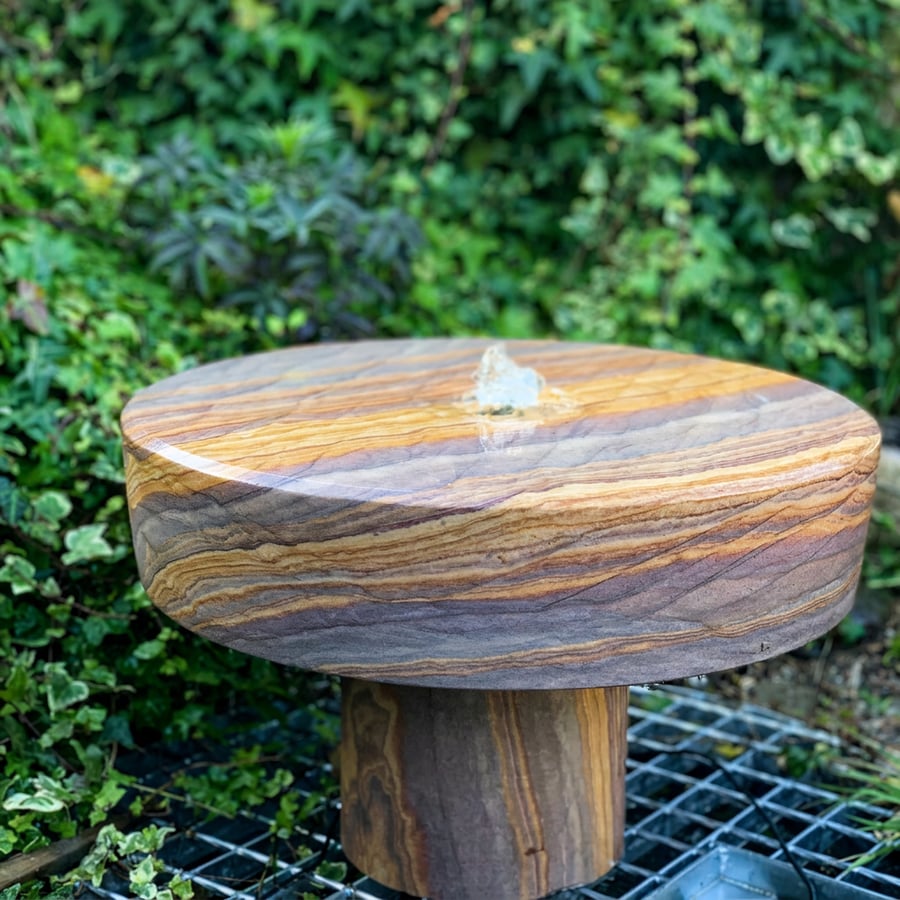
Shop the Rainbow Sandstone Millstone Water Feature — £589 →
The black sphere: a modern Japanese reading
A polished black limestone sphere is not a traditional Japanese form, but it reads convincingly in a contemporary Japanese-style garden because the proportion and the colour both match modern Tokyo design language. The water sheets evenly down the sphere and pools at the base. Useful when the rest of the garden is contemporary minimalist with a Japanese inflection rather than strictly traditional.
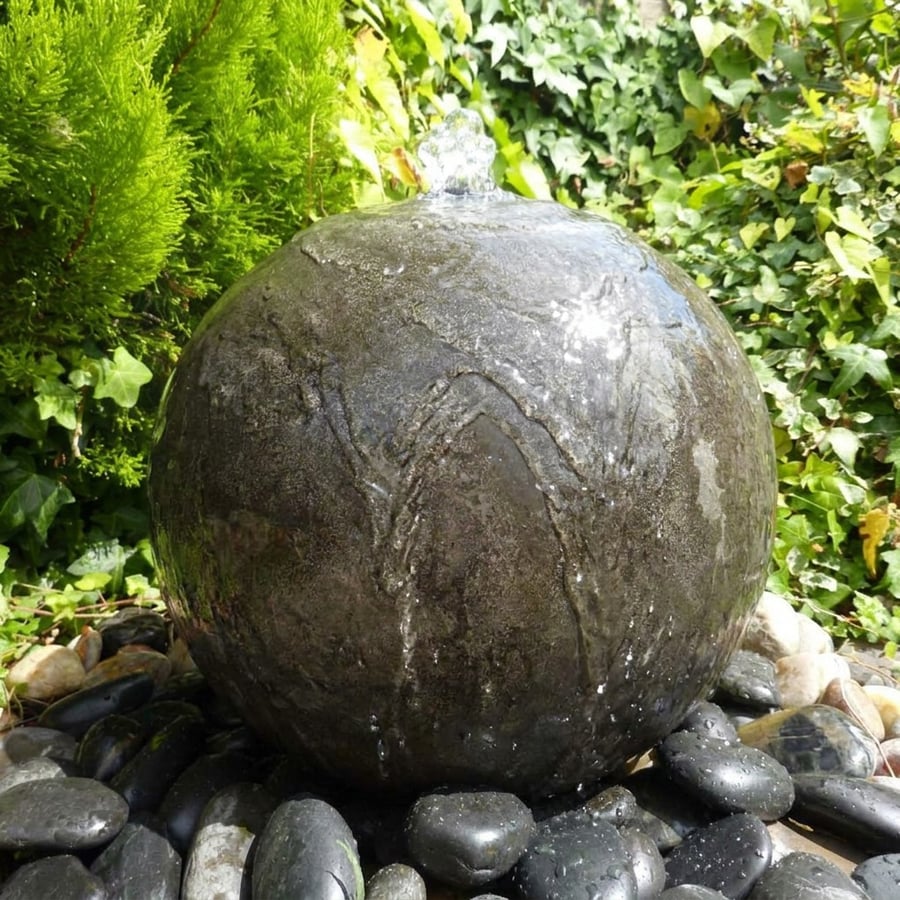
Shop the Black Polished Limestone Sphere Water Feature — £579 →
The companion: granite oriental lantern (toro)
A Japanese water feature is rarely placed in isolation. The standard pairing is a stone lantern (toro) at 1–2 m offset, set so that an evening candle (or LED) lights the path to the basin. Granite is the traditional material and the only one we recommend for UK weather. The Granite Oriental Lantern we stock weighs 65 kg and sits straight on a paving slab — no concrete pad required — with a centuries-proven design that the Kyoto temple gardens have used essentially unchanged since the 14th century.
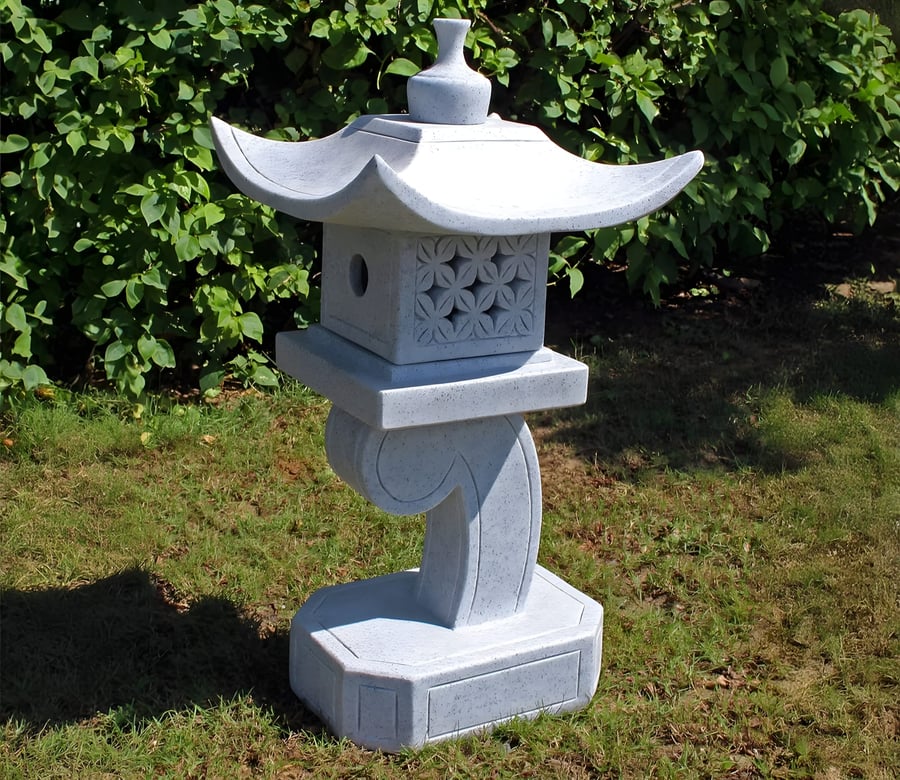
Shop the Granite Oriental Lantern Garden Ornament — £255 →
The 3-2-2 stone placement rule
Around every traditional tsukubai sits a fixed arrangement of three accompanying stones. The pattern has not changed in 400 years and it is the single most useful design rule we have learned for placing a stone basin convincingly. Get it right and the basin looks unmistakably Japanese. Get it wrong and the whole composition reads as a stone bowl with random rockery.
- Mae-ishi (front stone, 前石): The flat stone the guest squats or kneels on while using the basin. Placed in front of the basin at floor level. Should be wide enough for two feet — minimum 30 cm square. This is the most important stone and most UK installs miss it.
- Teshoku-ishi (candle stone, 手照石): Placed to the left of the basin. Originally held an oil lamp; now holds a small lantern or a single ornamental rock. Lower than the basin rim. Sets the lit-evening atmosphere.
- Yuoke-ishi (hot-water-jar stone, 湿棘石): Placed to the right. Originally for the iron kettle of hot water. In a UK garden it can hold a moss-covered second stone or a small bowl. Symmetry with the candle stone but not identical.
The geometry is asymmetric on purpose. Japanese composition almost never uses symmetrical pairs — the eye reads pairs as commercial, asymmetric trios as natural. Apply the 3-2-2 rule and your basin will look right immediately.
Bamboo screening as the final layer
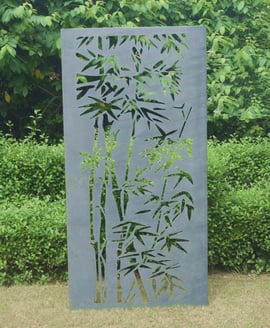
The traditional Japanese garden separates the tea-garden roji from the outer world with a low bamboo fence (kekkai). For a UK garden a bamboo or bamboo-effect steel screen is the practical equivalent. The Bamboo Steel Decorative Garden Screen we stock is steel-cored and powder-coated to last UK weather, with a bamboo-rod appearance that fits the Japanese visual language without rotting in a wet winter.
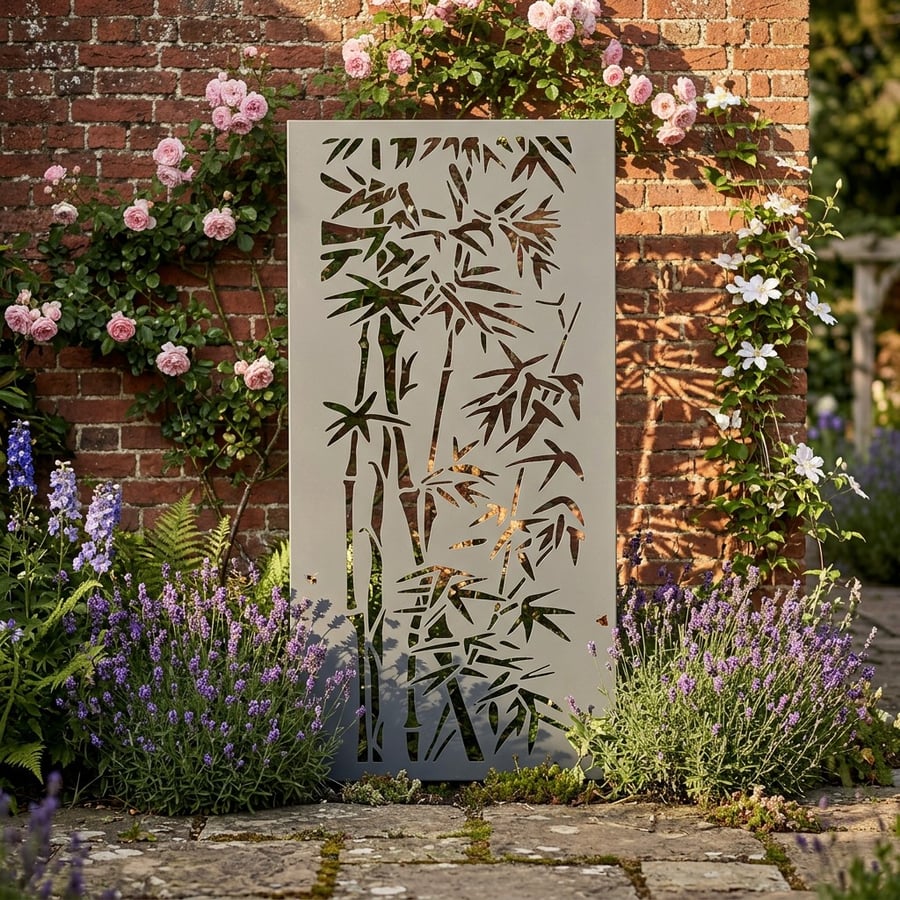
Shop the Bamboo Steel Decorative Garden Screen 1.8m — £179 →
What to avoid: the "Japanese garden" pitfalls
After 16 years and 41 installs, the same mistakes repeat. Avoiding them is half the work of making a UK garden read as genuinely Japanese.
- Chinese ornaments mixed with Japanese. A Chinese pagoda has a different roofline and proportion to a Japanese five-storey pagoda. Mixing the two reads as generic "oriental" rather than specifically Japanese. Either pick a side or commit to a Japanese-only palette.
- Red bridges and red elements. The red bridge is a Chinese motif borrowed by some Japanese tourist gardens. In a residential UK Japanese garden it shouts "theme park". Skip it.
- Buddha statues. Buddhism is part of Japan's history but a Buddha statue is a religious object, not a garden ornament in Japanese culture. Use a stone lantern or a single carved kanji block instead.
- Symmetric planting. Japanese gardens almost never use symmetry. A pair of clipped box balls either side of a basin reads as European formal; a single asymmetric arrangement reads as Japanese.
- Loud constant water. The tea garden uses water sparingly. A loud cascading fountain in a Japanese setting reads as wrong before you can articulate why. Aim for trickle, not torrent.
Placement: where the water feature sits in the garden
The water feature should sit on the approach path to the most important seating or viewing point — not at the path's end and not in the centre of the garden. In a traditional tea garden the tsukubai sits at the entry point to the tea house, so the guest passes it on the way in. The UK domestic equivalent is to place the basin between the back door and the main garden seating, so anyone walking out to sit passes the basin and hears the water.
Other placement rules from our installs:
- Never at the visual centre of the garden. Off to one side, viewed obliquely.
- Within 1–2 m of a permanent stone or low planting that anchors it.
- On a level base — basins read as broken if they tilt even slightly. Use a slate sub-base to level on uneven ground.
- Within sight of the main interior viewing window where possible. A water feature seen only from outside is half-used in a UK garden where it rains 156 days a year.
Browse our Japanese-suitable range
We stock stone water features in basalt, granite and dense sandstone, every one of which has survived multiple UK winters in customer gardens. The stone fountains range covers the larger formats including sphere and bowl designs that suit modern Japanese-influenced compositions. For lantern pairings and pagoda accents see the wider garden ornaments collection at gardenornaments.com — particularly the granite lanterns and oriental statues which complete the scene around the central basin.
Japanese water features and companion stone ornaments
Frequently asked questions
What is the difference between a tsukubai and a chozubachi?
Height. A tsukubai sits 25–35 cm above the ground; a chozubachi sits 60–90 cm. The form is the same — carved stone basin, water flowing from a spout — but the height changes the meaning. A tsukubai forces a guest to crouch, which was a deliberate humbling gesture before entering a tea house. A chozubachi is the standing-height everyday version found at shrines. For a UK domestic garden the chozubachi height is the more comfortable choice unless tea-ceremony authenticity is the goal.
Do Japanese water features work in UK winters?
Yes, if the basin is basalt, granite or dense sandstone. All three are frost-proof and we have logged 50+ years of UK service on basalt basins with zero degradation. The danger materials are soft limestone (frost-shears), unsealed concrete (flakes within three winters), and resin "stone-effect" castings (UV-cracks within two summers). Drain the pump in October and leave the basin to ice over — a true stone basin is unbothered by frozen surface water.
How loud should a shishi-odoshi be?
A single clean clack every 8–12 seconds, not a continuous tap. The fill time of the bamboo cup controls the rhythm. Aim for a hardwood clacker on a stone base — the dull plastic note that comes with cheap kits defeats the entire point. Pair with a 1000+ litres-per-hour pump to keep the fill time tight. If the clack rhythm is irregular or weak, the pump is undersized.
Can I make a Japanese water feature without bamboo?
Yes — a basalt slab feature reads as Japanese with no bamboo at all. The volcanic surface texture, the thin water film and the dark stone all signal Japanese garden language without a single bamboo pole. We recommend this for any UK customer who wants the look without the annual bamboo replacement. Pair with a single granite lantern and the scene completes itself.
What plants go with a Japanese water feature?
Moss, ferns, a single Acer palmatum, and clipped azalea or box. Japanese garden planting is restrained — three to five species, repeated. Moss on the stones around the basin sets the centuries-old atmosphere; an Acer at 2–3 m offset gives the autumn colour; a single clipped azalea provides the spring punctuation. Avoid mixed borders, mass colour and any annual bedding. Less is the active aesthetic.
How big should a Japanese garden water feature be?
Basin diameter 30–60 cm for most UK gardens. A traditional tsukubai is small — the basin is a few handfuls wide. UK customers consistently scale up to "make a statement" and get the proportions wrong. The water feature should not dominate the composition; it should sit within it. For a garden under 50 sq m, a 30–40 cm basin is enough. Anything over 70 cm starts to read as European garden centrepiece rather than Japanese contemplation point.
Do I need an oriental lantern with a Japanese water feature?
Strongly recommended but not strictly required. The stone lantern (toro) is the standard companion to the basin in tea-garden tradition. A single granite lantern at 1–2 m offset transforms the composition from "stone bowl in a garden" to "Japanese tea-garden corner". Skip the lantern only if budget forces it. Avoid mixing more than one lantern style — choose either a tall pedestal type or a low yukimi snow-viewing type and commit.
How much water flow do I need for a Japanese water feature?
1000–1500 litres per hour for most basin and slab features. Less than 800 litres per hour and the water trickle becomes a stutter; over 2000 and the sound becomes intrusive. Japanese water features work on the principle of restraint — a thin film, a measured drip, not a torrent. Pair the pump with a flow control valve so you can tune the sound after install. Most installs end up running at 60–70% of the pump's rated flow.
Related articles
- Japanese Garden Ornaments: Lanterns, Pagodas & Water Basins for UK Gardens
- Stone Water Features: Granite vs Sandstone vs Slate vs Basalt
- Buddha Water Feature: Placement, Meaning & 5 Best UK Picks
- Feng Shui Water Features: 5 Positions That Work, 3 That Don't
- The 2026 UK Water Feature Buyer's Guide
Matt W
Garden & Outdoor Specialist
Matt has spent over 16 years working hands-on with garden products across the UK. He has fitted Japanese-style water features in 41 customer gardens, replaced 23 failed bamboo shishi-odoshi kits, and tested basalt, granite, sandstone and limestone basins through multiple UK winters. His advice is based on what survives a wet British February, not on photographs of Kyoto temples in summer.