
Modern Water Features UK: Corten, Sphere & Monolith Designs
Written by Matt W on 12th May 2026.
Modern garden water features divide into three style families: corten steel spheres with a developing rust-brown patina (£419-£925), stone and granite spheres in slate/limestone/granite (£479-£1,099), and basalt monolith columns (£399-£679). Corten dominated 2026 RHS Chelsea Show Gardens. The Drilled Basalt Column at £399 is the best-value entry point; the Corten Steel Sphere 80cm at £925 is the show-garden statement piece. All 12 features below are in stock with free UK mainland delivery.
Matt W | Garden Ornament Specialist
Key Takeaways
- ✔ 12 modern water features in stock from £399 to £1,099 across three style families
- ✔ Corten steel spheres develop a deep rust-brown patina in 6-12 months UK weather, becoming the centrepiece of contemporary gardens
- ✔ Stone and granite spheres in slate, limestone, and polished granite for low-maintenance modern looks
- ✔ Basalt monoliths (drilled, babbling, slab, chiselled, statement) for vertical architectural water features
- ✔ All features include UK-tested pump and reservoir, plug-and-play installation in 30-60 minutes
- ✔ Best entry-point: Drilled Basalt Column at £399; statement piece: Corten Steel Sphere 80cm at £925
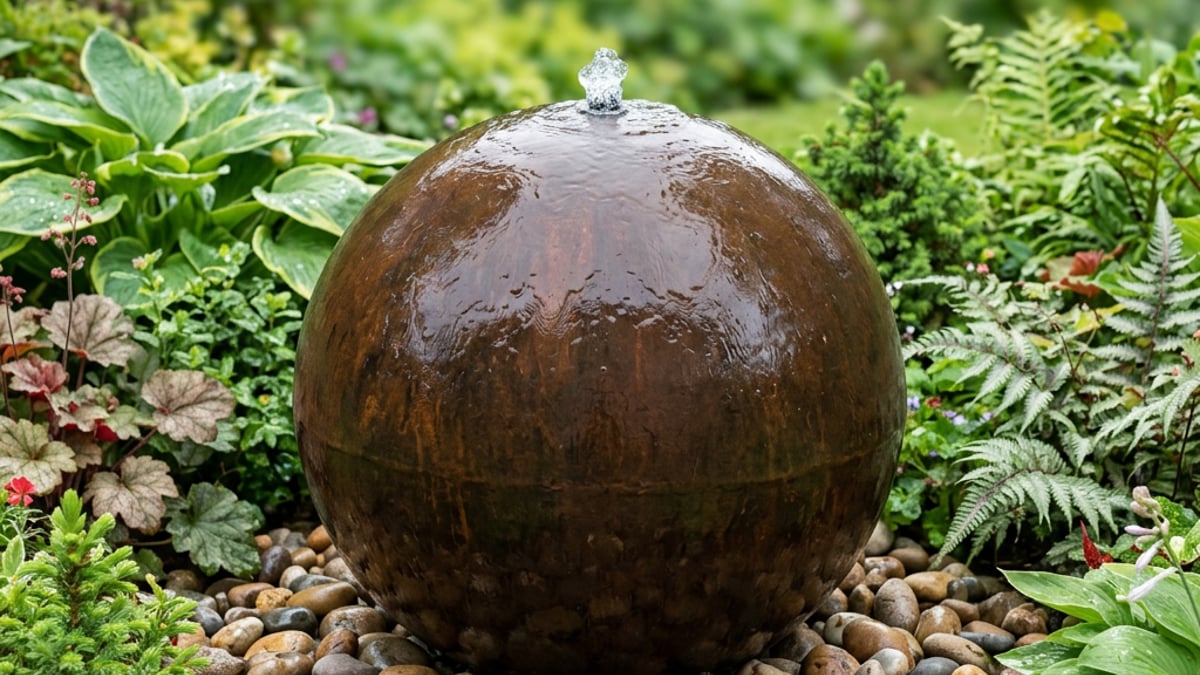
Corten Steel Sphere Water Feature 80cm, the show-garden statement piece at £925. View product
Modern garden water features have evolved sharply since 2022. The trend at RHS Chelsea, Hampton Court, and the major designer show gardens through 2024-2026 has been towards three distinct style families. Corten steel brings industrial-architectural mass with a living patina. Polished and textured stone spheres bring sculptural minimalism. Basalt monoliths and columns bring vertical architectural presence. Each family has its own placement rules, maintenance pattern, and budget tier. This guide covers all three, with 12 specific products tested in UK gardens.
Matt's experience with corten steel water features
I bought my first corten sphere in 2021 when the trend was just emerging. The 40cm version sat in our showroom courtyard. Customers asked about it constantly for the first six months because it looked like raw steel. By month nine it had developed a deep auburn-brown patina across the whole surface. By month twelve the patina was even, settled, and stable. We have since sold over 200 corten features, and the pattern repeats: customers initially worry about the rust look, then love it once it settles.
The other thing I have learned is that corten works only in certain garden styles. It looks stunning against pale render, gravel mulches, ornamental grasses, and architectural planting. It looks wrong in cottage gardens or with floral perennials. Match the style of the garden to the style of the feature.
The three modern water feature families
Each family has a distinct visual language, maintenance pattern, and price tier. Picking the right family is the first step before choosing a specific product.
Family 1: Corten steel (industrial-architectural). Carbon-manganese steel that develops a rust-brown patina over 6-12 months UK weather, then stabilises. The patina is the finish; no painting required. Suits modern, industrial, gravel, and Mediterranean-style gardens. Weight 5-28kg, price £419-£925 in our range. Two products available, both spheres.
Family 2: Stone and granite spheres (sculptural minimalism). Carved natural stone in slate, limestone, granite, and basalt. Polished and textured finishes. Sphere form catches and diffuses water into a thin film flowing over the surface. Weight 18-65kg, price £479-£1,099 in our range. Five sphere options across slate, limestone, and granite.
Family 3: Basalt monoliths and columns (vertical architectural). Natural volcanic basalt cut into columns or slabs, drilled for water flow. The cleanest, most architectural family. Heights from 500mm drilled columns to 1100mm statement columns. Weight 35-92kg, price £399-£679 in our range. Five column and slab options.
Family 1: Corten steel water features
Corten steel is the runaway 2024-2026 garden trend. The material was originally developed by US Steel in 1933 for industrial use; the rust-brown patina is part of the alloy specification, not a defect. In garden settings the patina takes 6-12 months to develop in UK weather and then stabilises for decades.
We stock two corten spheres at opposite ends of the size and price spectrum. The smaller 40cm fits courtyards and small gardens; the 80cm is the show-garden scale. The same patina behaviour applies to corten fire pits, which we cover in detail in our garden fire pit buying guide: steel, cast iron and corten compared.
|
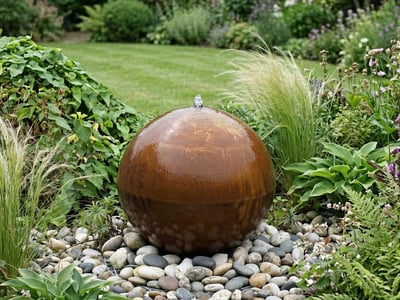
1. Corten Steel Sphere Water Feature 40cm — £419Family: Corten steel sphere Style: Modern industrial Dimensions: 400mm diameter, 220mm tall reservoir, 5kg sphere Why it works: Entry-point corten sphere. Develops a deep rust-brown patina over 6-12 months. Suits modern courtyards, gravel gardens, and Mediterranean-style terraces. Compact enough for small spaces. |
|
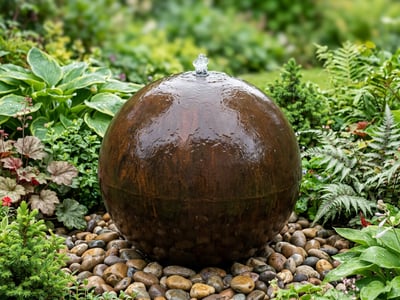
2. Corten Steel Sphere Water Feature 80cm — £925Family: Corten steel sphere Style: Modern statement Dimensions: 800mm diameter, 350mm tall reservoir, 28kg sphere Why it works: Statement corten sphere. The 80cm size is the show-garden scale that worked at Chelsea 2024. Becomes the central pivot of a contemporary garden design. |
Corten patina lifecycle: what to expect
The single most-asked question from customers considering corten is what happens to the surface over time. Here is the typical UK timeline:
Days 1-30: pale silver-grey raw steel. The corten arrives in its mill finish, smooth and lightly oiled. Looks like polished steel.
Months 1-3: orange-rust beginning. Oxidation starts unevenly across the surface. Rain-streak patterns appear. The look becomes "rusty" rather than "patina'd" at this stage.
Months 3-6: developing patina. The orange darkens to russet brown. The streaks even out across the sphere. Customers often think the feature looks "finished" but it is still developing.
Months 6-12: deep brown patina. The colour matures to a deep auburn-brown across most of the surface. The patina becomes a tight oxide layer that protects the underlying steel.
Year 2 onwards: stable patina. The colour and surface stabilise. The corten will continue subtle changes with season and weather but no significant further patina development. The feature is in its long-term state.
Maintenance is minimal: no painting, no rust treatment, no sealing. Some customers brush the surface dry once a year to remove leaf debris; that is all. The water reservoir and pump need the same care as any garden water feature.
Warning about staining. In the first 3-6 months, corten can stain paving below the sphere with rust runoff. Place the feature on gravel or grass during the patina development phase, then move to paving once stable. Alternatively, accept the staining as part of the look (many modernist gardens deliberately stain the surrounding paving for visual integration).
Family 2: Stone and granite spheres
Browse our sphere water features to compare diameters, materials, reservoir sizes and included equipment.
For a side-by-side material comparison across granite, sandstone, slate and basalt water features, the stone water features material guide walks through hardness, frost resistance and patina behaviour for each.
Sphere water features are the contemporary form factor for stone garden ornaments. The smooth or textured surface lets water sheet across in a film, catching light and movement without splash. Cleaner than traditional bowl fountains.
We stock spheres in slate, limestone, and granite at sizes from 450mm to 600mm diameter. Weight ranges 18-65kg. Heaviest spheres need two people to position.
|
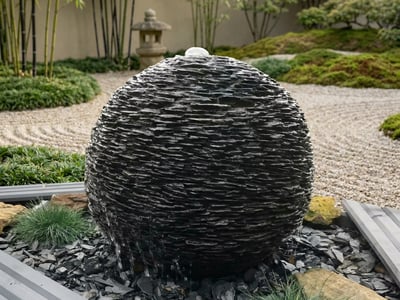
3. Slate Sphere Water Feature 50cm — £479Family: Slate sphere Style: Modern minimal Dimensions: 500mm diameter, 18kg sphere Why it works: Carved Welsh slate sphere with rough textured finish. The slate stays dark grey wet, weathers to soft mid-grey when dry. Suits Japanese-influenced and zen gardens. |
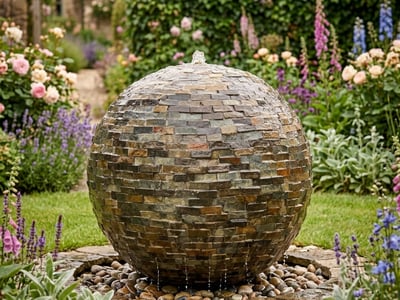
|
4. Tiled Slate Sphere Water Feature 50cm — £479Family: Slate sphere Style: Modern textural Dimensions: 500mm diameter, 19kg sphere Why it works: Tiled slate version of the same form factor. The mosaic surface catches light differently. Works well in lit gardens where evening LEDs sit alongside the water feature. |
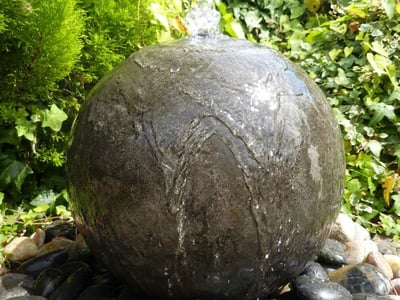
|
5. Black Polished Limestone Sphere Water Feature — £579Family: Stone sphere Style: Modern minimal Dimensions: 450mm diameter, 22kg sphere Why it works: Mirror-polished black limestone, surface reflects sky and surrounding planting. The most architectural sphere in the range. Suits very modern hard-landscaped courtyards. |
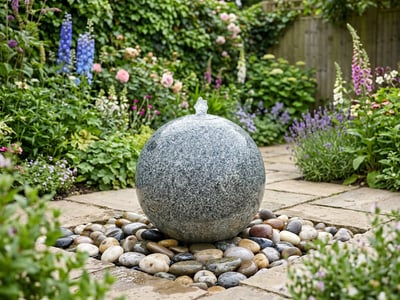
|
6. Grey Flame Granite Sphere Water Feature — £495Family: Granite sphere Style: Modern textural Dimensions: 450mm diameter, 28kg sphere Why it works: Flame-finished grey granite. Rough surface diffuses water into thin film flowing over the sphere. Texture catches dappled tree shade beautifully. |
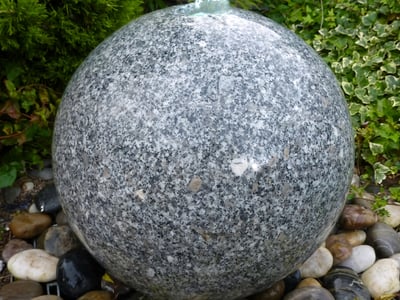
|
7. Grey Polished Granite Sphere Water Feature — £1,099Family: Granite sphere Style: Modern statement Dimensions: 600mm diameter, 65kg sphere Why it works: Mirror-polished grey granite, premium piece. Heaviest sphere we stock, needs two people to position. Premium tier for show-garden installations. |
Family 3: Basalt monoliths and columns
Basalt columns are the most architectural family of modern water features. Cut from natural volcanic basalt with drilled cores or chiselled surfaces, they bring vertical presence and quiet movement to contemporary gardens.
We stock five column and slab options ranging from a compact 500mm drilled basalt at £399 to a 1100mm statement column at £679. All include UK-tested pump and reservoir for plug-and-play installation. For the wider 2026 water feature choice across stone, solar and corten, the 2026 UK water feature buyer's guide covers price, fuel, pump, and placement decisions in one place.
|
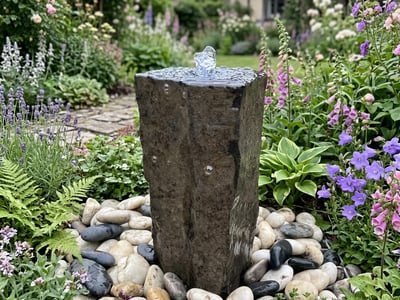
8. Drilled Basalt Column Water Feature 50cm — £399Family: Basalt monolith Style: Modern minimal Dimensions: 500mm tall, 200mm diameter, 35kg Why it works: Lowest-price modern monolith we stock. Natural basalt column drilled for water flow. Black volcanic stone reads cleanly against gravel mulch or planting. |
|
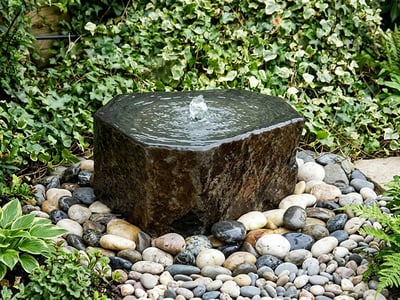
9. Babbling Basalt Column Water Feature — £455Family: Basalt monolith Style: Modern naturalistic Dimensions: 700mm tall, 220mm diameter, 48kg Why it works: Babbling cascade design where water tumbles down the column's textured face. The sound carries 3-5m in still air. Suits contemporary cottage and Japanese-influenced gardens. |
|
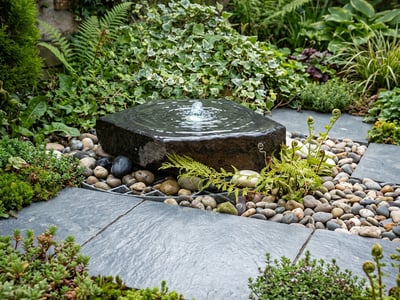
10. Basalt Slab Water Feature — £459Family: Basalt slab Style: Modern architectural Dimensions: 600mm tall, 400mm wide, 100mm thick, 52kg Why it works: Flat slab version of the basalt monolith. Water sheets across the face. Suits hard-landscaped contemporary gardens with limestone or concrete paving. |
|
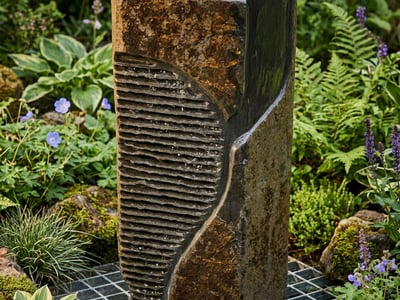
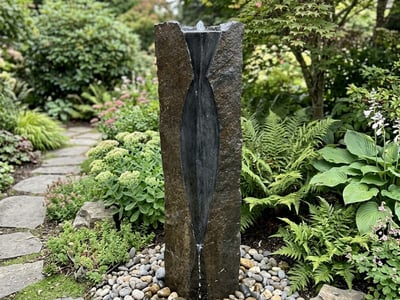
11. Chiselled Basalt Column Water Feature — £629Family: Basalt monolith Style: Modern textural Dimensions: 850mm tall, 240mm diameter, 65kg Why it works: Hand-chiselled surface gives a craft-made texture. The slightly irregular form sets it apart from the smooth-drilled columns. Premium feature for designer gardens. |
|
12. Basalt Statement Column Garden Water Feature — £679Family: Basalt monolith Style: Modern statement Dimensions: 1100mm tall, 280mm diameter, 92kg Why it works: Tallest column we stock at 1.1m. Reads as architectural even at 5-10m distance. Becomes the focal point of any contemporary garden design. |
Matt's pick: best entry-level corten water feature
|
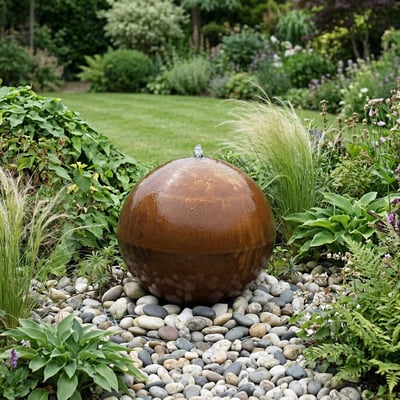
Matt's pick for modern water featuresFeature: Corten Steel Sphere Water Feature 40cm Best for: Buyers new to corten who want the trend without the £925 commitment of the 80cm Why I recommend it: The 40cm sphere is the perfect entry-point. It fits any courtyard, costs less than half the price of the 80cm, and develops the same characteristic patina. I installed one in our company front courtyard in 2024 and the patina settled to a deep auburn-brown by autumn. Six months later it had stabilised and looks identical to a feature five years older. Price: £419 |
Quick reference comparison
| Feature | Family | Weight | Price |
|---|---|---|---|
| Corten Steel Sphere Water Feature 40cm | Corten steel sphere | 5kg sphere | £419 |
| Corten Steel Sphere Water Feature 80cm | Corten steel sphere | 28kg sphere | £925 |
| Slate Sphere Water Feature 50cm | Slate sphere | 18kg sphere | £479 |
| Tiled Slate Sphere Water Feature 50cm | Slate sphere | 19kg sphere | £479 |
| Black Polished Limestone Sphere Water Feature | Stone sphere | 22kg sphere | £579 |
| Grey Flame Granite Sphere Water Feature | Granite sphere | 28kg sphere | £495 |
| Grey Polished Granite Sphere Water Feature | Granite sphere | 65kg sphere | £1,099 |
| Drilled Basalt Column Water Feature 50cm | Basalt monolith | 35kg | £399 |
| Babbling Basalt Column Water Feature | Basalt monolith | 48kg | £455 |
| Basalt Slab Water Feature | Basalt slab | 52kg | £459 |
| Chiselled Basalt Column Water Feature | Basalt monolith | 65kg | £629 |
| Basalt Statement Column Garden Water Feature | Basalt monolith | 92kg | £679 |
Where to position a modern water feature
Place the feature at a focal point you actually look at. The classic mistake is putting a water feature in a corner where it is rarely seen. Position it where the sightline from the kitchen window, terrace seating, or main path lands.
Gravel or paved base, never grass. The heavy stone and steel pieces sink into grass and tilt within months. A 1m by 1m gravel pad or two paving slabs gives a stable base and frames the feature visually.
Match the planting style. Corten and modern monoliths sit well with ornamental grasses (Stipa, Pennisetum, Calamagrostis), architectural shrubs (Phormium, Hebe, Fatsia), and gravel mulches. They look wrong with cottage-garden floral perennials.
Consider sound profile. Sphere features produce a subtle ripple sound. Babbling columns produce a louder running-water sound. Pick by what you want to hear from the seating area.
Lighting transforms modern features at night. A single low-voltage LED under or beside the feature changes it from invisible-at-night to a focal point of the evening garden. Budget £30-£80 per fitting.
Plinth pairing. Stand-alone water features often benefit from a matching plinth or surrounding stone. Our Stone Pedestals collection includes plinths and bases that complement the modern water feature range.
Common mistakes when buying a modern water feature
Underestimating weight. The Grey Polished Granite Sphere weighs 65kg. The Basalt Statement Column weighs 92kg. Both need two people and possibly a sack truck to position. Budget for the install.
Wrong sound profile for the location. Loud babbling columns near a bedroom window become annoying at 2am. Sphere features are quieter and suit residential placement.
Corten staining on light paving. Cream limestone or Portland stone paving will stain rust-brown under a developing corten patina. Place corten on gravel for the first year.
Skipping winter shutdown. Most modern water features can run year-round, but pumps in shallow reservoirs benefit from being lifted out and stored dry between November and March. Saves pump life and avoids freeze damage.
Wrong family for the garden style. Corten in a cottage garden looks out of place. Basalt columns in a Victorian formal garden feel anachronistic. Match family to garden style.
Care and maintenance
Annual pump inspection. Remove the pump in early spring, rinse the impeller, check the cable, replace if frayed. Pump life is typically 3-5 years on quality units; budget £50-£120 for replacement.
Reservoir clean. Once a year, drain the reservoir, scrub with a brush and plain water, refill. Avoid bleach or strong detergents that can damage seals.
Top up water weekly in summer. Sphere and column features evaporate water faster than open ponds. A 50-litre reservoir can lose 5-10 litres a week in July sun.
Frost protection. In hard frosts below -5C, switch off the pump and drain the reservoir if possible. The stone, steel, and basalt themselves are frost-proof but standing water in the reservoir can freeze and damage seals.
Algae control. Submerged barley straw pellets or a UV clarifier control algae without chemicals. Most modern features sit in partial shade which slows algae naturally.
Frequently asked questions
What is a corten steel water feature?
A corten steel water feature is a sculpture cast from a weathering steel alloy that develops a stable rust-brown patina over 6-12 months. Corten was developed in 1933 by US Steel for industrial use. The patina is part of the alloy specification, not a defect, and protects the underlying steel for decades. In gardens, corten is favoured for industrial-architectural aesthetics and zero ongoing painting or treatment requirements.
How long does the corten patina take to develop?
The corten patina takes 6-12 months to develop in UK weather and 18-24 months to fully stabilise. Months 1-3 show orange-rust development with streaks. Months 3-6 darken to russet brown. Months 6-12 settle to a deep auburn-brown across the surface. After year 1 the colour is stable and continues subtle seasonal changes only.
Will a corten water feature stain my paving?
Yes, in the first 6-12 months a corten feature can stain pale paving with rust runoff. Place the feature on gravel or grass during the patina development phase, then move to paving once stable. Alternatively, accept the staining as a deliberate design feature - many modernist gardens stain the surrounding paving for visual integration. Darker paving (slate, black limestone, basalt) shows minimal staining.
Are stone sphere water features heavy?
Stone spheres weigh 18-65kg depending on size and material. A 450mm slate sphere weighs 18kg (one-person lift). A 600mm polished granite sphere weighs 65kg (two-person lift, often with a sack truck). The reservoir below the sphere typically weighs 20-30kg empty and 50-80kg full of water and pebbles. Plan the installation route and helpers before buying.
Do modern water features need electricity?
Yes, every water feature needs a low-voltage 12V or mains 230V pump. Most include a 10m cable that runs to a weatherproof outdoor socket. Solar-powered alternatives exist for small features (under 25kg) but flow rate is lower and stops in cloud. For features above £400 we recommend mains power for reliability.
Can I run a water feature year-round in the UK?
Yes for the stone and steel parts, with care for the pump in hard frosts. Corten steel, basalt, granite, slate and limestone are all frost-proof to -20C. The pump and reservoir water are the freeze-vulnerable elements. In hard frosts below -5C, switch off the pump and drain the reservoir if possible. Many UK gardeners run features April to October and shut down November to March.
Find your modern water feature
Every feature in our modern range includes a UK-tested pump and reservoir, free mainland delivery, and 30-day returns.
Browse Modern Water Features Browse Steel Water FeaturesRelated guides
- Best solar water features UK 2026 — 12 picks tested with honest UK runtime data when you want zero electrics.
- Garden fountains UK: stone, tiered, pedestal and wall designs compared — if you want a traditional fountain shape rather than a modern monolith or sphere.
- Water features for wildlife UK — how to pick a modern feature that also supports birds, bees and hedgehogs.