
Formal Garden Ideas: 4 Rules for Symmetry and Focal Points
Written by Matt W on 6th Jul 2026.
A formal garden stands on three things: a straight axis, mirrored planting, and a focal point closing the view. Matched pairs do the mirroring. Two identical statues, urns or topiary balls flank a path or doorway and frame it. A brass armillary on a stone pedestal, 740mm to 1370mm tall, anchors the far end. None of it needs a big plot.
By Matt W | Garden Ornaments Specialist
Key takeaways
- Formality comes from geometry, not size: one straight axis, mirrored sides and a single focal point
- Matched pairs carry the symmetry; the Chatsworth lion pair is 360mm high and 112kg of cast stone
- Armillary spheres are the classic centrepiece: 15 pedestal designs from £390 to £644
- An urn on a plinth builds a focal point in two parts: 720mm of urn on 570mm of stone base
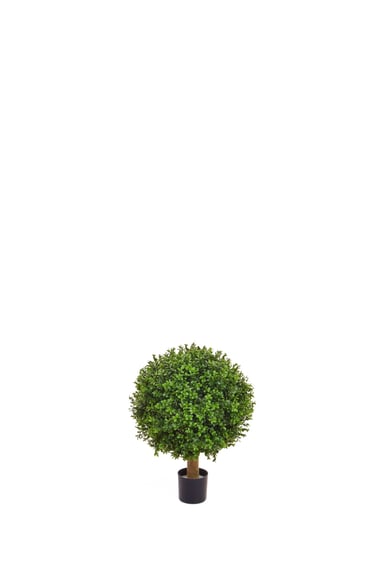
- Artificial buxus balls in 30cm, 40cm and 50cm sizes give clipped structure with no box blight risk
- A small front garden needs just three pieces: one pair by the door, one focal point on the centre line
Matt's note
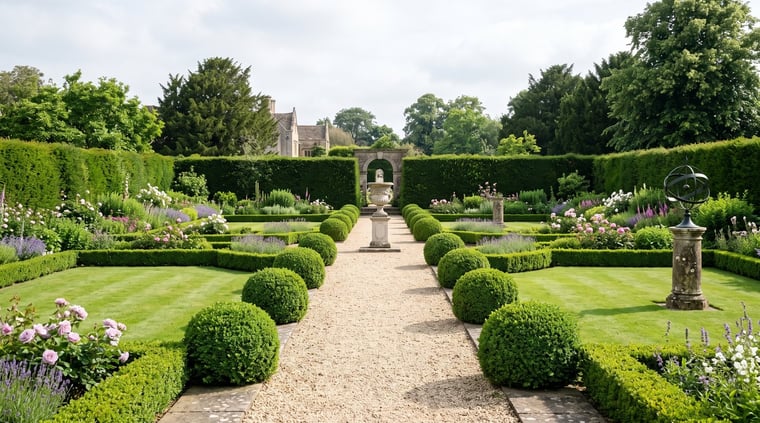
People think a formal garden needs a Chatsworth-sized budget and a gardener on staff. It needs neither. It needs discipline. Pick one straight line, usually the path from gate to door, and put everything in service of it. A pair of identical pieces either side, one focal point at the end, and stop. The most common mistake I see is five lovely ornaments dotted about with no relationship to each other. That is a collection, not a design. Three pieces placed with intent will beat ten placed on impulse every time.
What makes a garden formal?
A garden is formal when it is arranged around straight lines, mirrored planting and clipped evergreen structure. The style runs on four rules. First, one main axis: a straight sight line from the viewing point to a focal point. Second, symmetry: whatever sits on the left of that line is repeated on the right. Third, geometry: squares, circles and rectangles rather than loose curves. Fourth, restraint: a small set of shapes and materials, repeated.
Ornaments do the heavy lifting because they hold their shape all year. Hedges grow out, borders die back in November, but a stone urn reads the same in January as it does in June. That is why the great formal gardens lean so hard on statuary, urns and armillary spheres. Get the bones right and the planting becomes decoration rather than structure. Our guide to garden zoning ideas covers how a formal area can sit inside a larger, looser plot.
How do you create symmetry with matched pairs?
You create symmetry by placing two identical ornaments an equal distance either side of your axis. A matched pair reads as a frame, and the eye passes straight between them to whatever sits beyond. That is why pairs belong at thresholds: the front door, a gate, the top of steps or the start of a path. One statue is an object. Two identical statues are an entrance.
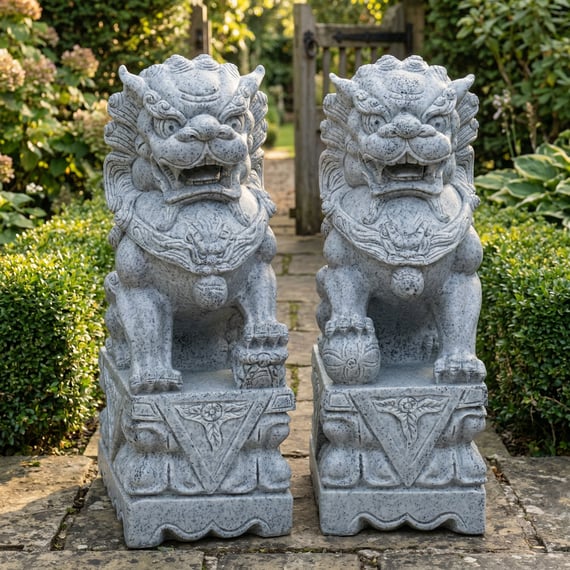
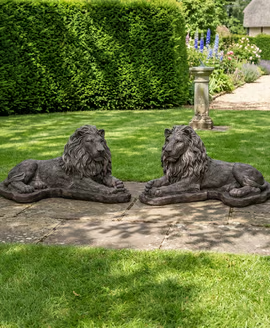
Scale and weight matter more than people expect. Our Chatsworth lion pair, based on Antonio Canova's 18th-century originals, stands 360mm high, with each lion 670mm deep and 410mm wide. The pair weighs 112kg in reconstituted stone, so they sit unmoved through winter gales. For a tighter spot, a pair of Foo dogs stands 410mm tall and weighs 20kg the pair, cast from crushed marble and resin. Both come in finishes that weather naturally. Sizing rules for getting this right are in our guide to garden statue sizes.
What is the best focal point for a formal garden?
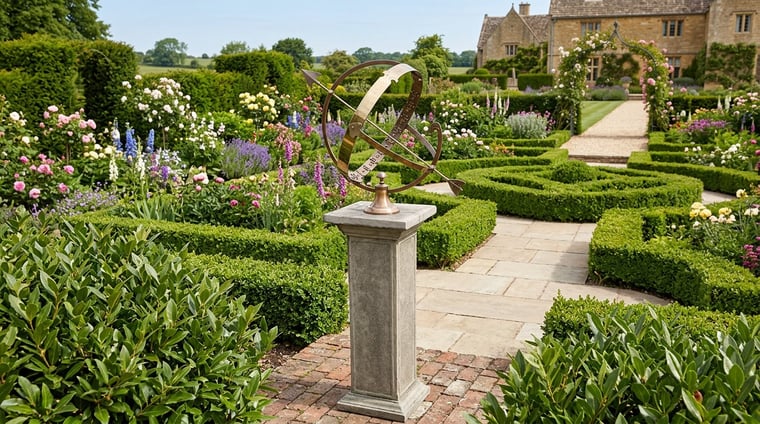
The best focal point is a single vertical piece at eye level, set where your main axis ends. An armillary sphere is the classic choice. The ringed brass sphere gives you height, shine and a touch of movement against clipped green, and it looks correct from every side. We stock 15 armillary designs on stone pedestals, from £390 for a 740mm fluted classical column to £644 for the largest. The Large Armillary on Athenian Pedestal stands 1370mm in total: a 930mm square stone column carrying a 440mm brass sphere. The footprint is just 350mm square.
A traditional sundial does the same job at a lower height. Our sundial setting guide shows how to align one so it genuinely tells the time. The third option is an urn on a plinth, which builds presence in two parts. The full range of armillary sphere sundials covers every pedestal style.
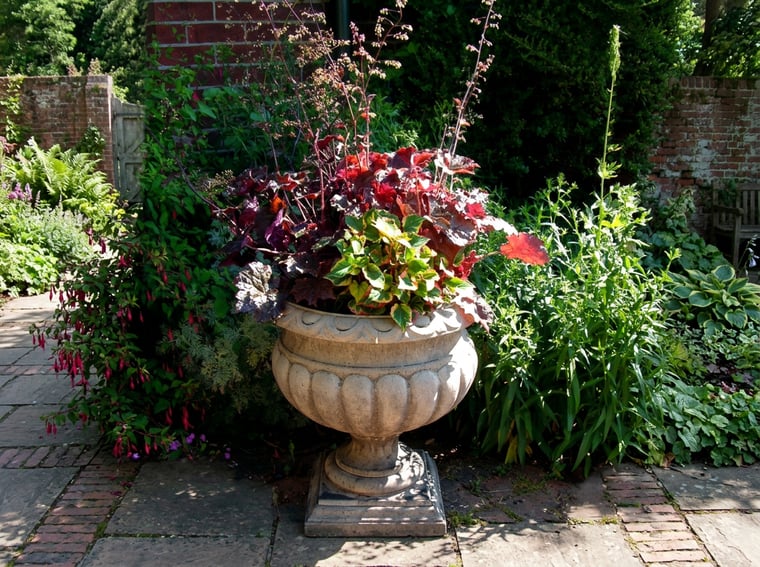
Urns earn their place because they take planting. The Large Buckingham urn is 720mm tall with a fluted bowl 740mm across, hand cast at 138kg. Set it on our Large Stone Plinth, 570mm tall on a 430mm x 430mm base, and the combination clears 1.2m before you add a single plant. What goes in the bowl is covered in our season-by-season urn planting guide. The wider stone garden urns range starts at £164.
| Piece | Height | Weight | Price | Best position |
|---|---|---|---|---|
| Chatsworth lion pair | 360mm | 112kg the pair | £275 | Flanking a door, gate or steps |
| Foo dog pair | 410mm | 20kg the pair | £239 | Porches and narrow paths |
| Brass armillary on classical pedestal | 740mm | Cast stone base | £390 | Centre of a parterre or lawn circle |
| Large armillary on Athenian pedestal | 1370mm | 350mm square base | £644 | Closing a long axis |
| Large Buckingham urn | 720mm | 138kg | £341 | On a plinth at the end of a vista |
| Large stone plinth | 570mm | 160kg | £370 | Under any urn or statue |
| Artificial buxus ball 40cm | 570mm potted | Light enough to move | £202 | Repeated along a path edge |
| Artificial buxus tower 120cm | 1200mm | Pot base | £452 | Either side of a front door |
Watch out for
Stone this heavy needs a proper base. The lion pair is 112kg, the Buckingham urn 138kg and the large plinth 160kg. Any of them will sink and tilt on bare soil within a season. A leaning focal point ruins a symmetrical design faster than anything else. Set each piece on a paving slab bedded level on sharp sand, or on an existing patio or path. Check it with a spirit level on the day and again a month later. The weight is a benefit after that: nothing this heavy walks off or blows over.
Do topiary balls work in a formal garden?
Topiary balls are the fastest way to add clipped structure, and the repeated sphere is the signature of the style. Run them in pairs down a path, station one at each corner of a parterre, or group three sizes by a doorway. Real box brings two problems in the UK: box blight and the box tree caterpillar, which can strip a plant in weeks. Real box also demands clipping twice a year, around June and September, to hold a crisp line.
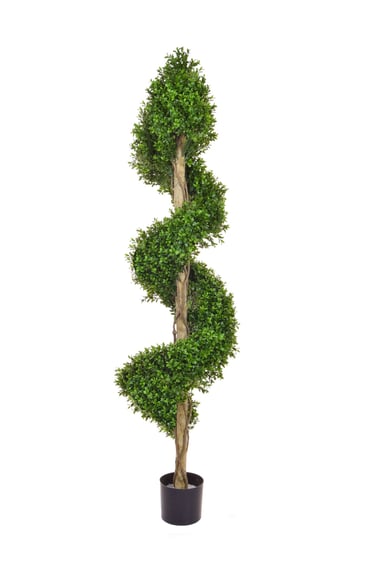
Our artificial buxus range sidesteps all of it. The balls come UV-stabilised for outdoor use in 30cm, 40cm and 50cm diameters, from £137. The 40cm ball stands 570mm in its pot and holds the same profile in February as in July. Beyond spheres there are 150cm spirals at 55cm wide, triple-ball stems and clipped towers up to 150cm. Drop one into a planter each side of the door and the job is done. Browse the full artificial plants range for every shape.
Matt's pick for instant formality
Best for: Flanking a front door, gateway or flight of steps as a true matched pair
Why I recommend it: The Chatsworth lions are faithful casts of Antonio Canova's 18th-century originals, sold as a true pair. Each lion is 670mm deep, 410mm wide and 360mm high. The pair's 112kg keeps them planted through any weather. One pair turns an ordinary doorway into an entrance, which is the whole trick of the formal style.
Price: £275
How do you lay out a small formal front garden?
Work from the door outwards and use exactly three elements. First, a matched pair at the door: two buxus balls in planters, two towers or the Foo dogs. Second, a straight path treated as your axis, even if it is only four metres long. Third, one focal point visible on the centre line, which in a small plot can simply be the pair framing the door itself. Resist adding a fourth element. Small formal gardens fail by addition, not subtraction.
Taller shapes earn their keep where ground space is tight. A 150cm spiral takes up a 55cm circle of ground yet gives you 1.5m of sculpted green, so a pair fits where lions never would. Repeat one shape rather than mixing five. Two spirals at the door and a ball at each path corner reads as a design; one of everything reads as a clearance sale.
Matt's tip: set out the axis with string before you buy
Run a string line from your main viewing point to where you think the focal point should sit. That usually means the kitchen window or the front gate. Stand a wheelie bin on the spot as a stand-in and live with it for a week. If the bin keeps catching your eye from the places you actually sit and walk, the spot is right. If you keep noticing it from nowhere, move it. A string line and a bin cost nothing. They have saved my customers from re-siting a 160kg plinth more than once.
We stock this range because formality is the one garden style you can buy off the shelf. The planting takes years; the structure takes a weekend. A matched pair, a pedestal piece and a few clipped shapes give you the geometry. The borders can catch up at their own pace. Browse our full collection of garden ornaments to plan yours.
- Matt W, Garden Ornaments
Frequently asked questions
What is the difference between a formal and informal garden?
A formal garden uses straight lines, symmetry and clipped shapes; an informal one uses curves. Formal designs mirror planting either side of an axis, while informal designs let plants set the shape.
What ornaments suit a formal garden best?
Matched pairs, urns on plinths, armillary spheres, sundials and clipped topiary shapes. Each holds a firm outline all year, which is what the geometry of the style relies on.
Where should a garden armillary sphere be placed?
At the end of your main sight line, ideally centred and in open light. On a pedestal it reads from 740mm to 1370mm high, so it closes a vista without blocking it.
Do statues have to be in pairs in a formal garden?
No, but pairs belong at entrances and single pieces belong at focal points. Use two identical statues to frame a threshold and one strong piece to end a view.
Are artificial topiary balls convincing outdoors?
Good UV-stabilised buxus reads as real from a metre away. The giveaway is fading, so buy UV-treated foliage and wipe it over occasionally; it never needs clipping.
How heavy should a formal garden ornament be?
Heavy enough not to move: our pairs run 20kg to 112kg and plinths up to 160kg. Anything over about 100kg should sit on a levelled slab rather than bare soil.