
What to Plant in Stone Urns and Planters: A Season-by-Season Guide
Written by Matt W on 15th Jun 2026.
Plant a stone urn using the thriller, filler, spiller rule: one tall focal plant, bushy plants to fill the middle, and trailers to spill over the rim. Change the planting with the seasons, with spring bulbs, summer trailers, autumn foliage and evergreen winter structure. Use a loam-based John Innes No.3 compost for weight and water retention, and crock the drainage hole. Cast stone is frost-proof, so a well-planted urn earns its place all year.
Matt W | Garden Ornament Specialist
Key Takeaways
- ✔ The thriller, filler, spiller rule gives a balanced urn every time: height, body and trailing edges.
- ✔ Spring: bulbs in layers (a bulb lasagne) for weeks of succession, underplanted with violas.
- ✔ Summer: long-flowering pelargoniums and salvias with trailing lobelia, bacopa and ivy.
- ✔ Autumn: heuchera, ornamental cabbage, asters and grasses for foliage and late colour.
- ✔ Winter: evergreen structure from skimmia, ivy, cyclamen and heathers.
- ✔ Use loam-based John Innes No.3: it holds water, feeds longer and adds weight that stops a tall urn toppling.
- ✔ Cast stone does not crack in frost like terracotta, so it stays planted and outdoors all year.
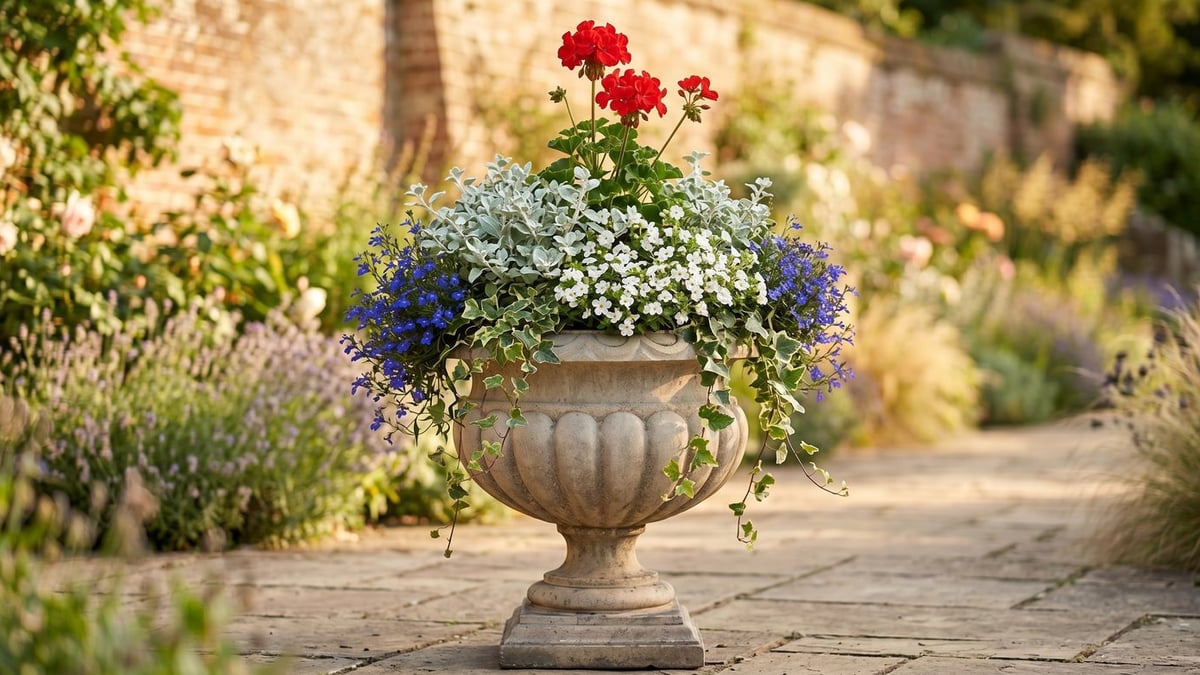
A summer urn built on the thriller, filler, spiller rule: upright pelargonium, soft filler and trailing edges. Browse our stone urns and planters.
A stone urn is a stage, and the planting is the performance. Get the shape of the planting right and almost any combination looks good; ignore it and the best plants still look flat. The rule that never fails is thriller, filler, spiller, and once you have it you can swap the cast each season. This guide takes you through the recipe, the compost and drainage that keep plants alive in a container, and exactly what to plant in spring, summer, autumn and winter. For how the materials compare, our guide to stone, terracotta and fibrecite planters compared is the place to start.
What we tell first-time urn owners
The mistake we see most is a beautiful urn with three sad bedding plants lost in the middle of it. An urn wants generous, layered planting that hides the soil and drapes the rim, not a polite row of the same thing. The second mistake is the compost: people fill a big urn with cheap, peat-free multipurpose that dries to dust by July and is so light the whole thing blows over. We always say spend on the compost, not just the plants. A loam-based John Innes No.3 holds water far longer, releases food slowly, and adds the weight that keeps a tall urn stable on a windy terrace. Get the compost and the shape right, and the planting almost does itself.
What to plant in a stone urn: the thriller, filler, spiller rule
Every good container planting has three jobs, and the thriller, filler, spiller rule names them. The thriller is the tall focal plant in the centre that gives height and drama, such as a phormium, a salvia or an upright pelargonium. The filler is the rounded, bushy planting around it that gives body and hides the compost, like violas, helichrysum or heuchera. The spiller is the trailing planting that softens and drapes over the rim, such as ivy, trailing lobelia or bacopa. Use one of each and the urn reads as full and balanced from day one, whatever the season.
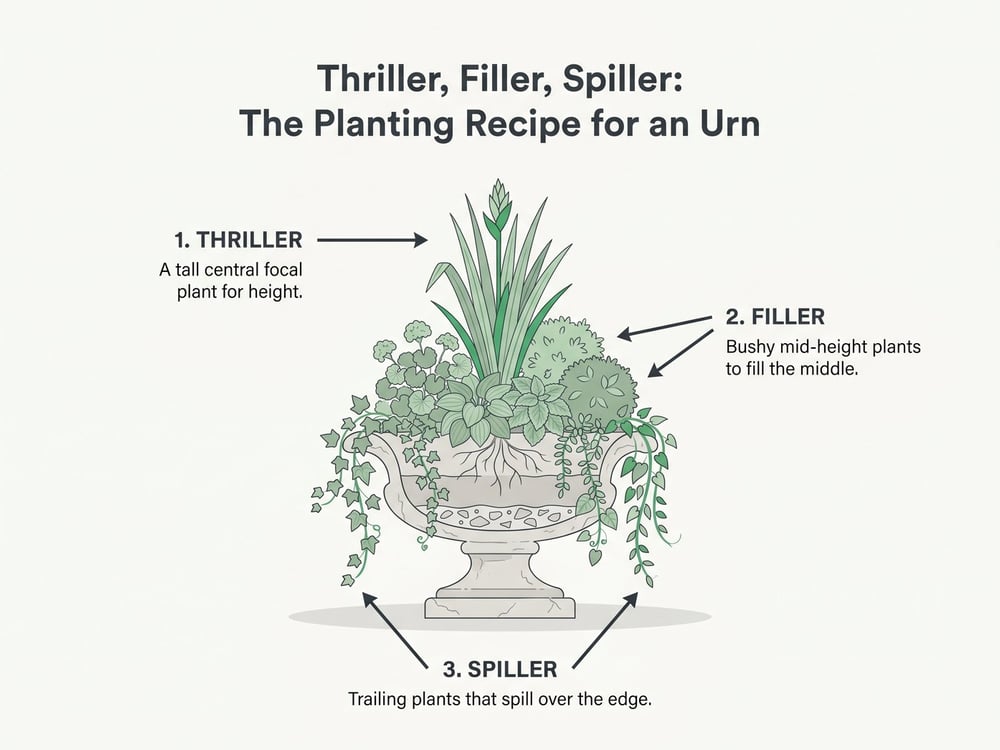
The thriller, filler, spiller rule: one tall focal plant, bushy fillers around it, and trailers spilling over the edge.
Get the basics right: drainage, compost and weight
Plants live or die in a container on three things, and none of them is the variety. First, drainage: cover the hole with a crock or a layer of gravel so roots never sit in water. Second, compost: a loam-based John Innes No.3 holds moisture and nutrients far better than light multipurpose, and its weight keeps a tall urn stable. Third, watering: an urn in summer sun can dry out in a day, so mix in water-retaining granules and check it daily in heat. Raise the urn on small pot feet for drainage and to stop it staining the paving. Stone is frost-proof, so it can stay out year-round.
Spring: bulbs and the bulb lasagne
Spring colour in an urn is planted the previous autumn, and the trick is to layer the bulbs. A bulb lasagne stacks bulbs at different depths so they flower in succession from one urn: tulips deepest, daffodils in the middle, and crocus or muscari near the top. As one fades the next rises through it, giving six to eight weeks of colour from a single planting. Underplant with winter violas and primroses for instant colour while the bulbs come through. It is the most rewarding planting of the year, and the cheapest per week of display.
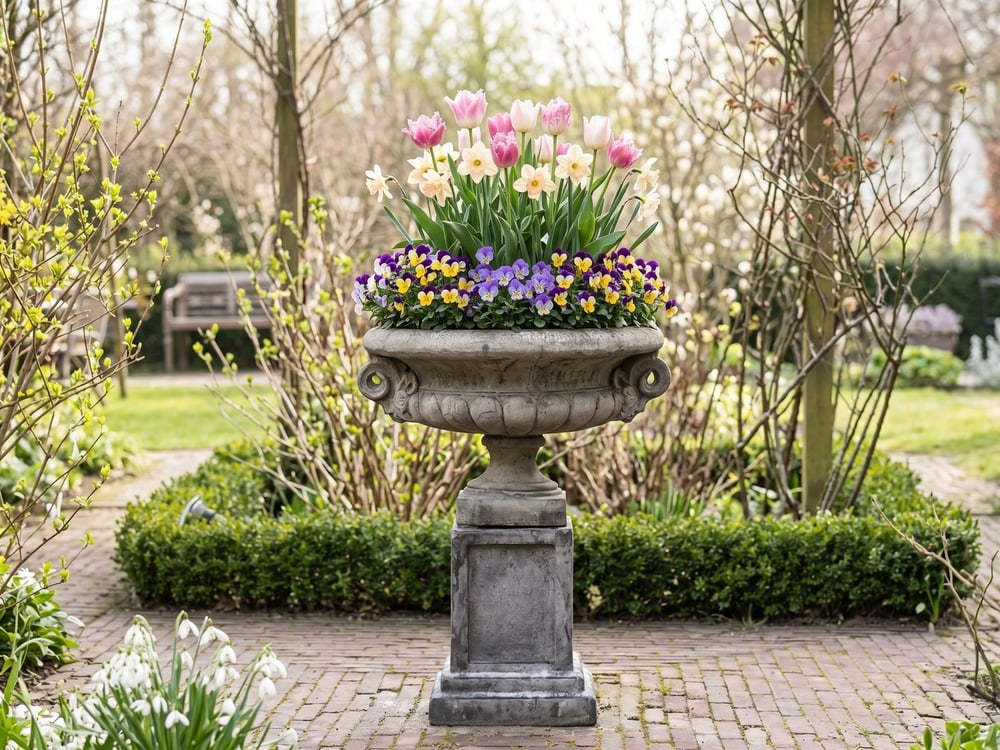
A shallow tazza suits a bulb lasagne: tulips and narcissi above a skirt of violas. Shop the Edwardian Tazza →
Summer: the long-flowering display
Summer is when an urn earns its keep, flowering from June to the first frosts. Lead with a heat-tolerant thriller such as an upright pelargonium, a salvia or cordyline, then fill with bushy bedding and let trailers cascade over the rim. The plants that go the distance in a British summer are pelargoniums, bidens, cosmos, helichrysum for silver foliage, and trailing lobelia, bacopa and ivy-leaved pelargonium for the spill. Feed weekly with a high-potash tomato feed once the urn is in full growth, and deadhead to keep the flowers coming. Troughs work the same way and are perfect for edible summer planting too.
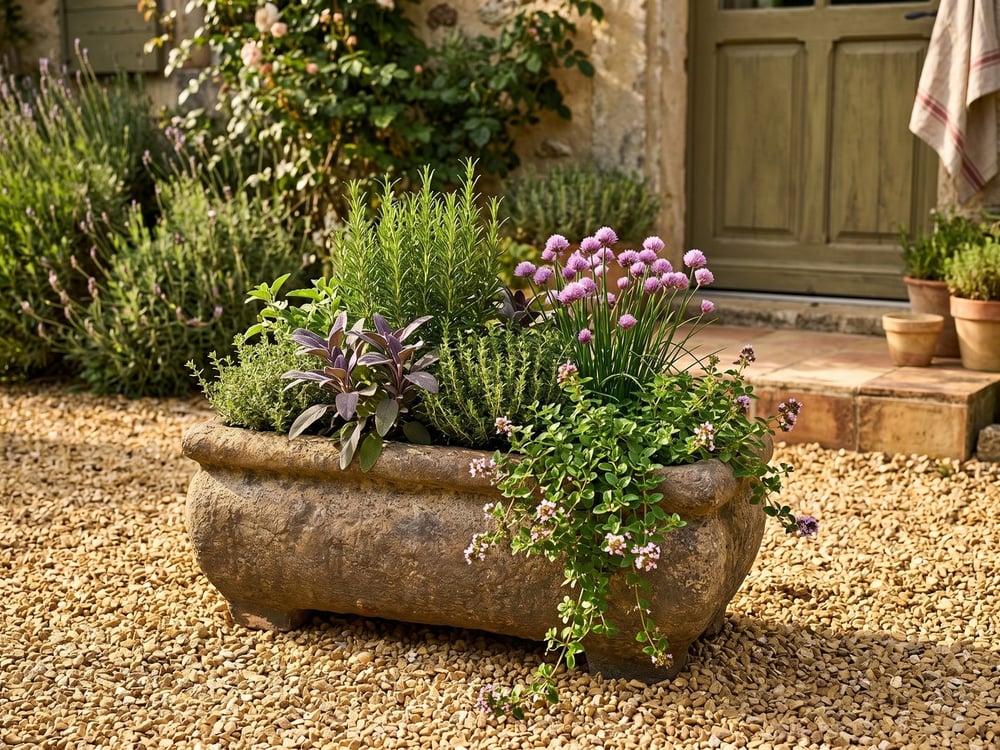
A stone trough by the kitchen door makes a handsome summer herb planter. Mediterranean herbs love the sharp drainage. Shop the Catalan Trough →
Autumn: foliage and late colour
Autumn planting leans on foliage rather than flowers, which lasts far longer as the light fades. Heucheras in amber, coral and plum are the backbone, holding colour for months. Add ornamental cabbages and kale for texture, dwarf asters and chrysanthemums for late flower, and an ornamental grass such as a carex for movement. Trailing ivy ties it together over the rim. This is a planting that slides straight into winter: leave the evergreen heuchera and ivy in place, and simply swap the spent annuals for winter structure when the time comes. An autumn urn carries the garden through its quietest weeks.
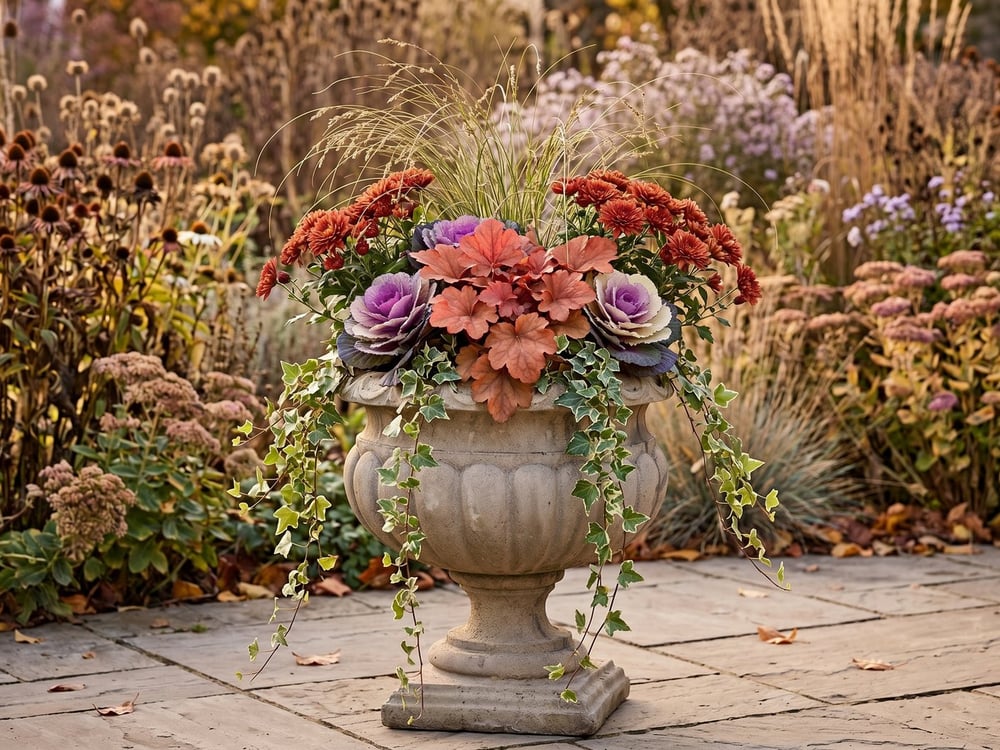
Autumn leans on foliage: heuchera, ornamental cabbage and grasses hold colour long after flowers fade. Shop the Buckingham Urn →
Winter: evergreen structure
A winter urn is about structure and small points of colour, not abundance. Build it around evergreens that look good for months: a skimmia for glossy leaves and red berries or buds, variegated ivy to trail, and a dwarf conifer or clipped box for height. Add winter cyclamen, heathers and gaultheria for colour at the rim, and hellebores for late-winter flower. Because cast stone is frost-proof, the urn itself needs no protection, unlike terracotta which can flake and crack in a hard freeze. A planted evergreen urn by a door is the easiest way to keep a garden looking cared-for through the dark months.
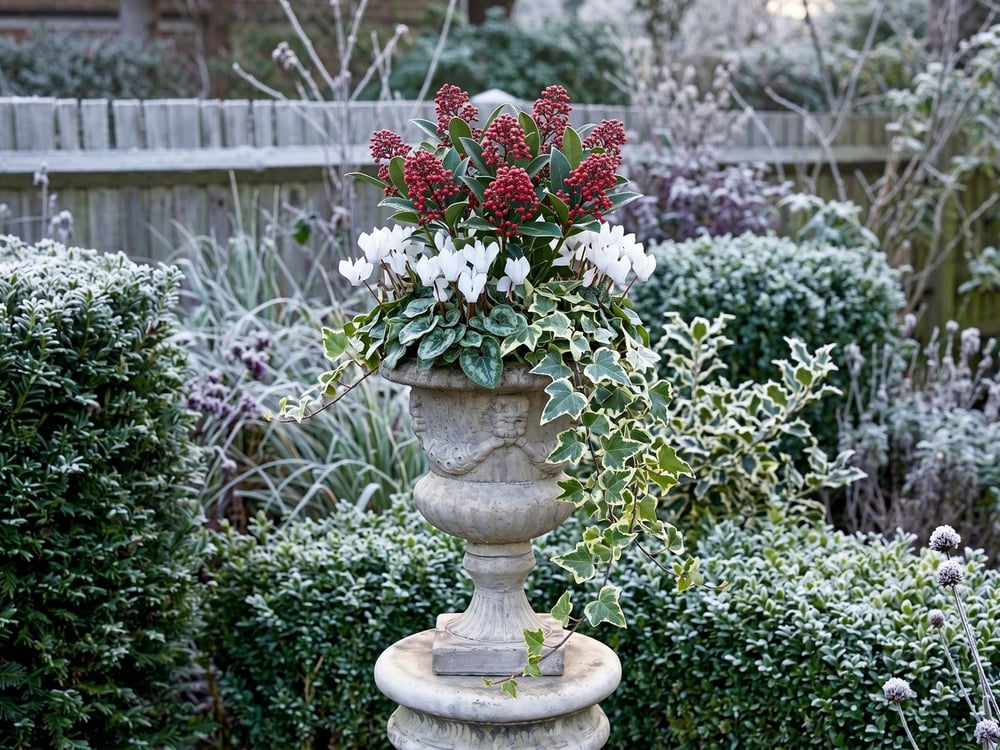
Winter structure from skimmia, cyclamen and ivy. Cast stone shrugs off the frost that would crack terracotta. Shop the Vienna Scroll Vase →
Troughs, alpines and low-maintenance planting
Not every container wants a changing display. A stone trough planted with alpines is as close to no-maintenance as planting gets. Sempervivums (houseleeks), saxifrage and creeping sedum thrive in poor, sharply drained soil, ask for almost no water, and look good every month of the year. Use a gritty compost, top-dress with stone chippings, and site the trough in full sun. Once planted it can be left for years, slowly knitting into a dense carpet of rosettes. It is the perfect planting for a busy gardener, a low wall, or anyone who wants permanence rather than a seasonal swap.
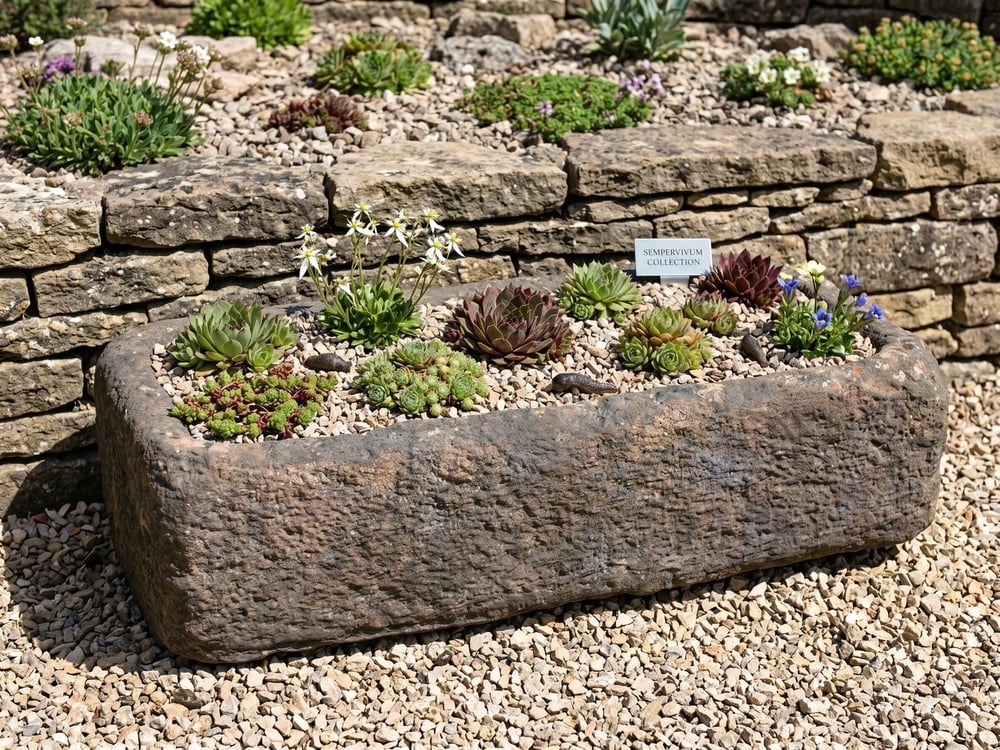
An alpine trough is the lowest-maintenance planting we know: sharp drainage, full sun, and years of interest. Shop the Rustic Stone Trough →
Season-by-season planting at a glance
| Season | Thriller | Filler | Spiller |
|---|---|---|---|
| Spring | Tulips, daffodils | Violas, primroses, muscari | Trailing ivy, aubretia |
| Summer | Upright pelargonium, salvia | Bidens, cosmos, helichrysum | Trailing lobelia, bacopa, ivy |
| Autumn | Ornamental grass (carex) | Heuchera, ornamental cabbage, asters | Trailing ivy |
| Winter | Dwarf conifer, clipped box | Skimmia, cyclamen, heathers | Variegated ivy |
Matt's Tip: spend on the compost
If you do one thing differently, swap cheap multipurpose for a loam-based John Innes No.3. It costs a little more, but it holds water through a hot week, feeds the plants for longer, and is heavy enough to keep a tall urn from blowing over. I mix in a handful of water-retaining granules for summer plantings and a few handfuls of grit for winter and alpines. The plants you buy matter far less than the soil you grow them in.
Matt's pick: the best all-round urn for seasonal planting
Matt's Pick for year-round planting
Best For: A classic urn you can replant every season
Why I Recommend It: The Buckingham is the right size and shape for the thriller, filler, spiller rule: deep enough for a bulb lasagne, wide enough for a full summer display, and handsome empty if you ever leave it bare. The fluted goblet form suits formal and cottage gardens alike, and the cast stone stays out all winter.
Price: £235
Stone urns and planters built to last
From compact troughs to grand fluted urns, our cast stone planters are frost-proof and age gracefully, with free UK mainland delivery and 30-day returns.
Browse All Stone PlantersFrequently asked questions
What is the best compost for a stone urn?
A loam-based John Innes No.3 is the best choice for a permanent stone urn. It holds water and nutrients far longer than light multipurpose compost, and its weight helps keep a tall urn stable. For summer displays, mix in water-retaining granules; for alpines and winter planting, add grit for sharper drainage. Always crock the drainage hole first so roots never sit in water.
What can I plant in a stone urn for winter?
Build a winter urn around evergreens such as skimmia, ivy and a dwarf conifer or clipped box. Add winter cyclamen, heathers and gaultheria for colour at the rim, and hellebores for late-winter flower. Cast stone is frost-proof, so the urn stays out all winter without protection, unlike terracotta. An evergreen urn by a door keeps the garden looking cared-for through the dark months.
How often should I water a planted urn?
Check it daily in summer, as an urn in full sun can dry out in a single hot day. Containers hold little soil, so they dry far faster than borders. Water in the morning or evening, soak until it runs from the base, and mix water-retaining granules into the compost when planting. Winter and alpine plantings need far less and should never sit wet.
Do stone urns crack in frost?
No, cast and natural stone planters are frost-proof and can stay outside all winter. Unlike terracotta, which absorbs water and flakes or cracks when it freezes, stone shrugs off British frosts. Raise the urn on pot feet so the drainage hole stays clear and water never pools and freezes underneath, and it will last for decades.
What is the thriller, filler, spiller rule?
It is a simple recipe for a balanced container: one tall focal plant, bushy fillers, and trailing plants over the rim. The thriller gives height in the centre, the filler gives body and hides the compost, and the spiller softens the edge. Use one of each and an urn looks full and balanced in any season, whatever plants you choose.
Can I plant herbs or vegetables in a stone trough?
Yes, a stone trough makes an excellent herb planter, especially for Mediterranean herbs. Rosemary, thyme, sage and oregano love the sharp drainage a raised stone trough gives, and a trough by the kitchen door keeps them to hand. Use a free-draining compost with added grit, site it in full sun, and water sparingly once established.
Related guides
- Why stone garden ornaments get better with age — how weathering and patina add character to urns.
- Stone pedestals and plinths — lifting an urn to the right height for impact.
- Summer garden styling — pairing planted urns with the rest of the garden.
- Front garden ornaments — using a pair of planted urns to frame a doorway.
- Browse our full range of garden ornaments to pair with your planters.