
Garden Statue Sizes: How Tall Should a Statue Be for Your Space?
Written by Matt W on 19th May 2026.
Garden statue sizing follows two rules: the top of the statue should sit at or just above the viewer's eye height when seated, and the viewing distance from the main seat should be roughly 3 times the statue's height. For a small UK back garden (under 30 sq m), pick a statue 40–80 cm tall. A typical 50 sq m plot suits 80–130 cm. Larger gardens take 1.5 m and above. Add a plinth at 1.5× statue height for any piece you want as a focal point.
Key takeaways
- ✓ Eye-line rule: top of statue at the viewer's seated eye height (around 110–120 cm above the ground)
- ✓ Viewing distance: 3× statue height — a 60 cm statue needs 1.8 m of clearance, a 1.2 m statue needs 3.6 m
- ✓ Garden-width rule: statue should be no taller than 1/8 of the garden's narrowest dimension
- ✓ Plinth maths: 1.5× statue height makes a piece read as a focal point rather than an ornament
- ✓ Small garden under 30 sq m: 40–80 cm statues only; anything taller overwhelms
- ✓ Medium garden 30–100 sq m: 80–130 cm is the sweet spot
- ✓ Large garden 100 sq m+: 1.5 m and above for statement focal points
- ✓ Buy the same statue in the wrong size and the entire investment is wasted — the same sculpture comes in three sizes for a reason
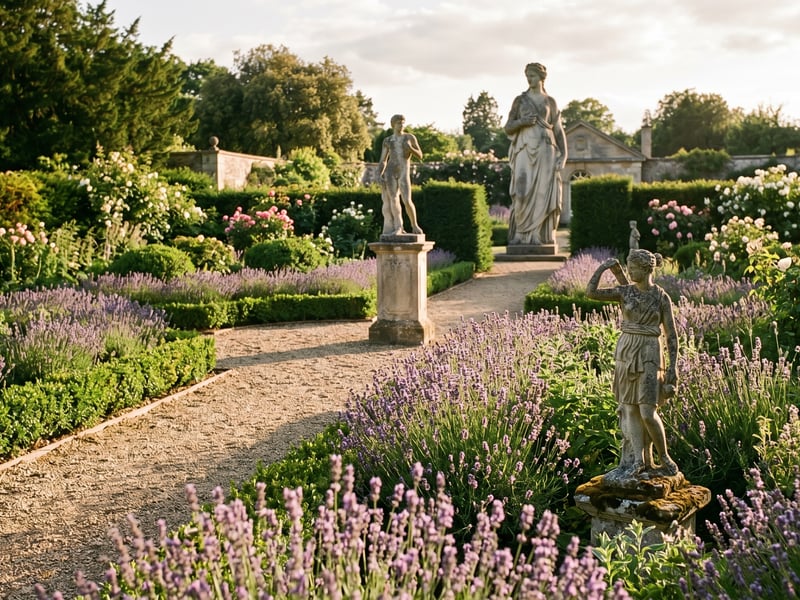
Our experience sizing garden statues for UK gardens
We have sold and delivered classical stone statues to UK gardens for 16 years. The single most common return reason is not damage, finish, or pose — it is size. Customers underestimate how big a statue looks on a website photo, then unbox a piece that fills their patio. Or they buy "small" thinking it sounds modest and end up with something the size of a flowerpot lost in a 4 m border. We started measuring every return for height, garden width, and viewing distance in 2018. Eight years and 200+ returns later, the patterns are clear — and the three rules in this guide solve almost all of them.
Rule 1: the eye-line principle
The most important rule in statue sizing is the eye-line principle. The top of the statue (the head, not the plinth) should sit at or just above the viewer's eye height when seated in the garden. UK seated eye height is roughly 110–120 cm above the ground for an adult on a typical garden chair or bench. Above this line and the statue dominates the view. Well below it and the figure reads as decorative clutter rather than a focal point.
To apply the rule: measure from the ground to your eyes when you sit in your usual garden chair. Subtract the height of any plinth you plan to use. The number you are left with is the maximum height of the statue itself for that seating position. A 50 cm plinth and a 110 cm seated eye line means the statue itself can be up to 60 cm tall. A 90 cm plinth and the same eye line means a 20 cm statue — which is why grand plinths suit busts rather than full figures.
Rule 2: the viewing-distance rule (3× height)
The viewing distance from your main seat to the statue should be roughly 3 times the statue's total height (statue plus plinth). A 60 cm statue needs 1.8 m of clearance, a 1.2 m statue needs 3.6 m, and a 1.8 m statue needs 5.4 m. Closer than this and the eye cannot take in the full piece without scanning. Further than this and the detail dissolves.
This is why the same statue in the same garden works perfectly from one angle and looks lost from another. Measure the actual sightline from your main seat (the one you use most often) to the proposed statue position. Use a tape measure, not your eye — gardens compress visual distance and most people overestimate. If the distance is shorter than 3× the statue height, either move the seating, move the statue, or buy a smaller piece.
Rule 3: the garden-width ratio
A statue should be no taller than 1/8th of the garden's narrowest dimension. A garden that is 4 m wide at its narrowest point supports statues up to 50 cm tall. A garden that is 8 m wide supports up to 1 m. A 12 m garden takes 1.5 m statues comfortably. Wider gardens take wider statues, with the limit always set by the narrowest sightline, not the longest.
This rule exists because the human eye sees a garden as a compressed picture frame. A statue more than 1/8th the width of that frame visually crowds the planting around it. Customers who break this rule usually report the same thing: "It looks too big" or "the rest of the garden disappears." The fix is either a smaller statue or a wider garden — and most people only have the first option.
The same statue in three sizes: Diana the Hunter
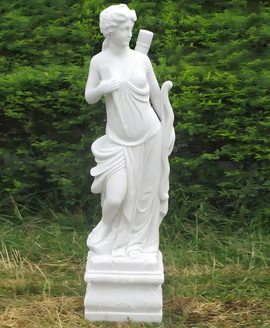
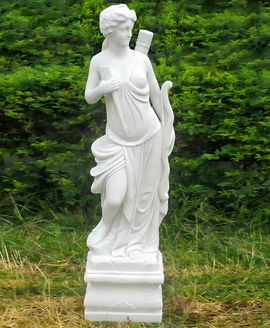
Most classical statues come in small, large, and extra-large versions of the same sculpture. The Diana the Hunter range is the clearest example we ship and the easiest way to show the sizing principle in action. Same figure, same finish, three completely different garden roles.
| Version | Height | Garden it suits | Recommended setting | Price |
|---|---|---|---|---|
| Diana the Hunter Small | ~55 cm | Under 30 sq m (courtyards, small back gardens) | Tucked into a flower border or on a low wall | £155 |
| Diana the Hunter Large | ~95 cm | 30–80 sq m (typical terraced and semi-detached gardens) | On a low plinth as a path-end focal point | £189 |
| Diana the Hunter Extra Large (Matt's Pick for statement) | ~1.4 m | 80 sq m+ (large gardens, country homes, formal lawns) | Centred at the end of a long vista on a tall plinth | £439 |
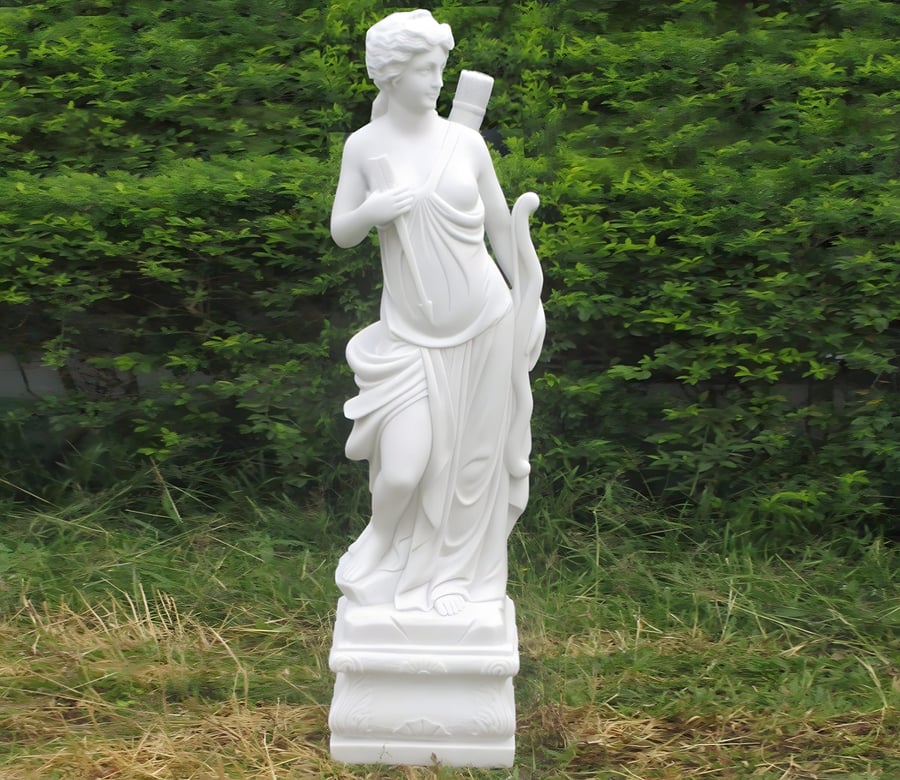
Shop the Diana the Hunter Small — £155 →
The Small version (£155) costs around a third of the Extra Large but in a small back garden it actually works better. Customers who bought the Extra Large for a 4 m wide patio have nearly all returned it — the figure dominates the seating and there is no clearance for the 3× viewing-distance rule. Match the size to the garden, not to your enthusiasm.
The 1.5× plinth rule
A plinth turns a statue into a focal point. The correct ratio is 1.5× the statue's own height. A 60 cm statue belongs on a 90 cm plinth. A 1 m statue belongs on a 1.5 m plinth. Anything shorter looks tentative; anything taller looks top-heavy. Plinths matter because they lift the statue clear of border planting, raise the figure's head to the eye-line height, and signal visually that this piece is the centrepiece of the view.
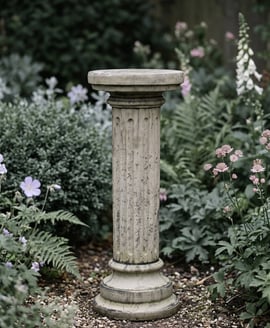
Our most-shipped plinth is the Brighton Column Stone Garden Pedestal at 78 cm tall, which pairs well with statues in the 50–65 cm range. For taller statues, look at the dedicated Stone Pedestals and Stone Plinths ranges. Our pedestals and plinths guide covers the full pairing maths.
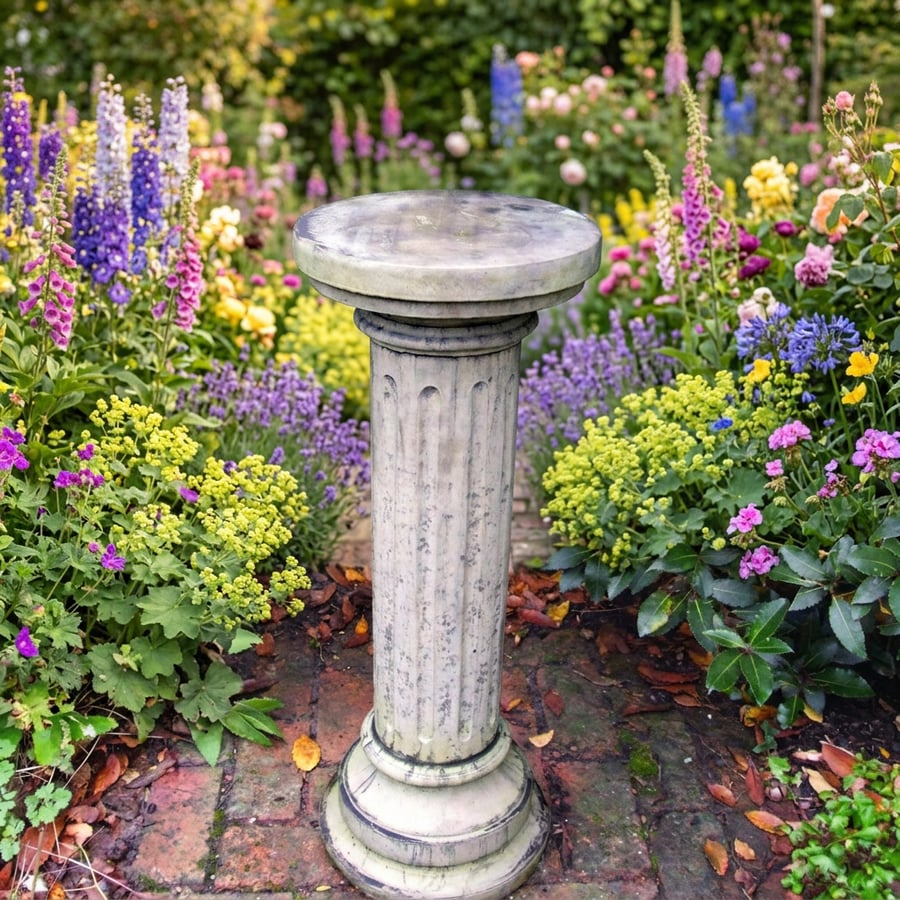
Shop the Brighton Column Stone Garden Pedestal — £235 →
Statue size by garden type
The right statue size depends almost entirely on the garden type and the viewing distance. The breakdown below is what we recommend to customers based on the gardens we deliver to most often.
Balcony or courtyard (under 15 sq m)
Maximum height: 50 cm including any plinth. Pick a single small statue and a single planter — no second focal point. The Diana Small or a bust on a low plinth works. The small garden ornaments guide covers space-saving picks in detail.
Small back garden (15–30 sq m)
Maximum height: 80 cm including plinth. One statue in a corner border or at the end of a short path. Avoid centre-of-lawn placement — small gardens cannot afford to lose a sightline.
Medium garden (30–80 sq m)
Sweet spot: 80–130 cm including plinth. This is the most flexible range and where the Diana Large (95 cm) lives. You can use one statue as the main focal point and a smaller second piece (under 50 cm) elsewhere without competing.
Large garden (80–200 sq m)
Sweet spot: 1.3–1.8 m including plinth. The Diana Extra Large (1.4 m) suits this scale. Position at the end of a long vista, ideally with planting that narrows the eye toward the statue. The large garden ornaments guide covers statement picks for this size range.
Country garden or formal lawn (200 sq m+)
1.8 m and above is needed to read as proportioned. A Heraldic Griffin (over 1 m before plinth) or paired statues either side of an avenue work well. At this scale, two matched statues often beat a single larger one because they frame the view rather than terminate it.
Common sizing mistakes (and the fixes)
After eight years of measuring returns, four mistakes account for the vast majority of "wrong size" complaints. Each one has a specific fix.
Mistake 1: buying for the photo, not the garden. Catalogue photos are shot in spacious gardens with low-angle lenses that make statues look bigger than they really are. Always check the height in cm against your garden's narrowest sightline. Fix: print a piece of A4 at the statue's exact height, tape it to a garden cane, and stand it where the statue will go before ordering.
Mistake 2: ignoring the plinth. A 60 cm statue on a 90 cm plinth is a 1.5 m presence. Many customers calculate for the statue alone and end up with a top-heavy ornament. Fix: always size the statue-plus-plinth combination, not the statue alone.
Mistake 3: centre-of-lawn placement in small gardens. Splits the sightline and makes the garden feel smaller. Fix: corner placement, or end-of-path focal point. Save central placement for gardens over 100 sq m.
Mistake 4: matching the statue size to the wall it sits against. Walls expand the visual frame, so a statue against a 2 m wall reads as smaller than the same statue against a 1 m hedge. Fix: measure the open sightline, not the backdrop, when applying the garden-width rule.
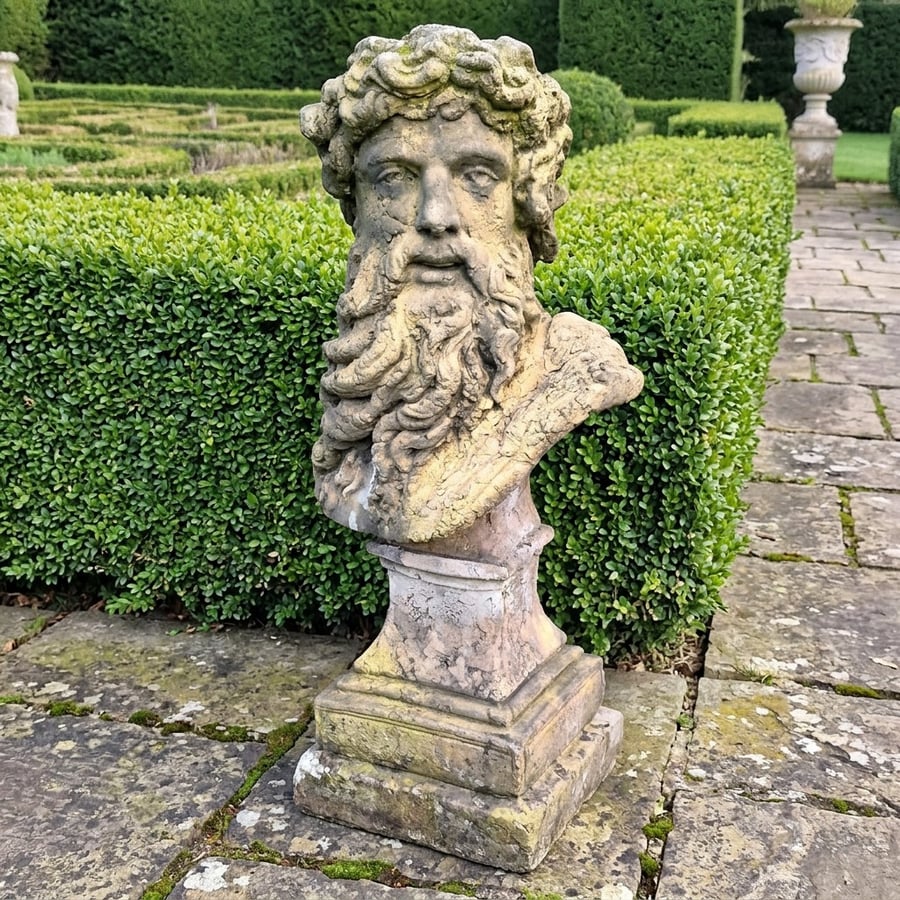
Shop the Hercules Bust Garden Statue — £285 →
Pairs and groups: when two statues beat one
Paired statues either side of a path, gate, or seating area solve two problems at once: they frame a view rather than terminate it, and each statue can be smaller (and cheaper) than a single statement piece. Two 80 cm matching figures often work where one 1.4 m piece would dominate. The Four Seasons Garden Statues set takes this further — four matching figures positioned around the cardinal corners of a lawn or seating square.
For pairs, measure the gap between the two statues. The gap should be at least 3× the height of one statue. Two 80 cm statues placed less than 2.4 m apart compete visually; the same pair at 4 m apart frames an entrance perfectly. Symmetrical pairs read as classical and formal — if your garden is informal cottage-style, a single off-centre piece often works better than a pair.
Matt's tip: live with the size before you commit
Before you order anything over 1 m, mock up the statue at full size in your garden for two days. Stack garden chairs, a bin, anything roughly the right height in the exact spot the statue will go. Live with it for 48 hours. Walk past it at breakfast, at lunch, at evening drinks. If it still feels right, order. If it has started to feel intrusive after one day, you have just saved yourself a £400 delivery cost and a £200 return courier. We have customers who have done this every single time for a decade and not made a single sizing mistake.
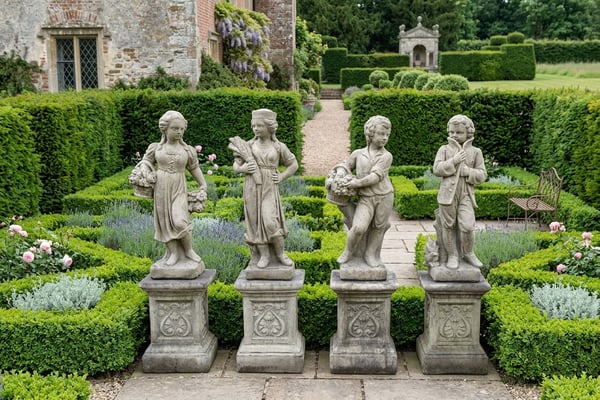
Matt's Pick: Four Seasons Garden Statues
Best For: Medium-to-large gardens (50 sq m+) where a single statue would feel marooned and a paired set is more practical than a single statement piece.
Why I Recommend It: Four matched figures solve the sizing problem by spreading visual weight across the garden. Each piece is small enough to suit a typical sightline, and the set positioned at the four corners of a square lawn or path system creates a coherent formal scheme. The investment is one-off and the visual payoff lasts decades.
Price: £604
Statement-piece sizing for collectors
Compare the full dimensions of our large garden ornaments, then mark the proposed footprint before ordering.
If the garden has the scale for it, a statement piece is the single most transforming purchase in the entire ornaments category. We are talking 1.5 m and above, often hand-carved, often £500+. The Heraldic Griffin at over £600 is the kind of piece that defines a garden for a generation. The Giant Right Hand Garden Statue at £475 is unmistakable modern art that suits architectural courtyards.
For statement pieces, the rules above still apply — eye-line, viewing distance, 1/8th width — but you also need to consider arrival sequence. A statement statue should announce itself gradually as the viewer walks toward it, not greet them at the back door. Site it so it is partly hidden by planting from the house and revealed in full only when the viewer reaches the end of the path. That delayed reveal is what makes the piece feel valuable rather than ostentatious.
Frequently asked questions
What size garden statue suits a small UK back garden?
For gardens under 30 sq m, pick statues 40–80 cm tall including any plinth. Anything bigger crowds the planting and breaks the 1/8th-of-width rule. A 60 cm Diana the Hunter Small on a 30 cm plinth (90 cm total) is the upper limit for a typical terraced-house back garden. Save 1 m+ statues for medium or large gardens with proper sightlines.
How tall should a garden statue be for a medium garden?
For 30–80 sq m gardens, the sweet spot is 80–130 cm including plinth. This range covers the Diana the Hunter Large (95 cm), most classical busts on a 60 cm pedestal, and mid-size mythological figures. One main focal-point statue plus one secondary piece under 50 cm is the maximum — more than that competes for attention.
What's the correct viewing distance for a garden statue?
Roughly 3 times the statue's total height (statue plus plinth). A 60 cm statue needs 1.8 m of clearance from the main seat. A 1.2 m statue needs 3.6 m. Closer than this and the eye cannot take in the full piece without scanning. Further than this and detail dissolves. Measure with a tape, not by eye — gardens visually compress distance.
Does a garden statue need a plinth?
Yes for focal-point statues; no for border or corner-tucked pieces. A plinth at 1.5× the statue's own height lifts the figure clear of planting and raises its head to seated eye level. Without a plinth, a 60 cm statue on the ground reads as ornament; on a 90 cm plinth it reads as focal point. For statues placed into a flower border or on a low wall, the surrounding height does the plinth's job.
What is the eye-line rule for garden statues?
The top of the statue (head, not plinth) should sit at or just above the viewer's seated eye height. UK seated eye height is 110–120 cm above the ground. Above this line the statue dominates; below it the figure feels decorative rather than commanding. This rule explains why grand plinths suit busts rather than full figures — the maths only works if the statue is short.
Can I put more than one statue in a small garden?
One main statue plus one small accent piece is the maximum for gardens under 50 sq m. Two equally-sized statues in a small garden compete for the eye and cancel each other out. If you want multiple pieces, choose a single statement statue plus one decorative bust or animal under 30 cm placed away from the main sightline. Larger gardens can absorb a paired statue arrangement or a four-piece set like the Four Seasons.
How do I know if a statue is too big before I buy?
Print a paper rectangle at the statue's exact height, tape it to a garden cane, and stand it where the statue will go. Walk around the garden for 48 hours. If the cane consistently catches your eye as intrusive, the statue is too big. If it disappears into the planting, the statue is too small. This mock-up method has saved every customer we have recommended it to from making a sizing mistake.
What's the biggest garden statue size sensible for a typical UK garden?
1.4–1.6 m for gardens up to 100 sq m, 1.8 m+ for gardens over 100 sq m. Beyond 2 m, the statue stops scaling proportionally to the garden and starts dominating regardless of where you put it. We rarely recommend anything over 1.8 m to customers in suburban gardens — that scale belongs to country properties, formal lawns, and large rural plots.
Browse our full range
We stock over 200 stone garden statues across small, medium, large, and extra-large versions. Every classical statue we sell is photographed against scale references and the measured height is listed in the product details. Not sure which size suits your sightline? Send us a garden photo with the proposed placement marked and we will recommend a height and plinth combination. Browse our wider collection of garden ornaments if you want to build a coherent scheme around the statue.
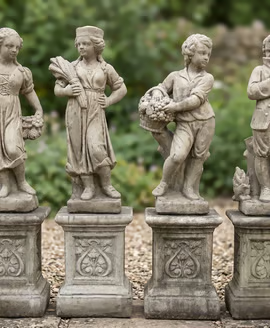
Garden statues across the size range
Related articles
- Large Garden Ornaments: Statement Pieces for UK Gardens
- Small Garden Ornaments: Space-Saving Ideas for UK Gardens
- Stone Pedestals and Plinths: How to Display Garden Statues
- Garden Statues UK: Types, Materials, Placement and Prices
- Where to Place Garden Sculptures: UK Positioning Guide
Matt W
Garden & Outdoor Specialist
Matt has spent over 16 years working hands-on with garden products across the UK. He tests materials in Staffordshire clay soil and hard-water conditions, and writes from direct experience installing, maintaining and repairing everything from stone water features to cast iron furniture. His advice is based on what actually survives a British winter, not what looks good in a catalogue.