
How to Set and Read a Garden Sundial (So It Actually Tells the Time)
Written by Matt W on 15th Jun 2026.
To set a garden sundial so it tells the time, point the gnomon (the angled blade) to true north, not magnetic north, and tilt it to match your latitude, which runs from about 51 degrees in the south of England to 57 in northern Scotland. The dial then shows solar time. For clock time, add or subtract the Equation of Time for the month, then add one hour for British Summer Time from late March to late October.
Matt W | Garden Ornament Specialist
Key Takeaways
- ✔ A sundial keeps time through the gnomon: the angled blade that casts the shadow. Get the gnomon right and the dial works.
- ✔ Point the gnomon to true (geographic) north, not the magnetic north a compass or phone shows.
- ✔ Tilt the gnomon to your latitude: roughly 51° in London, 53° in Manchester, 56° in Edinburgh, 57° in Aberdeen.
- ✔ A correctly set dial shows solar time, which differs from your clock by up to 16 minutes depending on the month.
- ✔ To read clock time: apply the Equation of Time for the month, add a longitude correction if you are west of Greenwich, then add 1 hour for British Summer Time.
- ✔ Our brass dials are cut for UK latitude, so the gnomon angle is already close for any British garden.
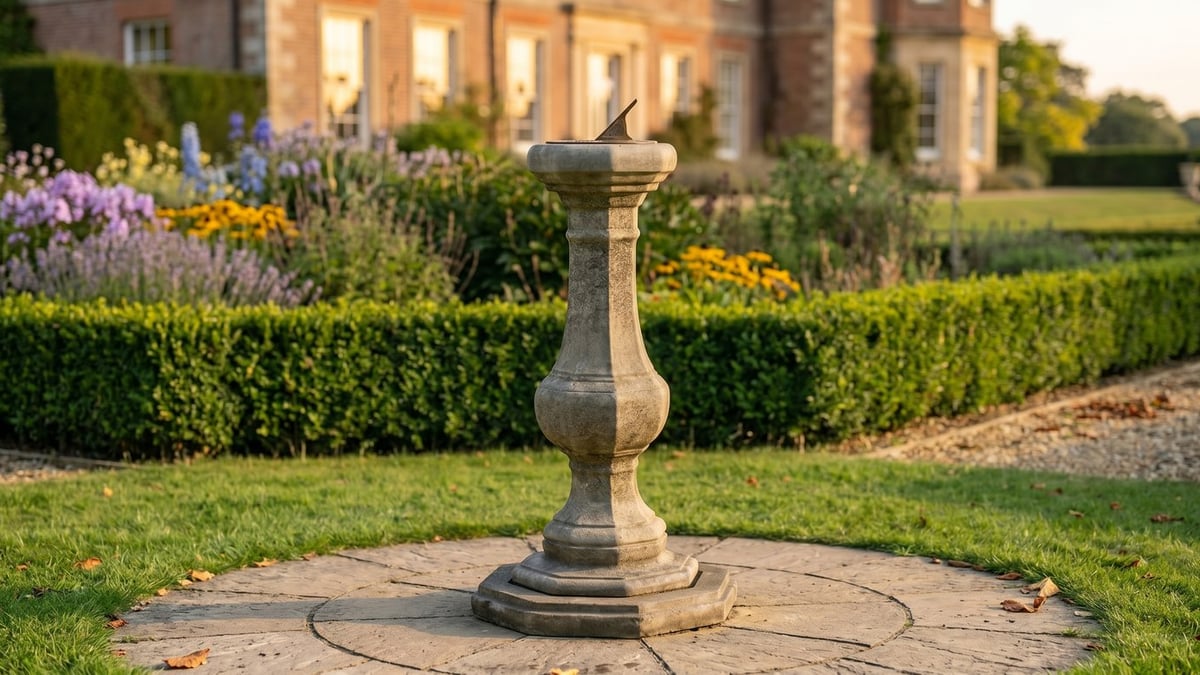
A horizontal brass dial set on a stone pedestal. Aligned to true north and tilted to its latitude, it reads solar time all summer. Browse our sundials and armillary spheres.
A sundial that points the wrong way is just an ornament. Set it properly and it becomes the oldest working instrument in your garden, accurate to within a few minutes once you know how to read it. The job has three parts: aim the gnomon at true north, tilt it to your latitude, then learn the small corrections that turn the dial reading into clock time. None of it needs tools beyond a phone and ten minutes. This guide walks through each step, and if you are still choosing a dial, our sundials and armillary spheres buying guide covers history, styles and sizing.
What customers ask us most
The call we field most about sundials is some version of "it does not tell the right time." Nine times in ten, nothing is faulty. The dial has been lined up with a phone compass, which shows magnetic north, and it has been read straight off the face without correcting for the time of year or for British Summer Time. People expect a sundial to match a wristwatch to the minute. It will not, and it was never meant to. It shows true solar time for your exact spot on the planet, which is a different and older thing. Once owners understand that, the disappointment turns into the bit they enjoy: a garden object that reads the sky rather than a battery.
What you need to set a sundial correctly
Setting a horizontal garden sundial comes down to three alignments, in this order. First, rotation: the gnomon must point to true north so the shadow sweeps the hours symmetrically. Second, tilt: the gnomon angle must equal your latitude, or the hour lines drift through the day. Third, level: the dial face must sit dead flat, because a tilted plate throws every reading off. Get those three right and the dial is set for life. The reading corrections come afterwards, and they are arithmetic, not adjustments to the dial. You will need a phone with a compass and a maps app, a small spirit level, and a calm ten minutes on a sunny day.
How a sundial actually tells the time
The shadow does not come from the sun moving. It comes from the earth turning, and the gnomon is built to track that turn. The gnomon's sloping edge, called the style, has to sit parallel to the earth's axis. That happens automatically when two things are true: the gnomon points to true north, and its angle above the dial equals your latitude. Once the style is parallel to the axis, the shadow rotates a steady fifteen degrees an hour and the hour lines mean something. This is why a sundial bought in Cornwall and a sundial bought in Inverness are not quite interchangeable: the further north you go, the steeper the gnomon needs to sit.
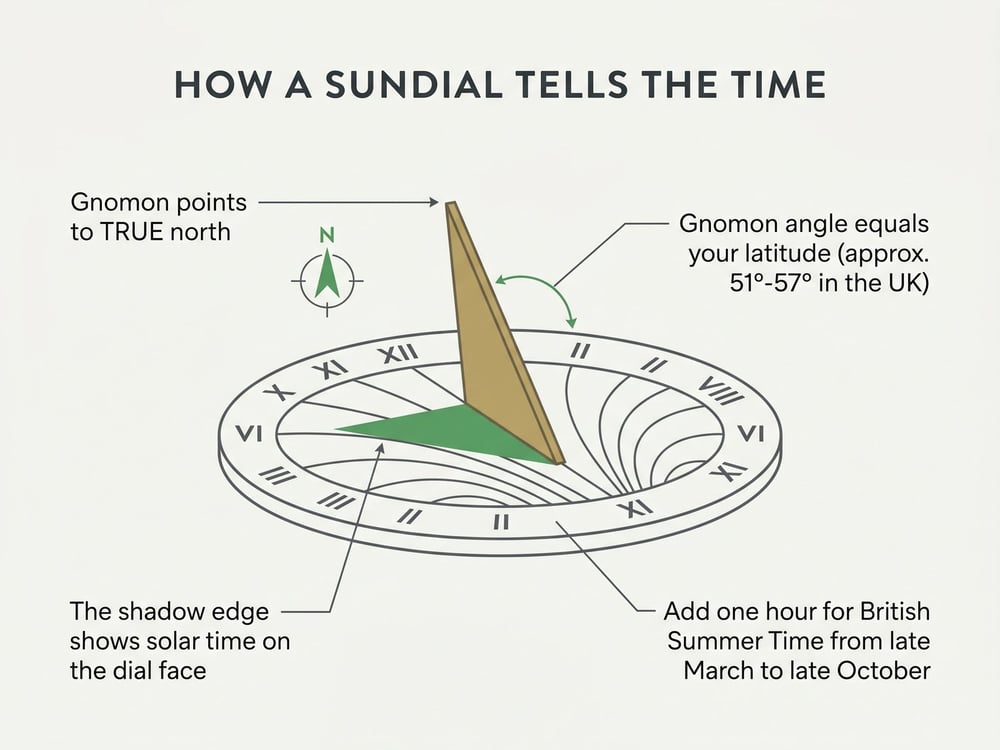
The gnomon points to true north and tilts to your latitude, so its edge sits parallel to the earth's axis. The shadow edge then marks solar time on the dial.
Step 1: Point the gnomon to true north, not magnetic north
True north and magnetic north are not the same place, and a sundial wants true north: the direction of the geographic North Pole. A compass and a phone point to magnetic north, which wanders over the years. Across the UK in 2026 the gap between the two is small, within a degree or so in most of England, but it is the wrong reference in principle and it shifts, so do not build your alignment on it. The reliable method is the sun itself. At local solar noon the sun sits due south, so the gnomon's shadow falls due north. Use a maps app or a clear-day shadow rather than the compass needle.
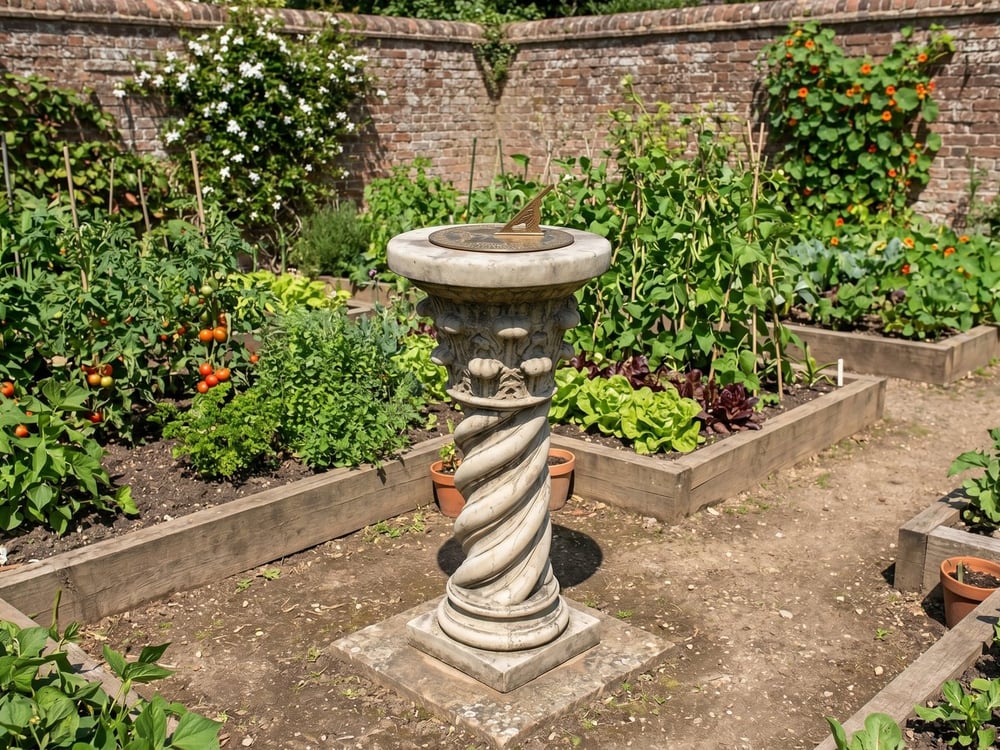
At midday the shadow is sharpest and easiest to align. Rotate the dial until the noon shadow runs along the XII line. Shop the Roman Pedestal Sundial →
Two ways to find true north without trusting the needle:
- The maps method. Open a satellite maps app, find north on screen, and sight a fixed line in your garden, such as a path edge or wall, that runs north to south. Set the dial to that line.
- The noon-shadow method. Work out when solar noon falls for your spot (it is rarely 12:00 on the clock). At that moment, any vertical stick casts a shadow pointing due north. Turn the dial until the gnomon shadow lands on XII.
Step 2: Set the gnomon angle to your latitude
The gnomon's angle above the dial face must match your latitude. A dial built for 51 degrees and used in Scotland will read increasingly off as the seasons change, because the style is no longer parallel to the earth's axis. Most quality horizontal dials sold in Britain, including ours, have the gnomon cut for central UK latitude, around 52 degrees. That is within a degree or two of almost everywhere people actually live, from Cardiff to Newcastle, so the residual error is a matter of minutes rather than hours. If you are at the extremes, far north Scotland or the south coast, it is worth knowing your figure.
| Location | Latitude (gnomon angle) |
|---|---|
| London / Bristol / Cardiff | about 51.5° |
| Birmingham | about 52.5° |
| Manchester / Leeds | about 53.5° |
| Newcastle / Belfast | about 55° |
| Edinburgh / Glasgow | about 56° |
| Aberdeen / Inverness | about 57° |
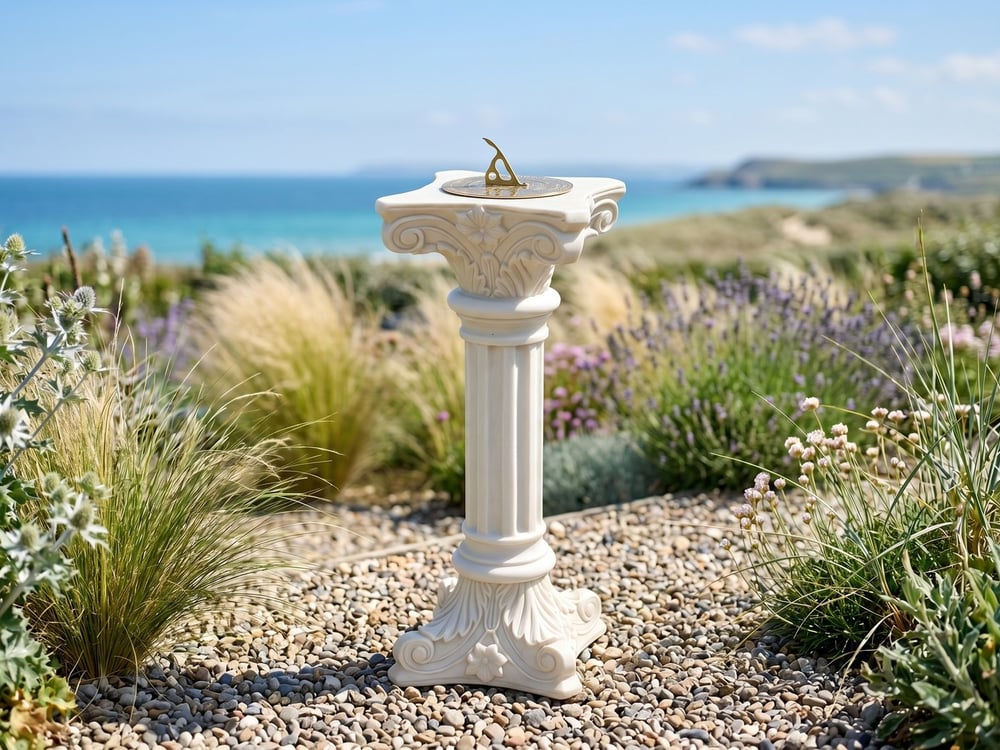
A column dial in an exposed coastal garden. The brass dial is cut for UK latitude, so it is ready to set wherever you are. Shop the Column Stone Sundial →
Step 3: Level the dial and read the shadow
A sundial only works on a level plate. Stand the pedestal on firm, flat ground, set the dial on top, and check it with a small spirit level in two directions. If the plate leans, the hours bunch on one side and stretch on the other. Most carved stone pedestals are heavy enough to stay put once levelled, but on a lawn it pays to bed the base on a paving slab so it does not sink and tilt over a wet winter. With true north set, the latitude angle right and the plate level, read the time from the edge of the shadow where it crosses an hour line. That reading is solar time, and the next section turns it into clock time.

Bed a pedestal on a slab so it stays level through a wet winter. A leaning dial bunches the morning hours. Shop the Victorian Pedestal Sundial →
Reading the dial: why solar time is not clock time
A correctly set sundial reads solar time, which drifts away from clock time for two reasons that have nothing to do with the dial. The first is the Equation of Time: the earth's orbit is an ellipse and its axis is tilted, so the sun runs ahead of the clock at some times of year and behind it at others, by as much as sixteen minutes. The second is longitude. Clocks across Britain all show Greenwich time, but the sun reaches a garden in Bristol about ten minutes later than one in Greenwich, because Bristol sits roughly 2.5 degrees of longitude west. Every degree west of Greenwich is four minutes of delay.
Matt's Tip: stop chasing the minute
I tell every customer the same thing: set the dial well, learn the monthly figure, and then enjoy it for what it is. A garden sundial that lands within five minutes of your watch is doing a beautiful job. If you want it spot on for one date, set it at solar noon on a clear day in mid-April or mid-June, when the Equation of Time is near zero, and it will look uncannily accurate for weeks. The rest of the year, the table below does the work in your head.
Equation of Time: the minutes to apply each month
This is the correction that turns the dial reading into mean (clock) time, before BST. A plus figure means the sundial is ahead of the clock, so you subtract those minutes; a minus figure means it is behind, so you add them. The values are approximate, taken around the middle of each month, which is close enough for any garden.
| Month (mid) | Sundial vs clock | What to do |
|---|---|---|
| January | 9 min behind | Add 9 min |
| February | 14 min behind | Add 14 min |
| March | 9 min behind | Add 9 min |
| April | about right | No change |
| May | 4 min ahead | Subtract 4 min |
| June | about right | No change |
| July | 5 min behind | Add 5 min |
| August | 4 min behind | Add 4 min |
| September | 5 min ahead | Subtract 5 min |
| October | 13 min ahead | Subtract 13 min |
| November | 16 min ahead | Subtract 16 min |
| December | 4 min ahead | Subtract 4 min |
So a worked example for a Bristol garden at the height of summer: the dial reads 1 o'clock. June needs no Equation of Time change. Bristol is about 10 minutes west of Greenwich, so add 10 minutes to get 1:10 GMT. Then add 1 hour for British Summer Time, giving 2:10 on your watch. The same dial reading in November would need 16 minutes subtracted, plus the 10-minute longitude correction, and no BST, landing near 12:54. Stone ornaments only improve as they weather in, and a brass dial is no different, as we cover in why stone garden ornaments get better with age.
Horizontal dial or armillary sphere?
The two classic garden timepieces work on the same principle but look and read very differently. A horizontal dial is the flat brass plate most people picture, easy to read at a glance and the simplest to set. An armillary sphere reads time on the inside of a central ring, with the arrow itself acting as the gnomon, and it makes a far stronger sculptural statement on a pedestal. Both need the same true-north and latitude alignment. The armillary's equatorial band carries the hour marks, and its arrow must point to the celestial pole, which is the same true-north-and-latitude rule in a different form.
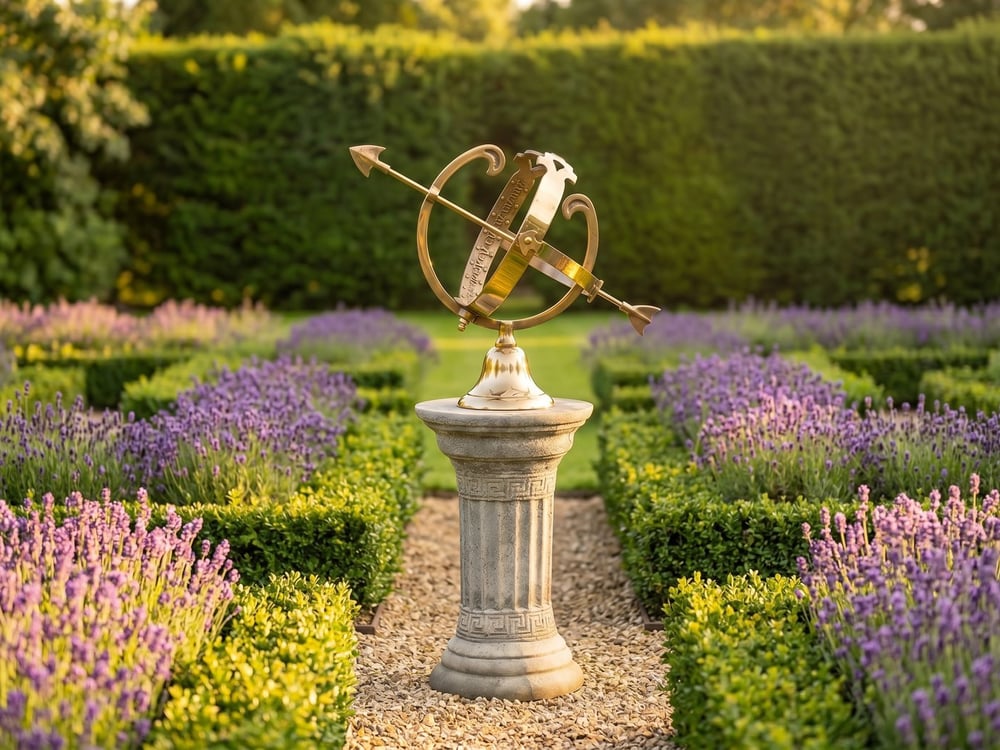
An armillary reads time on its equatorial ring, with the arrow as the gnomon. It anchors a formal planting beautifully. Shop the Brass Armillary →
| Feature | Horizontal dial | Armillary sphere |
|---|---|---|
| How you read it | Shadow on a flat plate | Shadow on an inner ring |
| Ease of reading | Easiest at a glance | Takes a moment to learn |
| Sculptural presence | Classic, understated | Bold, architectural |
| Setting it up | True north + latitude + level | True north + latitude (arrow to pole) |
| Best placed | Lawn centre, herb garden, path junction | Parterre centre, courtyard, focal point |
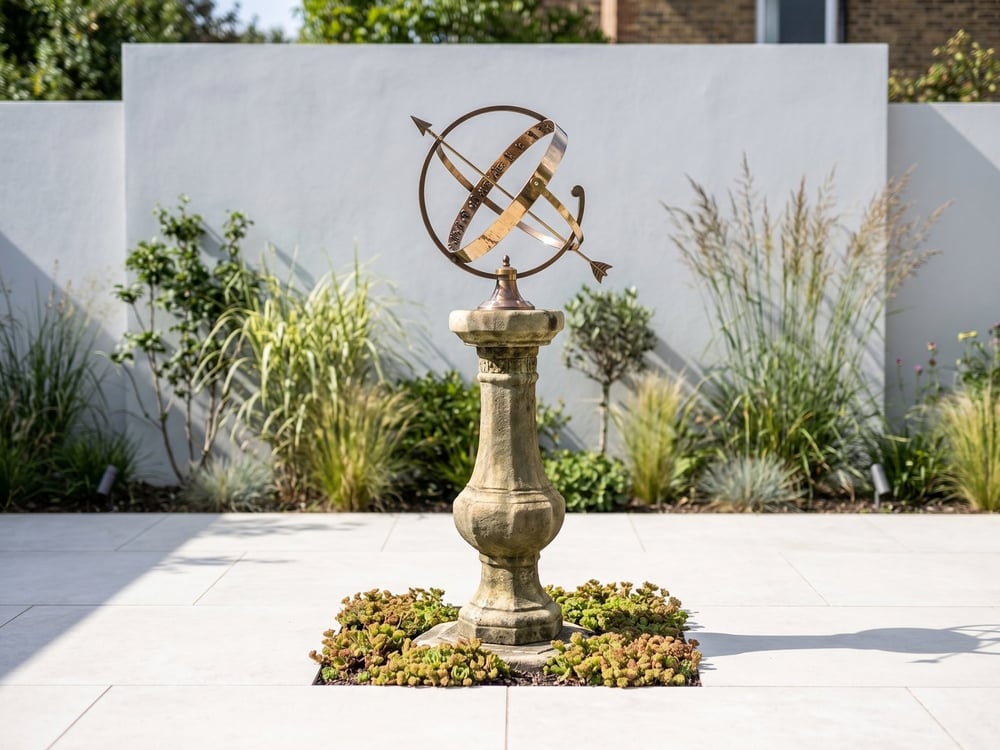
A large armillary holds its own as a courtyard centrepiece. Height matters: a tall pedestal lifts it to eye level. Shop the Large Armillary →
Whichever you choose, height and base matter as much as the dial. A sundial reads best at around waist to chest height, which is why the pedestal is part of the instrument, not just a stand. Our guide to garden obelisks and finials covers the same idea of using height to give a flat border structure and a focal point.
Matt's pick: the easiest dial to set and read
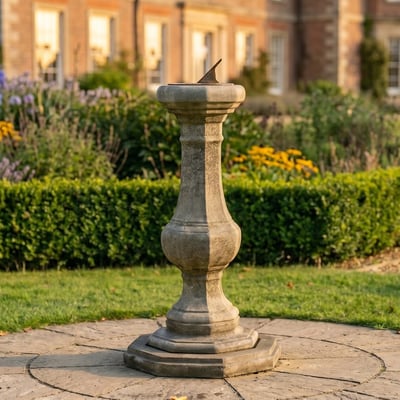
Matt's Pick for a first sundial
Best For: Anyone who wants a dial that is simple to set and easy to read
Why I Recommend It: The horizontal brass dial is the most forgiving piece we sell. The gnomon is already cut for UK latitude, so you only have to point it north and level it. The weathered stone pedestal lifts it to reading height and is heavy enough to stay put once bedded on a slab.
Price: £360
Sundials and armillary spheres, ready to set
More than 40 designs in aged brass on hand-carved stone pedestals, each dial cut for UK latitude, with free UK mainland delivery and 30-day returns.
Browse All SundialsFrequently asked questions
Why does my sundial not match my watch?
A sundial shows solar time, which differs from clock time by up to about 16 minutes. Two things cause the gap: the Equation of Time, which changes month to month, and your longitude, since clocks across Britain all run on Greenwich time. Apply the monthly figure, add four minutes for every degree you sit west of Greenwich, then add an hour for British Summer Time, and the dial and watch will agree.
Which way should a sundial face?
The gnomon must point to true north, so the dial faces south. True north is the direction of the geographic North Pole, not the magnetic north a compass shows. Find it from the sun: at solar noon a vertical shadow points due north. Rotate the dial until the gnomon's noon shadow falls on the XII line and it is correctly oriented.
What angle should the gnomon be?
The gnomon angle should equal your latitude, between about 51 and 57 degrees in the UK. That tilt makes the gnomon's edge parallel to the earth's axis, which is what lets the shadow keep even time. Most dials sold in Britain, including ours, are cut for central UK latitude near 52 degrees, close enough for gardens from Cardiff to Newcastle.
Do I need to reset my sundial in summer and winter?
No, you never move a correctly set dial; you adjust the reading instead. The dial stays fixed once it is aligned to true north and your latitude. What changes is the correction you apply: the Equation of Time figure for the month, and the extra hour for British Summer Time between late March and late October.
Can a sundial work in a shady garden?
It needs direct sun on the dial to cast a shadow, so it must sit where the sun reaches it. A spot that gets sun from mid-morning to mid-afternoon will tell time across the most useful part of the day. Deep shade under trees or against a north wall will leave the dial blank, however well it is set.
How accurate is a garden sundial?
Set properly and read with the monthly correction, a garden sundial lands within a few minutes of clock time. The limits are the Equation of Time and longitude, both of which the corrections handle, plus the sharpness of the shadow edge. For a garden ornament that runs on nothing but sunlight, a few minutes is remarkable accuracy.
Related guides
- Stone pedestals and plinths — how to get a sundial or statue to the right height.
- Garden statues for period properties — matching classical pieces to Georgian, Victorian and Edwardian homes.
- Garden ornament trends 2026 — what is leading UK garden decor this year.
- How to clean stone garden ornaments — keeping a pedestal looking its best.
- Browse our full range of garden ornaments to pair with your sundial.