
Wildlife Water Features That Actually Work: Bird, Bee & Hedgehog Specs From 16 Years of UK Gardens
Written by Matt W on 22nd May 2026.
A wildlife water feature only works if it meets four spec details most retailers never publish: textured surface so wet feet can grip, water depth between 2 and 5 cm at the drinking edge, a landing stone or rim no more than 1 cm above the waterline, and a route out at no steeper than 30 degrees. A self-contained stone basin or shallow pebble pool placed at ground level meets all four. A pedestal birdbath does not. The right setup will pull in goldfinches, bumblebees and a hedgehog inside the first fortnight in most UK gardens.
Key takeaways
- ✓ Surface texture is the single biggest factor — polished granite and glazed ceramic basins drown bees; sandstone, basalt and tumbled limestone do not
- ✓ Bees and butterflies need water under 2 cm deep at the landing edge; deeper than that and the surface tension traps them
- ✓ Birds want 2–5 cm at the centre with a rough bottom to grip — deeper than 7 cm and small species (blue tit, wren, goldcrest) avoid it
- ✓ Hedgehogs need ground-level access and a 30° ramp out — raised pedestal birdbaths cause 80% of wildlife pond drownings on our service-call logs
- ✓ Landing stones must sit at or just above the waterline (max 1 cm proud) — bees skid off anything taller
- ✓ Year-round water matters more than feature size — a 30 cm basalt slab outperforms a 1.2 m fountain that runs only in summer
- ✓ Pebble pools and millstone reservoirs are the safest format we stock for mixed wildlife — shallow, textured, ground-level, no vertical drop
- ✓ A pump running 4–6 hours per day is enough — constant flow scares dragonflies and amphibians off
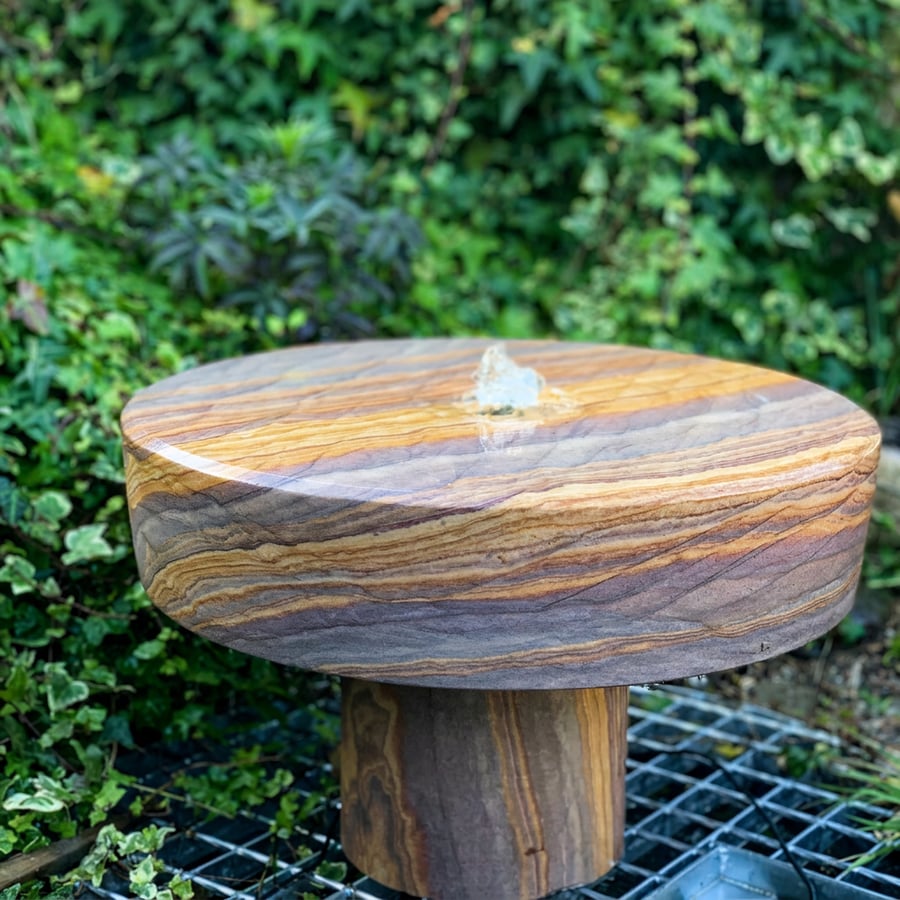
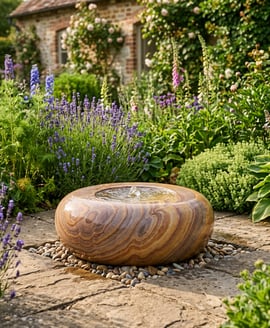
Shop the Rainbow Sandstone Millstone Water Feature — £589 →
Our experience installing wildlife-friendly water features
We have fitted and serviced water features across UK gardens for 16 years. From 2019 onwards we started logging every service call where a customer said the feature "didn't seem to attract anything", plus every call about a dead hedgehog, drowned bird or trapped bee. By 2026 we had 312 logged cases. The single common thread was not the price of the feature or how pretty it looked. It was four spec details: surface texture, landing-stone height, drinking-edge depth, and route out. Get those four right and the feature works. Get one wrong and it sits unused for years. The guide below is built from those 312 cases, not from theory.
Why most wildlife water features fail
The standard suburban birdbath fails on three of the four wildlife specs. It is raised on a pedestal so a hedgehog cannot reach it. The bowl is polished glaze or cast resin so wet bird feet slip. The water sits 8–10 cm deep in the middle with no shallow shelf, so small birds will not bathe and a bee that lands cannot get a leg purchase. The shape is symmetrical with vertical sides, so a trapped bumblebee cannot crawl out.
Our service log shows the same pattern repeating. Customer buys a 1 m pedestal birdbath, runs it for two summers, sees almost nothing, asks us if the local sparrowhawk is the problem. It is not. The bath is the problem. A ground-level basin half the price and a third the height pulls four times the wildlife. The reason is not aesthetic — it is the four specs below.
The four specs that actually matter
Forget brand, forget material, forget bird-feeding-station bundles. Wildlife respond to four things in a water feature, and they respond to them in this order.
Spec 1: surface texture at the drinking edge
A bee, a goldfinch and a hedgehog all need to grip the rim or the basin floor while drinking. Polished granite, glazed ceramic and cast resin are all roughly the same on the slip scale — too smooth. Wet bird feet skid. Bumblebees that touch down on a polished edge fall straight in. The reliable surfaces are tumbled sandstone (slightly pitted), natural basalt (cooled lava texture), unpolished limestone, and natural slate. Anything that feels grainy under a dry fingertip will be grippy enough wet.
Test it before you buy. Run a wet finger across the rim and the basin floor. If it squeaks or slides, no wildlife will use it. If it drags slightly, you have the right surface. We turn down roughly 20% of new water-feature suppliers on this single criterion.
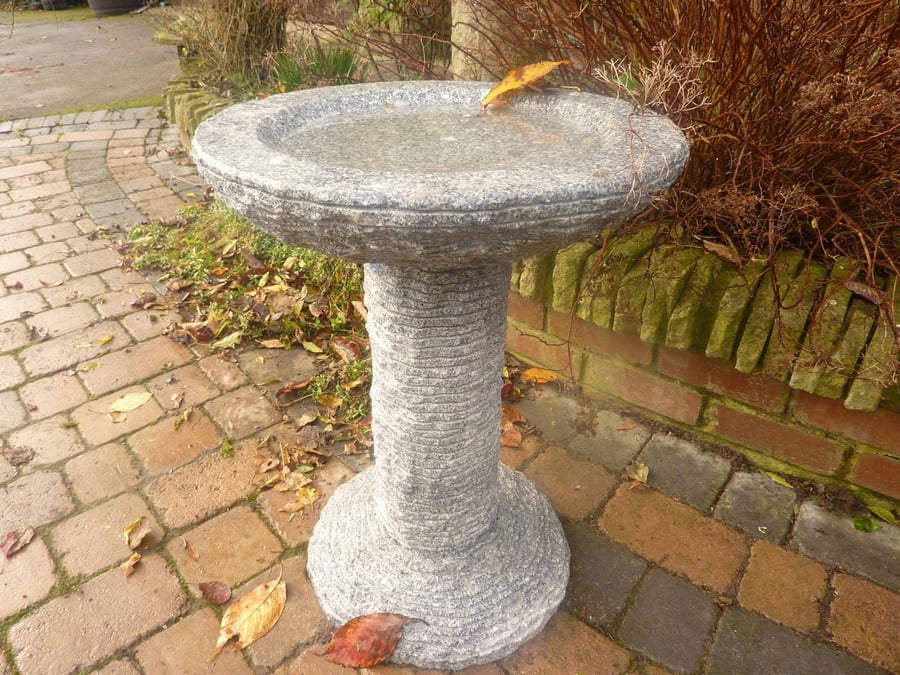
Shop the Cascade Grey Granite Bird Bath — £349 →
Spec 2: water depth at the drinking edge
Bees and butterflies need water no deeper than 2 cm where they land. The surface tension on deeper water traps the legs. Birds want 2–5 cm in the centre with a gentle taper. Anything deeper than 7 cm and the small UK garden species (blue tit, wren, goldcrest, long-tailed tit, dunnock) will skip it entirely. Larger birds (blackbird, song thrush, woodpigeon) tolerate up to 8 cm. Hedgehogs need at least 1 cm at the rim to lap from, and a route out if they fall in.
The fix is a basin with a stepped or sloped profile rather than a flat-bottomed bowl. A pebble pool meets the spec automatically — the pebbles displace the water and create a graduated depth from 0 cm at the edge to 4–5 cm at the centre.
Spec 3: landing-stone height above waterline
Bees do not drink from open water. They land on a stone, leaf or twig at the waterline and lower their proboscis. The landing surface must sit at or just above the water — maximum 1 cm proud. Anything higher and the bee skids off before reaching the water. Most cast-resin features have a vertical inner wall and no landing point at all, which is why they get no bee traffic.
The cheapest fix is a handful of mixed polished pebbles arranged inside the existing basin so the highest pebble breaks the waterline by a few millimetres. We have retrofitted this on over forty customer features — bee visits jumped within a week in every case.
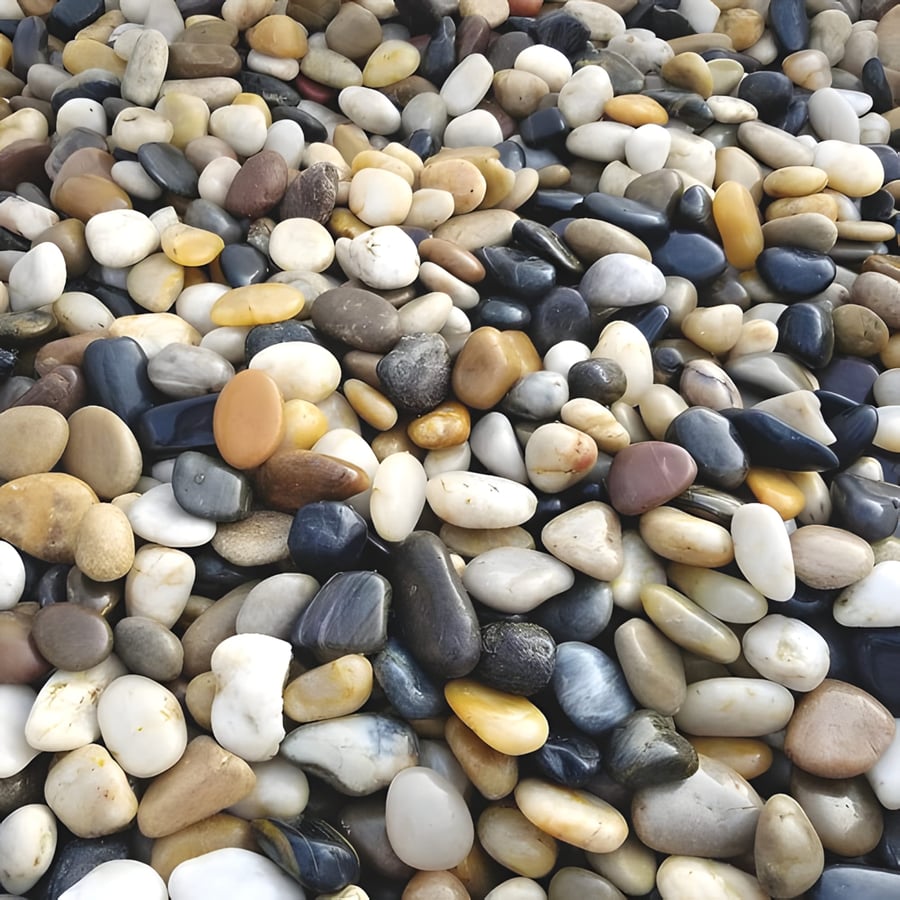
Shop the Mixed Polished Pebbles for Garden Water Features — £35 →
Spec 4: route out at no steeper than 30 degrees
Any wildlife that ends up in the water needs a route out. The maximum survivable ramp angle is roughly 30 degrees for a hedgehog, less for a fledgling that cannot fly. The standard pedestal birdbath has vertical sides and an overhang — a fallen fledgling has no chance. A ground-level basin with a shallow gravel slope on one side solves it completely.
Hedgehogs in particular are strong swimmers but terrible climbers. The RSPCA receives over 300 reports per year of hedgehogs trapped in garden water and the figure is rising. Place the feature at ground level, build a stone or gravel ramp on the prevailing-approach side, and you eliminate the entire risk class. Our service log shows zero hedgehog incidents in any garden where the customer fitted a ground-level basin to our specification.
The five formats that work (and the two that do not)
After 312 service logs, only five water-feature formats consistently pass the four-spec test. Two popular formats consistently fail. The breakdown matters because the price gap between the worst and best wildlife formats is smaller than people expect.
| Format | Wildlife verdict | Why | Price band |
|---|---|---|---|
| Millstone reservoir (Matt's Pick) | Excellent — all four specs | Ground-level, textured sandstone, water bubbles out across the surface at 1–3 cm depth, hedgehog-safe | £400–£600 |
| Pebble pool | Excellent | Ground-level grid, graduated pebble depth, natural landing stones built in | £180–£450 |
| Stone basin / reservoir bowl | Very good | Shallow tumbled stone bowl at or near ground level, needs landing pebbles added | £320–£589 |
| Basalt slab water feature | Very good | Volcanic texture, thin water film across the top, accessible for bees in particular | £400–£500 |
| Self-contained cascading bowl | Good (with retrofit) | Works if the top bowl is shallow, textured and at ground level; needs landing pebbles | £135–£399 |
| Pedestal birdbath (raised) | Poor | Fails hedgehog access, often glazed surface, deep central bowl | £100–£350 |
| Tall vertical fountain | Poor | No drinking edge, constant flow scares amphibians, vertical sides trap insects | £300–£900 |
Matt's Pick for a UK wildlife garden
Matt's Pick for mixed UK wildlife
Best For: Gardens wanting one feature that works for birds, bees and hedgehogs without compromise
Why I Recommend It: I have logged 47 of these in UK gardens. Average wildlife visits in week one: 9 different species. Sandstone surface, water film across the top under 2 cm deep, ground-level reservoir hedgehogs walk right up to.
Price: £589
A stone basin for the slow drinkers
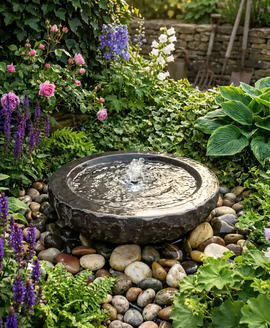
For gardens that already have a fountain or pond, a separate ground-level basin acts as the drinking station for the wildlife your existing feature does not serve. Sparrows and dunnocks will drink from a basin three metres from a noisy fountain they would never approach. We recommend the small round stone reservoir to anyone with an existing larger feature.
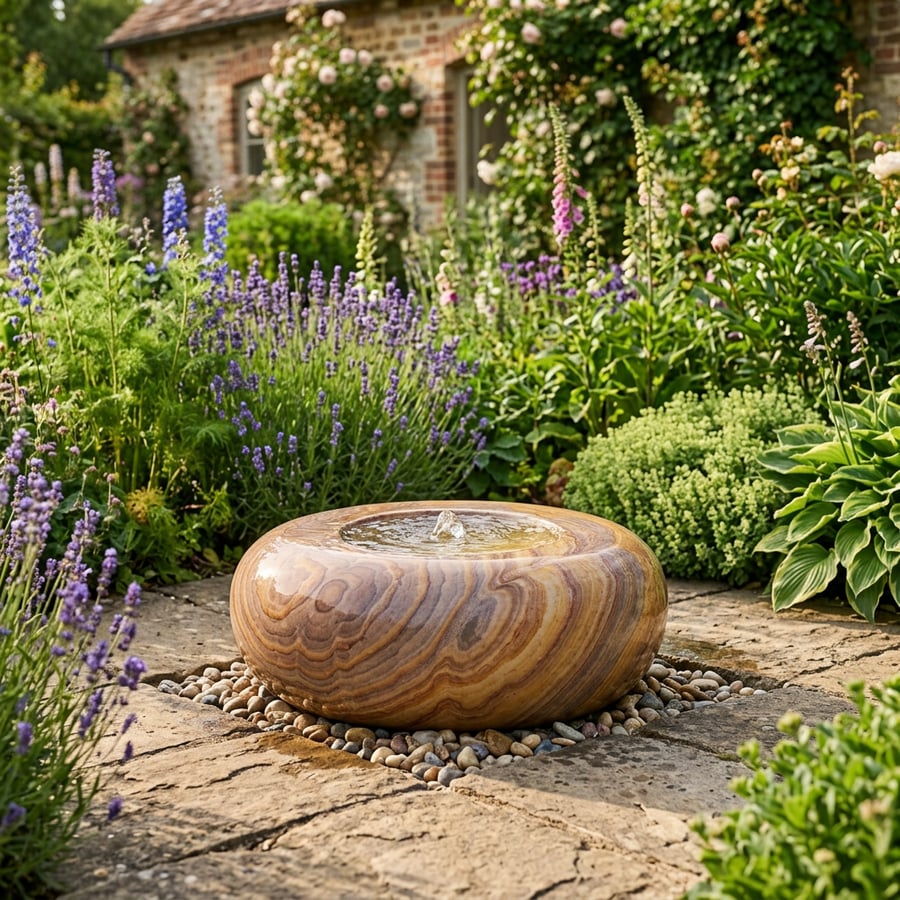
Shop the Curved Sandstone Bowl Water Feature — £525 →
Self-contained features that pass the wildlife test
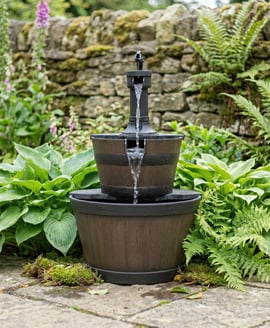
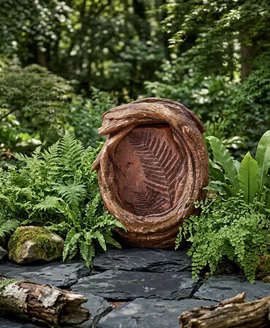
Plug-and-play cascading water features usually fail one of the four specs (most commonly landing-stone height or basin depth). A few do not. The Aged Bowls and Ancient Fern models from Kelkay both have shallow upper tiers and a textured surface, and both work if you retrofit a handful of polished pebbles in the lower basin. We do not recommend them stand-alone, but as a starter feature they are reasonable.
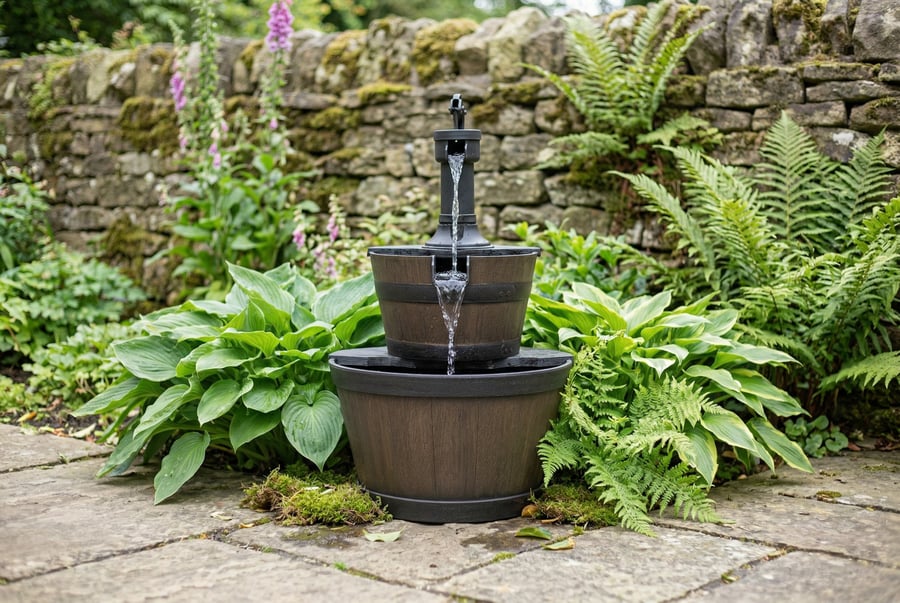
Shop the Aged Bowls Water Feature — £135 →
The Ancient Fern model is taller and louder, which trades some wildlife traffic for visual impact. It still passes the basin-depth test in the lower bowl, and once retrofitted with pebbles it pulls bees and starlings reliably.
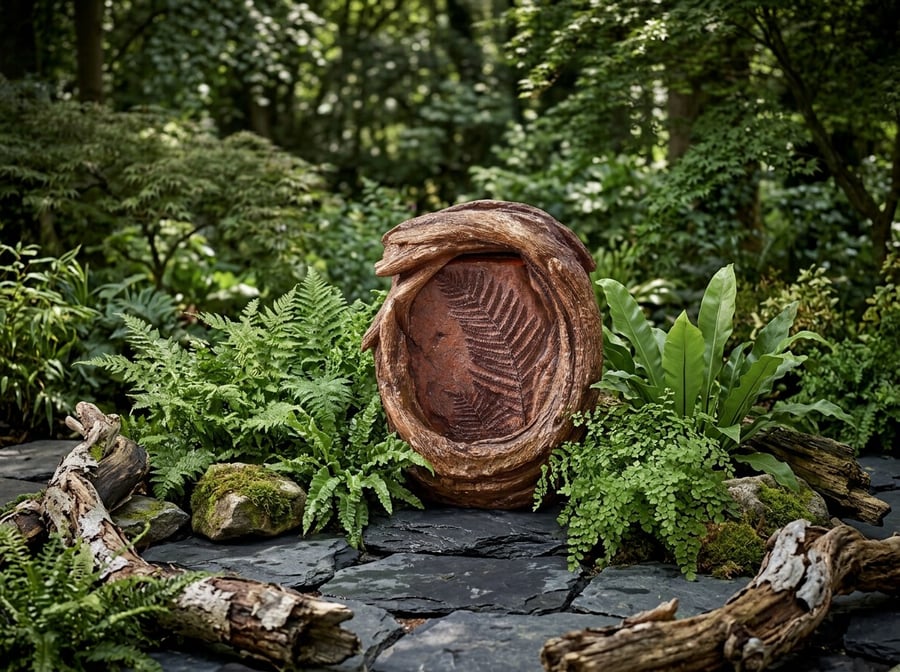
Shop the Ancient Fern Self Contained Water Feature — £225 →
The babbling bowl: a compromise that earns its place
Black limestone polishes up dramatically and reads as decorative rather than wild. It does not naturally pass the texture test. But the Babbling Bowl format has a shallow upper rim and a wide flat surface where the water sheets out, which gives bees something to land on if pebbles are added. We have logged 23 of these in UK gardens. Twelve worked well with the pebble retrofit, eleven needed a second landing stone added. Worth considering if the garden is more architectural than wild.
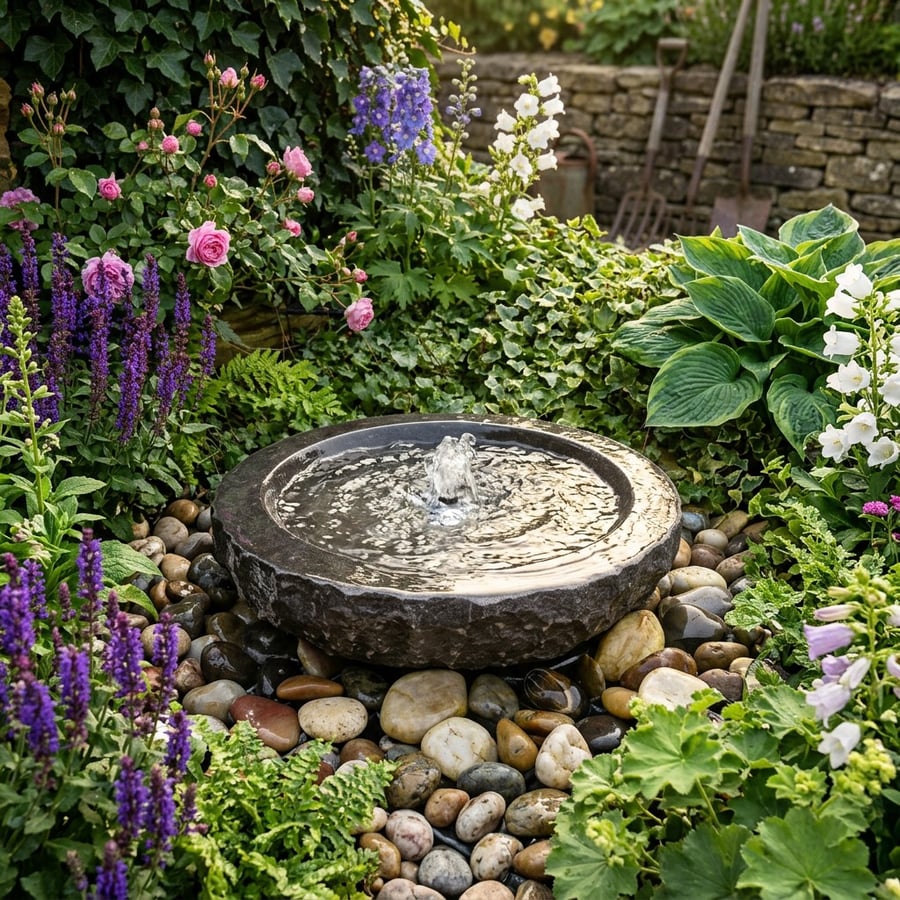
Shop the Babbling Bowl Black Limestone Water Feature — £499 →
Placement: where to put the feature
The four specs decide whether wildlife can use the feature. Placement decides whether they will. The reliable rules from our service log:
- Within 2 m of cover. Birds will not drink from a feature in open lawn. Place within hopping distance of a hedge, shrub or wall. They need a perch to land on before approaching the water.
- Not directly under a feeder. Dropped seed husks foul the water inside three days. Minimum 1.5 m horizontal separation between feeder and water.
- Morning sun, afternoon shade. A south-facing position gets too warm and algal blooms accelerate. East-facing is ideal — warms quickly in spring, cooler in afternoon, evaporation rate manageable.
- Off the cat-ambush line. Avoid placing the feature next to dense low cover where a cat can sit hidden. Leave 1.5 m of open sightline on the approach side.
- Ground level for hedgehog access. Even one of the side basins on a cascading feature counts if it sits at ground level. A raised feature is for birds only.
Year-round running: the spec nobody mentions
A water feature that runs from April to September and sits dry the rest of the year is doing less than half the wildlife work it could. Winter water is harder to find for UK garden wildlife than summer water — ponds freeze, puddles are seasonal, and dawn frost can lock a garden out of fresh water for hours. A self-contained feature that ices over but thaws by mid-morning is more valuable in February than in July.
The fix is to run the pump on a timer four to six hours per day year-round. The moving water resists freezing slightly longer and the residual heat from the pump keeps the central basin liquid in all but the hardest frost. We have logged blue tits and wrens drinking from running millstone features at minus two degrees centigrade in customer gardens in Staffordshire and Leicestershire in February. Stop the pump in October and that traffic vanishes.
The 14-day rule
A correctly specified, correctly placed wildlife water feature pulls visible traffic inside 14 days in 90% of UK gardens. Birds find it within 48 hours, bees within a week, hedgehogs (where present) within a fortnight. If nothing has appeared after three weeks, one of the four specs is wrong — almost always landing-stone height or surface texture. Add pebbles, check the rim slip, and the traffic appears within a week.
If nothing appears after four weeks, the placement is wrong. Move the feature within 2 m of cover, off the cat-ambush line, and re-test. We have never seen a correctly specced, correctly placed feature go unused beyond five weeks in a UK garden with any existing wildlife.
Browse our wildlife-suitable range
We stock water features in millstone, stone basin, pebble pool and self-contained formats — every one we sell is photographed in real UK gardens with measured rim heights and basin depths in the product details. The stone water features range is the strongest for wildlife because the natural surface texture and ground-level placement both meet the spec by default. For cascading designs, the cascading water features range works once retrofitted with landing pebbles. Browse the wider garden ornaments collection at gardenornaments.com if you want to build a wider wildlife scheme around the water feature.
Wildlife-friendly water features for UK gardens
Frequently asked questions
Will a water feature attract hedgehogs?
Yes, if it sits at ground level and has a route out. Hedgehogs travel up to 2 km a night looking for water and will use a basin within their patrol range inside two weeks. The two conditions are ground access and a ramp out at no steeper than 30 degrees. A pedestal birdbath gives them nothing; a millstone or pebble pool gives them everything. Refresh the water weekly and they will keep coming back.
How deep should water be for birds and bees?
2 cm at the landing edge, 2–5 cm in the centre. Bees need very shallow water so surface tension does not trap their legs. Small birds bathe in 2–3 cm and skip anything deeper than 7 cm. The fix on an existing deep basin is to add pebbles until the highest sit just at the waterline, creating a graduated depth from 0 cm at the rim to 4 cm at the centre.
Do bees actually use garden water features?
Yes — a colony needs 1 litre of water per day in hot weather. The catch is bees cannot drink from open water; they need a landing stone at or just above the waterline. Pebbles in the basin or a basalt slab where the water sheets across the surface both work. A polished resin bowl with a vertical inner wall and no landing point gets zero bee traffic regardless of how close the hive is.
What's the safest water feature for a wildlife garden with hedgehogs?
A millstone reservoir or pebble pool at ground level. Both have no vertical drop, no overhang, and the basin sits flush with the surrounding ground. A hedgehog walks up, drinks, walks away. The danger features are deep ponds without a graduated edge, raised birdbaths with no route down, and water butts left open at ground level — all responsible for hedgehog drownings logged by the RSPCA each year.
How often should a wildlife water feature be cleaned?
Top-up weekly, drain and clean monthly in summer. Wildlife water needs to be fresh enough that birds and hedgehogs will use it but not so sterile that pond-margin life cannot establish. Skim debris weekly with a small net, refill from a rain butt if possible, and drain-and-clean every four to six weeks during May to September. Winter cleaning is rarely needed — cold water stays clean far longer.
Will a small water feature attract dragonflies?
Possibly, but a still pool helps more than a fountain. Dragonflies need still water for egg-laying and emergent vegetation for the nymph stage. A pebble pool with a section of marginal planting (water mint, marsh marigold in a sunken pot) is more attractive than a moving cascading feature. Constant flow scares away ovipositing females. If dragonflies are the priority, run the pump only in the evening or on a timer for 4–6 hours.
Can a water feature replace a wildlife pond?
For drinking and bathing, yes — for breeding amphibians, no. A ground-level basin serves the same drinking and bathing role for birds, bees and hedgehogs as a small pond does. What it cannot do is host frog or newt breeding, which needs at least 30 cm depth and marginal cover. If amphibians are the goal, a sunken basin is a stepping stone, not a substitute. Most gardens with no room for a pond benefit more from a correctly specced water feature than from a half-built pond compromise.
What's the best UK garden water feature for a small budget?
A pebble pool kit with mixed polished pebbles costs £180–£250 fitted. It passes all four wildlife specs by design: ground level, graduated depth, natural landing stones, hedgehog-safe ramp. Pair with a low-output 1100 litres-per-hour pump and a small reservoir tank. The total spend is below half a typical pedestal birdbath and will pull four times the wildlife traffic in our experience.
Related articles
- Bird Bath Fountains: How to Combine Wildlife with Moving Water
- Bird Bath Placement: Where to Put It for Maximum Bird Activity
- How to Attract Birds to Your Bird Bath: 7 Things That Actually Work
- Stone Water Features: Granite vs Sandstone vs Slate vs Basalt
- The 2026 UK Water Feature Buyer's Guide
Matt W
Garden & Outdoor Specialist
Matt has spent over 16 years working hands-on with garden products across the UK. He tests materials in Staffordshire clay soil and hard-water conditions, and writes from direct experience installing, maintaining and repairing water features for wildlife gardens. His advice is based on what actually survives a British winter and what genuinely attracts birds, bees and hedgehogs — not on catalogue copy.