
Bird Bath Placement: Where to Put It for Maximum Bird Activity (UK 2026)
Written by Matt W on 11th May 2026.
A UK garden bird bath attracts the most species when placed 3-5 metres from cover (shrubs, climbing-frame structures, low trees), raised at least 1m off the ground on a pedestal or wall, and positioned to catch morning sun without sitting in full afternoon shade. Water depth must be 1.5cm at the edges sloping to a maximum of 5cm at the centre — deeper water excludes smaller species like blue tits and goldfinches. Wash and refill every 2-3 days in summer, daily in heatwaves. This guide covers the exact placement decisions that turn an empty bird bath into a regular feeding station.
Key takeaways
- ✅ The 3-5m rule beats the 2m RSPB rule for cat safety. 2m gives birds escape cover but also gives cats ambush range. 3-5m gives birds line-of-sight warning of approaching predators while keeping cover reachable.
- ✅ Height matters more than basin design. A 1m pedestal puts the bath above most cat-strike range and above ground-level disturbance from foxes and rodents.
- ✅ Morning sun, afternoon shade is the optimum. Birds bathe in the warmer first half of the day; afternoon shade keeps water cooler and slows algal growth.
- ✅ 1.5cm depth at the edge is non-negotiable. Birds drown in deeper water than they can stand in. A pebble or two in the centre creates a graduated depth.
- ✅ Keep the bird bath separate from the feeder. Birds defecate while feeding; sharing the same water source spreads salmonella and trichomonosis.
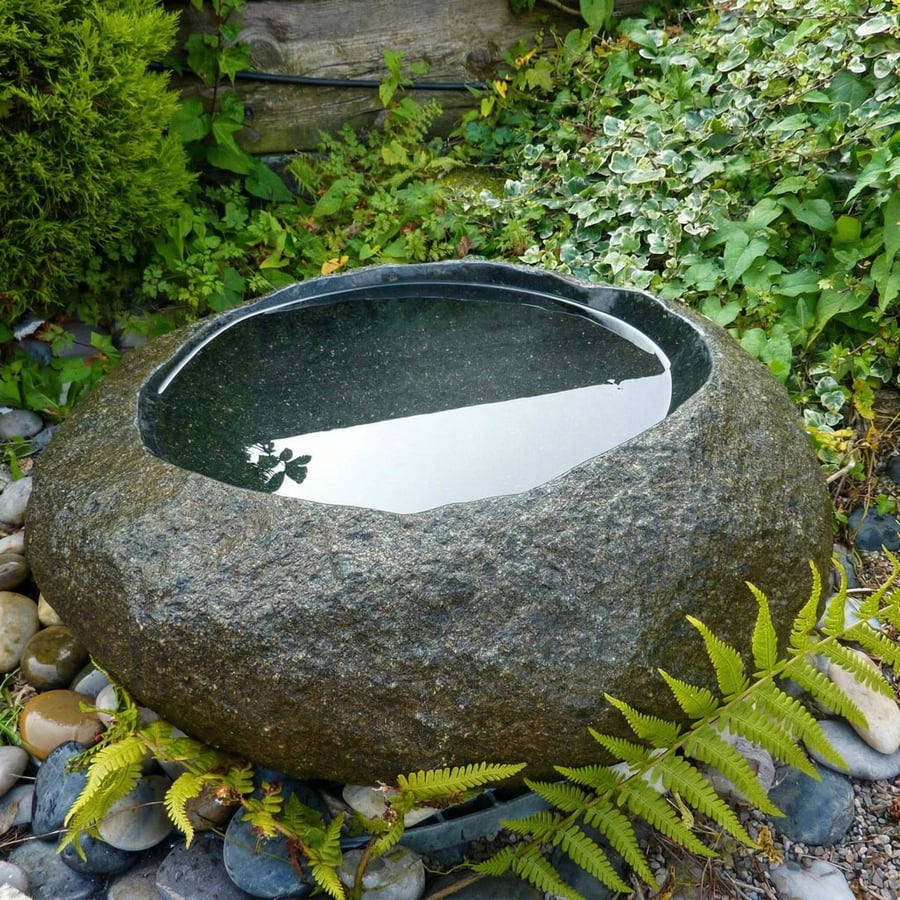
The Natural Basin Stone Bird Bath — positioned the right way: 4m from a shrub border, raised, with a clear flight path in and out.
Installer's note
In 14 years of installing bird baths in UK gardens, the placement mistake I see most often is the opposite of what most online guides suggest. RSPB and many garden centres recommend "2m from cover so birds can dart back to safety". In urban gardens with cats — which is most UK gardens — that 2m distance is also the exact range from which a cat in shrub cover can pounce. We have customers who moved a bath from 2m out to 4m and saw bird use treble within a fortnight. Birds prefer line-of-sight over ambush range. 3-5 metres is the right number.
The five placement rules that actually matter
Rule 1: Distance from cover — 3 to 5 metres
Birds need cover within flying distance for two reasons: somewhere to retreat if startled, and somewhere to preen and dry off after bathing. The common 2-3m guidance assumes a garden without cats. In any garden with regular cat traffic, that distance is too close to a cat ambush from inside shrub cover.
Three to five metres gives the bath room to be a visible, "safe" zone — birds can see approaching threats including cats stalking from cover — while still being within easy flying distance of refuge. Watch your garden for cat traffic for a week. Wherever cats settle to watch (under deck chairs, behind pots, inside dense climbers), measure 4m out from that point — that is where the bath belongs.
Rule 2: Height — 1m+ on a pedestal, or 50cm if ground-level is necessary
A pedestal bird bath at 1m+ height puts the basin above most cat-strike range. Cats can spring 1.5m vertically but rarely accurately, and from a pedestal the bird has the better view. Wall-mounted bird baths at 1.5m+ are even safer.
Ground-level baths (millstone-style, natural basin) are good for ground-feeding birds like dunnocks, robins and blackbirds, but need extra distance from cover — 5m+ rather than 3-4m. Place them on an open area of paving, lawn, or short gravel where any approaching cat is fully visible.
Rule 3: Light — dappled or morning sun, not full afternoon
Birds bathe most actively in the first half of the day, particularly mornings between 7am and 10am in summer. A bath catching morning sun warms the water slightly, making bathing more comfortable. Full afternoon sun has the opposite effect — water heats to 25C+ and accelerates algal growth.
The optimal placement is morning sun, afternoon shade. East-facing positions, light dappled shade under deciduous trees, or sites screened from late-day sun by a wall or hedge all work. Avoid full-shade positions under conifers — the water stays cold and the lack of UV encourages algae and bacteria.
Rule 4: Distance from feeders — 3m minimum
Bird feeders attract concentrated bird activity and concentrated bird droppings. Sharing water and food locations encourages disease transmission — particularly salmonella (which kills sparrows and finches) and trichomonosis (which has devastated greenfinch populations since 2005).
Place the bath at least 3m from any feeder, ideally with shrubs or planting between them. The two stations should be near each other in the garden as a whole (birds appreciate convenience), but not at the same single perch point. Rotate feeder locations seasonally to reduce ground contamination.
Rule 5: Flight paths — clear approach and exit
Birds approach a bath in a swooping arc, not a straight line. They need a clear flight path of 2-3m in two directions — an entry and an exit. A bath placed under a low overhanging branch, against a wall with a single approach, or surrounded by tall hanging baskets restricts that flight pattern and reduces use.
Watch a working bath for ten minutes and you will see the pattern: birds arrive from one side, bathe, and exit on the opposite side. Position the bath so both arcs are clear. The exit arc particularly matters — a wet bird flying low is more vulnerable than a dry one arriving.
Sun, shade and seasonal placement
| Aspect | Light pattern | Suitability | Note |
|---|---|---|---|
| East-facing, open | Morning sun, afternoon shade | Excellent | The ideal position for year-round use. |
| South-facing, open | Full sun all day | Acceptable with daily refill | Water heats; algae growth faster in summer. |
| West-facing, open | Morning shade, afternoon sun | Sub-optimal | Birds bathe less in afternoons; water warms when not in use. |
| North-facing, open | No direct sun | Sub-optimal | Cold water, slower drying; OK in summer, poor in winter. |
| Under deciduous tree | Dappled summer, open winter | Excellent | Bonus: natural debris removal by rain through bare branches. |
| Under evergreen (yew, holly) | Permanent deep shade | Avoid | Water stays cold and stagnant; algae thrives. |
1. Natural Basin Stone Bird Bath — best ground-level pick
The Natural Basin is a hand-carved Indian sandstone basin shaped from a single block, with a shallow 35cm-wide bowl and a textured natural exterior. Bowl depth varies from 2cm at edge to 5cm at centre — the textbook depth profile for UK garden birds. Weight 24kg, footprint 40cm circular. At £265 it is mid-range for natural stone.
Place on a lawn or gravel area at least 5m from any shrub cover, since the ground-level format gives no height defence against cats. The natural rough texture gives birds excellent footing — smoother polished basins are slippery when wet and reduce comfortable use. Add one or two pebbles to the centre if you want to mark the depth gradient visually.
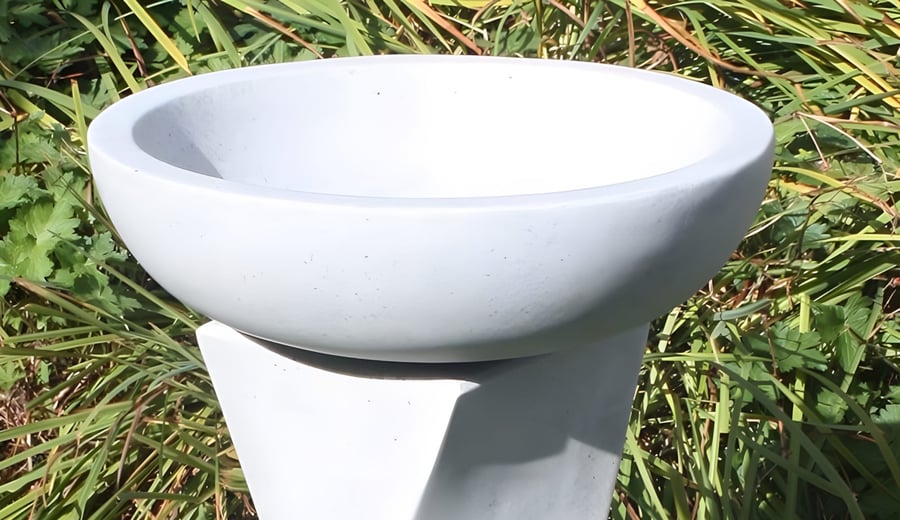
2. Spiral Bird Bath in White — best contemporary pedestal pick
The Spiral Bird Bath in White is a 95cm-tall hand-finished resin-stone pedestal with a spiral-twisted column and a 38cm wide bowl. The white finish is genuinely white — not cream — reading bright against green planting. Bowl depth 1.5cm to 4cm. Total weight 28kg. At £239 the price reflects the sculpted detail.
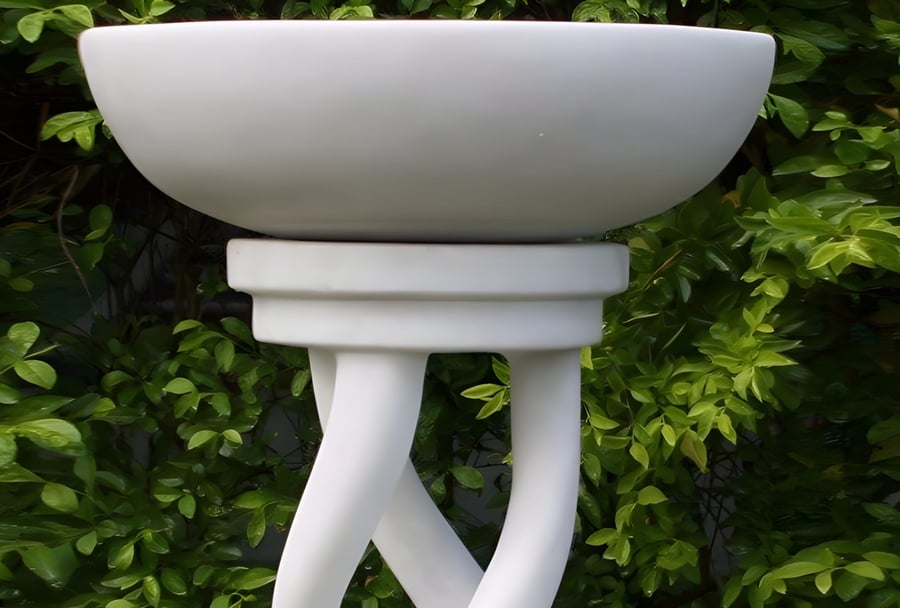
Pedestal designs put the bowl at 95-100cm — above most cat ambush range and at eye level for human viewing from a kitchen window. The Spiral Bird Bath in Granite at £239 is the same form in a darker mottled finish for contemporary schemes. Both ship in two parts (pedestal and bowl) for easier handling, joined on assembly.
3. Cascade Pink Granite Bird Bath — best low-maintenance natural stone
The Cascade Pink Granite is a 90cm tall solid pink granite pedestal with an integral cascading bowl design. Granite is fully frost-proof, needs no winter intervention, and weighs 42kg — it stays put once positioned. Bowl depth 1.5cm at edge to 5cm at centre. At £335 it is mid-range; the grey granite variant at £349 is identical in shape but darker.
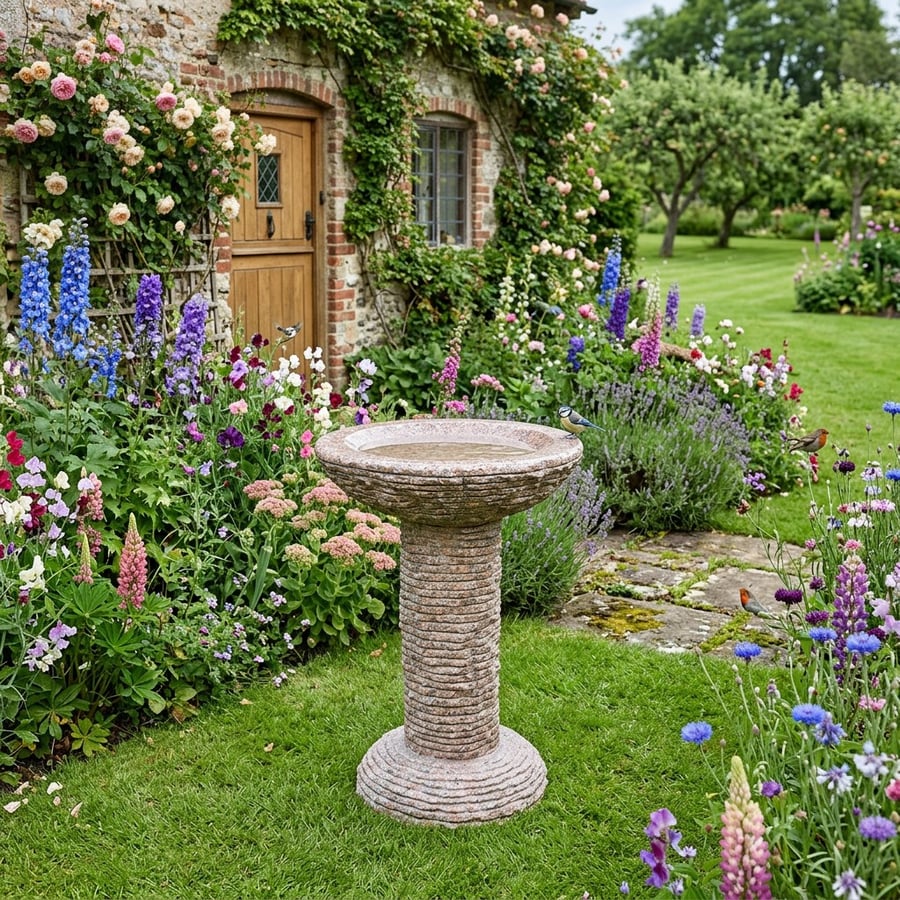
Granite is the right choice when you want to install once and not think about the bath again. The smooth polished bowl needs minimal cleaning — a quick wipe with a non-detergent brush every fortnight removes algae. Pair with a 1m radius of pebbles or planted ground cover at the base for an integrated look.
4. Georgian Bird Bath in Granite — best classical pedestal
The Georgian Bird Bath in Granite uses a fluted classical column and circular bowl in mottled-grey resin stone. Total height 88cm; bowl diameter 36cm; bowl depth 1.5cm-4cm. Weight 26kg. At £239 it is mid-range. The white variant at £239 is the same form for traditional gardens.
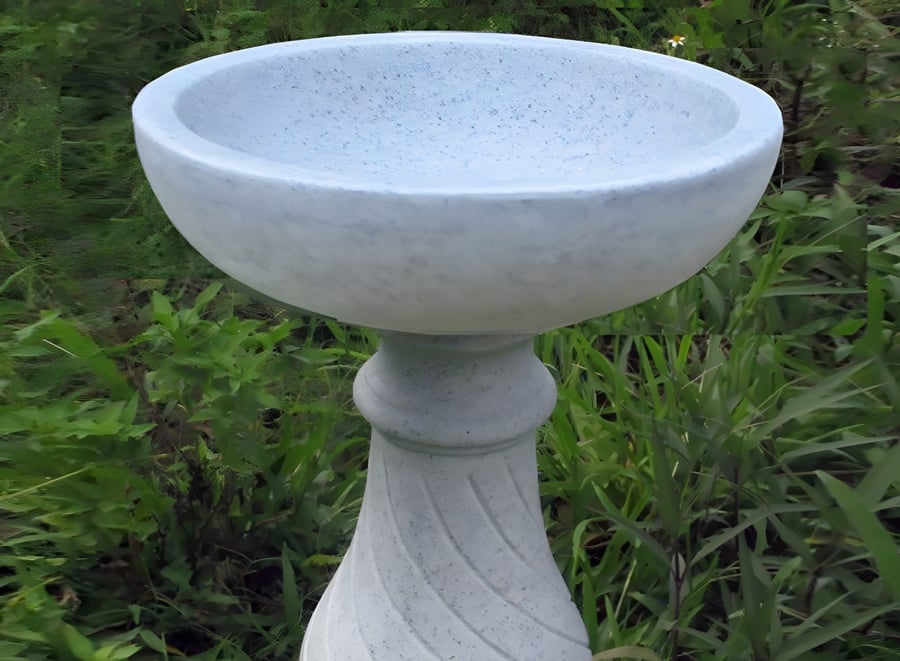
The Georgian style works in any traditional, formal, or country garden. The fluted column reads as architectural rather than purely functional, so the bath also doubles as a focal point. Position 4m from the nearest hedge or shrub border, with herbaceous planting at the base softening the transition. The 88cm height is above-cat-strike range for any normal domestic cat.
5. Large Edwardian Birdbath in Sandstone — best traditional pick
The Large Edwardian in Sandstone is an 80cm-tall traditional pedestal with a chunky column and a 35cm round bowl. Hand-finished cast stone in a sandstone tone that weathers to a softer mid-buff over two seasons. Total weight 32kg. Bowl depth follows the 1.5-4cm profile. At £210 the price sits at the budget-mid tier.
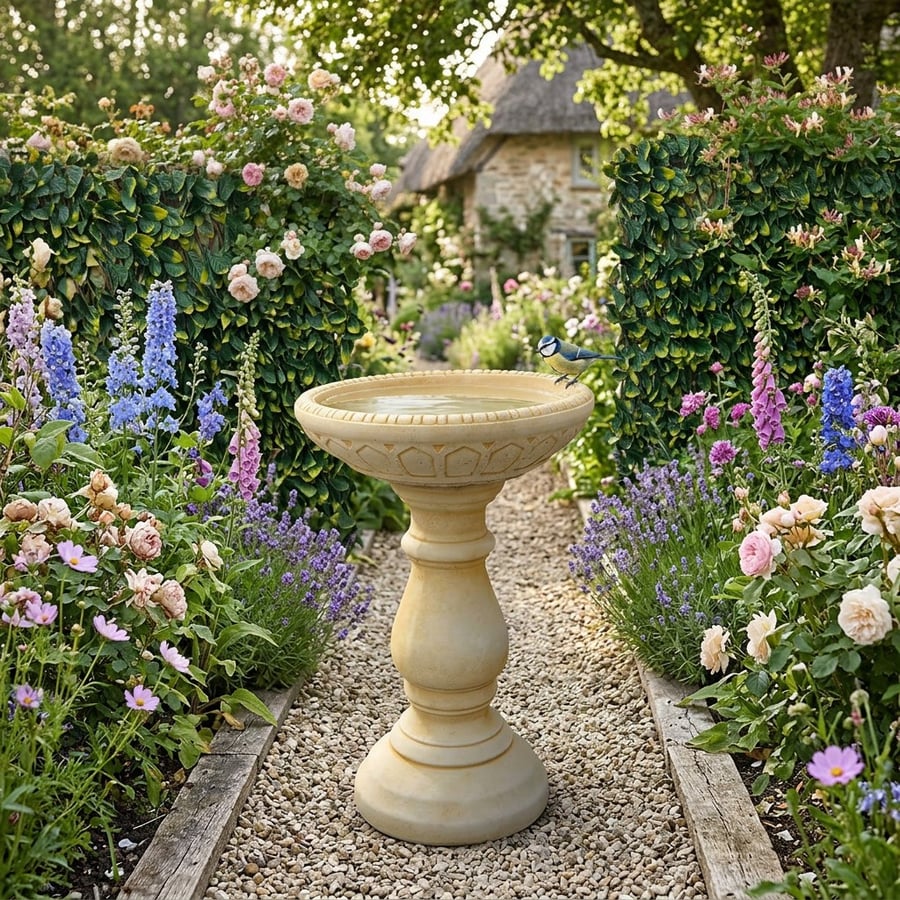
Cast sandstone is more affordable than natural granite and reads warmer in tone — the right call for cottage gardens, country plots, and any setting where granite would read too cold. The trade-off is winter maintenance: drain the bowl in November and cover with a fleece in temperatures below -5C. The cast stone tolerates frost; the water sitting inside the bowl is what cracks any stone bath.
6. Twisted Granite Bird Bath — best decorative pedestal
The Twisted Granite is an 85cm pedestal with a hand-carved twisted column in mottled-grey resin stone. The twisted form gives more visual interest than the standard fluted column without becoming flashy. Bowl 34cm wide, 1.5cm-4cm deep, weight 24kg. At £229 it is at the budget-mid tier for pedestal designs.
The Twisted Granite is the choice when you want a pedestal bird bath as a deliberate garden ornament, not just a functional bath. The mottled finish reads as natural stone from 3 metres — only on close inspection is the cast pattern visible. Pair with low-mounded planting at the base; the ornamental column rewards a clear pedestal-to-foliage transition.
Side-by-side: 6 bird baths compared
| Bird bath | Style | Height | Bowl size | Weight | Material | Price |
|---|---|---|---|---|---|---|
| Natural Basin Stone | Ground-level | 15cm | 35cm | 24kg | Hand-carved sandstone | £265 |
| Spiral Bird Bath White | Contemporary pedestal | 95cm | 38cm | 28kg | White resin stone | £239 |
| Cascade Pink Granite | Natural pedestal | 90cm | 36cm | 42kg | Solid pink granite | £335 |
| Georgian Bird Bath Granite | Classical pedestal | 88cm | 36cm | 26kg | Granite-effect resin | £239 |
| Large Edwardian Sandstone | Traditional cast | 80cm | 35cm | 32kg | Sandstone-finish cast | £210 |
| Twisted Granite | Decorative pedestal | 85cm | 34cm | 24kg | Granite-effect resin | £229 |
What to do in the first two weeks
A new bird bath usually takes 5-14 days to start attracting regular visitors. The factors that speed this up: visible water (a small ripple from a wind-stirred surface helps), proximity to existing bird activity (within sight of an established feeder or perch), and contrast (a pale bath against dark planting catches the eye).
If after two weeks no birds are using the bath, change one variable at a time. First check the depth: birds drown in baths deeper than 5cm, and many UK guides recommend depths that are too deep. Add pebbles to reduce centre depth. Second, check distance from cover. If the bath sits in the middle of open lawn with no cover within 6m, birds may not feel safe approaching. Move it 1m closer to a shrub border. Third, check the water itself — rainwater or filtered water is preferred; chlorinated tap water deters some species.
Cleaning and refilling routine
The single most important hygiene rule is to refresh the water before it goes green. In a UK summer, that means every 2-3 days; in heatwaves or full sun positions, daily. In winter, every 5-7 days is enough — bacterial growth is slower in cold water. Always tip the bath out and refill rather than topping up — topping up concentrates dropping residue and minerals.
For deep cleaning, use a stiff-bristled brush and warm water with no detergent. Detergent residue is toxic to birds in even small amounts. Once a month, scrub the bowl thoroughly to remove biofilm. If algae has taken hold, a 1:10 solution of household white vinegar will kill it — rinse three times before refilling.
Wear gloves during cleaning. Bird droppings can transmit zoonotic diseases including salmonellosis and ornithosis (psittacosis). The risk to humans is low but real, particularly for immunocompromised people. Our wildlife ornaments guide covers full hygiene protocols.
Winter use — the often-missed opportunity
Winter is when bird baths are most valuable. Natural water sources freeze, drinking opportunities shrink, and birds need water more (not less) for preening, which is critical to maintaining feather insulation in cold weather. A working winter bird bath is more important than a winter feeder for some species.
The challenge is keeping it from freezing. The cheapest reliable solution is a small float (a ping-pong ball works) on the water surface — air movement keeps a small area unfrozen down to about -3C. Below that, heated bird baths (mains-powered ceramic heaters that sit in the bowl) keep water liquid down to -10C. Avoid pouring boiling water into a frozen bath; the temperature differential cracks cast stone and most natural stones.
For winter, choose granite or basalt rather than cast stone. Both survive freeze-thaw cycles without intervention. Cast stone and sandstone need draining and covering once temperatures drop below -5C consistently.
|
Matt's Pick: Best UK Bird Bath for Placement Flexibility 2026Best For: Any UK garden where you want install-once, no-maintenance reliability Why I Recommend It: The Cascade Pink Granite is a single piece of solid stone. At 42kg it stays exactly where you put it. Frost-proof for any UK winter, no covers needed. The 1.5-5cm bowl depth profile is correct for UK garden birds straight out of the crate. The 90cm height puts it above cat ambush range in almost any garden. Price: £335 |
Frequently asked questions
Where should I put a bird bath in my garden?
Three to five metres from the nearest shrub or hedge cover, raised on a pedestal where possible, in a position that catches morning sun and afternoon shade. Avoid placing it under conifers, against a single wall with no clear flight path, or within 3m of a bird feeder. The exact spot should give birds a clear approach arc from at least two directions and a visible line of sight to potential predators.
How far should a bird bath be from cover?
3-5 metres for most UK gardens. Two metres — sometimes recommended — is too close for cat safety, since cats can ambush from that range while concealed in shrub cover. Three to five metres gives birds line-of-sight warning of approaching predators while still being within easy flying reach of refuge.
How deep should the water in a bird bath be?
1.5cm at the edges sloping to a maximum of 5cm at the centre. Deeper water excludes smaller species like blue tits, goldfinches and wrens because they cannot stand safely. Adding pebbles or a flat stone to create a gradient solves a too-deep bath. Birds drown in water deeper than they can stand in.
What is the best height for a bird bath?
1 metre or more on a pedestal, or 50cm minimum at ground level. Pedestal-mounted baths above 90cm sit above most cat strike range and give birds a better view of approaching threats. Ground-level baths work for ground-feeders like dunnocks and robins but need 5m+ clearance from cover. Wall-mounted baths at 1.5m+ are the safest from cat predation.
Should a bird bath be in sun or shade?
Morning sun with afternoon shade is the optimum. Birds bathe most actively in the first half of the day, and warmed morning water is more inviting. Full afternoon sun heats the water to 25C+ and accelerates algal growth. Avoid deep permanent shade under conifers — cold stagnant water encourages bacteria.
How often should I clean a bird bath?
Refresh the water every 2-3 days in summer; deep clean monthly with a brush and warm water. Never use detergent — even small residue is toxic to birds. For stubborn algae, a 1:10 white vinegar solution kills it — rinse three times before refilling. Wear gloves; bird droppings can carry diseases transmissible to humans.
Can I place a bird bath near a bird feeder?
Not closer than 3 metres. Sharing the same area concentrates droppings around the water source and spreads salmonella and trichomonosis, the disease that has devastated UK greenfinch populations since 2005. Keep water and food stations near each other within the garden (birds appreciate convenience) but separated by at least 3m with planting between.
What attracts birds to a bird bath fastest?
Visible water movement, proximity to existing bird activity, and contrast against surroundings. A small ripple from a wind-stirred surface or a dripping water source signals safe drinking water from 10m+ away. Position within sight of an established feeder or perch tree. A pale bath against dark planting catches the eye. Most baths attract regular visitors within two weeks.
Browse our full range of garden ornaments or jump straight to the stone bird baths collection to see every design in stock.