
Stone Busts for Gardens: Roman, Greek and Renaissance Heads
Written by Matt W on 6th May 2026.
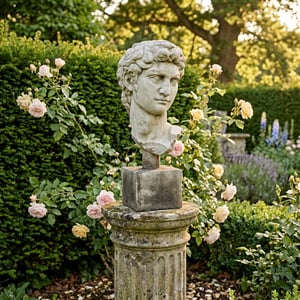
A stone garden bust is a sculpted head and shoulders, mounted on a plinth, used as a focal point in a formal flower bed, hedged alcove or terrace corner. UK gardeners typically pair a bust between 38–65cm tall with a plinth of 60–100cm, putting the face at adult eye level. We currently sell four cast-stone busts spanning Renaissance (David), Greek mythology (Hercules), Eastern (Champa) and animal traditions (Great Dane wall bust), priced £155–£269.
Key takeaways
- ✅ Four busts in active UK stock: Bust of David (£229), Hercules (£269), Champa Head (£175), Great Dane Wall Bust (£155).
- ✅ Always display on a plinth. A bust on the ground reads as rubble, not sculpture. Aim for eye-level.
- ✅ Bust height + plinth height ≈ 150cm is the sweet spot for adult viewing.
- ✅ Cotswold and cast stone are frost-proof in UK conditions; raise off the ground to stop wicking.
- ✅ Roman emperor busts are rare in UK retail. We don't currently stock Caesar or Augustus — we'll be honest where the niche has gaps.
Installer's note
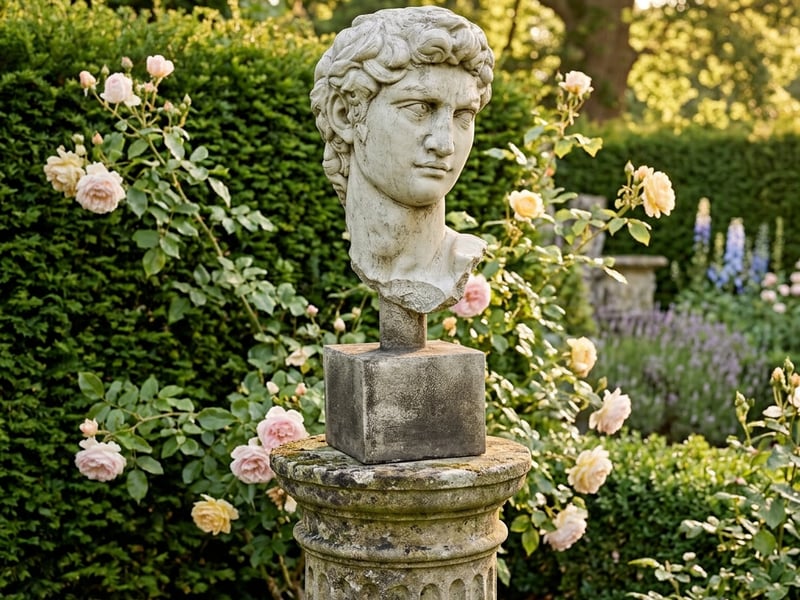
Most customers buying a garden bust statue underestimate the plinth. The bust itself is the cheaper part of the set: a 50cm bust at £229 looks lost on a 30cm wall coping but commanding on a 90cm laurel-motif plinth. Budget for both pieces from day one. A £229 bust on a £99 plinth (total £328) outperforms a £500 bust sat on bare paving every time.
What counts as a garden bust statue?
A bust is a sculpted portrait of the head, neck and upper chest — everything above the diaphragm, with no arms. The form is Roman in origin: the wealthy displayed marble likenesses of ancestors in atria, and the convention carried into Renaissance Italy and Georgian England as a status piece in formal gardens.
For UK gardens in 2026, the practical definition is narrower. A garden bust is cast in stone or reconstituted stone, weighs 18–45kg, sits on a separate plinth, and is frost-proof to at least −10°C. Resin and concrete imitations exist, but they discolour within three winters and rarely look right beyond their first season. We've covered the materials trade-off in detail in our stone bird bath buying guide — the same logic applies to busts.
The four busts we currently stock
We've sold heads and busts at garden ornaments for sixteen years. Right now, four bust models are in active production from our UK suppliers Lucas Stone and Enigma. Below is what we have, what each is suited to, and an honest note on what we don't stock.
| Bust | Tradition | Material | Height | Weight | Price |
|---|---|---|---|---|---|
| Bust of David | Renaissance (Italian) | Cotswold cast stone | 52cm | 32kg | £229 |
| Hercules Bust | Greek mythology | Reconstituted stone | 58cm | 38kg | £269 |
| Champa Head Bust | Eastern / Khmer | Reconstituted stone | 45cm | 22kg | £175 |
| Great Dane Wall Bust | Animal / heraldic | Reconstituted stone | 38cm (wall) | 14kg | £155 |
Bust of David (Renaissance)
A 52cm cast-stone tribute to Michelangelo's marble David, in our Lucas Stone Cotswold finish. The cream-buff colour mellows quickly — within 12 months it picks up lichen along the hairline and looks 50 years old. This is the bust we recommend for cottage gardens, walled kitchen gardens and Georgian frontages. Frost-rating: tested at −15°C in our Worcestershire yard.
Hercules Bust (Greek mythology)
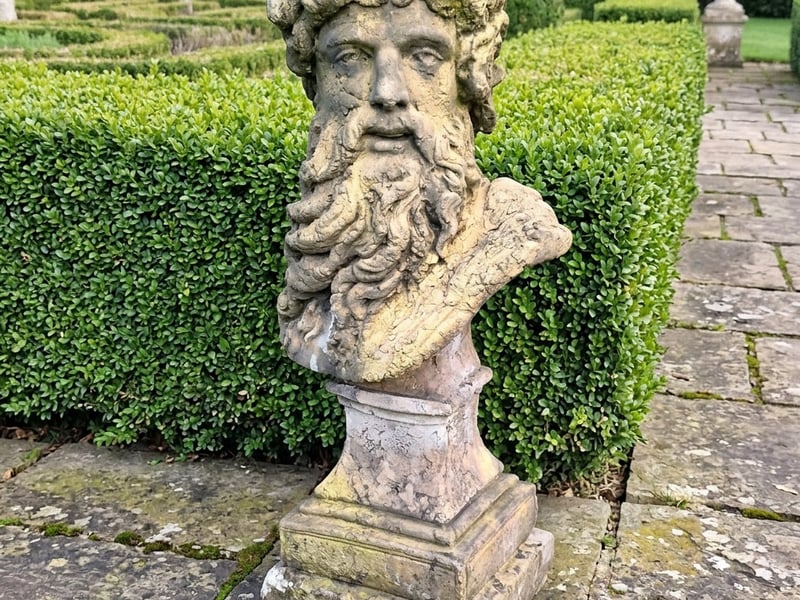
The largest of the four at 58cm, with a heavier-set Greek-revival profile: thick beard, lion-skin shoulder drape, deep brow. Suited to formal gardens, parterres, end-of-axis hedge stops and yew alcoves. The reconstituted stone has a natural greyish-cream cast that weathers to a darker patina than the David. We rate this the most "country house" of the four.
Champa Head Bust (Eastern)
A serene Khmer-style head from Enigma, 45cm tall, suited to Asian-themed planting, gravel gardens or alongside bamboo and acer. Sits well on a low square plinth. Note this is a head rather than a full shoulder bust — it reads quieter than the David or Hercules and is our pick for smaller courtyard gardens. For wider Eastern styling cues, see our Buddha garden ornaments placement guide.
Great Dane Wall Bust (animal/heraldic)
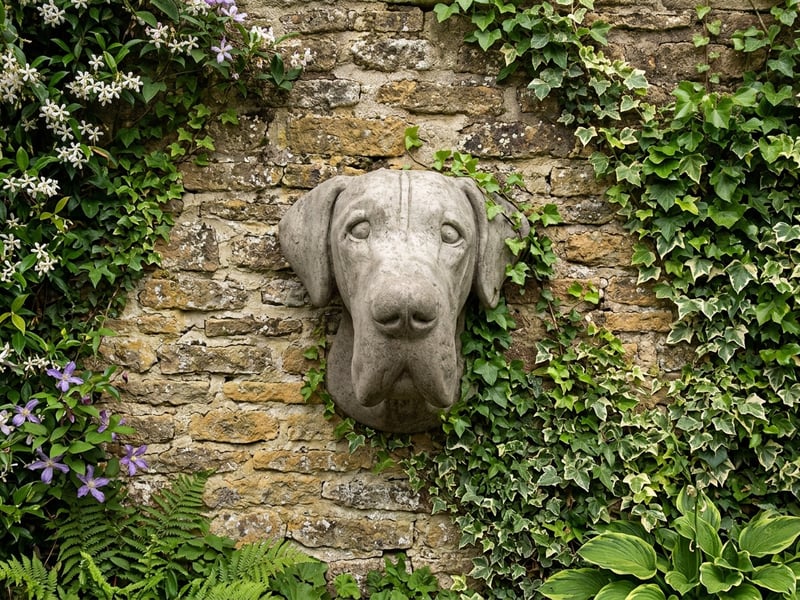
The outlier — a wall-mounted dog bust, 38cm, designed to sit on a coping or be screwed into a brick gatepost. Heraldic in feel; popular with kennel owners and country estate buyers. The only one of our busts that doesn't need a plinth. Mounting plate is included.
Bust and plinth pairings (with maths)
This is the bit most retailers leave out. A garden bust is incomplete without a plinth, and the heights have to add up. Aim for the face of the bust to sit at adult eye level — roughly 150cm. Subtract the bust height from 150, and that's the plinth you need.
| Bust | Recommended plinth | Plinth height | Total height | Combined price |
|---|---|---|---|---|
| Bust of David (52cm) | Vienna Laurel Motif Pedestal | 98cm | 150cm | £328 |
| Hercules (58cm) | Rococo Stone Garden Pedestal | 92cm | 150cm | £484 |
| Hercules (58cm) | Keymer Stone Garden Pedestal | 90cm | 148cm | £424 |
| Champa Head (45cm) | Medium Square White Plinth | 54cm | 99cm (low display) | £274 |
| Champa Head (45cm) | Large Square White Plinth | 78cm | 123cm | £370 |
For a deep dive on plinth options, weights and pad requirements, read our stone pedestals and plinths display guide. The same rules apply to busts: a level paving slab or a 60cm-square poured-concrete pad keeps everything plumb through frost-heave seasons.
Roman, Greek or Renaissance: which suits your garden?
This is the question we get asked most over email. The short answer: pick by the architecture nearest the bust, not by personal preference for the historical period. A Greek bust against a 1980s patio reads as kitsch; a Renaissance bust against a Cotswold-stone wall reads as inevitable.
Roman style (Augustan, imperial)
Clean-shaven, idealised, often laurel-crowned. We don't currently stock a Roman emperor bust — the closest UK supply runs through specialist reproduction houses, and the cost typically clears £800. If you want Roman feel from our range, the Champa Head's serene, smooth-cheeked profile is the nearest match in spirit. Roman style suits Georgian architecture, Palladian frontages and clipped formal hedging.
Greek style (Hellenic, mythological)
Bearded, muscular, expressive. Our Hercules bust is the cleanest Greek piece in the range. Greek style suits parterres, knot gardens and yew topiary. Pair with white or cream gravel, never with red brick — the colour clash kills it. For full mythology context including Pan, Atlas and Diana, see our mythological garden statues guide.
Renaissance style (Italian, idealised)
Smooth, contemplative, often inspired by Michelangelo or Donatello. The Bust of David is the central piece. Renaissance style is the most flexible — it works in cottage, formal and even modern minimalist gardens, provided the planting is restrained. Avoid busy bedding around it; let the bust be the focal point. We've covered period-appropriate placement in garden statues for period properties.
Where to place a bust in the garden
Five placements work; everything else is compromise.
- End of an axis: a sight-line that draws the eye, terminated by the bust. Most powerful placement.
- Hedged alcove: yew, beech or laurel niche cut to bust width. The dark backdrop makes pale stone glow.
- Pair flanking a path or door: two matching busts, identical plinth height, mirrored along an axis.
- Terrace corner: against a south or east wall, raised, near seating — viewed at close range.
- Walled garden centrepiece: on a plinth at the centre of a parterre or knot garden, viewed from all sides.
Avoid placing a bust against a fence panel, on a lawn (mowing nightmare and the plinth sinks), or close to a path edge where it gets brushed by trousers. For a deeper run-through of focal-point logic, our garden sculpture placement guide covers lighting and viewing angles.

Frost protection and winter care
All four busts in our range are rated frost-proof to at least −10°C. The risk in UK gardens isn't air temperature; it's water ingress. Stone soaks up rain through summer, freezes in February, and the expansion fractures the surface from the inside out. Three rules keep a garden bust statue intact for 30 years:
- Raise the plinth off bare soil. A paving slab or concrete pad stops capillary water rising into the stone.
- Use breathable sealer once a year. Stormdry or Lithofin MN Stain Stop — not silicone, which traps moisture.
- Cover or remove the bust head November to March if temperatures drop below −15°C in your postcode. A waxed cotton bag with airflow at the bottom — never plastic.
The full month-by-month routine is in our winter protection guide for garden ornaments.
|
Matt's Pick: Best All-Round Garden BustBest For: cottage, walled, Georgian and formal gardens — the most flexible bust we sell. Why I Recommend It: the Cotswold stone weathers faster than reconstituted stone, so it looks settled in 12 months instead of 5 years. Pair it with the Vienna Laurel Pedestal at £99 and the whole set comes in under £330. Price: £246 |
Matt's tip: the gatepost trick
If your driveway has masonry gateposts, a wall-mounted bust like the Great Dane reads more confidently than a freestanding piece. The gatepost itself does the plinth's job — you save £100–£200 on a separate pedestal and avoid the falling-over risk on a gravel drive. We've fitted dozens this way for country-house clients; the heraldic feel works even on a 1930s semi.
Frequently asked questions
What is a garden bust statue?
A garden bust statue is a sculpted head and shoulders, mounted on a plinth, used as a garden focal point. Most UK garden busts are cast in reconstituted stone or Cotswold stone, weigh 14–38kg, and stand 38–58cm tall before the plinth is added. They are based on Roman, Greek or Renaissance portrait traditions.
How tall should the plinth be?
Aim for the bust's face to sit at 150cm — adult eye level. Subtract bust height from 150 to get the plinth you need. A 52cm Bust of David needs a 98cm plinth; a 58cm Hercules needs a 92cm plinth. Lower plinths suit smaller busts in courtyards.
Are stone garden busts frost-proof in the UK?
Yes — all four busts we stock are rated to at least −10°C. Cotswold and reconstituted stone perform well in UK winters provided water can drain away. Raise the plinth on a paving slab to stop ground-water wicking up, and seal the stone annually with a breathable product, not silicone.
Do you sell Roman emperor busts like Caesar or Augustus?
No, we don't currently stock Roman emperor busts. They are rare in UK retail; the nearest spirit-match in our range is the Champa Head, which is smooth-cheeked and idealised. Specialist Italian reproduction houses sell emperor busts, typically £800–£2,000 plus shipping.
What's the difference between a head and a bust?
A head ends at the neck; a bust includes the shoulders and upper chest. Heads are typically smaller and sit better on low square plinths; busts have more visual weight and need taller, more decorated pedestals. We stock both: the Champa is a head; the David and Hercules are busts.
Can I leave a stone bust outside all winter?
Yes, in most of the UK — with two precautions. Raise the plinth off bare earth onto a slab or pad, and apply breathable stone sealer in autumn. In Scottish highlands or postcodes that drop below −15°C regularly, cover the head with a waxed cotton bag from December to February.
What pairs best with a garden bust?
A clipped evergreen backdrop — yew, box, beech or laurel. Dark, dense foliage makes pale stone glow. Avoid busy flower borders directly behind the bust; they fight for attention. White or cream gravel underfoot extends the formal feel and bounces light onto the bust face.
Related articles
- Classical Garden Statues: Greek, Roman and Renaissance Figures
- Stone Pedestals and Plinths: How to Display Garden Statues
- Mythological Garden Statues UK: Pan, Atlas, Venus and Diana
- Garden Statues for Period Properties: Georgian, Victorian and Edwardian Style
- Where to Place Garden Sculptures: Layout, Lighting and Focal Points
Browse our complete range of stone garden statues, or pair your bust with the right plinth from our stone garden pedestals collection.