
Artificial Topiary That Looks Real: UK Buying Guide
Written by Matt W on 8th Jul 2026.
Artificial topiary gives you clipped evergreen shapes with no watering, feeding or trimming. UV-stabilised foliage keeps its colour outdoors on doorsteps, patios and balconies. Garden Ornaments stocks over 50 artificial plants. Buxus balls come in 30cm, 40cm and 50cm diameters. Spirals and towers run from 60cm to 300cm, with bay laurel ball trees to 150cm. Delivery is £19.75 to mainland UK.
By Matt W | Garden Ornaments Specialist
Key takeaways
- Real box needs clipping in June and September, and faces box blight plus the box tree caterpillar. Artificial buxus dodges all three
- UV-stabilised means the foliage holds its green outdoors; untreated foliage can fade in one south-facing summer
- Buxus balls run 30cm to 50cm from £137; spirals run 90cm to 300cm from £199
- Every piece arrives in a plain nursery pot, sized to drop straight into a decorative planter
- 10-15kg of gravel ballast in the planter base stops wind toppling a tall spiral or tower
- Fire-retardant foliage is a separate rating, specified for indoor and commercial settings rather than gardens
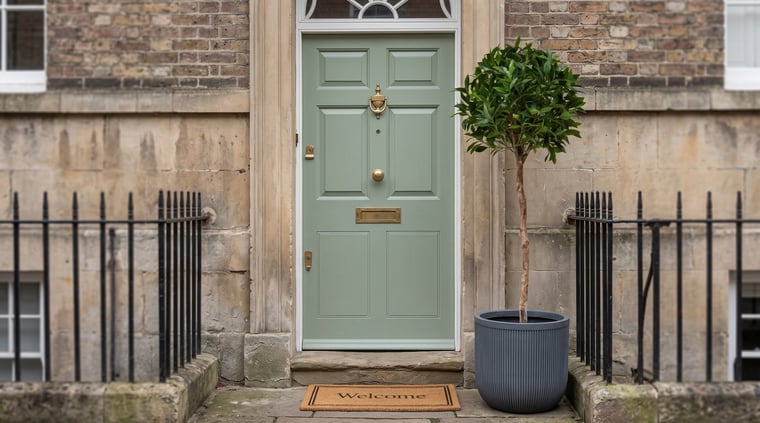
Shop the Bay Laurel Ball Tree 135cm →
Browse the full artificial topiary and faux plants range →
Matt's note
I resisted stocking artificial plants for a long time. Then I watched the box tree caterpillar strip a customer's twenty-year-old parterre in three weeks, and I changed my mind. The good stuff has moved on enormously. Two-tone foliage, real timber trunks, UV treatment that actually works. The cheap stuff on marketplace sites has not moved on at all. It is what gives faux planting its reputation. This guide is about telling one from the other.
Why are UK gardeners switching to artificial topiary?
Because real box has become hard work to keep alive in Britain. Box blight has been rotting clipped hedging here since the mid-1990s. The box tree caterpillar arrived in gardens in 2011 and has spread across most of England and Wales. The RHS guidance on box tree caterpillar is blunt: infestations can defoliate a plant in weeks. A healthy plant also needs precise trims in June and September to hold a crisp ball or spiral.
Artificial buxus skips the whole list. No blight, no caterpillars, no trimming, no watering through hosepipe bans. The shape you buy in February is the shape you have in July. That is why clipped faux shapes now do the heavy lifting in formal front gardens. We break the style down in our guide to formal garden ideas. The trade-off is honest: you give up scent, wildlife value and the pleasure of growing something. For structure, though, faux now competes on looks alone.
What does UV resistant actually mean?
UV resistant means the foliage polymer contains stabilisers that absorb ultraviolet light before it breaks down the pigment. Sunlight is what kills artificial plants. Untreated PVC or polyethylene leaves bleach from deep green to a pale grey-green. A south-facing position can do visible damage in a single summer. UV-stabilised foliage holds its colour for years in the same spot.
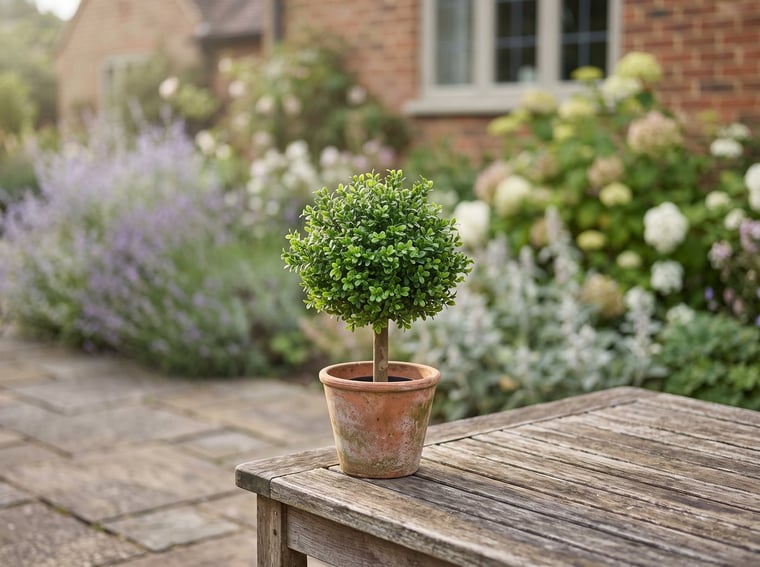
This is the single most important line on any faux plant listing. Every topiary piece in our range from supplier TreeLocate, a UK artificial plant specialist, is UV-stabilised for outdoor use. The 30cm buxus ball, for example, stands 33cm tall, spreads 30cm wide and costs £137. It arrives in a 10cm x 11cm PVC nursery pot, made to drop straight into a decorative planter.
Fire retardant is a different rating and buyers mix the two up. Fire-retardant foliage is made to resist catching light. It is specified for indoor and commercial settings: hotel receptions, bars, restaurants, covered arcades. Venues often require it in their fit-out spec. It says nothing about fade resistance. If a plant is going outside your front door, UV matters. For a commercial interior, ask for the fire-retardant pieces. They start with topiary grape-vine mats at £74.
Which artificial topiary shapes work best?
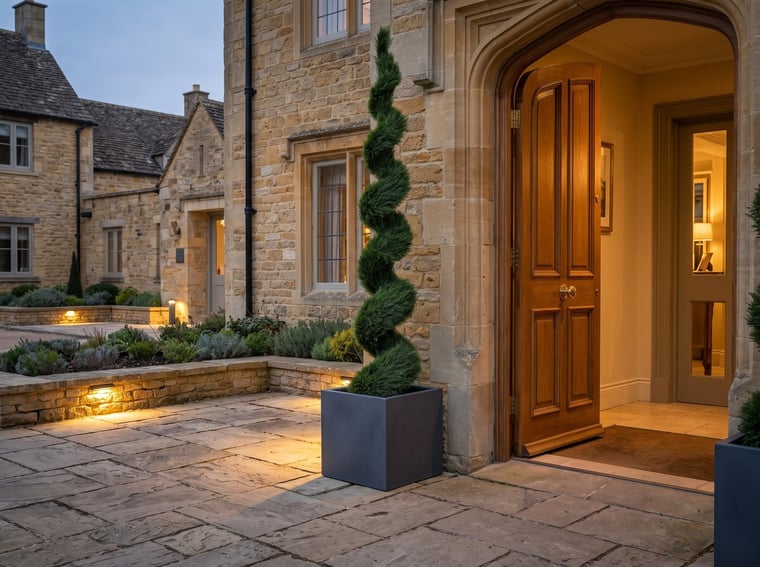
Five shapes cover almost every job. Balls give low, repeatable structure along path edges and in window boxes. Ball trees lift the sphere to head height on a bare trunk, the classic doorway look. Spirals add movement and suit narrow frontages, since a 120cm spiral occupies a circle just 25cm wide. Towers are clipped cones for a more architectural entrance. Triple balls stack three graded spheres on one stem, giving the most presence per pound spent.
| Piece | Height | Price | Best position |
|---|---|---|---|
| Buxus ball 30cm | 33cm | £137 | Window boxes, table tops, path edges |
| Buxus ball 50cm | 50cm | £286 | Repeated along a border or low wall |
| Buxus triple ball 120cm | 120cm | £170 | Either side of a front door |
| Boxwood spiral 120cm | 120cm | £321 | Narrow frontages, 25cm footprint |
| Buxus tower 120cm | 120cm | £452 | Flanking gates and porches |
| Bay laurel ball tree 135cm | 135cm | £249 | Doorsteps and covered porches |
| New buxus ball tree 150cm | 150cm | £355 | Larger entrances and courtyards |
| Cedar spiral 300cm | 300cm | £1,287 | Atriums, hotel entrances, double-height spaces |
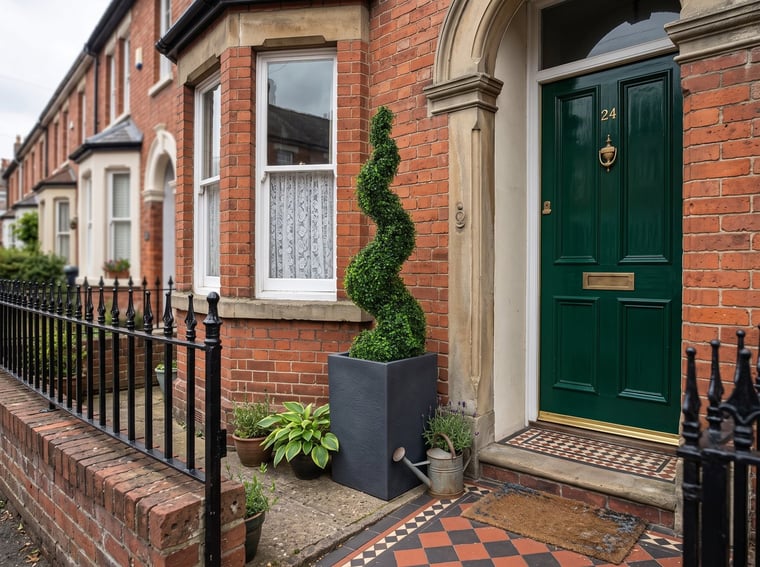
Shop the 120cm Boxwood Spiral →
Towers are the pick where a doorway wants formality rather than movement. The clipped cone reads as architecture, which suits porticos, gate piers and symmetrical frontages. They run from 60cm desk-height pieces to the full 150cm.
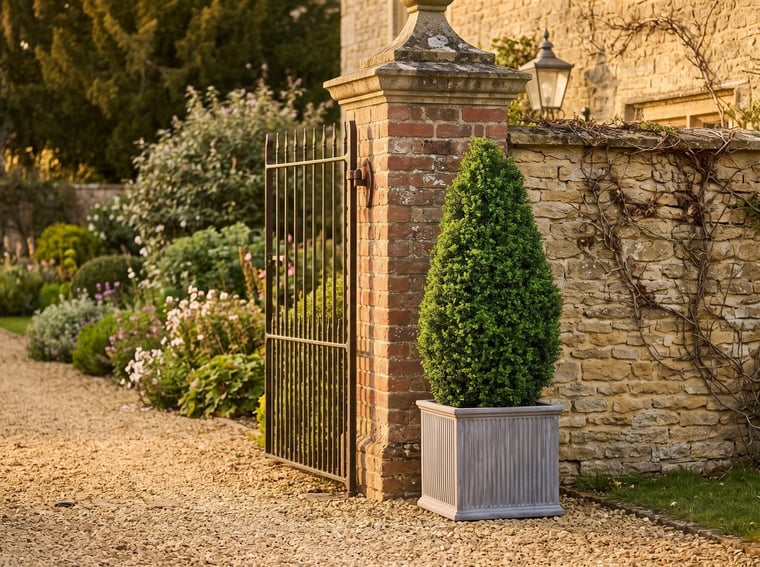
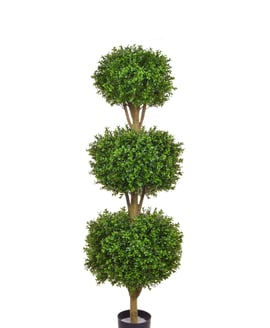
Matt's pick for doorway impact
Best for: Flanking a front door where you want height without a 45cm-plus footprint
Why I recommend it: The 120cm triple ball is the best value tall piece in the range. Three graded spheres on a natural-look stem, 45cm across at the widest ball, UV-stabilised throughout. It gives tower-scale presence for well under half the price of the 120cm tower. The stacked shape reads as deliberate topiary rather than a plastic bush.
Price: £170
How do you make artificial topiary look real outdoors?
Get the base right and nobody looks twice; get it wrong and nobody looks at anything else. Seven habits separate convincing faux planting from the obvious kind.
First, never display the nursery pot. Every piece arrives in plain PVC or LDPE, sized to drop inside a decorative planter. The 120cm spiral sits in a 14cm x 27cm pot for exactly this reason. Second, weight the planter with 10-15kg of gravel or sharp sand before the plant goes in. Third, top-dress the surface with bark, moss or pebbles so no plastic rim shows. Our guide to filling a large planter covers the layering.
Fourth, mix faux structure with real seasonal planting. A pair of artificial balls flanked by pots of living lavender borrows realism from its neighbours. Fifth, place pieces where a real plant could plausibly grow; a lush green spiral in a lightless passage announces itself. Sixth, work in pairs and repeats, because repetition reads as intent. Seventh, rinse the foliage twice a year. Dust is the giveaway on close inspection, not the leaves.
Watch out for wind
Artificial trees are light. A 150cm spiral weighs a fraction of the planted equivalent and acts like a sail in a gusty porch. Unballasted, it will be lying across your path by November. Put 10-15kg of gravel or sharp sand in the planter base and keep it low. Choose a planter at least a third the height of the tree. On exposed balconies, tie the nursery pot to a batten inside the planter as well.
Where does faux planting beat the real thing?
Anywhere a real plant would sulk or die. North-facing doorsteps are too dark for dense box. Yet the doorway is exactly where clipped structure earns its keep. Our guide to front garden ornaments shows why. Basement courtyards and side returns are the same story. Balconies and roof terraces add weight limits, drying wind and no outside tap. Faux planting has none of those problems.
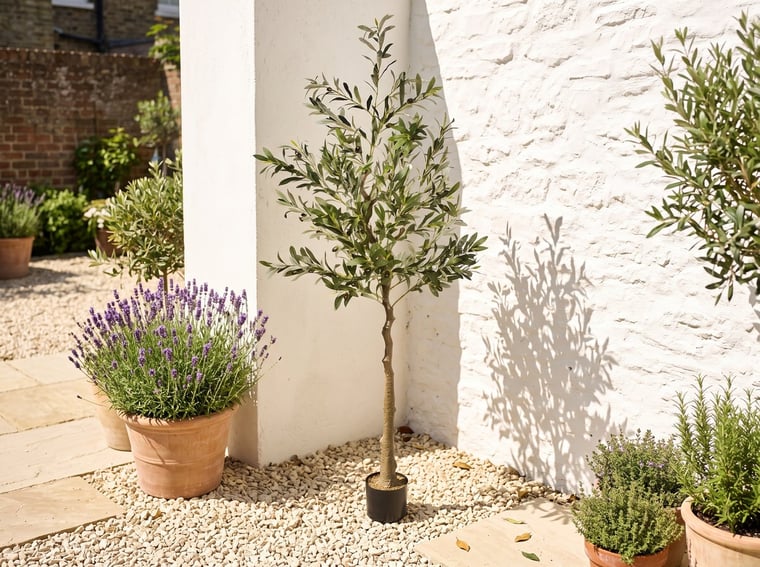
Renters get a benefit nobody mentions: the garden moves out with you. A pair of ball trees, an olive and a couple of wall panels pack into a van like furniture. The 1.7m artificial olive tree at £79 gives a Mediterranean courtyard feel with no frost risk. We cover the look in our Mediterranean garden guide below.
Faux also solves vertical problems. Artificial living wall panels clip over a tired fence or a bin store. The boxwood pattern costs £55 per square metre, with 50cm x 50cm panels from £19. No irrigation lines, no feeding, no bare patches in February. Panels are the fastest screening fix short of a fence replacement.
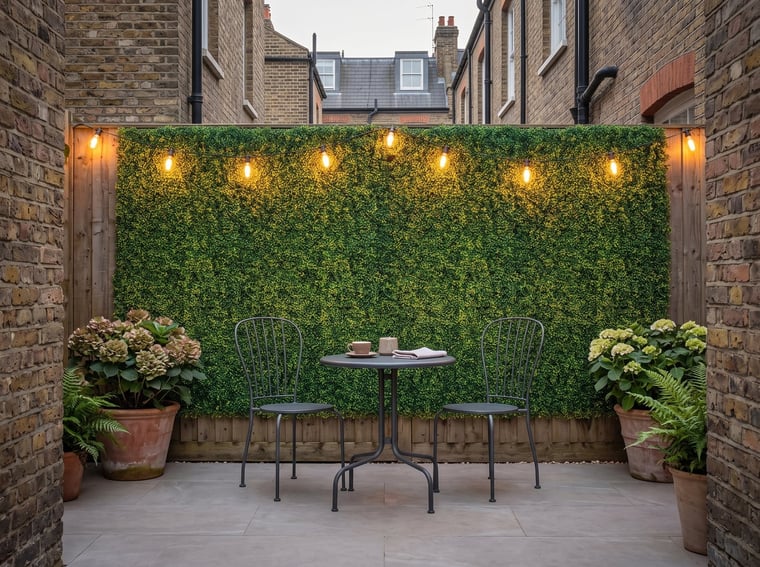
Shop the Boxwood Living Wall →
How do you look after artificial plants?
Two rinses a year and a wipe. Hose the foliage down in spring and autumn to shift dust and cobwebs, working from the top down. A damp cloth lifts anything stubborn from individual leaves. Avoid solvent cleaners, which can strip the UV coating. Check ballast and fixings each autumn before the gales arrive. That is the entire maintenance calendar, which is rather the point.
Matt's tip: judge a faux plant by its trunk, not its leaves
Leaf technology is good almost everywhere now. Trunks are where budgets get cut. A moulded plastic stem with a fake bark texture kills the illusion from ten paces. Our bay laurel and ball trees use natural timber trunks. It is the first thing I show people. One test beats all others when comparing listings. Scroll past the foliage close-ups and find a photo of the stem.
We stock this range because structure should not be the hard part of a garden. Real planting rewards patience; doorways, rentals and shady corners rarely offer any. A UV-stable ball tree either side of the door gives the finished look on day one. In return it asks for a hose-down twice a year. Browse our full collection of garden ornaments to build the rest of the picture.
- Matt W, Garden Ornaments
Frequently asked questions
How long does artificial topiary last outdoors?
UV-stabilised foliage keeps its colour outdoors for years, not months. Position, cleaning and foliage quality set the pace; untreated bargain foliage can bleach in a single south-facing summer.
Can artificial plants stay outside all winter?
Yes, UV-rated outdoor foliage handles frost, rain and wind without damage. The winter risk is toppling rather than weathering, so check ballast and fixings before the stormy months.
What does UV resistant mean on an artificial plant?
The foliage contains stabilisers that stop sunlight bleaching the green pigment. It is the key spec for any faux plant used outdoors in the UK.
What is fire-retardant artificial foliage for?
Indoor and commercial settings where fit-out rules require flame-resistant materials. Hotels, bars and reception areas typically specify it; it is a separate rating from UV resistance.
How do you stop an artificial tree blowing over?
Put 10-15kg of gravel or sharp sand in the planter base. Keep the weight low and use a planter at least a third of the tree's height. Tie in on exposed balconies.
How do you clean artificial topiary?
Hose it down in spring and autumn, then wipe leaves with a damp cloth. Skip solvent cleaners, which can strip the UV coating from the foliage.
Related articles
- Mediterranean Garden Ideas: A Sun-Baked Look for UK Gardens
- What to Plant in Stone Urns and Planters: A Season-by-Season Guide
- Garden Planters and Urns: Stone, Terracotta and Fibrecite Compared
- Garden Mirrors: How to Use Outdoor Mirrors to Create Space and Light
- Garden Ornament Trends 2026: What's Hot in UK Garden Decor