
Garden Statues for Period Properties: Georgian, Victorian and Edwardian Style
Written by Matt W on 28th Apr 2026.
A garden statue should look like it was always there. The way to make that happen with a Georgian, Victorian or Edwardian house is to match the statue style to the era of the property. Georgian gardens want classical restraint — lions in pairs, Hercules busts, fluted urns. Victorians wanted sentiment — cherubs, angels, Diana the Hunter. Edwardians wanted the sundial back, with naturalistic deer and clean lines. Match the era and a stone statue stops looking placed and starts looking inherited.
Matt W — 16 years installing garden statuary across UK gardens, from Georgian rectories in Bath to Victorian terraces in Manchester to Edwardian villas in Surrey. The advice in this guide comes from photographing real properties, matching statue styles to architectural surveys, and watching what reads as authentic versus what reads as ornamental gift-shop.
Key Takeaways
- ✅ Georgian (1714-1837): Classical Greek and Roman figures, paired lions, fluted urns on plinths, symmetry above all.
- ✅ Victorian (1837-1901): Cherubs, angels, mythological figures, ornate fountains. Asymmetry encouraged.
- ✅ Edwardian (1901-1910): Sundials and armillary spheres return, naturalistic animal sculpture, cleaner lines.
- ✅ Stone matters: Cotswold stone for Georgian/Victorian, Bath stone for Edwardian. Resin reads modern in any era.
- ✅ Placement rules differ: Georgian = paired and symmetrical. Victorian = focal point in flower bed. Edwardian = end of axis.
- ✅ Don't mix eras: A Victorian cherub on a Georgian terrace looks bought, not inherited. Pick the right era and commit.
Installer's Note
Most clients overshoot the era. They live in a 1905 Edwardian villa and want to fill the garden with rococo cherubs because the cherubs look "old". The cherubs are old — but they're old to a different decade. The eye picks this up even when the brain doesn't, and the result is a garden that feels staged rather than authentic. Before buying anything, take a photo of your front door and match the architectural details (sash glazing bars, brick bonds, window proportions) to the era. Then commit to that era's statue language. One properly matched stone figure beats four mismatched ones at four times the cost.
How to identify your property's era in 60 seconds
Before picking statues, confirm what you're working with. The fastest test is the front-of-house architectural detail:
- Georgian (1714-1837): Tall sash windows with thick glazing bars, fanlight above the front door, brick or stucco facade with strict symmetry, low-pitched roof often hidden behind a parapet, classical proportions (the front door is centred between equal-width window bays).
- Victorian (1837-1901): Bay windows (often double-storey on detached and semi-detached homes), ornate brickwork in two or three colours, decorative ridge tiles, gothic-revival pointed arches in some periods, asymmetric front elevation with a side-set front door.
- Edwardian (1901-1910): Wider, lower-proportioned windows with thinner glazing bars, half-timbering above the ground floor, lighter brick (often red or pale stock), simpler more horizontal facade, often a porch tile floor in red and black.
If the property predates 1714 it's Stuart, Tudor or earlier and falls outside the scope of this guide — for those gardens you're better with Tudor knot-garden urns or Jacobean obelisks, both stocked but in a different price band. For everything from 1714 to 1910, the rules below apply.
Georgian garden statues (1714-1837)
Georgian gardens were governed by classical restraint, symmetry and a deep reverence for Greek and Roman antiquity. The Grand Tour of Italy and Greece sent young aristocrats home with a head full of marble figures, and the gardens that followed reflected that obsession. Statues weren't sentimental decoration — they were references to a shared classical canon, placed in calculated positions where they could "speak" to one another across an axis.
The hallmarks: pairs over singles, classical figures over Christian, urns on plinths over loose ornaments, symmetry over informality. A Georgian garden statue should imply you've read Ovid, even if you haven't. Coade stone — the artificial stone perfected by Eleanor Coade in 1769 — allowed the middle classes to access the same look that previously cost a fortune in Portland stone. Most "Georgian" statues you'll see today are descendants of that Coade tradition.
Paired lions: the Georgian signature
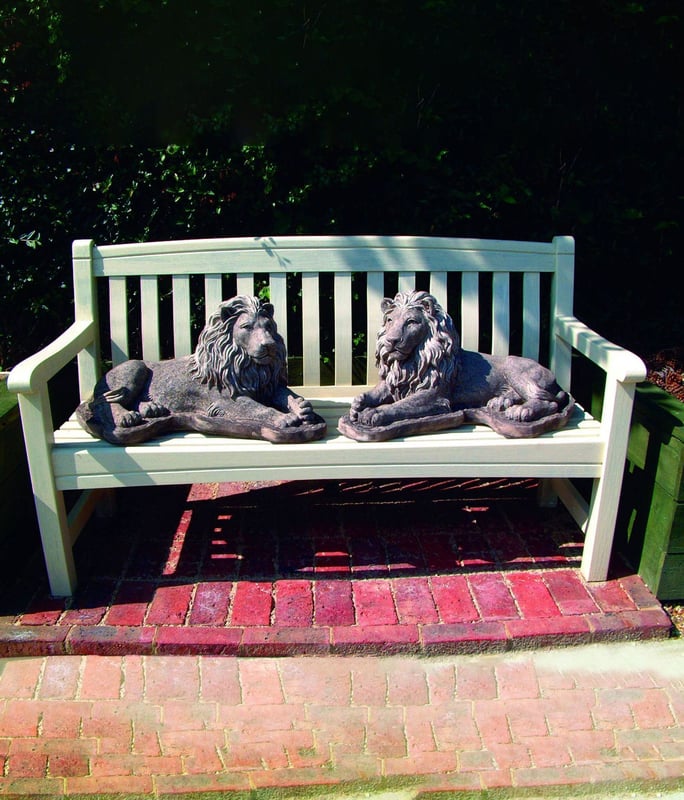
Nothing says Georgian quite like a pair of lions. Originally placed at the foot of grand entrance steps to imply nobility (the Italian palazzo tradition the Georgians borrowed wholesale), they migrated outwards into gardens through the 18th century — flanking gate piers, terminating axes, sitting at the foot of stone stairs leading down to lawns. They almost never appeared singly. Symmetry was the point.
The Chatsworth Lions pictured at the top of this guide are the version most UK Georgian properties want. Cast in cotswold-effect reconstituted stone, supplied as a pair (one head turned left, one turned right so they face each other), and weighing 35kg per lion. They sit happily on stone gate piers, the top of brick walls flanking a path, or on plinths at the foot of formal steps.
Classical busts on plinths
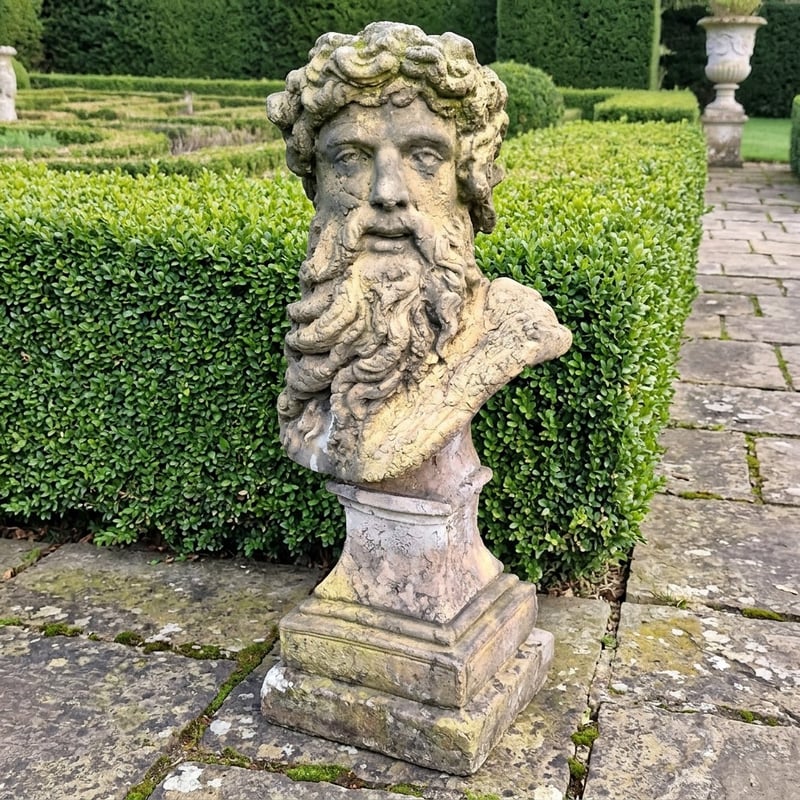
The classical bust on a plinth is the Georgian shorthand for "I have read the classics". Hercules, Apollo, Venus, Caesar — all turn up in walled gardens, alcoves and at the end of pleached lime walks across the country. The bust itself is usually 35-50cm tall; the plinth doubles or triples that. The combination needs to read as one piece, not two stacked objects.
The Hercules Bust shown above is a 38cm carved stone head and shoulders that pairs with a tapered plinth from our stone plinths range. Place it in a niche cut into a yew hedge, at the end of a gravel path, or in the corner of a courtyard where two walls meet. The classical viewing rule: the bust should be at eye level when you stand 3 metres back from it. Below eye level reads as ornamental; above eye level reads as overbearing.
For more on choosing the right plinth height for a bust or figure, our companion guide on stone pedestals and plinths walks through the proportions in detail.
Stone urns: the Georgian workhorse ornament
If you only buy one Georgian piece, make it an urn. They were everywhere — flanking entrance steps, terminating yew walks, marking the corners of formal lawns, sitting on parapets above brick walls. The fluted classical urn is essentially the punctuation mark of Georgian garden design. Even a small urn does serious architectural work in a garden because the shape itself reads as 18th-century.
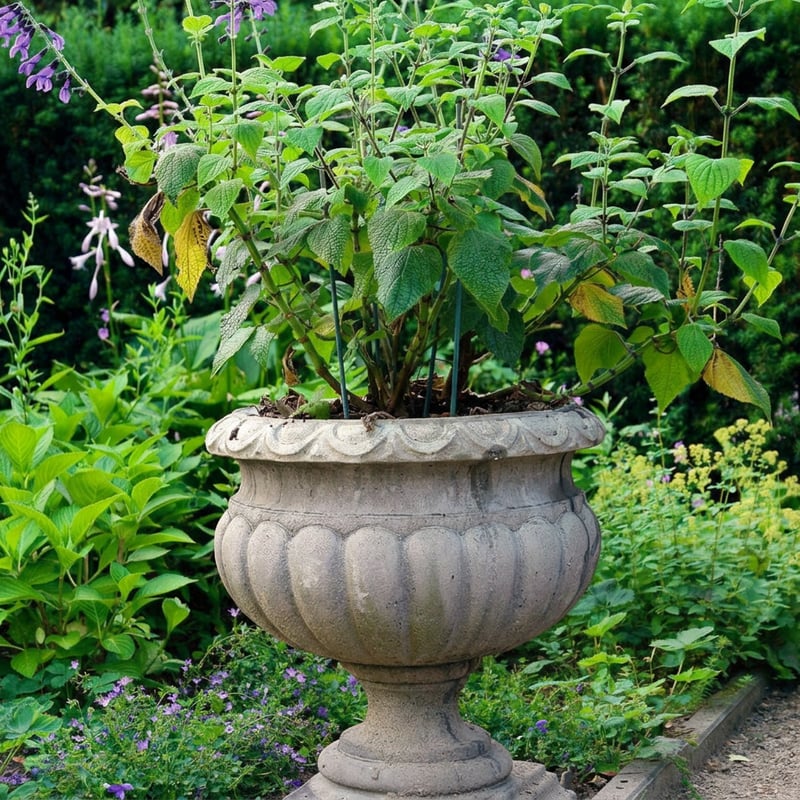
The Buckingham Urn is the most flexible piece in our Georgian range. 56cm tall, classic fluted body on a stepped circular base, weighs 28kg. It works as an architectural statue on its own (placed empty on a plinth) or as a planter (filled with box, ivy, or pelargoniums in summer). Two of them flanking an entrance gate or path is the textbook Georgian move — one urn looks placed, two urns look intentional.
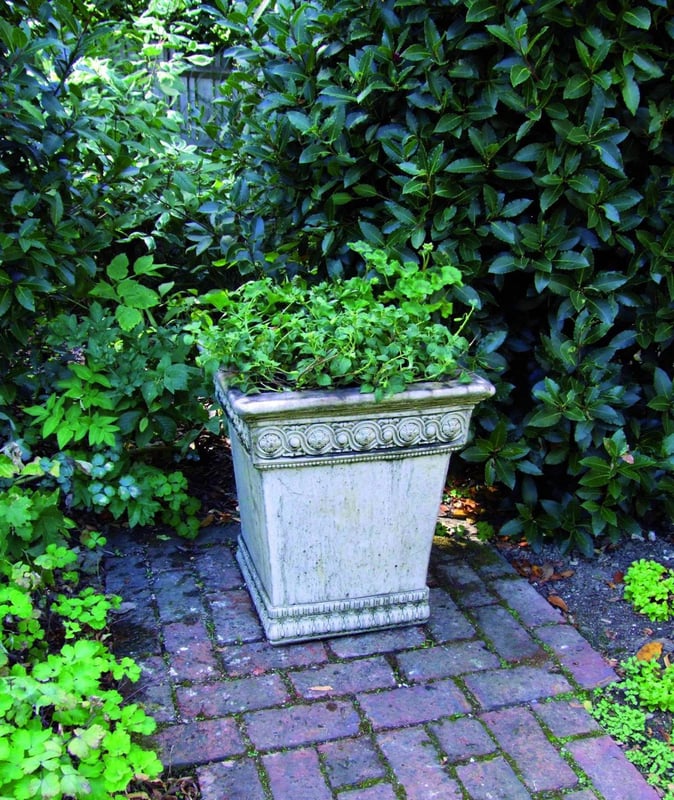
Where the Buckingham reads as restrained Georgian, the Empire Urn pictured above leans into the more decorative side of the era — later Georgian and Regency taste, with deeper relief work, scrolled handles, and a more sculptural silhouette. At 65cm tall and 38kg, it's the urn for the larger Georgian property where a Buckingham would look modest. Pair them at the top of stone steps, or use a single Empire as the focal point at the end of a long axis.
Browse the full Stone Garden Statues range for more Georgian-suitable pieces, including additional bust options and pairs of statuary.
Victorian garden statues (1837-1901)
The Victorians inherited the Georgian classical canon and then weighed it down with sentiment. Cherubs replaced lions in popularity, angels appeared in private gardens for the first time in centuries, fairies arrived from Romantic poetry, and the cast-iron foundries of Birmingham and Coalbrookdale industrialised garden ornament so any villa-owner could afford what only aristocrats had owned a generation earlier.
The hallmarks: cherubs and putti, mythological figures with narrative (Diana hunting, Bacchus drunk, Persephone gathering flowers), angels with explicit Christian symbolism, ornate central fountains, and the death of strict symmetry. A Victorian gardener wanted you to feel something walking past the statue, not just admire its proportions. The shift from Georgian intellect to Victorian emotion is the single biggest change in British garden statuary in 300 years.
Cherubs: the Victorian universal piece
Cherubs (technically putti, plural of putto, but nobody calls them that any more) are the most-bought Victorian statue type for one simple reason: they work in almost any garden setting. Sentimental enough for a cottage, refined enough for a town garden, small enough for a courtyard, big enough to hold a focal point. The Victorian range usually has them in playful poses — reading, sleeping, embracing, sheltering, holding a bird or a basket of flowers.
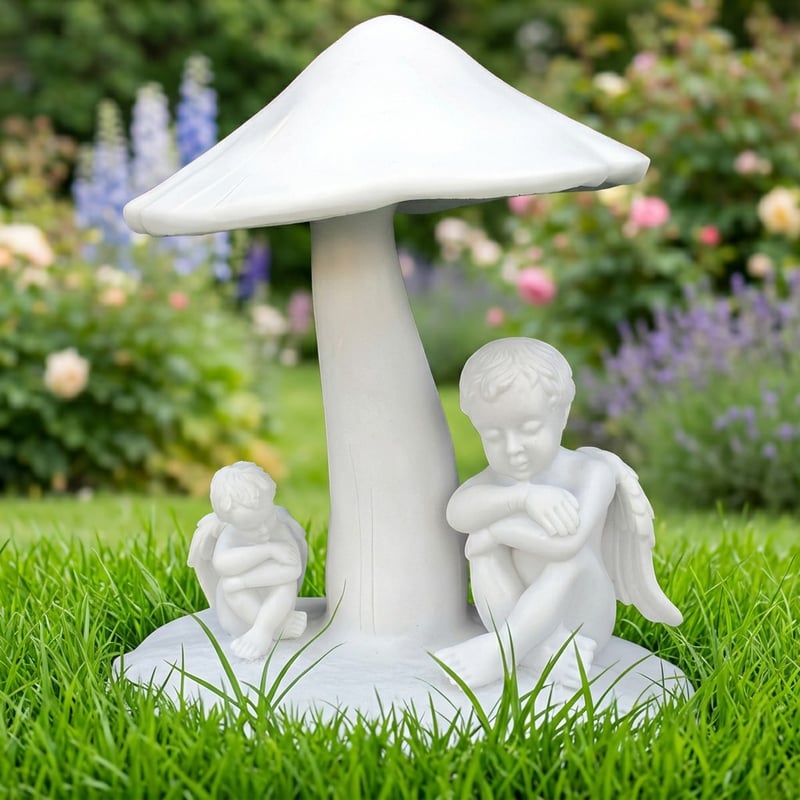
The Sheltering Cherubs piece above is exactly the kind of narrative ornament Victorians loved — two cherubs huddled together under a stone toadstool, reading as charming rather than saccharine because the carving is good. 32cm tall, 9kg, sits on the corner of a flower bed or under a tree where it can be a discovery rather than a focal point. Victorian sentiment lives or dies on the quality of the carving; thin, mass-produced cherubs look cheap, while properly carved ones become heirloom pieces.
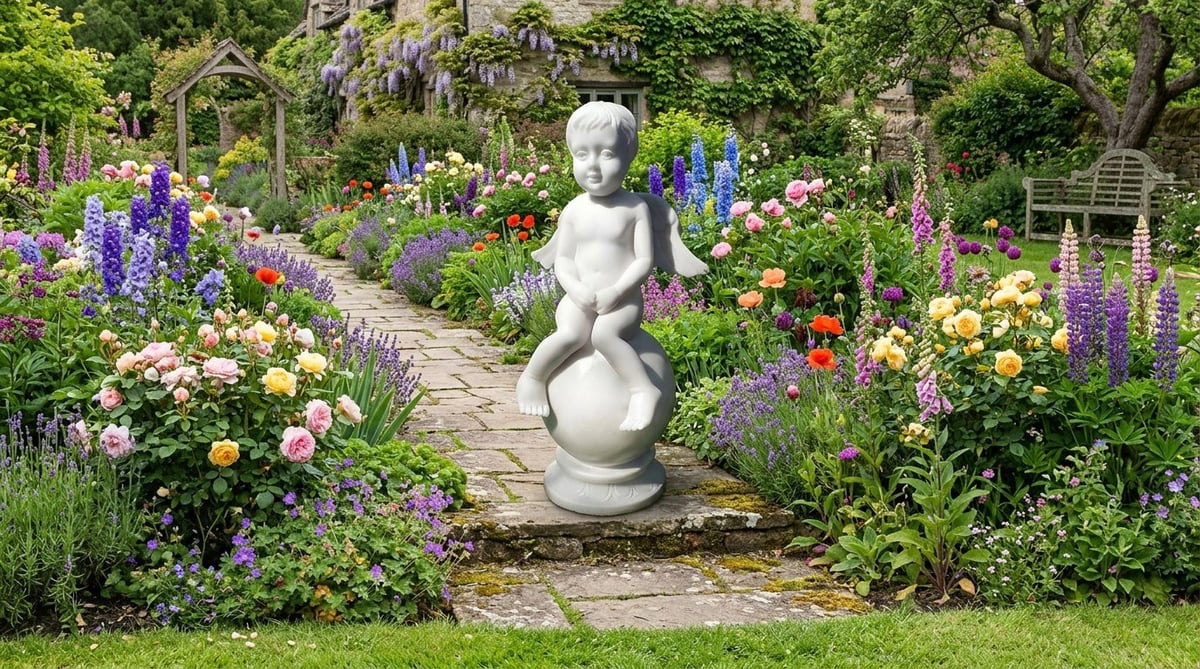
The Patient Cherub is our most-bought single cherub piece. 38cm seated figure, head resting on hand, a meditative pose that reads better than the more theatrical "playing" cherubs in modest gardens. At £149 it's the entry point for Victorian-era statuary — affordable, properly carved, and small enough to slot into an existing planting scheme without dominating it. Place it half-hidden in a fern bed, beside a small water feature, or at the corner of a path where it appears as you turn.
Mythological figures: Diana, Venus and the Romantic narrative
The Victorians revived mythological subjects after a century of Georgian classical restraint, but they gave them dramatic narrative and softer, more sentimental treatment. Diana the Hunter became more popular than the Georgian Apollo because Diana implied a story — the chase, the moonlit forest, the bow drawn. The same statue could be in a Georgian garden but it would feel different there.
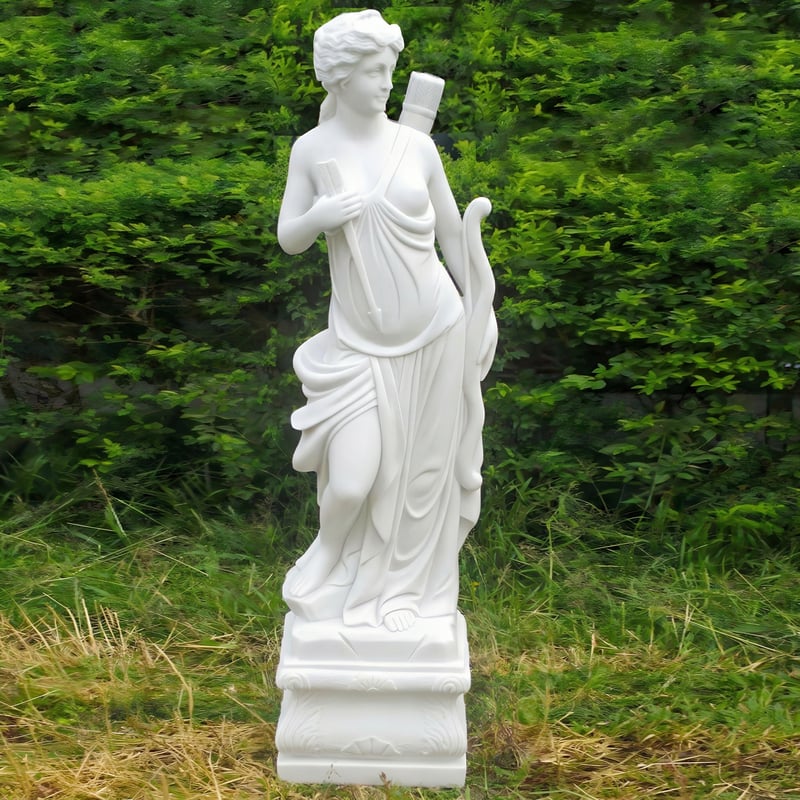
Diana the Hunter at 86cm tall is one of the rare Victorian pieces that demands a focal placement — she's not a ferns-and-shadows ornament, she's a "stand at the end of the rose garden and command attention" piece. Place her at the end of an axis, on a low plinth at the back of a long border, or on a curved gravel path where the eye runs to her. The dynamic pose — drawing the bow — means she should be visible from a distance, not tucked into planting.
Angels: a Victorian invention
Christian iconography in private gardens was rare before Victoria. By the 1860s, white marble (and marble-effect) angels had become a fixture in Victorian villa gardens, often set in remembrance gardens or beside small water features. The shift was theological as much as decorative — the Victorians collapsed the boundary between sacred and domestic, and angels in the rose bed reflected that.
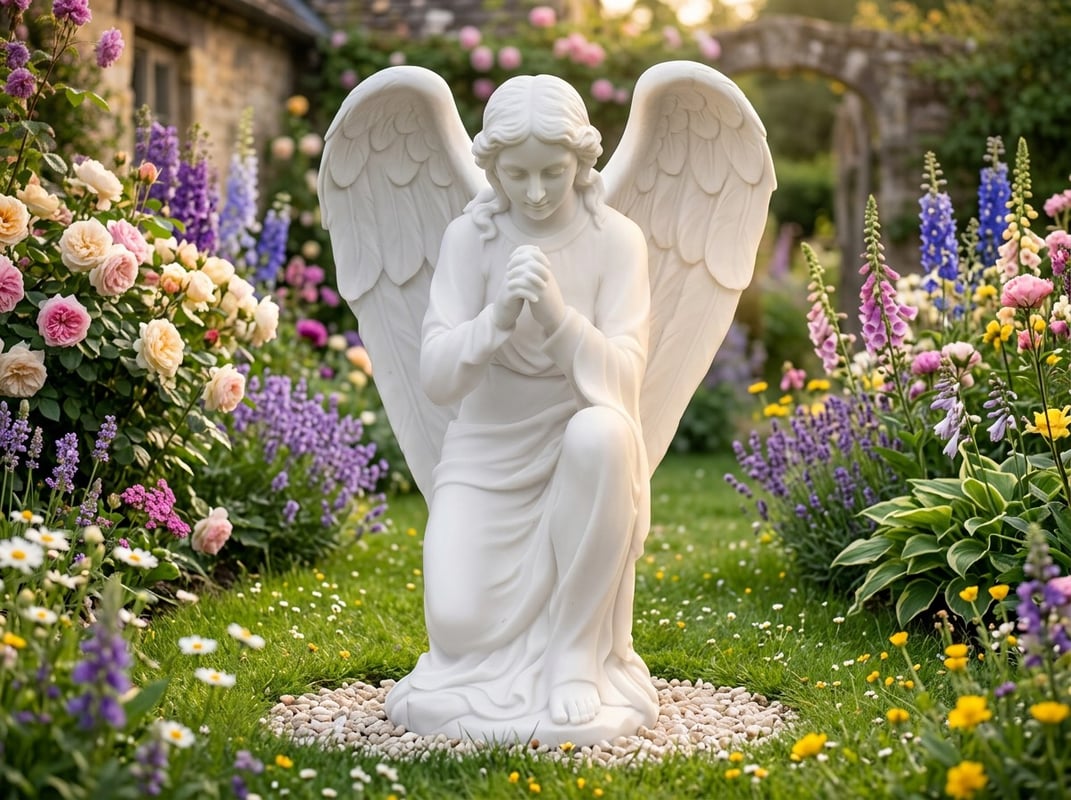
The Praying Angel above is the classic Victorian piece — 78cm tall, kneeling pose, white finish that picks up moonlight and lantern light beautifully on long summer evenings. It belongs in a quiet corner rather than a focal axis. Set behind low planting (lavender, white roses, hostas) where it appears half-hidden, or beside a water feature where the white catches reflected light. White angels in full sun look harsh; placement matters more here than in any other category.
Edwardian garden statues (1901-1910)
The Edwardians reacted against Victorian sentiment with a renewed appetite for restraint — but a different kind of restraint than the Georgians. Where Georgians drew on classical Greek and Roman models, Edwardians looked at Arts & Crafts ideals (William Morris, Gertrude Jekyll, Edwin Lutyens), formal terraced gardens with Italian Renaissance influence, and a strong revival of the sundial and armillary sphere as garden focal points.
The hallmarks: sundials and armillary spheres at the centre of formal terraces, naturalistic animal sculpture (deer in repose rather than dramatic hunting scenes), simpler classical figures without Victorian sentiment, lighter Bath stone in place of darker Cotswold, and a return to the focal-point principle of Georgian gardens but with smaller, more domestic-scaled pieces. An Edwardian garden has fewer statues than a Victorian one but each piece is more carefully placed.
Armillary spheres: the Edwardian centrepiece
The armillary sphere — an open globe of brass rings showing the celestial equator, ecliptic and meridian — became the defining Edwardian garden ornament. Lutyens and Jekyll specified them at the centre of dozens of their formal gardens between 1900 and 1914, and the format spread quickly to suburban Edwardian villas with formal rear gardens.
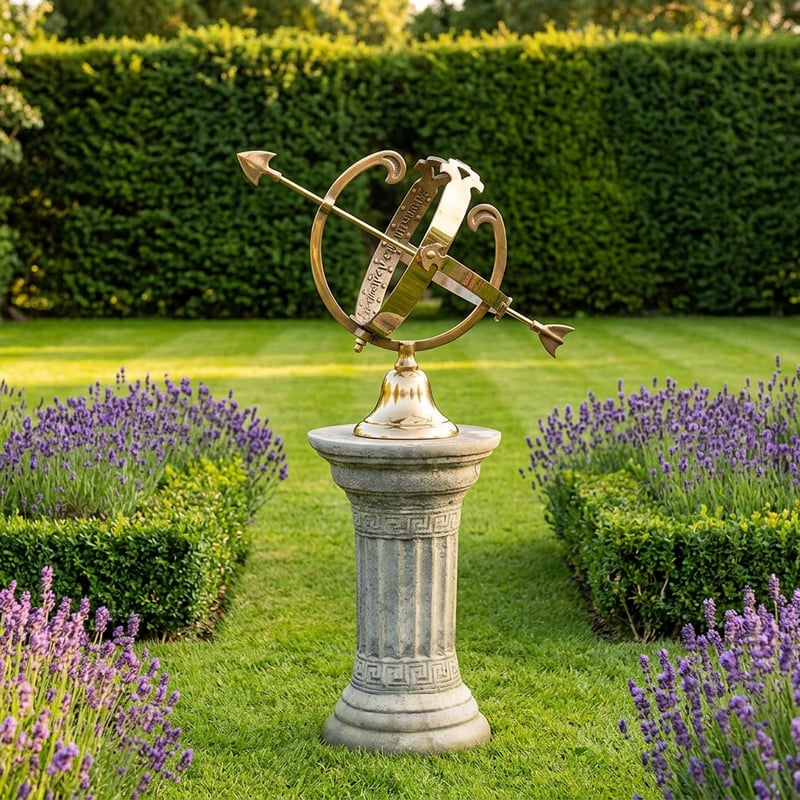
The Brass Armillary on Classical Pedestal pictured above is the Edwardian gold standard — aged brass rings on a tapered classical stone pedestal, total height 1.4m, weight 22kg. It belongs at the geometric centre of a formal lawn, in the middle of a box parterre, or at the crossing of two paths. The brass weathers to a soft verdigris over five to ten years, which is desirable — bright new brass reads as modern, while a verdigris armillary reads as inherited.
Sundials: the older form, revived
Sundials predate every era covered in this guide — they go back to Roman Britain — but they fell out of fashion through the late Victorian period and were revived hard by Edwardian Arts & Crafts gardeners as a symbol of clean, functional ornament. Where the Victorians wanted decoration, the Edwardians wanted ornament that did something. A sundial that tells the time is more Edwardian than a cherub that doesn't.
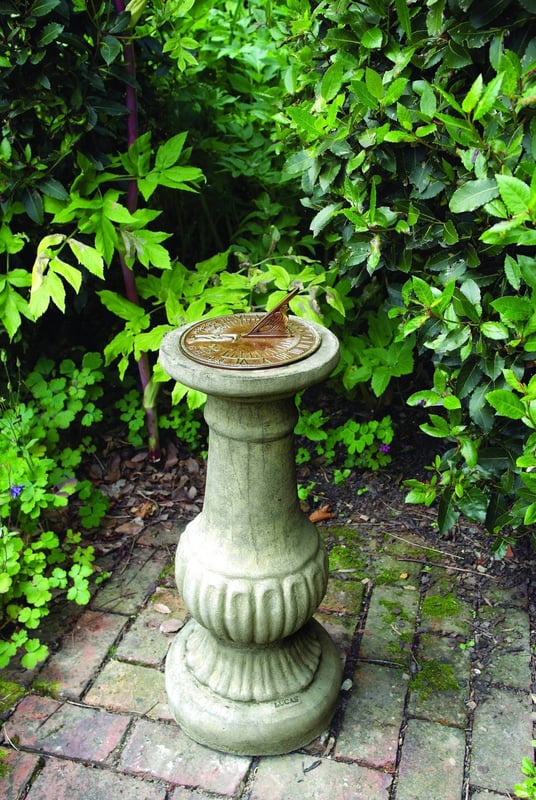
The Aged Brass Sundial on Victorian Stone Pedestal pictured above is a useful crossover piece — the pedestal is in the heavier Victorian style (squared, decorative carving on the column), but the brass dial on top is the Edwardian element. This works particularly well on properties with overlapping era cues — late Victorian/early Edwardian villas built around 1895-1905, where the architecture itself crosses the boundary. Total height 1.1m, weight 26kg. Place it where it gets midday sun (the sundial's only requirement) and where the eye runs to it as a path-end ornament.
Naturalistic animals: the Edwardian shift
Edwardian taste moved animal sculpture from Victorian dramatic poses (rearing horses, hunting hounds) towards naturalism — deer grazing, dogs lying down, birds resting. The shift mirrors the broader Arts & Crafts move towards observed nature rather than romanticised nature. A Victorian deer would be running with antlers held high; an Edwardian deer would be lying in dappled shade.
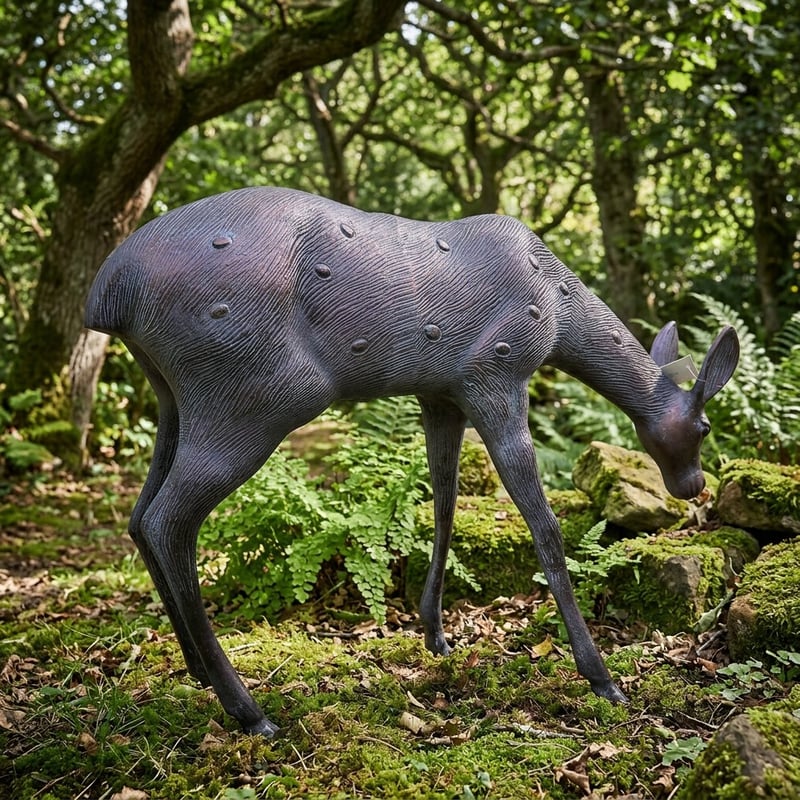
The Grazing Doe sculpture is the Edwardian piece I recommend most often for properties built in the 1900-1910 window. 78cm long, 52cm tall, head lowered in a feeding pose — placed at the back of a shrub border or at the edge of a woodland section, it reads as a deer that wandered in rather than a sculpture that was placed. That's the Edwardian aesthetic in one sentence: ornament that pretends not to be ornament.
For the broader history of classical figures across Georgian and Victorian gardens (Hercules, Diana, Venus and the rest), our companion piece on classical garden statues covers each figure's mythology and placement in detail. For the wall-mounted ornament that often complements a period garden, see our guide to garden wall art and plaques.
Era comparison at a glance
| Era | Subjects | Placement | Stone / finish | Symmetry | Typical price |
|---|---|---|---|---|---|
| Georgian (1714-1837) | Lions, classical busts, urns, sphinxes | Paired flanking entrances and axes | Cotswold, Portland, Coade stone | Strict | £200-£400 |
| Victorian (1837-1901) | Cherubs, angels, mythological figures, fountains | Focal points in flower beds | White marble, cast iron, terracotta | Asymmetric | £149-£400 |
| Edwardian (1901-1910) | Sundials, armillaries, naturalistic animals | Centres of formal terraces, end of axes | Bath stone, brass, lead | Formal but small-scale | £249-£629 |
Matching the stone to the era
Stone choice is the second-biggest decision after subject. Different eras used different stones, and the colour of the stone is a major part of why a period statue reads as authentic. Modern resin or pure white reconstituted stone gives the game away immediately — even from across a garden, the eye spots the wrong material before it spots the wrong subject.
- Cotswold-effect stone (warm honey-tan): Right for Georgian and early Victorian. Reads as warm-weathered Portland or Bath stone after 50 years.
- Bath-effect stone (paler buff): Right for Edwardian and Lutyens-Jekyll inspired gardens. Lighter than Cotswold, picks up dappled light better in shaded gardens.
- Aged white / antique white: Right for Victorian angels and cherubs. Avoid stark new-white finishes — they read as resin even when they aren't.
- Aged brass / verdigris: Right for Edwardian sundials and armillaries. New bright brass takes 5-10 years to weather; an "aged brass" finish jumps that timeline.
- Lead / pewter (heavy metallic grey): Right for late Georgian and Edwardian formal gardens. The most expensive option, but unmistakable in person.
Cotswold stone is our most-bought finish across all three eras because it's the most flexible — it works in Georgian, Victorian and Edwardian gardens, while pure white reads as Victorian-only. If you're not certain which era to commit to, Cotswold buys you the most flexibility.
Placement rules differ by era
Where you put the statue matters as much as which statue you pick. Each era had distinct placement conventions, and matching those conventions is the second half of making a statue look inherited rather than dropped.
- Georgian: paired and symmetrical. Lions either side of gate piers. Urns flanking entrance steps. Busts in symmetrical niches. Single statues at the absolute end of an axis where they terminate a formal view. Never random asymmetric placement.
- Victorian: focal point in informal planting. A cherub half-hidden in a fern bed. An angel beside a water feature. Diana at the end of a rose garden but with informal beds around her. The statue should appear discovered rather than aligned.
- Edwardian: centre of a formal feature. Armillary at the dead centre of a box parterre. Sundial at the crossing of two paths. Deer at the back of a shrub border in dappled shade. Restraint — one significant piece per garden room, not many small ones.
For more on the broader principles of statue placement — sightlines, lighting, focal points — see our guide to where to place garden sculptures.
Matt's Tip: Buy the plinth, not just the statue
The single biggest mistake on period properties is putting a beautiful stone statue directly on the ground or on a paving slab. Every era we've covered — Georgian, Victorian, Edwardian — placed statues on pedestals, plinths or column bases. The plinth raises the statue to eye level (where it's actually meant to be viewed), establishes that it's an ornament rather than a garden gnome, and roots it visually in the period. Budget £100-£200 for the plinth in addition to the statue. A £200 statue on a £120 plinth looks right; a £500 statue on a paving slab looks wrong. See our stone pedestals range for plinths sized to each statue category.
Common mistakes on period properties
Things we see often when called in to consult on period gardens that aren't quite working. None of these are fatal, all of them are correctable:
- Era-mixing on the same axis. A Georgian urn at one end of a path and a Victorian cherub at the other. Pick the era and commit. If you have inherited mixed pieces, separate them into different garden rooms so each room reads as one era.
- Modern resin in period settings. Resin reads as plastic in person even when the photo looked convincing. For period properties, always go with reconstituted stone, real stone, lead or brass — never resin.
- Singletons where pairs are needed. Georgian gardens are about symmetry. A single lion looks lost; a single Georgian urn flanking an entrance looks wrong. If you can only afford one Georgian piece, place it on the central axis as a focal point, not asymmetrically.
- Wrong scale for the property. A 30cm cherub on a Victorian double-fronted villa looks lost. A 1.4m armillary in a 4m-wide Edwardian terrace garden looks comical. Statue height should roughly match the height of the back fence or the height of the ground-floor windowsills.
- Placement directly on lawn. No era placed statues directly on grass. Grass kills the visual base, prevents proper drainage, and rots the lower stone. Always use a paving slab, gravel ring, or stone plinth as the base.
Matt's Pick
|
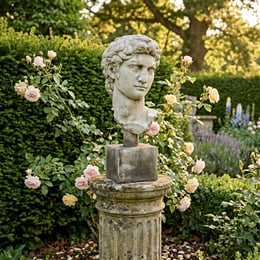
Matt's Pick for Period PropertiesBest For: Buyers who want one statue that works across Georgian, Victorian and Edwardian settings without committing to a single era. Why I Recommend It: The Bust of David in Cotswold-effect stone is the rare period piece that reads as authentic in any era from 1714 onwards. Renaissance origin (Michelangelo, 1504) puts it earlier than all three British eras, which means it pre-dates them all and slots into any of them as a "pre-existing" piece. The Cotswold finish ages well, the bust scale (45cm) suits most domestic gardens, and the carving quality is good enough to bear close inspection. If you're undecided on which era to commit to — or you have a property that crosses eras — this is the safest single-piece statement. Price: £246 |
Winter care for period stone statues
Real stone, reconstituted stone and brass all have winter weaknesses on UK properties. The lifecycle of a period stone statue depends on what you do between November and March. Brief notes by material:
- Cotswold-effect reconstituted stone: Frost-tolerant down to -15°C. The vulnerability is water absorption into the base where it sits on the plinth — lift the statue clear of the plinth in late October, wipe the underside dry, and reset on a thin felt pad.
- Real Cotswold or Bath stone: More porous than reconstituted. Apply a breathable stone sealer in October every 3-4 years, never a non-breathable one (which traps moisture).
- White marble or marble-effect: Most vulnerable. Cover with a fitted statue cover from December to February. Black mould on white marble is the common winter damage and is very hard to remove.
- Aged brass armillaries and sundials: Frost-proof. The brass actually weathers more attractively in winter wet. No action needed.
- Cast iron Victorian pieces: Repaint chips immediately. Rust starts in 4-6 weeks once the powder coat is broken. Touch-up paint sold by the manufacturer.
For the full month-by-month winter protocol across all materials, see our guide to protecting garden ornaments in winter.
Frequently asked questions
What is a traditional garden statue in the UK?
A traditional UK garden statue is a stone, lead, marble or brass figure in the Georgian, Victorian or Edwardian decorative tradition. The three eras together cover roughly 1714 to 1910 and include classical figures (Hercules, Diana, Venus), paired lions, fluted urns, cherubs and angels, naturalistic animals, sundials and armillary spheres. Modern resin statues are not in this tradition.
Are Georgian and Edwardian garden statues different?
Yes — Georgian statues lean to paired classical figures and urns; Edwardian to sundials, armillaries and naturalistic animals. Georgian gardens emphasised strict symmetry and Greek/Roman classical references. Edwardian gardens revived the sundial and armillary sphere as central focal points and preferred naturalistic animal sculpture (deer in repose) over Georgian dramatic figures.
What stone is right for a Georgian garden?
Cotswold-effect or real Portland stone is the most authentic choice for a Georgian garden. Coade stone (the artificial stone perfected by Eleanor Coade in 1769) was the original middle-class option and most modern reconstituted stones are descendants of that tradition. Avoid pure white finishes, which read as Victorian, and avoid resin, which reads as modern.
Can I put a Victorian cherub in an Edwardian garden?
You can, but it will read as inherited rather than period-correct. Edwardian taste deliberately moved away from Victorian sentiment, so a cherub in an Edwardian setting suggests the Victorian piece pre-dates the property. This works if the rest of the garden is otherwise Edwardian and the cherub is placed in an informal corner, but it's not the strongest choice.
How much should I budget for a period garden statue?
Budget £200-£400 for a single piece, plus £100-£200 for the plinth. Smaller cherubs and busts start at £149-£220. Mid-range pieces (Diana the Hunter, Sheltering Cherubs, Buckingham Urn, Hercules Bust) sit at £220-£280. Larger armillaries on classical pedestals run £375-£629. Always budget the plinth separately — a statue on the ground looks wrong in any era.
Where should I place a stone statue on a Georgian property?
Place Georgian statues symmetrically and in pairs wherever possible. Lions on gate piers. Urns flanking entrance steps. Busts in matched niches at the ends of paths. Single statues only at the absolute end of a central axis as a focal terminus. Never asymmetric placement — it conflicts with the Georgian principle of symmetry as architecture.
Are Cotswold stone statues frost-proof?
Yes — Cotswold-effect reconstituted stone is frost-rated to -15°C and survives UK winters without protection. The only winter weakness is water pooling at the base where the statue meets the plinth. Lift the statue clear of the plinth in late October, dry the underside, and replace on a thin felt pad. Real Cotswold stone is more porous and benefits from a breathable sealer every 3-4 years.
Related reading
- Garden Statues UK: Types, Materials, Placement and Prices
- Classical Garden Statues: Greek, Roman and Renaissance Figures
- Stone Pedestals and Plinths: How to Display Garden Statues
- Garden Wall Art and Plaques: Metal, Stone and Decorative Screens
- Where to Place Garden Sculptures
Browse our full collection of garden ornaments for stone statues, water features, sundials and pedestals to suit Georgian, Victorian and Edwardian gardens.