
Mythological Garden Statues UK: Pan, Atlas, Venus and Diana
Written by Matt W on 5th May 2026.
Mythological garden statues bring classical narrative into a UK garden in a way no modern sculpture can match. Diana with her bow drawn implies the chase. Venus reading from the Aphrodite Anadyomene tradition implies love. Hercules in bust form implies the labours. This listicle ranks 9 mythological garden statues we stock for UK gardens, with the mythology behind each figure, where in the garden each one belongs, and the UK-specific frost ratings that matter through winter. Total height including pedestal runs 68cm for compact pieces up to 175cm for the largest Venus de Milo.
Matt W — 16 years installing garden statuary across UK gardens, including 30+ commissions where clients specifically asked for Greek and Roman mythological figures. The placement advice in this guide comes from on-site walks with customers in Bath, Edinburgh, the Cotswolds and the Home Counties, and from tracking which figures suit which property era.
Key Takeaways
- ✅ Match the figure to the garden's intent. Diana suits hunting estates, Flora suits cottage gardens, Hercules suits formal walled gardens.
- ✅ Pedestal adds 35-55cm of height. The figure should be at eye level when viewed from 3m back.
- ✅ Cotswold-effect cast stone handles UK winters at -15°C; resin/polystone is rated only -10°C.
- ✅ Greek and Roman names overlap. Diana = Artemis, Venus = Aphrodite, Hercules = Heracles - same figure, different mythology.
- ✅ Drape and pose dictate placement. Static poses anchor focal points; dynamic poses (Diana drawing bow) need a sight line.
- ✅ Pan and Atlas are rare in our range. Where stocked they sit in the £200-£400 band - season demand spikes in spring.
Installer's Note
After placing more than 30 mythological figures across UK gardens, the single biggest determinant of whether the statue reads as authentic is whether the figure's narrative fits the property. A Diana in mid-chase looks magnificent at the end of a long Edwardian gravel walk; the same Diana on a 4m courtyard patio looks like she is about to put an arrow through the kitchen window. Match the figure to the available sight lines first, then worry about size and budget.
9 mythological garden statues for UK gardens
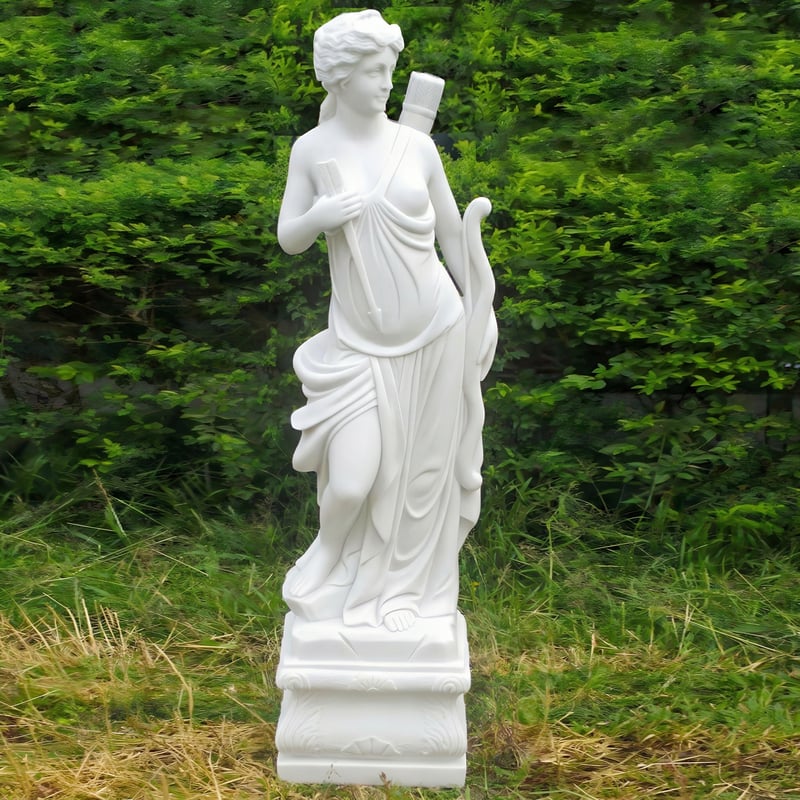
1. Diana the Hunter - Roman goddess of the hunt
Mythology: Roman Diana / Greek Artemis - virgin huntress, twin sister of Apollo, goddess of wild animals, the moon and chastity. Almost always depicted with a bow and a hunting hound, sometimes with a crescent moon at her brow. The pose in our range shows her drawing the bowstring, mid-chase.
Specs: 86cm tall (Large), Cotswold-effect cast stone, frost rating -15°C, around 38kg. Best on a low plinth at the end of a formal axis or rose garden.
Where it works: Hunting estates, large country gardens, formal Edwardian rear gardens with a 6m+ sight line. The dynamic pose needs distance to read; do not place her closer than 4m from the primary viewing point. Pictured at the top of this guide. Price £189.
2. Venus de Milo - Greek goddess of love
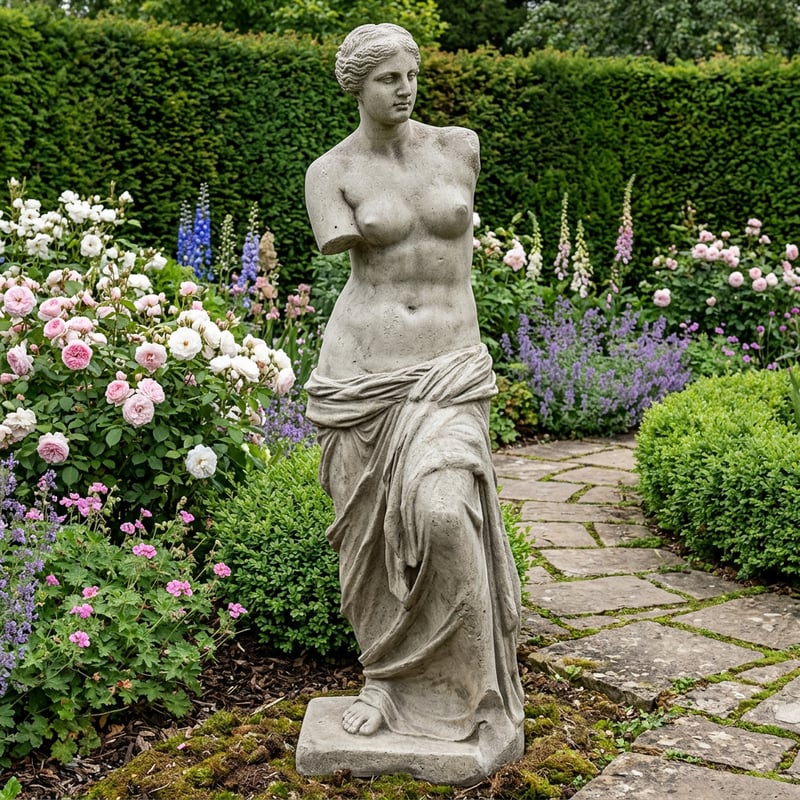
Mythology: Roman Venus / Greek Aphrodite - goddess of love, beauty, desire and fertility. The Venus de Milo is the most-famous surviving Hellenistic sculpture (130-100 BC), discovered on the Greek island of Milos in 1820 and held by the Louvre. The lost arms are part of the appeal; sculptors have reconstructed her holding everything from an apple to Ares' shield.
Specs: 175cm tall (Large), Cotswold-effect cast stone, frost rating -15°C, around 78kg in two pieces. The largest mythological figure in this listicle - this is a focal-point piece.
Where it works: Walled gardens, alcoves cut into yew hedges, the centre of a box parterre. Venus needs a backdrop - dark planting, evergreen hedge, or a stone wall - to read against. Avoid open lawn placement; she gets lost without a backdrop. Price £355.
3. Hercules - Greek demigod of strength
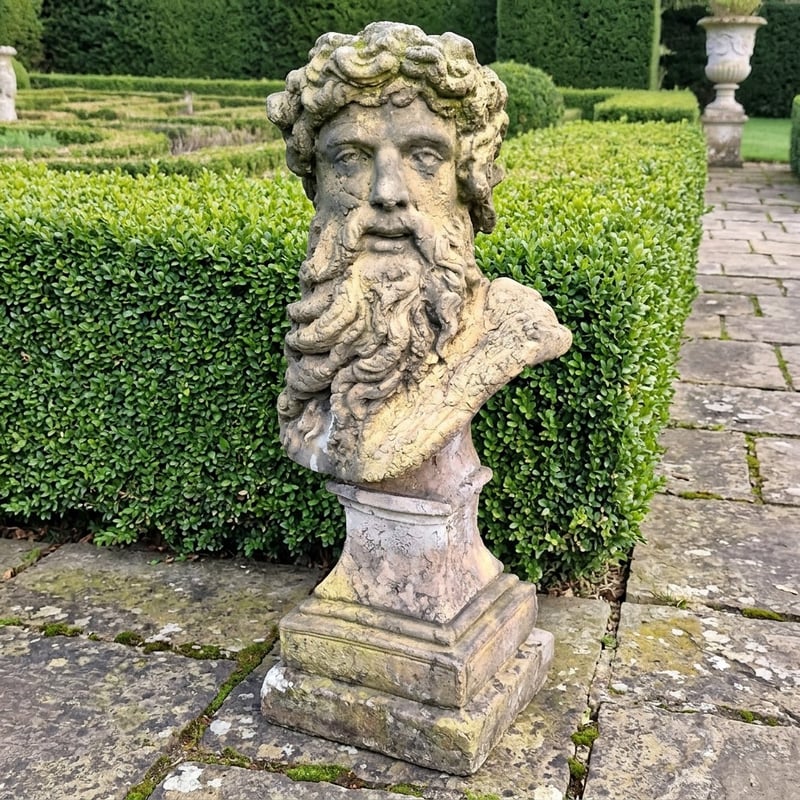
Mythology: Roman Hercules / Greek Heracles - son of Zeus, completed the twelve labours including slaying the Nemean Lion (whose pelt he wears in most depictions). The bust format is what survives in most Roman copies - the original full statues are largely lost.
Specs: 38cm bust on a tapered plinth (plinth adds 90-110cm depending on choice), Cotswold-effect cast stone, frost rating -15°C, bust around 18kg.
Where it works: Formal walled gardens, niches, the corner of a courtyard where two walls meet. Hercules is intentionally an "interrupted view" piece - the bust appears as you turn a corner rather than as a long-axis terminus. Pair with one of our stone pedestals sized to match. Price £285.
4. Poseidon water feature - Greek god of the sea
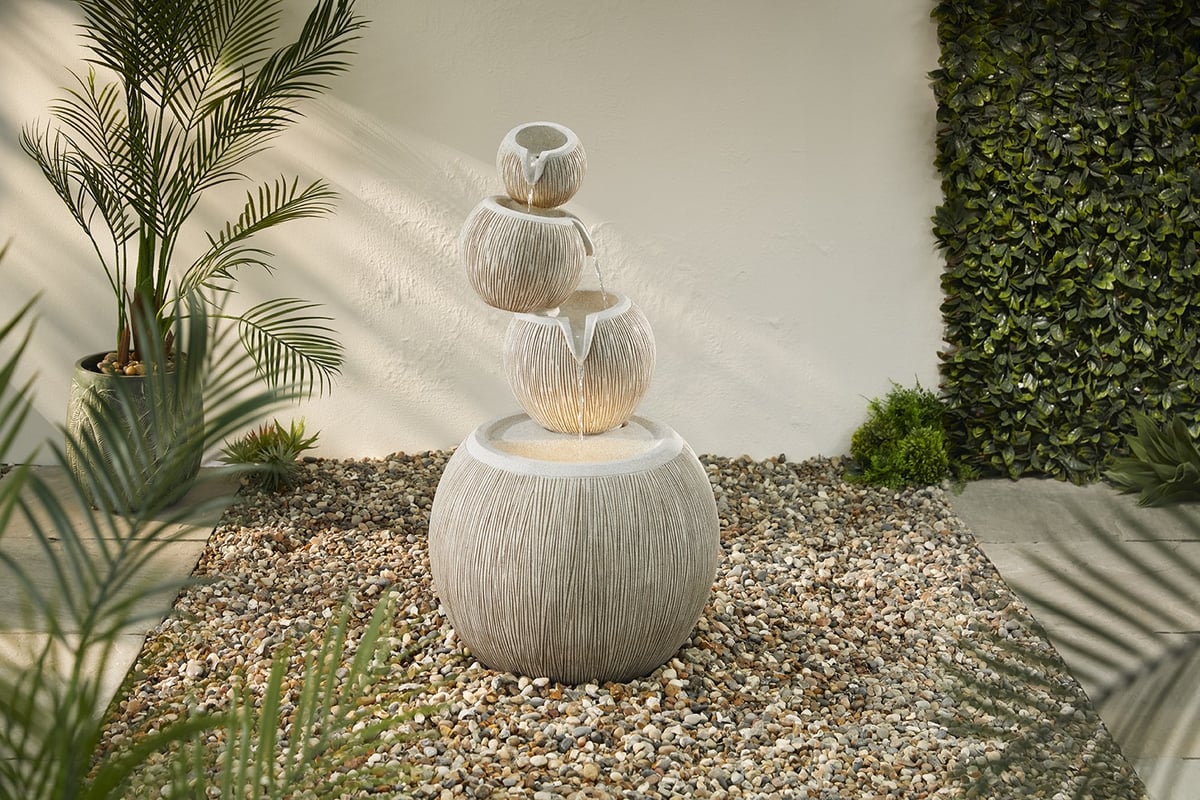
Mythology: Greek Poseidon / Roman Neptune - god of the sea, earthquakes and horses. Brother of Zeus and Hades, depicted with the trident and often riding a chariot pulled by hippocamps (sea horses). Most-recognised in Bernini's 1620s "Neptune and Triton" pose.
Specs: 78cm tall self-contained water feature, polyresin construction with antiqued bronze finish, frost rating -10°C, integrated pump and reservoir. Plug-and-play - no plumbing needed.
Where it works: Coastal gardens, gardens with maritime planting (sea holly, thrift, sea kale, Mediterranean palms), or any setting where the water sound matters as much as the figure. Bring indoors or empty the reservoir from October to March - the polyresin handles cold but the pump does not. Price £400.
5. Hebe - Greek goddess of youth
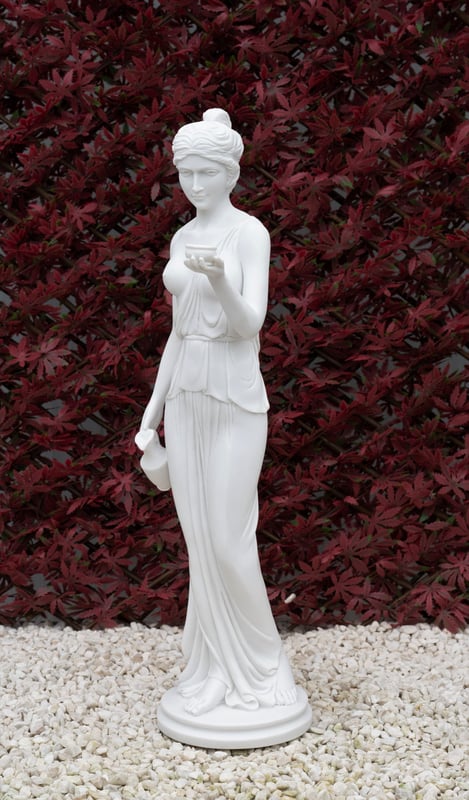
Mythology: Greek Hebe / Roman Juventas - daughter of Zeus and Hera, cup-bearer of the gods on Mount Olympus, goddess of youth and bride to the deified Hercules. Almost always depicted holding a goblet of nectar (the drink of immortality). One of the most-popular garden figures in Victorian and Edwardian England.
Specs: 86cm tall, polystone with white finish, frost rating -10°C, around 22kg. Lighter and easier to position than the cast stone figures.
Where it works: White cottage gardens, small courtyards, beside a small pool or fountain (the nectar-cup motif pairs well with water). Place against dark planting (yew, holly, rosemary) to make the white pop. Price £210.
6. Flora - Roman goddess of flowers and spring
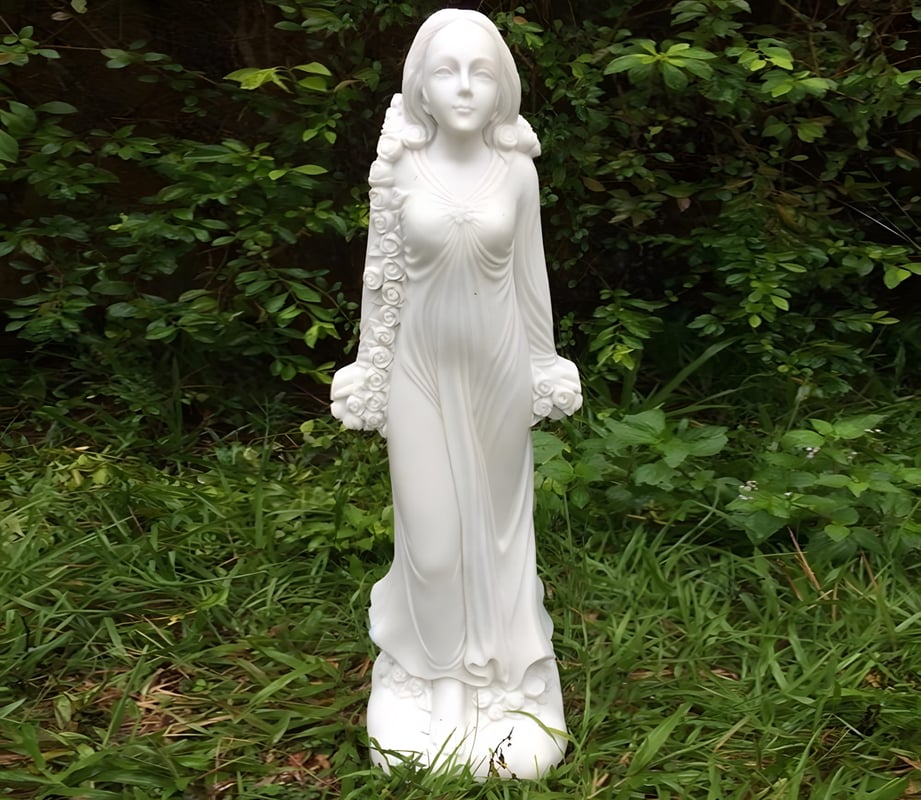
Mythology: Roman Flora / Greek Chloris - goddess of flowers and the season of spring. Her festival, the Floralia, ran 28 April to 3 May. Botticelli's "Primavera" (1482) is the most-famous Renaissance depiction; she carries a basket or armful of mixed blooms.
Specs: 145cm tall (Large), Cotswold-effect cast stone, frost rating -15°C, around 62kg. Substantial focal-point piece.
Where it works: Cottage gardens, herbaceous borders in full bloom, kitchen gardens with flowers grown for cutting. Flora is best surrounded by what she represents - place her amongst hardy perennials and self-seeders rather than on bare paving. Price £495.
7. Iris - Greek messenger goddess of the rainbow
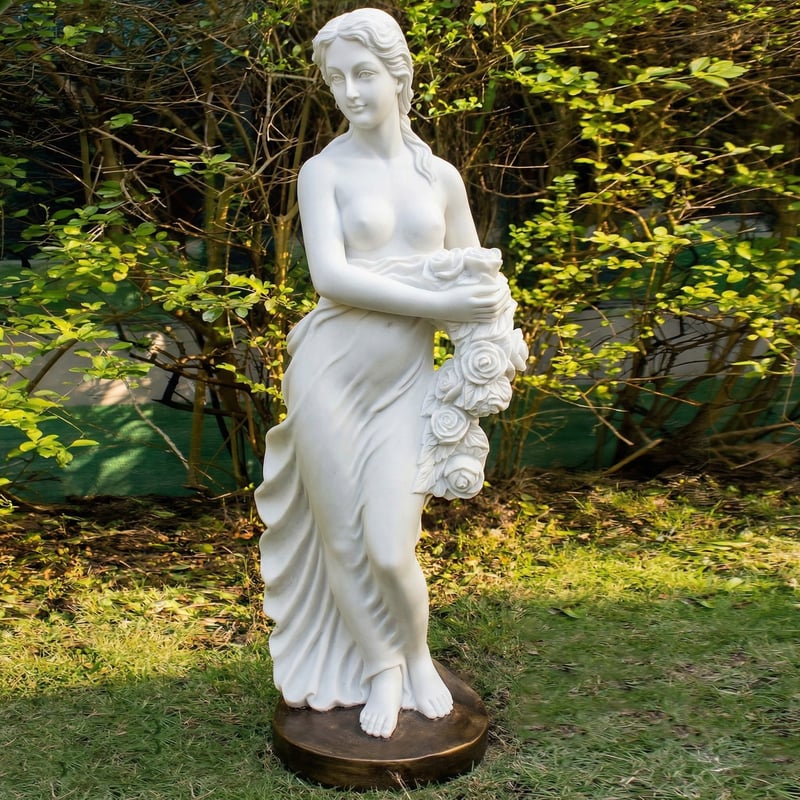
Mythology: Greek Iris (no Roman equivalent name - she retains the Greek) - personification of the rainbow and messenger between gods and mortals. Sister of the Harpies, daughter of Thaumas and Electra. Often depicted with golden wings and a herald's staff.
Specs: 95cm tall (Large), Cotswold-effect cast stone, frost rating -15°C, around 32kg.
Where it works: Mid-border placements where the figure is mostly visible but partly obscured by planting (the messenger-in-motion theme suits this), woodland-edge gardens, gardens with iris (the flower) plantings nearby. Price £189.
8. Gaia - Greek primordial earth goddess
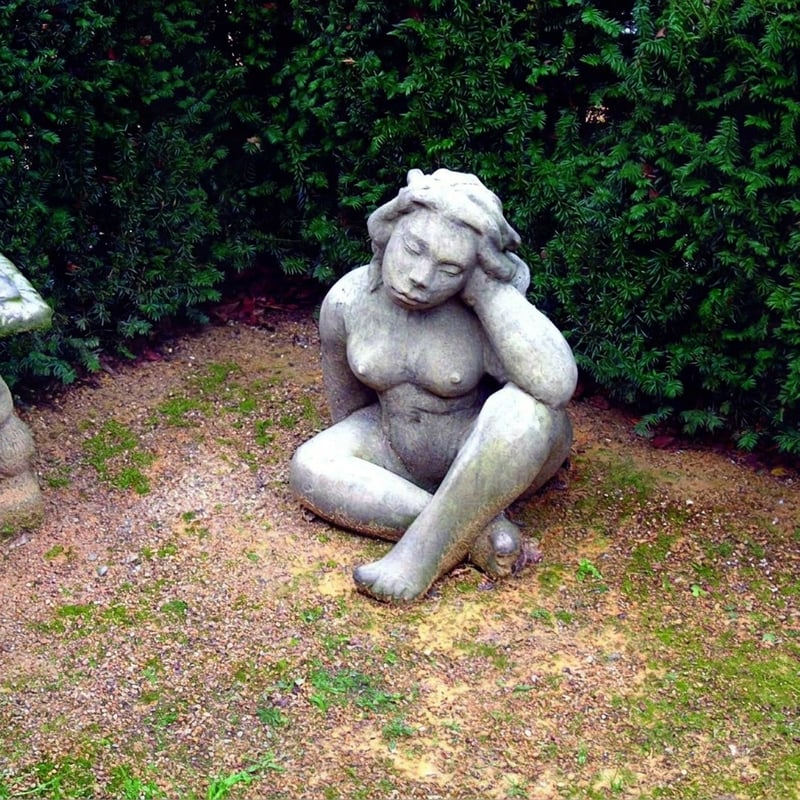
Mythology: Greek Gaia (or Ge) / Roman Terra - the personification of Earth itself, mother of the Titans, grandmother of Zeus. One of the primordial deities (older than the Olympians). The seated pose places her in a posture of reflection rather than action.
Specs: 68cm tall in seated pose, Cotswold-effect cast stone, frost rating -15°C, around 28kg. The lowest-profile figure in this listicle.
Where it works: Wildlife gardens, naturalistic plantings, wildflower-meadow edges, woodland borders. The seated pose suits ground-level planting around her - she becomes part of the bed rather than rising above it. Price £315.
9. Fortuna - Roman goddess of fortune
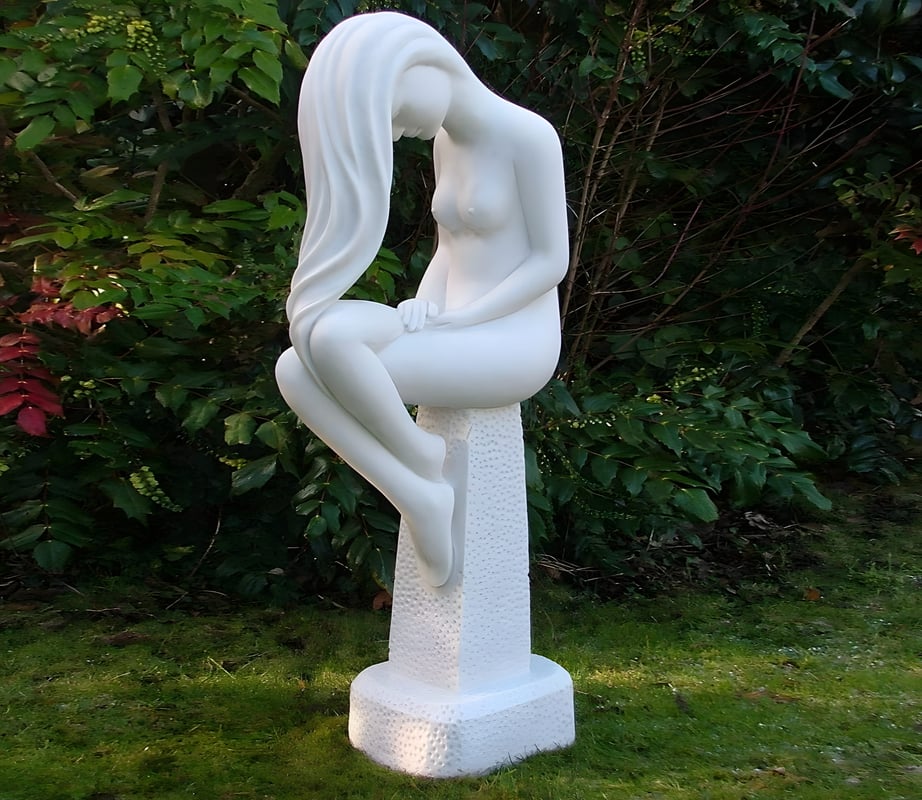
Mythology: Roman Fortuna / Greek Tyche - goddess of fortune, luck and personification of fate. Often depicted with a wheel (Rota Fortunae - the wheel of fortune), a cornucopia, or blindfolded. The wheel turns regardless of merit, which is why she became a favourite Renaissance allegorical subject.
Specs: 110cm tall (Large), polystone with white contemporary finish, frost rating -10°C, around 24kg.
Where it works: Modern paved courtyards, contemporary gardens with white planting (white roses, white agapanthus, white phlox), or as a balance to a darker focal piece elsewhere in the garden. The contemporary finish reads as Renaissance reinterpretation rather than direct Roman antiquity. Price £289.
Comparison: which figure for which garden
| Figure | Mythology | Best garden type | Height | Frost rating | Price |
|---|---|---|---|---|---|
| Diana the Hunter | Roman / Greek Artemis | Country, formal axis | 86cm | -15°C | £189 |
| Venus de Milo | Roman / Greek Aphrodite | Walled, parterre | 175cm | -15°C | £355 |
| Hercules Bust | Greek Heracles | Formal courtyard niche | 38cm + plinth | -15°C | £285 |
| Poseidon (water feature) | Greek / Roman Neptune | Coastal, Mediterranean | 78cm | -10°C | £400 |
| Hebe | Greek / Roman Juventas | White cottage, courtyard | 86cm | -10°C | £210 |
| Flora | Roman / Greek Chloris | Cottage, herbaceous border | 145cm | -15°C | £495 |
| Iris | Greek (no Roman name) | Mid-border, woodland edge | 95cm | -15°C | £189 |
| Gaia (seated) | Greek / Roman Terra | Wildlife, wildflower | 68cm | -15°C | £315 |
| Fortuna | Roman / Greek Tyche | Modern, contemporary white | 110cm | -10°C | £289 |
Placement rules for mythological figures
Mythological figures earn their place when the placement reflects the mythology. Five rules I have used across 30+ installations:
- Action figures need a sight line. Diana drawing her bow needs 4m+ of clear view. Her energy is wasted in a confined corner.
- Static figures anchor focal points. Venus, Hebe, Flora work best at the end of an axis or in a niche where they hold position rather than imply motion.
- Busts need a plinth. A bust on a paving slab looks lost. Budget £100-£200 for a plinth that raises the bust to eye level (3m viewing distance).
- Pair the planting to the figure. Flora wants flowers around her. Diana wants ground cover and shadow. Gaia wants groundcover and stone. The wrong planting fights the figure.
- Match the era of your house. Cotswold cast stone reads Georgian/Victorian. White polystone reads contemporary. Bronze reads Edwardian. See our guide on garden statues for period properties for full era-matching rules.
For broader placement principles - sight lines, lighting at dusk, group composition - see our guide on where to place garden sculptures. For the wider classical canon (Greek, Roman, Renaissance figures including those not in this listicle), our companion piece on classical garden statues covers each tradition in depth.
Winter care by material
The frost ratings in the comparison table are not theoretical - they are the manufacturer's tested limits. Three rules for UK winters:
- Cotswold-effect cast stone (-15°C): Apply a breathable stone sealer in October every 3-4 years. Lift the figure off the plinth in late October, dry the underside, replace on a felt pad.
- Polystone / white finish (-10°C): Cover with a fitted statue cover from December to February. Cold the polystone tolerates; freezing rain expanding inside surface micropores is what cracks it.
- Polyresin water features: Drain the reservoir, disconnect the pump and bring the pump indoors. The figure can stay outside under a cover if rated for it - check the spec sheet.
For the full month-by-month winter protocol across stone, resin and metal, see our piece on how to protect garden ornaments in winter. For the underlying material physics, our pillar article on garden ornament materials goes into depth.
Why no Pan or Atlas in this listicle?
Pan and Atlas are two of the most-searched mythological figures in UK garden statuary searches but are unusually thin in the wholesale supply chain. Pan (Greek god of wild nature, half-goat, plays the syrinx pipes) was popular in Victorian rockeries and is making a comeback in wildlife-led gardens; we typically stock him only in the spring/summer when seasonal stock arrives. Atlas (the Titan condemned to hold up the sky) is even rarer - sourced almost exclusively as a sundial pedestal rather than a standalone figure, because the pose lends itself to bearing a celestial sphere.
If you specifically want Pan or Atlas and we are out of stock, two options: contact us directly for sourcing (we can usually find Pan within 4-6 weeks via supplier searches), or look at the Mythical Garden Statues collection for dragons, gargoyles, and other non-classical mythological figures that fill similar roles in the garden.
Browse the full mythological range
The full stone garden statues range includes additional figures across Greek, Roman and Renaissance traditions - Bust of David, Discobolus, the Hebe in bronze, multiple Hercules sizes and figures from Roman myth not pictured here. Combined with our stone pedestals and stone plinths ranges, you can build a fully period-appropriate display for any UK garden era.
Frequently asked questions
What are the most popular mythological garden statues in the UK?
Diana the Hunter, Venus de Milo and Hercules are the three best-selling mythological garden statues in our UK range. Diana suits formal axes, Venus de Milo anchors walled gardens, and Hercules in bust form sits in courtyards and niches. Together they account for around 60% of mythological-figure orders we ship in any given year.
Are Greek and Roman gods the same figure with different names?
Yes - most major Greek deities have a Roman equivalent name. Greek Artemis = Roman Diana, Greek Aphrodite = Roman Venus, Greek Heracles = Roman Hercules, Greek Poseidon = Roman Neptune. The figures are functionally identical; the Romans adopted Greek mythology and renamed the gods. Some figures like Iris kept their Greek name in both traditions.
What height should a mythological garden statue be?
Aim for the figure's eye level to match the viewer's eye level when standing 3 metres back. For a 1.7m viewer that means a 1.5m total height (figure + plinth). Smaller figures (under 1m) need a taller plinth to compensate. Larger figures (over 1.5m) read as monumental and work without a plinth in some settings.
Do mythological garden statues survive UK winters?
Yes - Cotswold-effect cast stone is rated to -15°C and survives any UK winter. Apply breathable stone sealer in October every 3-4 years and lift the figure clear of the plinth before the first hard frost to dry the underside. Polystone figures are rated -10°C and benefit from a fitted cover from December to February. Polyresin water features need the pump removed and reservoir drained.
Can I have a mythological figure in a small garden?
Yes, but pick the figure carefully. Static seated figures (Gaia, Hercules bust on a low plinth) suit small gardens because they hold position without demanding distance. Avoid action figures (Diana, Mercury) in spaces under 4m wide - the dynamic pose looks cramped without a sight line to release the energy.
Related reading
- Classical Garden Statues: Greek, Roman and Renaissance Figures
- Garden Statues for Period Properties
- Garden Statues UK: Types, Materials, Placement and Prices
- Where to Place Garden Sculptures
- Stone Pedestals and Plinths: How to Display Garden Statues
Browse our full collection of garden ornaments for stone statues, water features, pedestals, plinths and the full mythological range across Greek, Roman and Renaissance traditions.