
Where to Place Garden Sculptures: Layout, Lighting & Focal Points
Written by Matt W on 4th Mar 2026.
Key takeaways
- ✓ Start every placement decision from your most-used window, not from outside
- ✓ Use the rule of thirds: place sculptures at intersection points, not dead centre
- ✓ Uplighting suits classical stone; downlighting suits modern metal and abstract pieces
- ✓ Sundials need unshaded south-facing positions with direct sun from 9am to 3pm
- ✓ One well-placed piece beats five scattered ornaments every time
Garden sculpture placement starts with the view from your house, not the view from the garden. The rule of thirds positions ornaments at intersection points rather than dead centre, while uplighting from below suits classical stone and downlighting from above works better for modern metal. Sundials need unshaded south-facing spots with 9am-3pm direct sun. Most placement mistakes come from choosing a position while standing outside rather than checking from your kitchen window first.
Garden ornament specialist with 15 years experience. Has positioned hundreds of stone statues, water features, and sundials in UK gardens.
Matt's experience
I have placed hundreds of garden ornaments over the years. The single biggest lesson I have learned is that you should never decide where a sculpture goes by standing in the garden and looking around. Walk back inside, stand at your kitchen window, and work out what you see. That is the view you will look at every single day. Ninety percent of the time, people move their ornament after I ask them to do this simple test.
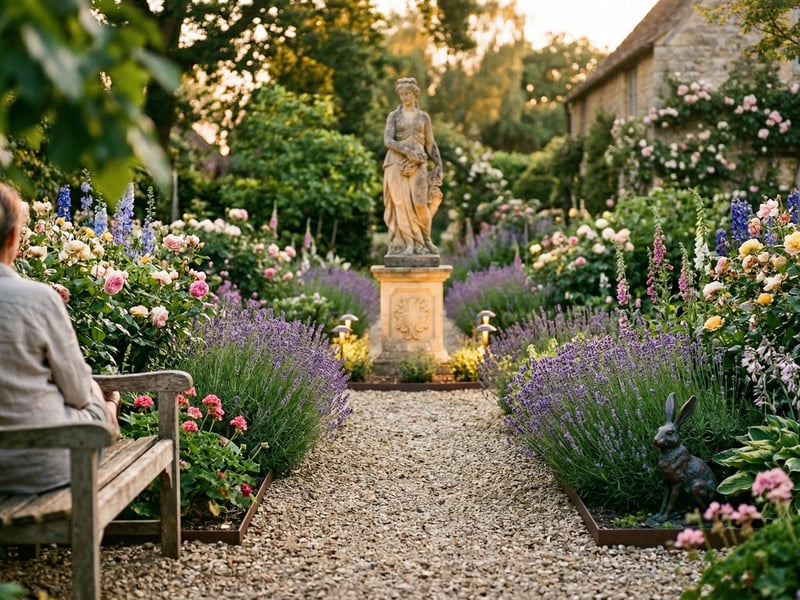
The window test: why placement starts indoors
The most common placement mistake is choosing a position while standing in the garden. You spend far more time looking at your garden through windows than walking through it. The view from your kitchen, living room, or bedroom window is the one that matters most.
Stand at each window in turn. Look at where your eye naturally lands. The end of a path, a gap in the planting, a bare stretch of fence: these are the spots where a sculpture will have the biggest visual impact. In my experience, the kitchen window view beats everything else because you see it dozens of times a day while making tea, washing up, or cooking dinner.
If you have a patio door or conservatory, the eye-level view changes. Seated positions (sofas, dining chairs) create lower sight lines. Place taller ornaments further back and shorter pieces closer to the glass. A sitting hare ornament at 600mm works well within 3-4 metres of patio doors, while a full-height classical statue reads better at the far end of the garden.
How to use the rule of thirds in your garden
The rule of thirds divides your garden into a 3x3 grid, and sculptures look best where the grid lines cross. Dead centre placement feels static and predictable. The four intersection points (roughly one-third and two-thirds along each axis) create more natural, pleasing compositions.
To apply this, stand at your main viewing point and mentally split the garden into three equal horizontal bands and three vertical bands. Place your main sculpture at one of the four crossing points. If you have a second piece, put it at the diagonally opposite intersection. This creates balance without symmetry.
Formal gardens with clipped hedges and straight paths can break this rule. Symmetrical placement either side of a central axis works when the garden itself is symmetrical. But for mixed borders, cottage gardens, and informal layouts, the rule of thirds produces consistently better results. I have tried centre placement many times and moved the piece within a week almost every time.
Sight lines, paths, and natural stopping points
Every garden path creates a sight line, and the end of that sight line is where your eye expects to find something. A sculpture at the end of a path gives you a reason to walk down it. Without it, the eye drifts and the path feels pointless.
Curved paths are slightly different. The sculpture should appear at the point where the path turns and reveals a new view. Garden designers call this the "reveal moment" and it works just as well in a 20-metre garden as a stately home. A brass sundial on a stone pedestal at a path junction gives walkers a reason to pause and look around.
Gaps in hedging, archways, and garden gates also frame views. Place a sculpture so it appears centred within the frame. The frame does the design work for you: it narrows the visual field and directs attention to whatever sits inside it. Even a small ornament gains presence when framed by an arch or a gap in a yew hedge.
What size ornament for what size garden
The height of your ornament should be roughly one-third of the height of whatever sits behind it. A 1.8-metre fence suggests an ornament around 600mm tall. A 3-metre tree line behind it can support something taller, up to a metre. Go bigger than this ratio and the ornament overpowers the setting. Go smaller and it disappears.
Width matters too. A single narrow statue on a wide lawn looks lost. Pair it with a plinth or water feature base to anchor it visually and spread the footprint. Alternatively, group several smaller pieces in odd numbers (three or five) to create a cluster that reads as a single composition from a distance.
| Garden size | Ornament height | Viewing distance | Good fit |
|---|---|---|---|
| Courtyard (under 25 sq m) | 200-400mm | 2-4 metres | Wall plaques, small animals, tabletop bird baths |
| Small (25-80 sq m) | 400-600mm | 4-8 metres | Sitting hares, small buddhas, patio bird baths |
| Medium (80-200 sq m) | 600mm-1m | 8-15 metres | Pedestalled sundials, classical figures, water features |
| Large (over 200 sq m) | 1m+ | 15+ metres | Full-size statues, large water features, armillary spheres |
These are starting points, not rules. A bold oversized piece in a small courtyard can work brilliantly if it is the only ornament. The problem is usually too many medium-sized pieces rather than one piece being the wrong size. Our guide to garden ornament materials covers weight limits for different surfaces if you are concerned about placing something heavy on a patio or deck.
Placing sculptures by type
Sundials and armillary spheres
Sundials need direct, unshaded sunlight from 9am to 3pm to function properly. South-facing positions are essential in UK gardens. Even partial shade from a tree or building during midday makes the dial inaccurate for half the day. Place them away from the house's shadow line, especially during winter when shadows stretch much further.
An armillary sphere on a stone pedestal works as a garden centrepiece or at the meeting point of two paths. The sphere catches light from every angle, so unlike flat sundials, armillaries look good even when the sun is low. Position them where you can see the metalwork glint from the house.
Bird baths
Bird baths work best 2-3 metres from shrubs or trees that give birds an escape route from cats. Place them in the open where birds can see approaching predators, but within a short flight of cover. A limestone bird bath on a lawn or gravel area gives clear sight lines all around.
Avoid placing bird baths directly under trees. Falling leaves clog the water and overhanging branches give cats a pouncing position. Partial shade is fine but full shade encourages algae. Our bird bath guide covers ongoing maintenance in more detail.
Animal sculptures
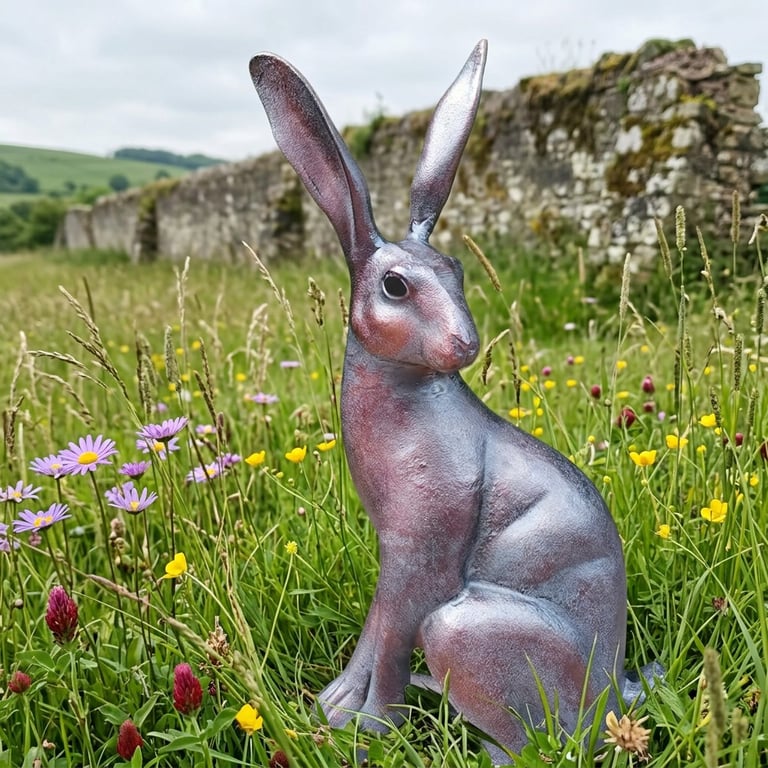
Animal ornaments look most convincing tucked into planting at ground level rather than displayed on plinths. A hare half-hidden in tall grass or a hedgehog beneath a shrub creates a moment of discovery. Visitors spot them and feel like they have found something, which is far more rewarding than a hare on a pedestal in the middle of a lawn.
Larger animals like deer work differently. They need space around them and look best silhouetted against sky or a hedge. Position them at the edge of a border looking into the garden. Our animal garden ornaments guide has placement advice for 15 different types.
Classical and religious statues
Classical figures need a clean backdrop to stand out: a dark hedge, a plain wall, or open sky. Busy mixed borders compete visually with the sculpture and neither one wins. A plain evergreen hedge (yew, box, laurel) provides the contrast that lets the detail show.
Religious statues, including angel figures and buddhas, suit quieter, more sheltered spots. A shaded alcove or a corner near a seat. The mood they create matters more than being visible from across the garden, so treat them as destinations you walk towards rather than pieces you admire from a distance.
How to light garden sculptures
Good lighting makes a garden ornament look twice as good after dark. Bad lighting makes it look worse than no lighting at all. The technique depends on the material. Stone and metal respond to completely different approaches, and getting it wrong is easy. I have seen beautifully carved statues ruined by a cold white spotlight pointed straight at them.
Uplighting (light from below)
Place a ground-level spotlight 300-500mm in front of the sculpture, angled upward at 30-45 degrees. This technique suits classical stone statues because it picks out carved detail and casts dramatic upward shadows. Warm white (2700K) bulbs work best with natural stone. Cool white makes stone look grey and dead.
Downlighting (light from above)
Mount a light in a nearby tree or on a wall bracket, pointed downward. This mimics moonlight and suits modern, abstract, and metal sculptures. The shadows fall naturally and the piece looks lit by the environment rather than by a spotlight. Polished and brushed metal finishes respond particularly well to downlighting.
Solar vs mains lighting
| Feature | Solar | Mains (12V) |
|---|---|---|
| Installation | No wiring, push into ground | Needs a qualified electrician |
| Running cost | Zero | Around £5-15 per year |
| Light output | 50-200 lumens | 300-1000+ lumens |
| Winter performance | Reduced (short days, low sun) | Consistent year-round |
| Control | Dusk-to-dawn auto only | Timer, dimmer, remote control |
| Best for | Path edges, subtle accent | Feature lighting, uplighting |
Solar lights are fine for path marking and subtle accent work. But if you want to properly light a sculpture, mains 12V is worth the electrician's fee. The difference in light quality and reliability, especially November through February, is obvious. A badly lit sculpture looks worse than an unlit one.
Placement by garden style
Cottage gardens
Cottage gardens suit weathered stone and aged metal. Tuck ornaments into planting so they look like they have always been there. A sundial surrounded by lavender works. So does a bird bath half-screened by climbing roses. Avoid anything too polished or new-looking. If it looks like it was delivered yesterday, it does not belong in a cottage garden.
Formal gardens
Symmetry drives formal placement. Matched pairs of urns flanking a path, a classical figure centred on the main axis, identical bird baths in mirrored borders. The key is restraint: fewer pieces, larger scale, precise positioning. A single gargoyle breaking the symmetry can add personality without undermining the formality.
Small and courtyard gardens
Small gardens benefit from one strong piece rather than several small ones. Wall-mounted sculptures save floor space and draw the eye upward, making the garden feel taller. If you use a freestanding piece, place it against the furthest boundary to create depth. A buddha head planter at the back wall with trailing greenery pulls the eye through the whole space.
Five common placement mistakes
- Dead centre on the lawn. It splits the garden into two halves and looks like an afterthought. Move it to the one-third point or tuck it into a border edge.
- Too many pieces too close together. Three ornaments within 2 metres of each other look cluttered, not curated. Space them so each has its own "breathing room" of clear ground or planting around it.
- Ignoring the backdrop. A grey stone statue against a grey fence disappears. Move it in front of a dark hedge or paint the fence behind it a deep green.
- Wrong height for the viewing distance. A 200mm ornament at 15 metres is invisible. Use the sizing table above and actually walk to your viewing point to check.
- Forgetting winter. That perfect summer position might be shaded, waterlogged, or hidden behind bare stems for five months of the year. Check the spot in January, not July. Our frost protection guide covers winterproofing once you have found the right position.
Matt's Tip: The trial run
Before you commit to a position, put a bucket or cardboard box of roughly the same size in the spot for a week. Look at it from your windows morning, noon, and evening. Walk past it. If you stop noticing it, it is in the wrong place. If your eye keeps finding it, you have got the right spot. I do this with every large installation and it has saved a lot of rearranging. Moving a 50kg stone statue is no fun at all.
|
Matt's Pick for placement versatilityBest for: Borders, path edges, and discovery spots in mixed planting Why I recommend it: At 600mm tall, it works in every garden size. Tuck it into tall grasses or place it on a lawn edge. I have positioned dozens of these and they always look natural because the sitting pose reads as calm rather than decorative. Price: £149 |
Seasonal placement adjustments
The sun moves through a 50-degree arc between summer and winter in UK gardens, and shadows shift with it. A position that gets full sun in June might sit in solid shade from November to February. This matters for sundials, solar-lit features, and any piece you want to see clearly from the house during darker months.
Winter is when garden ornaments earn their keep. Bare trees and dormant borders strip away the visual noise and leave your sculptures fully exposed. A piece that worked perfectly in summer, half-hidden by foliage, might look awkward and exposed in January with nothing around it. The best all-year placements have some evergreen structure nearby: box, holly, or yew.
Consider moving lightweight pieces seasonally. A fairy ornament tucked into summer perennials can come forward to a patio table or windowsill over winter. Our guide to securing garden ornaments explains how to fix heavier pieces in place all year round. Browse our full collection of garden ornaments for more ideas.
Further reading
Frequently asked questions
Where is the best place to put garden statues?
At the end of a path or sight line viewed from your most-used window. Stand at your kitchen or living room window and find the spot where your eye naturally rests. The rule of thirds suggests placing sculptures at one-third or two-thirds along the garden's length rather than dead centre, which creates a more natural composition.
How far apart should garden ornaments be?
At least 3-4 metres between separate pieces in a medium garden. Ornaments placed closer than this compete for attention and look cluttered. If you want to group pieces, treat them as a single composition and leave clear space around the whole group rather than between individual items.
Should garden statues be in sun or shade?
It depends on the material and the ornament type. Sundials need full sun from 9am to 3pm. Stone weathers well in any exposure. Painted and resin ornaments last longer with some afternoon shade because UV degrades colour and finish over time. Bird baths benefit from partial shade, which slows algae growth.
How do you make a garden sculpture look natural?
Place it where something similar might actually exist. A hare in long grass, a bird bath near shrubs, a sundial in an open lawn. Let planting grow around the base so the ornament looks settled rather than dropped into position. Weathered, patinated finishes blend in faster than clean polished surfaces.
What is the best lighting for garden statues?
Uplighting with warm white 2700K bulbs for classical stone statues. Position the light 300-500mm in front and angle upward at 30-45 degrees. Modern and metal sculptures suit downlighting from a tree or wall bracket. Solar lights work for path accents but mains 12V gives far better results for feature lighting.
Do garden ornaments look good on gravel?
Yes, gravel provides a clean, neutral base that suits most ornament styles. It drains well (reducing frost damage risk) and the texture contrasts with smooth stone or metal. Bed heavier pieces slightly into the gravel for stability and surround the base with a few larger cobbles to anchor the transition.
Can you put garden ornaments on decking?
Yes, but check the weight limit of your deck boards. Standard softwood decking supports 150-200 kg per square metre. A large stone statue can weigh 80-150 kg concentrated on a small footprint, so place it over a joist for support rather than between joists. Use rubber pads underneath to prevent scratching and water trapping.
Matt W
Garden & Outdoor Specialist
Matt has spent over 16 years working hands-on with garden products across the UK. He tests materials in Staffordshire clay soil and hard water conditions, and writes from direct experience fitting, maintaining, and repairing everything from stone statues to cast iron furniture. His advice is based on what actually survives a British winter, not what looks good in a catalogue.