
Large Garden Ornaments: Statement Pieces That Transform Outdoor Spaces
Written by Matt W on 4th Mar 2026.
Large garden ornaments start at 60cm tall and weigh between 25kg and 205kg depending on material. Reconstituted stone is the most popular choice for UK gardens, rated frost-proof to -20°C. Prices range from £65 for cast stone animals to £1,250+ for life-size classical figures. A standard patio supports up to 244kg per square metre, but ornaments over 100kg need a purpose-laid concrete base to prevent cracking individual slabs.
Key Takeaways
- ✅ 60cm+ is classed as "large" by UK retailers; 91cm+ is "extra large"
- ✅ Reconstituted stone is frost-proof to -20°C and develops natural patina
- ✅ Anything over 25kg needs two people to lift (HSE guidance)
- ✅ A 600x600mm paving slab prevents lawn damage under heavy pieces
- ✅ No planning permission needed for garden ornaments in most cases
- ✅ Pallet delivery is kerbside only — you handle the final positioning
What counts as a large garden ornament?
UK retailers generally class anything over 60cm (2ft) as large. Wayfair uses 91cm as its "extra large" threshold. In practical terms, a 60-90cm piece works as a border accent or patio feature. At 90-120cm, you have a standalone lawn centrepiece. Above 120cm, you are into statement territory that needs a bigger garden and a solid base beneath it.
Weight matters more than height when planning placement. A 90cm reconstituted stone Buddha weighs around 65kg. A 120cm classical goddess can hit 180kg. The weight determines what base you need, how many people you need on delivery day, and whether your patio can handle it. We include specific weights on every product page, so check before you order.
The bigger the ornament, the fewer you need. One well-placed 120cm statue does more for a garden than a dozen smaller pieces scattered across borders. This is the single most common piece of advice from garden designers, and after selling large garden ornaments for years, I agree with it completely.
Installer's Note
I have delivered hundreds of large stone ornaments across the UK. The number one mistake buyers make is underestimating the weight. A 120cm classical statue looks manageable in photographs, but 180kg of reconstituted stone does not move easily across a lawn. Before you order anything over 50kg, walk the route from your front gate to the final position. Check for steps, narrow paths, soft ground, and locked side gates. You need that route clear on delivery day, and you need a rated sack truck and at least one other person to help.
Types of large garden ornaments
Classical statues and figures
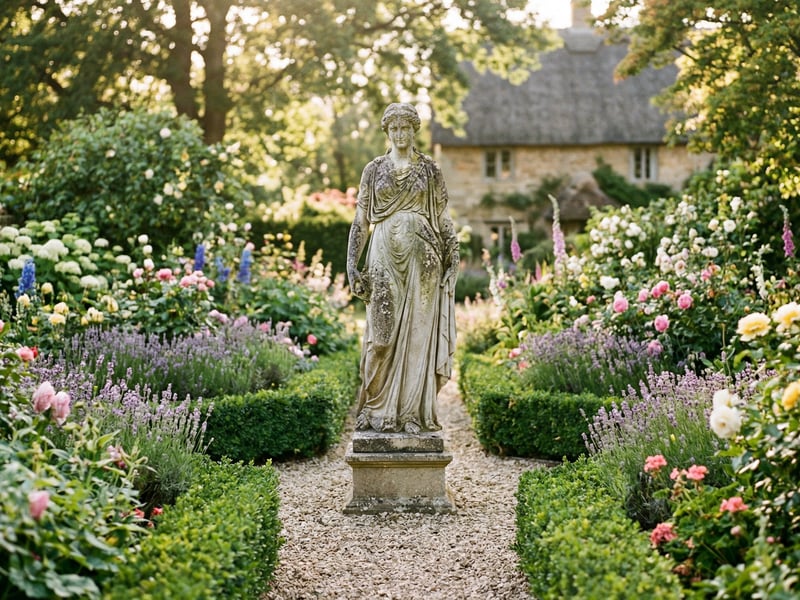
Greek goddesses, Roman busts, cherubs, and mythological figures remain the bestselling category for large ornaments. A piece like the Draped Maiden Garden Statue at £499 is a traditional centrepiece for the end of a path or an archway entrance. Cast stone versions weigh 80-180kg and develop beautiful lichen and moss over the first 12-18 months outdoors.
Classical busts on plinths are a strong 2026 trend. They pair particularly well with minimalist modern planting, creating contrast between period detail and clean lines. The Diana the Hunter Extra Large at £439 is a good example of this category done well.
Large Buddha and oriental figures
Buddha statues are consistently among our most popular large ornaments. The Large Grand Buddha Head at £445 weighs around 130kg and sits best in a gravel garden surrounded by bamboo or ornamental grasses. Seated Buddhas need less height for visual impact because their wide silhouette fills horizontal space.
Oriental ornaments suit both dedicated zen areas and mixed planting schemes. A single large Buddha placed off-centre in a gravel bed anchors the whole space without needing symmetrical planting around it. Read our sculpture placement guide for more positioning advice.
Large animal sculptures
Pairs of lions guarding a driveway entrance, a stag on a lawn, a heron by a pond. Animal ornaments work because people react to them instinctively. The Large Elegant Stag at £285 in rusted metal stands out against green hedging and changes character with the seasons as light shifts. Stag sculptures are one of the strongest garden trends running through 2026.
Life-size animal pieces are heavier than they look. The Female Great Dane Statue at £689 is a solid stone piece that needs a permanent position and proper base. Our full guide to animal garden ornaments covers the complete range.
Large water features and fountains
A large water feature gives you something no statue can: moving water and the sound that comes with it. The Basalt Statement Column Water Feature at £679 stands nearly a metre tall and is self-contained, meaning it has a built-in pump and reservoir. No plumbing needed. Fill with water, plug it in, and it runs.
Stone water features weigh more than equivalent-sized statues because of the reservoir. Budget for a concrete pad if you are placing one on lawn or gravel. Electric pumps need an outdoor IP65-rated socket within 10 metres. Our solar and self-contained water features guide covers running costs in detail.
Large urns and planters
Stone urns on pedestals are the traditional choice for flanking doorways or sitting either side of garden steps. The Large Buckingham Stone Urn at £325 is a good mid-range example. Remember that filled urns weigh roughly double their empty weight once you add compost and plants.
Contemporary and abstract sculptures
Corten steel and rusted metal abstract forms have become noticeably more popular over the past two years. They develop a controlled rust patina over the first 6-12 months and then stabilise. The Large Gorilla in Bronze at £389 shows how contemporary pieces can be figurative rather than abstract while still fitting modern garden design.
How heavy are large garden ornaments?
Weight varies dramatically by material and height. This table shows typical weights for reconstituted stone, the most common material for UK garden ornaments.
| Height | Typical Weight | People Needed | Equipment |
|---|---|---|---|
| Under 60cm | 5-25kg | 1 person | None |
| 60-90cm | 25-65kg | 2 people | None or hand trolley |
| 90-120cm | 65-180kg | 2-3 people | Sack truck (200kg rated) |
| 120cm+ | 120-205kg+ | 3+ people | Heavy-duty sack truck + plywood sheets |
Metal ornaments are lighter than stone at the same height. A 90cm metal stag weighs around 15-25kg. Resin pieces are lighter still at 5-15kg for a 90cm figure. But lighter materials need anchoring in windy gardens, while heavy stone stays put by its own weight. Anything over 50kg rarely shifts in normal UK wind conditions.
What base does a large ornament need?
The right base stops slabs cracking and prevents the ornament sinking over time. The base you need depends entirely on the ornament's weight and the surface you are placing it on.
| Ornament Weight | On Patio | On Lawn | On Gravel |
|---|---|---|---|
| Under 25kg | No base needed | No base needed | No base needed |
| 25-50kg | No base needed | 600x600mm paving slab flush with turf | Slab on compacted gravel |
| 50-100kg | Spread across 2+ slabs | Slab on 50mm compacted gravel bed | Dig out gravel, lay concrete pad |
| 100-200kg | 75-100mm concrete pad | Concrete pad on 75mm Type 1 sub-base | Concrete pad on Type 1 sub-base |
| 200kg+ | 150mm concrete foundation with rebar | Professional installation | Professional installation |
Will a large ornament damage my patio?
A standard UK patio (100mm concrete slab on compacted sub-base) supports approximately 244kg per square metre. Most large ornaments fall within this limit. The risk is not total weight but point load. A 150kg statue standing on four small feet concentrates force on those contact points, which can crack individual paving slabs. If your ornament weighs over 100kg and has a small base footprint, lay a 600x600mm concrete spreader slab underneath it.
Will it damage my lawn?
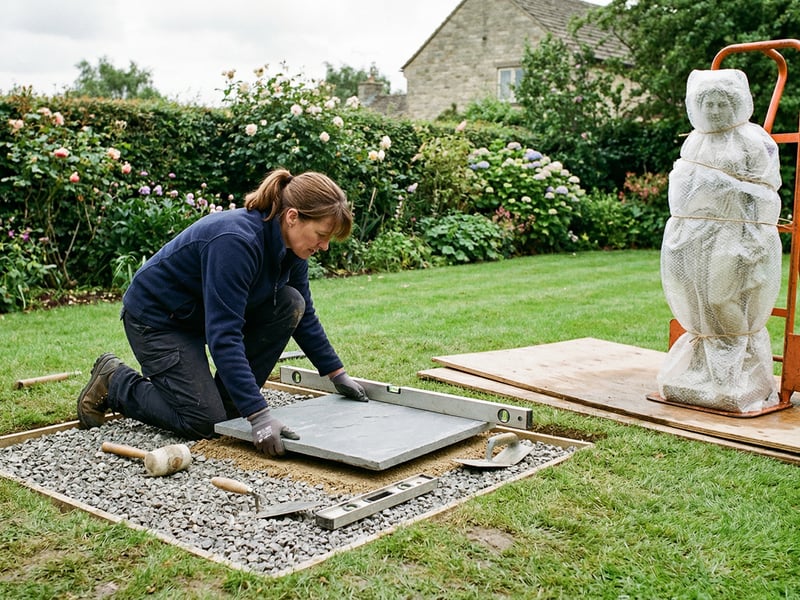
Yes, if placed directly on grass. Any ornament over 15-20kg compresses soil and blocks sunlight. You will see yellowing within two weeks and dead patches within six weeks. The fix is simple: lay a 600x600mm paving slab flush with turf level. This protects the grass and lets you mow right up to the ornament. On clay soils that hold water, pack 50-75mm of compacted gravel beneath the slab to prevent sinking.
Matt's Tip: The Plywood Path Trick
When you need to move a heavy ornament across a lawn, lay plywood sheets as a temporary path for the sack truck wheels. Without plywood, a loaded sack truck on wet grass digs ruts you will spend months repairing. I keep two 8x4 sheets in the van for exactly this. Move one in front of the other as you go. It takes ten minutes longer but saves the lawn completely.
Do I need planning permission for a large garden ornament?
Almost certainly not. Garden ornaments are classed as "incidental" garden features under permitted development rules, not structures. This applies to statues, fountains, bird baths, planters, and sundials of any size. You do not need to apply for permission or notify your local authority.
There are a few edge cases. If your property is a listed building, any external additions may need listed building consent. Properties in conservation areas may face restrictions on features visible from public roads. And while there is no height limit for ornaments, the 2.5 metre rule for garden structures near boundaries is a sensible guide. Keep very tall pieces at least 2 metres from boundary fences to avoid neighbour disputes.
Self-contained water features with built-in pumps need no permission. Features requiring mains plumbing or significant ground excavation may need building regulations approval, but this applies to large ponds, not standard fountain features. Read our securing garden ornaments guide for anchoring advice.
Choosing the right material
Material determines weight, durability, frost resistance, and how the piece ages. This comparison covers the main options available in the UK.
| Material | Weight (90cm piece) | Frost Rating | Lifespan | Price Range | Ages How |
|---|---|---|---|---|---|
| Reconstituted stone | 50-65kg | Safe to -20°C | 20+ years | £150-£600 | Develops lichen and moss naturally |
| Natural stone | 70-90kg | Excellent | 100+ years | £500-£2,000+ | Weathers and develops patina |
| Bronze / cast metal | 30-50kg | Excellent | 50+ years | £300-£1,250+ | Develops green verdigris |
| Corten steel | 20-40kg | Excellent | 30+ years | £200-£800 | Controlled rust patina (6-12 months) |
| Resin / fibreglass | 5-15kg | Moderate | 5-10 years | £50-£200 | UV fading, may become brittle |
| Terracotta | 15-30kg | Poor unless frost-proof fired | Variable | £40-£150 | Cracks in frost if not rated |
Reconstituted stone is the safest all-round choice for the UK climate. It is a blend of crushed limestone and architectural aggregate, cast in moulds that capture fine detail. After 12-18 months outdoors, it develops a natural patina that is practically identical to carved natural stone. Our complete guide to garden ornament materials covers each option in depth.
Avoid cheap terracotta for year-round outdoor display. Budget terracotta from Mediterranean suppliers is not fired at the temperatures needed for UK frost resistance. I have seen pieces crack in the first November. If you want terracotta, check that it is specifically rated as frost-proof before buying.
How to prepare for delivery of a large ornament
Large ornaments over 30kg arrive by pallet courier. This is kerbside delivery, meaning the driver unloads the pallet to the nearest solid, flat surface at ground level using a tail-lift. The driver will not carry it up your driveway, through your side gate, or into your garden. That last stretch is your responsibility.
Prepare before delivery day:
- Check the weight on the product page. Anything over 50kg needs a sack truck rated for the weight and at least one other person.
- Walk the route from your front gate to the final position. Measure gate widths. Check for steps.
- Clear the path. Move wheelie bins, bikes, plant pots. You need unobstructed access.
- Prepare plywood sheets if crossing lawn. Two 8x4 sheets let you leapfrog across grass without leaving ruts.
- Prepare the base in advance. Lay a concrete pad or paving slab before the ornament arrives, not after.
- Someone must be home to inspect and sign. Check for damage before signing. Photograph any chips or cracks immediately.
Scottish Highlands, Northern Ireland, and some island postcodes may incur delivery surcharges. We offer free UK mainland delivery and show any additional charges at checkout.
Placing a large ornament in a small garden
Small gardens benefit more from one large ornament than several small ones. A single 90cm statue gives a small garden a centre of gravity. Scatter a dozen smaller pieces around the same space and it just looks busy.
Place a large ornament at the furthest point from your main viewpoint, usually the back wall or far corner of the garden. This creates depth. A tall piece against a fence or wall with climbers growing around it makes the boundary recede visually.
Mirrors work well behind large ornaments in small gardens. A weather-rated outdoor mirror placed behind a statue doubles the visual depth of a narrow space. Keep the ornament colour light (pale stone, white) to reflect available light.
Five months of winter is where large ornaments really pay off
From November to March, most plants have died back. Borders are bare. Lawns are brown or muddy. For five months of the year, a garden's structure comes entirely from hard landscaping: paths, walls, fences, and ornaments. A large stone statue or urn is the one thing in the garden that still looks good in January.

Shop the Draped Maiden Garden Statue →
Position your main ornament where it is visible from the house, ideally from a window you look through daily. A 120cm classical figure against bare winter branches creates a silhouette that changes with the light through the season. Stone develops its best patina through winter rain and frost, so the piece actually improves during the months when everything else looks dormant.
This winter structure argument is the practical case for spending more on one quality large piece rather than spreading the budget across several smaller ornaments that disappear behind summer planting. Learn more about seasonal positioning in our frost protection guide.
Common mistakes when buying large garden ornaments
Buying too small. People who are nervous about commitment buy a 60cm piece for a large garden, then wish they had gone bigger. Visit a garden centre and stand next to different sizes to get a sense of scale before ordering online.
Not checking the weight. A "large" resin statue weighs 15kg and one person can carry it. A "large" stone statue weighs 180kg and needs a sack truck. Always check the product page.
Skipping the base. Placing a 100kg ornament directly on grass or loose gravel leads to sinking and damage within weeks. Spend £20 on a paving slab and ten minutes laying it. It prevents problems that cost far more to fix.
Forgetting coastal salt. If you live within a kilometre of the coast, salt spray accelerates weathering on limestone and mild steel. Choose granite, bronze, aluminium, or stainless steel for coastal gardens.
Blocking a mowing line. A large ornament in the middle of a lawn creates awkward mowing around it. Place it on a paved area, in a border, or at the edge of the lawn where it does not interrupt the mowing pattern.
|
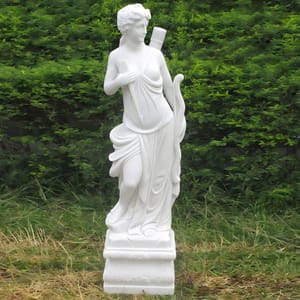
Matt's Pick for a Large Statement StatueBest For: A dramatic focal point at the end of a path or in the centre of a lawn Why I Recommend It: The Diana is one of our tallest figures and the pose has real presence. She commands attention from across a garden without being over the top. The weathered stone finish looks right from day one. Price: £439 |
How to maintain large garden ornaments
Stone: Wash annually with plain water and a stiff brush. Avoid pressure washers, which erode carved detail on reconstituted stone. Algae and lichen can be left for a natural aged look or removed with a dilute algae treatment. Our ageing guide explains how to encourage patina if you want the aged look sooner.
Metal: Wipe with a damp cloth. Apply linseed oil or a specialist metal sealant once a year to slow patina development if you want to preserve the original finish. Bronze and corten steel are designed to patina, so maintenance is optional rather than essential.
Resin: Wipe clean with soapy water. Apply UV-protectant spray annually to slow fading. Resin pieces have a 5-10 year outdoor lifespan compared to 20+ for stone, so treat them as shorter-term investments.
Can I move a large ornament later?
It depends on the weight. Under 50kg, two people can reposition a piece without equipment. Between 50 and 100kg, you need a heavy-duty sack truck and plywood sheets to protect surfaces. Above 100kg, consider hiring a local landscaper with a mini-crane or engine hoist.
Treat placement as semi-permanent. Moving a 120kg statue across a lawn leaves ruts and damages turf. Plan the position carefully before delivery, and prepare the base in advance. If you are not sure about the position, place a cardboard box of similar dimensions in the spot for a few days and view it from different angles before committing. Browse our full collection of garden ornaments for more ideas.
Frequently asked questions
How much do large garden ornaments weigh?
Large stone ornaments weigh between 25kg and 205kg depending on height and material. A 60cm reconstituted stone piece weighs around 25-35kg. A 90cm Buddha weighs approximately 65kg. A 120cm classical statue can reach 180kg. Resin alternatives are much lighter at 5-15kg for similar sizes, but they have shorter outdoor lifespans and need anchoring in windy conditions.
Do large garden ornaments need planning permission?
No, garden ornaments do not need planning permission in the UK. They are classified as incidental garden features under permitted development rules. The exception is listed buildings, where external additions may need listed building consent, and conservation areas, where visible features may need approval from the local conservation officer.
Will a heavy garden ornament crack my patio?
A standard UK patio supports up to 244kg per square metre, which covers most ornaments. The risk comes from concentrated point loads on individual slabs. A 150kg statue on small feet can crack a single paving slab. Place a 600x600mm concrete spreader slab underneath heavy pieces to distribute the weight across multiple slabs and prevent cracking.
What is the best material for large garden ornaments in the UK?
Reconstituted stone is the best all-round material for UK gardens. It is frost-proof to -20°C, develops natural lichen patina over 12-18 months, and lasts 20+ years outdoors. It costs less than natural stone or bronze but looks practically identical once weathered. Avoid budget terracotta for year-round outdoor display because it cracks in frost unless specifically rated as frost-proof.
How do I stop a large garden ornament sinking into the lawn?
Lay a 600x600mm paving slab flush with turf level beneath the ornament. On clay soils or waterlogged ground, pack 50-75mm of compacted gravel beneath the slab to create a stable base. Without a slab, ornaments over 20kg compress the soil and kill the grass within two to six weeks. The slab also lets you mow right up to the ornament.
What does kerbside delivery mean for garden ornaments?
Kerbside delivery means the courier unloads the pallet to the nearest solid surface at ground level. The driver uses a tail-lift to lower the pallet from the vehicle. They will not carry it up driveways, through gates, or into gardens. You need your own equipment (sack truck, trolley) and at least one helper to move it from the kerbside to its final position.
How do I clean a large stone garden ornament?
Wash stone ornaments with plain water and a stiff brush once a year. Avoid pressure washers because the high pressure erodes carved detail on reconstituted stone. Lichen and moss can be left to develop naturally for an aged appearance or removed with a dilute proprietary algae treatment. Never use bleach or acidic cleaners, which can damage the stone surface and kill surrounding plants.
Further reading
- The complete guide to garden ornament materials
- Where to place garden sculptures: layout, lighting and focal points
- How to secure garden ornaments: anti-theft and wind protection
- Cottage garden ornaments: traditional styles that never date
- Best garden ornaments 2026: expert picks by material and style
Matt W
Garden & Outdoor Specialist
Matt has spent over 16 years working hands-on with garden products across the UK. He tests materials in Staffordshire clay soil and hard water conditions, and writes from direct experience fitting, maintaining, and repairing everything from stone statues to cast iron furniture. His advice is based on what actually survives a British winter, not what looks good in a catalogue.