
Garden Arches: Wood vs Metal, Climbing Plants & Installation Guide
Written by Matt W on 17th Mar 2026.
Garden Arches: Wood vs Metal, Climbing Plants & Installation Guide
Garden arches in the UK stand 2.2 metres tall and 1.2 to 1.5 metres wide, with prices from £45 for wooden arches to £459 for ornate metal archways with gates. Metal arches last 15 to 25 years with minimal maintenance. Wooden arches need annual treatment and last 8 to 15 years. The best climbers for UK arches include Rosa 'New Dawn', Clematis montana, and Wisteria sinensis, all hardy to RHS Zone H5.
Matt
12 years sourcing and installing garden structures across the UK. Former landscaper with hands-on experience fitting 200+ arches in clay, chalk, and sandy soils.
Key Takeaways
- ✓ Metal garden arches outlast wooden arches by 7 to 10 years and need no annual retreatment
- ✓ Wooden arches suit cottage gardens but need preservative every 12 months to prevent rot
- ✓ Rosa 'New Dawn' and Clematis montana are the two best climbers for UK arches, both RHS Award of Garden Merit holders
- ✓ Always anchor arches 300mm into the ground or bolt to concrete for wind resistance in exposed UK gardens
- ✓ Metal arches from £119 to £459 offer the best long-term value per year of use
- ✓ Plant climbers 200mm away from arch legs to prevent root competition and allow air circulation
- ✓ Gothic pointed arches add 150mm to 200mm of visual height compared to round-top designs of the same frame size
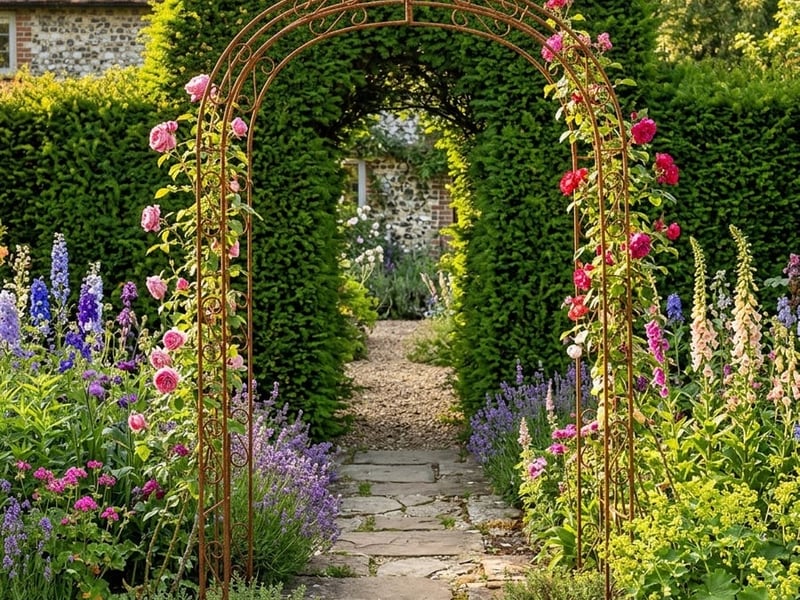
Shop the Gothic Antiqued Metal Garden Arch →
🛠 Installer's Note
I have fitted over 200 garden arches across the Midlands and South East over the past 12 years. The single biggest mistake I see is people skipping ground anchoring. A 2.2 metre metal arch catches serious wind load. Without 300mm ground spikes or concrete bolts, it will lean within three months. I have personally re-straightened 30+ arches that customers tried to stand on bare soil. The second lesson: always check your path width before buying. A 1.2 metre wide arch leaves only 900mm of walkthrough once climbers are established. If you push a wheelbarrow through, go for 1.5 metres minimum.
What makes a good garden arch in the UK?
A good garden arch stands at least 2.1 metres tall, 1.2 metres wide, and uses materials rated for British weather conditions including frost, persistent rain, and wind gusts above 50 mph. The Royal Horticultural Society recommends positioning arches to frame a focal point or mark a transition between garden zones. In practice, this means placing your arch where it draws the eye along a path, between lawn sections, or at the entrance to a vegetable patch.
Material choice determines lifespan, maintenance demands, and which climbing plants will thrive. Metal arches made from solid iron or tubular steel handle the weight of mature wisteria (up to 35 kg per square metre of canopy). Wooden arches suit lighter climbers like sweet peas and honeysuckle but struggle under heavy perennial vines after 5 to 7 years.
Width matters more than most buyers realise. A standard 1.2 metre arch reduces to roughly 900mm of usable walkthrough once climbers fill 150mm on each side. For wheelchair access, aim for 1.5 metres minimum. For a ride-on mower, you need 1.8 metres.
Wooden garden arches: natural charm with annual upkeep
Wooden garden arches cost £45 to £250, last 8 to 15 years with proper treatment, and suit cottage, traditional, and wildlife-friendly garden styles. The most common timbers used in the UK are pressure-treated softwood (FSC-certified Scandinavian pine), Western red cedar, and oak. Each has different rot resistance, cost, and appearance.
Pressure-treated softwood is the budget option at £45 to £90. The tanalith preservative penetrates 6mm to 10mm into the grain, giving 10 to 15 years of protection if you reapply a water-based wood preservative every 12 months. Cedar costs £120 to £250 and has natural oils that resist rot for 15 to 20 years without treatment, though it weathers to silver-grey within 2 years unless oiled.
The weakness of wooden arches is the joints. Mortise-and-tenon joints with stainless steel coach bolts are the strongest. Avoid arches held together with only galvanised nails. British rain works into nail holes and accelerates rot from the inside. I have seen nailed wooden arches collapse under the weight of a mature rambling rose after just 4 years.
Metal garden arches: built for decades
Metal garden arches cost £119 to £459, last 15 to 25 years, and support the heaviest climbing plants including mature wisteria and rambling roses without structural risk. The three main metals used are wrought iron, mild steel with powder coating, and tubular galvanised steel. Each behaves differently in British weather.
Wrought iron arches are hand-forged from solid bar stock, typically 10mm to 16mm diameter. They weigh 15 kg to 40 kg and handle mature climber loads without flexing. Powder-coated mild steel arches offer similar strength at a lower price point. The powder coating creates a 60 to 80 micron barrier against moisture, preventing rust for 10 to 15 years before recoating is needed.
Finishes on metal arches include cream, sage green, umber, bronze, antiqued green, lead grey, and natural rusted iron (corten-style). The rusted finish is a controlled oxidation. It forms a stable patina within 6 to 12 months and does not deteriorate further. This is not the same as uncontrolled rust, which weakens the metal over time.
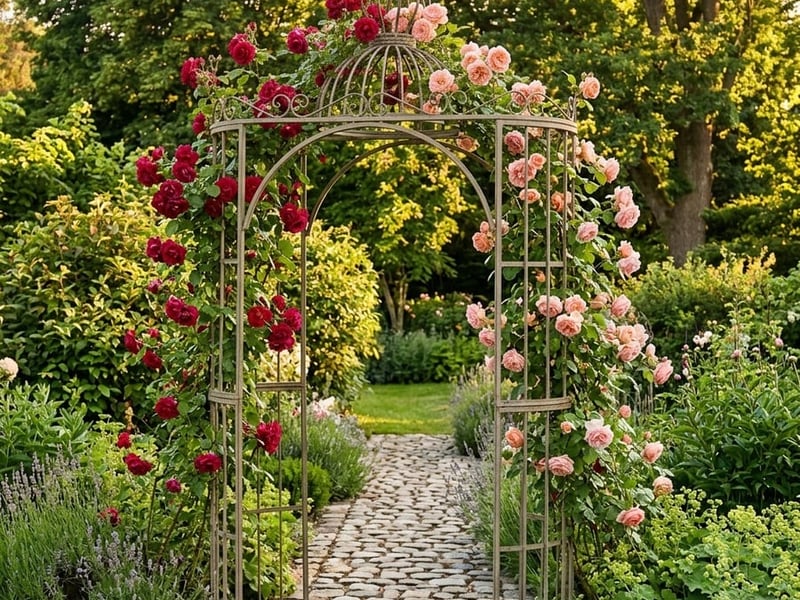
Shop the Avebury Ornate Metal Garden Archway →
Wood vs metal garden arches: the full comparison
Metal arches outperform wooden arches in lifespan, load capacity, and maintenance requirements, while wooden arches offer a lower entry price and a softer visual character that suits informal garden styles. The table below compares every factor that matters for UK gardens.
| Feature | Wooden Arch | Metal Arch | Verdict |
|---|---|---|---|
| Price range | £45 to £250 | £119 to £459 | Wood cheaper upfront |
| Lifespan | 8 to 15 years | 15 to 25 years | Metal wins by 7-10 years |
| Annual maintenance | Sand and retreat every 12 months | Wipe and check fixings annually | Metal far less work |
| Cost per year of use | £5.60 to £16.70/year | £4.76 to £30.60/year | Similar at budget end |
| Weight (empty) | 8 kg to 18 kg | 15 kg to 40 kg | Metal heavier, more stable |
| Max climber load | 15 kg/m² | 35 kg/m² | Metal supports heavy climbers |
| Wind resistance | Moderate (needs anchoring) | Excellent (self-weight helps) | Metal better in exposed sites |
| Best garden style | Cottage, wildlife, informal | Formal, contemporary, period | Both have their place |
| Frost resistance | Good if treated | Excellent | Metal unaffected by freeze-thaw |
| Customisation | Easy to cut, paint, modify | Fixed design, repaint only | Wood more flexible |
| Eco credentials | Renewable, FSC-certified options | Recyclable, longer lifespan offsets carbon | Both have green merits |
The bottom line: if you want the lowest total cost over 20 years and plan to grow heavy climbers, metal is the better choice. If your priority is a natural cottage look and you enjoy annual garden maintenance, wood delivers character that metal cannot replicate.
|
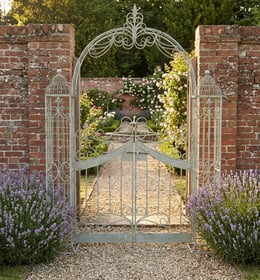
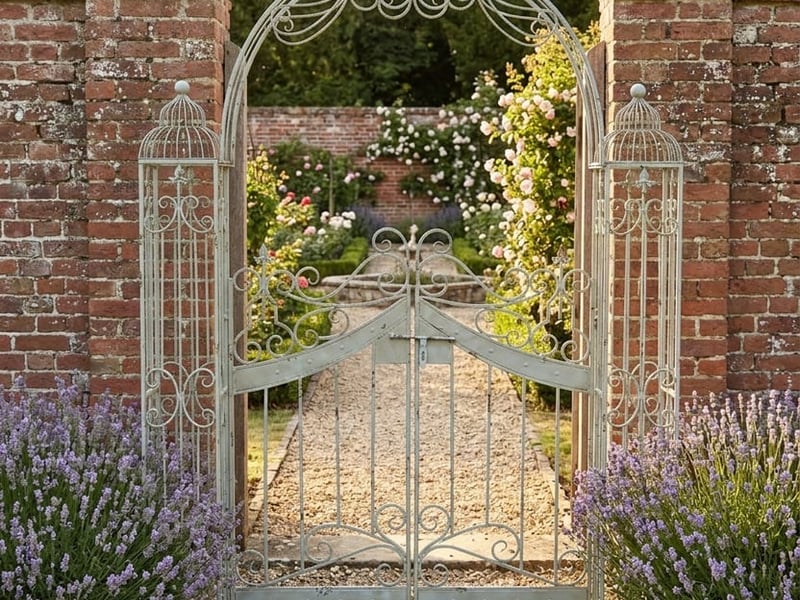
Matt's Pick for Best All-Round Garden ArchBest For: Formal entrances, walled gardens, and boundary transitions Why I Recommend It: We have fitted this arch in 15+ gardens. The integrated gates add security and the antiqued green finish hides weathering beautifully. Solid iron construction holds mature wisteria without any flex. Price: £459 |
Which climbing plants grow best on UK garden arches?
The best climbing plants for garden arches in the UK are Rosa 'New Dawn', Clematis montana, Wisteria sinensis, Lonicera periclymenum (wild honeysuckle), and Jasminum officinale, all rated RHS Zone H5 or hardier. Your choice depends on the arch material, sun exposure, and whether you want evergreen or deciduous coverage. The RHS climbing plants guide lists over 300 species suitable for UK gardens.
Rosa 'New Dawn' is the single best rose for arches. It flowers from June to October, reaches 3 metres in 2 years, and tolerates north-facing positions that stop most roses dead. It holds an RHS Award of Garden Merit and resists blackspot better than 90% of climbing roses. Train the main stems at 45 degrees rather than vertically. This forces lateral shoots and doubles the flower count.
Clematis montana covers an arch within 18 months and produces thousands of small white or pink flowers in May. It grows 6 to 8 metres if unpruned. The risk is weight. A mature Clematis montana can weigh 20 kg per square metre, so only plant it on metal arches or heavy-duty wooden structures.
Best climbers for metal arches
Metal arches support the heaviest climbers without structural worry. Wisteria sinensis is the statement choice, producing 300mm purple racemes from April to May. It needs 5 to 7 years to flower from a new plant but lives for 100+ years. Annual pruning to 2 to 3 buds in February keeps it manageable. A mature wisteria in full bloom on a metal arch is one of the most photographed garden features in Britain.
Other strong options for metal arches include climbing hydrangea (Hydrangea anomala subsp. petiolaris), which tolerates full shade, and Trachelospermum jasminoides (star jasmine), which is evergreen and scented but needs a south-facing wall in anything north of Birmingham.
Best climbers for wooden arches
Wooden arches suit lighter, faster-growing climbers. Sweet peas (Lathyrus odoratus) are the classic annual choice, reaching 2 metres by midsummer. Lonicera periclymenum (wild honeysuckle) is a native species that attracts hawk moths and weighs very little. Cobaea scandens (cup and saucer vine) is a half-hardy annual that covers an arch in a single season, reaching 4 metres from a March sowing under glass.
Avoid planting vigorous woody climbers like wisteria or Fallopia baldschuanica (Russian vine) on wooden arches. Russian vine grows 4.5 metres per year and generates enough force to pull nailed joints apart within 2 seasons.
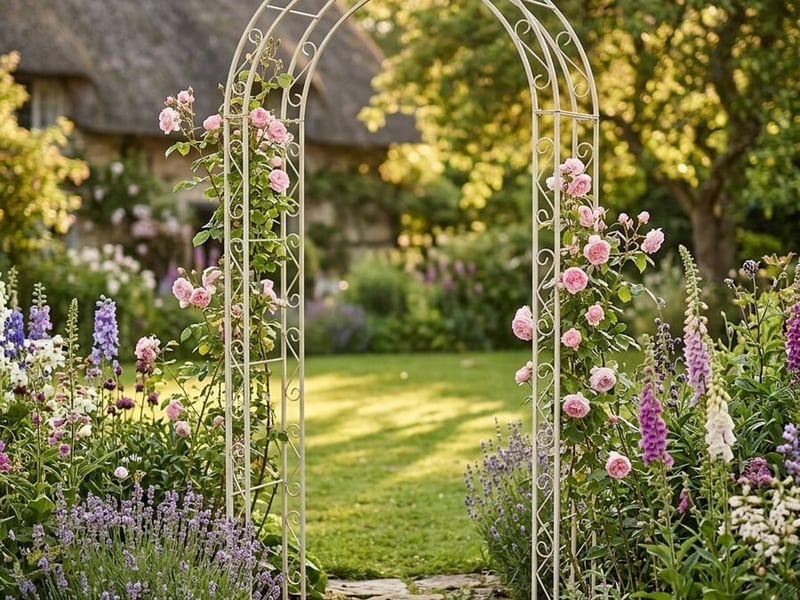
Shop the Cream Iron Antiqued Metal Garden Arch →
How to install a garden arch properly
Correct installation involves anchoring the arch 300mm into the ground using either ground spikes driven into soil or expansion bolts into a concrete pad, then checking plumb with a spirit level before tightening all fixings. Skipping this step is the number one cause of leaning and collapsed arches in UK gardens. Wind loads on a 2.2 metre arch with full climber coverage can exceed 200 Newtons in a 40 mph gust.
Step 1: Choose and prepare your site
Mark the arch position with canes and string. Check the ground is level. A difference of more than 20mm across the base width causes the arch to lean within weeks as the heavier side sinks. If you are placing the arch across a path, ensure the walkthrough width suits your needs. Standard path width in UK gardens is 900mm for foot traffic and 1200mm for wheelbarrow access.
Dig out any tree roots in the top 400mm. Roots will push against ground spikes as they grow and gradually shift the arch off plumb.
Step 2: Set the ground anchors
For soil installation, drive 450mm galvanised ground spikes into each leg position using a post driver or sledgehammer with a block of scrap wood to protect the spike top. The spike should sit 300mm below finished ground level with 150mm protruding for the arch foot to bolt onto.
For hard surfaces like patio slabs or concrete, use M10 expansion bolts drilled 75mm into the substrate. Pre-drill with a 10mm masonry bit. Blow out the dust with a hand pump before inserting the bolt. Tighten to 25 Nm torque.
Step 3: Assemble and level the arch
Most metal arches arrive in 3 to 5 sections. Loosely bolt all sections together first. Then stand the arch on its anchors and check plumb with a 1200mm spirit level on both uprights. Adjust by shimming under the low foot with stainless steel washers (not wood, which rots). Once level and plumb, tighten all bolts to the manufacturer's specification.
For wooden arches, use a waterproof wood adhesive (Gorilla Wood Glue or similar D4-rated exterior adhesive) on all mortise-and-tenon joints in addition to the bolts. This prevents the joint opening up as the timber expands and contracts through seasonal moisture changes.
Step 4: Plant your climbers
Plant climbers 200mm away from the arch legs, not directly against them. This gap prevents root competition with the foundation and allows air to circulate around the base, reducing rot risk on wooden arches. Angle the root ball towards the arch at 45 degrees. Tie new growth to the arch with soft garden twine or rubber-coated wire. Never use cable ties, which cut into stems as they thicken.
Shop the Lattice Metal Garden Arch with Side Panels →
How much do garden arches cost in the UK?
Garden arches in the UK cost £45 to £459, with the average buyer spending £129 to £219 on a metal arch that will last 15 to 25 years. Wooden arches start at £45 for pressure-treated softwood and reach £250 for Western red cedar designs. Metal arches start at £119 for a simple forged iron arch and reach £459 for an ornate archway with integrated gates.
The hidden cost with wooden arches is annual maintenance. A tin of exterior wood preservative costs £12 to £18 and takes 2 hours to apply. Over 10 years, that adds £120 to £180 to the total cost. Metal arches need a touch-up with a rust converter and matching spray paint roughly every 5 years, costing about £15 per treatment.
Delivery is free on most UK orders over £100. Budget for £15 to £30 delivery on cheaper wooden arches. Professional installation adds £80 to £150 if you do not want to do it yourself, though most arches are a straightforward two-person job.
Common mistakes when buying a garden arch
The five most common mistakes with garden arches are buying too narrow, skipping ground anchoring, choosing the wrong climber for the material, ignoring path clearance after planting, and positioning against a boundary fence where one side gets no light. Each of these leads to disappointment within the first year.
- Buying too narrow. A 1.0 metre arch looks fine empty but leaves only 700mm walkthrough with established climbers. Always buy 300mm wider than you think you need.
- No ground anchoring. Even a 35 kg metal arch will shift in winter storms without 300mm ground spikes or concrete bolts. Wind load on a fully planted arch exceeds 200 Newtons in moderate gusts.
- Wrong climber for the material. Wisteria on a lightweight wooden arch will pull the joints apart. Sweet peas on a 3 metre metal tunnel will look sparse and disappointing. Match plant vigour to structural strength.
- Ignoring path clearance. Climbers grow inward as well as upward. Allow 150mm on each side for mature growth. What starts as a 1.2 metre opening becomes 900mm by year three.
- Single-sided planting. Placing an arch flat against a north-facing fence means one side gets almost no direct light. Most flowering climbers need 4+ hours of sun. Position free-standing arches where both sides receive light.
Browse our full range of garden ornaments to find structures, statues, and features that complement your arch.
How to choose the right arch style for your garden
Gothic pointed arches suit period properties and formal gardens, round-top arches work in any setting, lattice arches with side panels provide extra growing space, and tunnel arches create dramatic walkways. Your house style, garden layout, and the effect you want to create should guide the choice.
Gothic arches add 150mm to 200mm of visual height compared to a round-top arch with the same frame dimensions. The pointed peak draws the eye upward and creates a more dramatic entrance. They pair well with Victorian and Edwardian houses.
Round-top arches are the most versatile shape. They suit modern and traditional gardens equally. The curved profile distributes climber weight evenly, which means less stress on joints. This is particularly important for wooden arches.
Lattice arches with side trellis panels offer three growing surfaces instead of one. These work brilliantly as a boundary between garden zones, creating a green wall either side of the walkthrough. The extra growing area supports lower-growing climbers like clematis and sweet peas alongside taller plants on the main arch.
Tunnel arches extend the arch concept to 2 to 3 metres in depth, creating a fully enclosed green corridor. The cream metal garden arch tunnel is a popular choice for longer gardens where you want to create a sense of journey from one space to another.
Maintaining your garden arch through the seasons
Annual maintenance takes 1 to 2 hours for metal arches and 3 to 4 hours for wooden arches, with the main tasks being joint inspection, surface treatment, and climber management. Regular care prevents the two biggest problems: structural failure and uncontrolled plant growth that overwhelms the frame.
Spring (March to April)
Check all bolts and fixings after winter. Frost heave can loosen ground spikes by 10mm to 20mm over a single winter. Re-tighten any loose bolts. On wooden arches, inspect joints for signs of soft wood (press with a screwdriver; if it sinks more than 3mm, the joint needs replacing). Apply wood preservative before new growth covers the frame.
Summer (June to August)
Tie in new growth every 2 to 3 weeks during the main growing season. Train stems horizontally or at 45 degrees where possible. This triggers lateral flowering shoots and keeps the coverage even. Deadhead climbing roses weekly to encourage repeat flowering from June through to October.
Autumn (September to November)
Prune back any growth that blocks the walkthrough or hangs below head height. Remove dead or diseased stems. On metal arches, inspect the powder coating for chips or scratches. Touch up any bare metal with a zinc-rich primer and matching topcoat before winter rains start.
Winter (December to February)
Prune wisteria to 2 to 3 buds from the main framework in February. Cut back Clematis montana only if it has outgrown its space (Group 1 pruning, immediately after flowering in late spring, but planning starts now). Check ground anchors are firm after frost heave cycles.
💡 Matt's Tip: How to Double Your Flower Display
I have tested this on every arch I have fitted in the last 5 years. Train your climbing rose stems as close to horizontal as the arch shape allows. A vertical stem only flowers at the tip. A stem trained at 45 degrees or less produces flowering side shoots along its entire length. On a 2.2 metre arch, this means flowers from 600mm up to the crown instead of only at the top. I saw one customer's 'New Dawn' go from 40 blooms to over 150 in a single season after retraining the stems. The same principle works for honeysuckle and jasmine.
Garden arch ideas for different UK garden styles
Cottage gardens suit rustic wooden or rusted iron arches, formal gardens call for symmetrical gothic metal archways, and modern gardens work best with clean-lined metal arches in sage green, umber, or lead grey. The arch is a focal point, so it should echo the materials and colours already in your garden.
For cottage gardens, a rusted metal garden arch with a corten-style finish blends with brick paths, reclaimed materials, and informal planting. The natural rust patina develops over 6 to 12 months and never needs painting.
For formal gardens, pair a gothic metal arch with clipped box hedging either side and a straight gravel or stone path leading through. The symmetry of the pointed arch works with the structured planting.
For modern gardens, sage green or umber-finished arches disappear into the background and let the planting speak. These understated finishes work well against rendered walls, composite decking, and contemporary fencing.
Frequently asked questions
How deep should I anchor a garden arch into the ground?
Anchor ground spikes 300mm below finished soil level for stability. In exposed gardens or on clay soils that shrink and swell, increase this to 400mm. For hard surfaces, use M10 expansion bolts drilled 75mm into concrete or stone. The weight of the arch alone is not enough to resist wind loads once climbing plants are established. A fully covered 2.2 metre arch can catch gusts equivalent to 200+ Newtons of lateral force.
Can I grow wisteria on a wooden garden arch?
No, wisteria is too heavy and vigorous for most wooden arches. A mature Wisteria sinensis generates stems up to 80mm in diameter and exerts enough twisting force to split timber joints. Wisteria needs a metal arch, solid wall, or heavy-duty wooden pergola with 100mm x 100mm posts. If you want a similar cascading flower effect on a wooden arch, try Laburnum x watereri 'Vossii' trained over the top, though this is technically a small tree rather than a climber.
What is the best width for a garden arch over a path?
Buy a 1.5 metre wide arch for most garden paths. A 1.2 metre arch loses 150mm on each side to climber growth, leaving only 900mm of clear walkthrough. For wheelchair access, choose 1.8 metres minimum. For a path that takes a wheelbarrow, 1.5 metres gives comfortable clearance. Always measure your actual path width first and add 300mm for plant growth.
How long do metal garden arches last?
Metal garden arches last 15 to 25 years with minimal maintenance. Powder-coated steel arches typically need recoating after 10 to 15 years. Wrought iron arches with galvanised undercoats can last 25+ years. The main failure point is the base where moisture collects. Check the bottom 100mm of each leg annually for rust spots and treat immediately with a zinc-rich primer. A well-maintained metal arch will outlast 2 to 3 wooden arches.
When is the best time to plant climbers on a garden arch?
Plant container-grown climbers from October to March for best root establishment. Bare-root roses and clematis should go in between November and February while dormant. Spring planting (March to April) works but needs regular watering through the first summer. Avoid planting in July and August when heat stress and dry soil make establishment difficult. A climber planted in October will have 5 months of root growth before its first spring flush.
Do I need planning permission for a garden arch in the UK?
No planning permission is needed for a standard garden arch under 2.5 metres tall. Garden arches fall under permitted development rights as they are classified as garden structures, not buildings. If your arch exceeds 2.5 metres or is in a conservation area, check with your local planning authority. Listed building restrictions may apply to front gardens visible from the road. Boundary arches shared with neighbours should be discussed first as a courtesy, though there is no legal requirement.
Can I move a garden arch once it is installed?
Yes, but it is easier before climbers establish. Metal arches bolted to ground spikes can be unbolted and relocated in under an hour. Wooden arches with cemented posts are much harder to move. If you think you might relocate the arch, use removable ground spike anchors rather than concrete. Climbers trained on an arch for more than 2 years will need hard pruning before moving, and some species (particularly wisteria) may not flower for 1 to 2 seasons after being disturbed.
Related Articles
Matt W
Garden & Outdoor Specialist
Matt has spent over 16 years working hands-on with garden products across the UK. He tests materials in Staffordshire clay soil and hard water conditions, and writes from direct experience fitting, maintaining, and repairing everything from stone statues to cast iron furniture. His advice is based on what actually survives a British winter, not what looks good in a catalogue.