
Cottage Garden Ornaments: Traditional Styles That Never Date
Written by Matt W on 4th Mar 2026.
Key takeaways
- ✓ Cottage gardens suit weathered stone, aged brass, and cast iron. Shiny resin and polished metal look wrong
- ✓ Sundials, bird baths, and stone animals are the three ornament types that define the style
- ✓ Cast stone develops genuine lichen and patina within 6-12 months. Yoghurt speeds it up to 4-8 weeks
- ✓ Plant-ornament pairings matter: sundials with thyme, bird baths with foxgloves, hares in long grass
- ✓ Less is more. Two or three well-placed pieces look better than a dozen scattered ornaments
Cottage garden ornaments are weathered, traditional pieces that look like they have been in the garden for decades. The style favours cast stone sundials, bird baths, and animal figures over anything shiny or modern. A 2025 Thompson and Morgan survey found 40% of UK gardeners choose the cottage style, making it the country's most popular garden type. Cast stone develops natural lichen and patina within 6-12 months. Ornament prices range from £39 for small stone animals to £399+ for stone fountains.
Garden ornament specialist with 15 years experience. Supplies stone ornaments to cottage gardens across the UK.
Matt's experience
I can usually tell within 30 seconds whether an ornament will suit a cottage garden. If it looks new, it will not. That sounds unhelpful, but it is the honest truth. The whole point of a cottage garden is that everything looks like it has been there forever, growing and weathering together. A brand-new white resin statue on a cottage garden border looks like someone left their shopping in the flowerbed. Cast stone, aged brass, rusted iron — these are the materials that earn their place over a season or two.
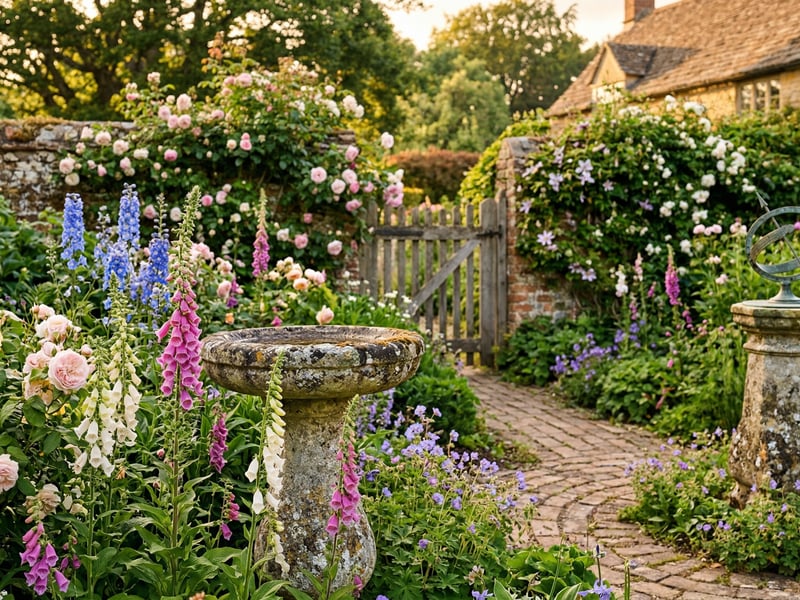
What makes an ornament "cottage garden"?
A cottage garden ornament looks like it has been outside for years, surrounded by plants that have grown up around it. The style came from working gardens where people grew food and flowers together in whatever space they had. Ornaments were practical (sundials for telling time, bird baths for pest-eating birds) or repurposed (old troughs as planters, broken pots left in borders).
The modern cottage garden takes this informal, layered look and recreates it deliberately. The ornaments need to match. Natural materials that weather and age: cast stone, brass, cast iron, terracotta. Traditional shapes rather than abstract or geometric. And restraint, above all. A cottage garden with twelve ornaments looks like a garden centre display. Two or three pieces, properly placed and half-hidden by planting, look like they belong.
Gertrude Jekyll, the garden designer who published Garden Ornament in 1918, wrote that the best garden ornaments "seemed to have grown up with the garden itself." That is still the best test I know. If your ornament looks placed, it is wrong. If it looks found, you have got it right. Our materials guide compares how each material weathers over time.
The best ornament types for cottage gardens
Sundials on stone pedestals
A brass sundial on a stone pedestal is probably the single most traditional cottage garden ornament in existence. They have been in English gardens since the 1500s, and the combination of aged brass on weathered stone looks right in any cottage setting. Place one where paths meet or in the centre of a herb garden surrounded by low thyme and chamomile.
The brass dial develops a dark brown-green patina over 12-18 months. Do not polish it. That patina is exactly what you want. We stock 26 sundials starting with the Brass Sundial on Classical Pedestal at £229, with aged brass versions from £255 if you want the patinated look immediately.
Stone bird baths
Bird baths are the most practical cottage garden ornament because they actually do something. Birds bathe, drink, and keep your slug population down. A traditional pedestal bird bath among foxgloves and delphiniums is one of those combinations that just works. Every garden photographer knows this, which is why you see it in every magazine spread about cottage planting.
Stone bird baths weather beautifully. Within a year, the bowl rim develops a line of green algae and the pedestal picks up lichen. The Dove Birdbath at £185 has a carved bird on the bowl edge that gives it character from day one. Our bird bath guide covers placement and maintenance.
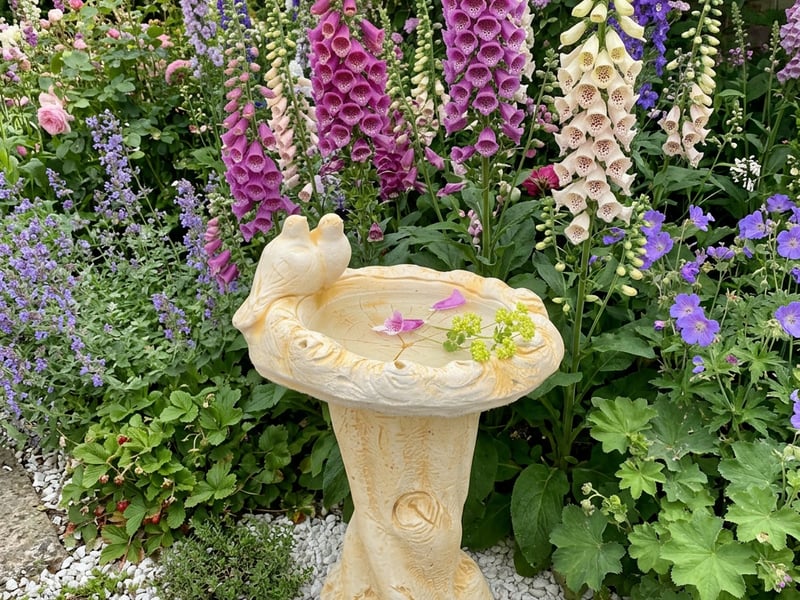
Shop the Dove Birdbath in Sand Stone →
Stone animals
Hares, hedgehogs, and rabbits are the classic cottage garden animals because they are the creatures you would actually see in one. Exotic animals (elephants, lions, meerkats) belong in other settings. Cottage gardens stick to British wildlife.
Place stone animals at ground level, tucked into planting. A stone rabbit at £50 half-hidden in lady's mantle. A stone hedgehog at £45 beneath a rosemary bush. These small pieces reward visitors who notice them, which is very cottage garden. Our animal ornaments guide covers all 15 types we stock.
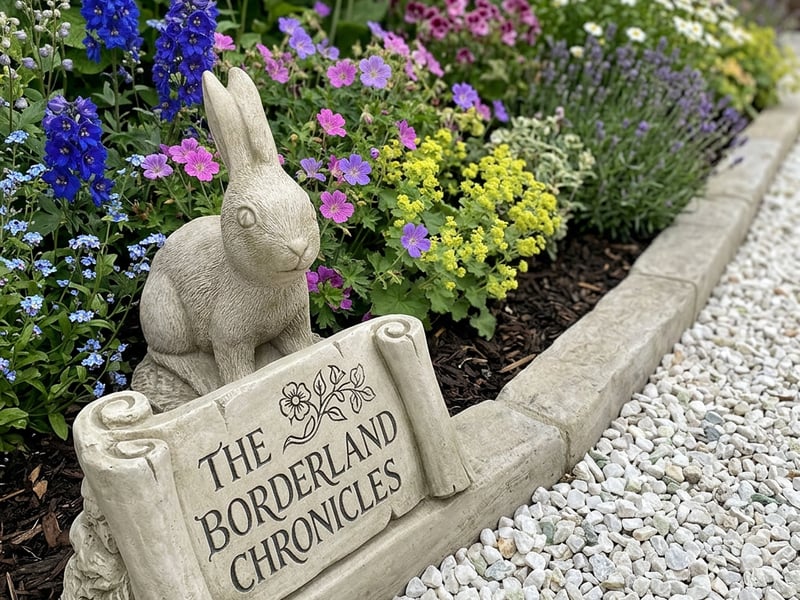
Shop the Cheeky Rabbit Garden Ornament →
Classical urns and planters
Stone urns filled with trailing pelargoniums or ivy are a cottage garden staple, especially either side of a doorway or at the top of steps. The urn itself is ornamental even when empty. Over winter, an empty stone urn with a crust of frost on it looks better than most things in the garden.
The Thatched Urn at £149 has a rustic, hand-finished look that suits cottage borders. The Buckingham Urn at £220 is more formal but still works against an old brick wall with climbing roses above it.
Cherubs and classical figures
A stone cherub sitting on a wall or peeking out of a border adds the kind of personality that modern sculptures cannot match. They have been in English gardens since the Georgian era and they suit the playfulness of cottage planting. The Patient Cherub at £149 has a thoughtful pose that works well on a low wall or tucked into a corner.
Materials that work and materials that do not
The simplest test: if it would look at home in a National Trust walled garden, it belongs in a cottage garden. If it would look more natural in a Chelsea Flower Show "contemporary" exhibit, it does not.
| Material | Cottage garden? | Ageing behaviour | Lifespan |
|---|---|---|---|
| Cast/reconstituted stone | Yes — perfect | Lichen and moss in 6-12 months | 50+ years |
| Natural stone | Yes — ideal | Weathers well from day one | 100+ years |
| Aged brass | Yes | Green-brown patina, 12-18 months | 50+ years |
| Cast iron | Yes | Rust patina develops quickly | 30+ years |
| Terracotta | Yes | White salt deposits, moss growth | 10-20 years (frost risk) |
| Bronze | Yes | Green verdigris in 2-5 years | 100+ years |
| Resin (stone-effect) | No — fades | UV damage, colour loss, no moss | 5-10 years |
| Polished granite | No — too modern | Barely changes | 100+ years |
| Stainless steel | No — too shiny | Stays shiny, looks contemporary | 50+ years |
Cast stone costs 2-3 times more than resin upfront. But it is the only material that genuinely looks better with age. A five-year-old cast stone bird bath covered in lichen looks like a genuine antique. A five-year-old resin one looks faded. The maths works out in stone's favour over any timescale longer than a couple of years.
How to age new ornaments to fit your garden
If you cannot wait 12 months for natural weathering, yoghurt is the fastest reliable method. I recommend this to customers who buy a new stone piece and want it to match existing weathered ornaments. It works because the live bacteria in yoghurt encourage moss and lichen spores already in your garden's air to colonise the stone surface.
Paint natural yoghurt (not flavoured) onto the stone with an old paintbrush, concentrating on crevices, carved detail, and the north-facing side where moss grows fastest. Leave it exposed to rain. You should see green growth within 4-8 weeks. Repeat the application once to speed things up.
Other methods that work:
- Ash or soot rub: Mix fireplace ash with water and rub into the surface. Creates a grey patina immediately. Needs reapplying after heavy rain.
- Placement: Set the ornament directly on bare soil in partial shade. Ground moisture wicks up into porous stone and accelerates weathering. South-facing positions stay drier and take longer to develop growth.
Avoid "instant ageing" spray paints. They look artificial and peel within a year. Our full ageing guide covers four proven methods in detail.
Matt's Tip: The National Trust test
Next time you visit a National Trust or English Heritage garden, look at what ornaments they use and how they are placed. Not the grand formal pieces on the main terraces — look at the walled kitchen gardens and the cottage-style borders. You will see stone bird baths, weathered sundials, terracotta pots with chips and cracks, and the odd stone animal in a border. Nothing shiny, nothing new. Copy that and your cottage garden will look right. I have visited Sissinghurst, Hidcote, and Great Dixter more times than I can count, and every visit teaches me something about placing ornaments.
Pairing ornaments with cottage garden plants
The plants around an ornament matter as much as the ornament itself. A bare stone bird bath on a mown lawn is not cottage garden. The same bird bath surrounded by foxgloves, hardy geraniums, and aquilegia looks completely different.
Specific pairings that work well:
- Sundials: Surround the base with creeping thyme and chamomile. They release scent when brushed and keep the area low so the dial stays readable.
- Bird baths: Frame with tall planting on two sides (delphiniums, hollyhocks, verbena bonariensis) but leave the front open so birds can approach safely.
- Stone animals: Plant lady's mantle, hardy geraniums, or nepeta around the base. Let the foliage grow up to partly hide the piece.
- Urns: Fill with trailing ivy, pelargoniums, or lobelia. Place against a wall with climbing roses or honeysuckle above.
- Benches: Position under scented plants — jasmine, honeysuckle, or a David Austin rose trained over an arch behind the seat.
The general rule is that cottage garden ornaments should look like the plants are winning. Not swallowed completely, but partly screened. Let the lady's mantle creep over the base of the sundial pedestal. Let the thyme colonise the cracks in the paving around the bird bath. This takes a season to establish but the result is that the ornament looks like it grew there.
What to avoid in a cottage garden
Some ornaments actively undermine the cottage look, no matter how nice they are on their own. They are not bad products. They just belong in different gardens.
Polished stainless steel spheres and cubes are modern sculpture pieces. They catch the light beautifully in a minimalist gravel garden. In a cottage border, they look like they fell off a lorry. Geometric abstract sculptures and glass garden art have the same problem. Anything with built-in LED lighting is right out.
Bright white resin statues also jar. Cottage gardens are about weathered, muted tones. Think lichen-covered stone and darkened brass, not showroom white. A pristine white classical figure needs a formal Italianate terrace, not a herbaceous border. If you want a figure in a cottage garden, choose one in stone rather than white resin, and let it weather for a year before judging it.
Too many ornaments is worse than the wrong kind. I have seen cottage gardens with a bird bath, a sundial, two urns, three animals, a bench, an arch, and a water feature all in 50 square metres. It looked like a showroom. The best cottage gardens I know have two or three pieces, well placed, with planting doing the heavy lifting. Our sculpture placement guide covers the principles in detail.
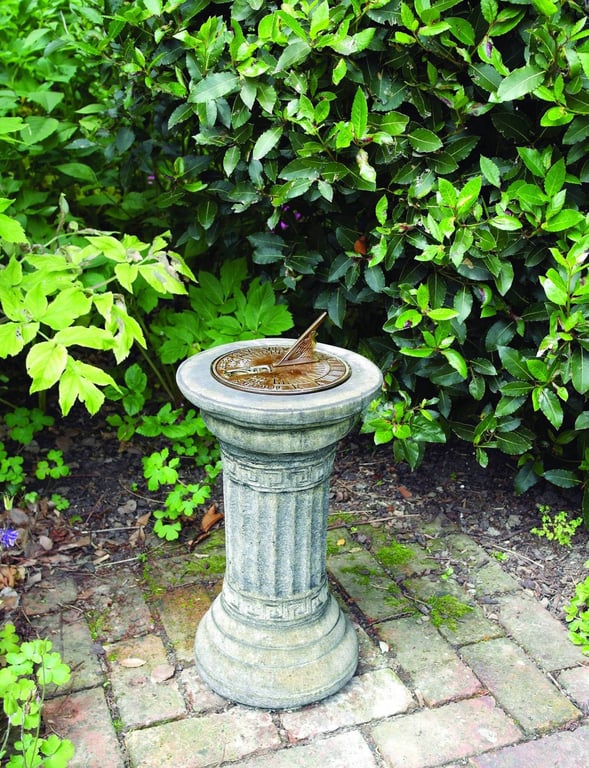
|
Matt's Pick for cottage gardensBest for: Path junctions, herb garden centres, walled garden focal points Why I recommend it: The aged brass dial already has the patina that new brass takes 18 months to develop. The classical stone pedestal weathers quickly, and within a year it looks like it has been there for decades. I have sold more of these to cottage garden customers than any other single product. Price: £255 |
A brief history of the cottage garden
The modern cottage garden was shaped by William Robinson, Gertrude Jekyll, and Margery Fish across about 90 years. Robinson published The Wild Garden in 1870 and argued against the stiff Victorian bedding that was fashionable at the time. He wanted hardy plants growing together naturally, without rows and without bare soil between them.
Gertrude Jekyll, a trained painter, took Robinson's ideas and added colour theory. She designed over 400 gardens between 1880 and 1932, many of them with the architect Edwin Lutyens. Her 1918 book Garden Ornament is still the best reference on using sundials, urns, and stone ornaments in planted settings. She treated ornaments as part of the composition, not afterthoughts.
Margery Fish made the style accessible to ordinary gardeners. Her garden at East Lambrook Manor in Somerset, created from the 1940s onwards, became the model cottage garden. Her 1961 book Cottage Garden Flowers influenced a generation of gardeners who wanted beauty without formality. The garden is still open to visitors and still looks wonderful.
Why cottage garden ornaments are trending in 2026
Cottage garden searches are up 125% year on year according to garden retail data, and the "cottagecore" aesthetic continues to drive interest in weathered, handmade, and vintage-look garden pieces. The RHS named cottage planting as one of its 2026 focus themes.
The sustainability movement is helping too. Reclaimed stone, vintage terracotta, and cast iron pieces that last decades appeal to gardeners who do not want to replace plastic ornaments every few years. A cast stone bird bath that lasts 50 years and looks better every year is the opposite of disposable garden decor. Our frost protection guide explains how to ensure stone ornaments last through UK winters. Browse our full collection of garden ornaments for more ideas.
Further reading
Frequently asked questions
What ornaments suit a cottage garden?
Weathered stone sundials, bird baths, and animal figures in natural materials. Cast stone, aged brass, cast iron, and terracotta all suit the style. Avoid shiny resin, polished granite, stainless steel, and anything that looks factory-new. The cottage look depends on ornaments that age and weather naturally.
How many ornaments should a cottage garden have?
Two or three pieces in a medium-sized garden. Less is more in cottage gardens because the planting should be the star. One focal piece (a sundial or bird bath) plus one or two small discoveries (stone animals half-hidden in borders) is the classic approach. More than that risks looking cluttered.
How do you make new garden ornaments look old?
Paint natural yoghurt onto cast stone and leave it exposed to rain. The live bacteria encourage moss and lichen growth within 4-8 weeks. Alternatively, rub fireplace ash mixed with water into the surface for an instant grey patina. Placing the ornament on bare soil in partial shade also speeds natural weathering.
What is the difference between a cottage garden and a formal garden?
Cottage gardens use informal, dense mixed planting with no bare soil and curved paths. Formal gardens use symmetrical layouts, clipped hedges, and geometric shapes. Ornaments differ too: cottage gardens suit weathered, asymmetrical pieces tucked into planting. Formal gardens use matched pairs of urns, centred statuary, and polished finishes.
Do cottage garden ornaments need to be stone?
Stone is the most popular material but not the only option. Aged brass sundials, cast iron planters, terracotta pots, and bronze animal figures all work well. The common thread is that the material must weather and age attractively. If it stays looking new after a year outdoors, it probably does not suit the cottage style.
Are resin ornaments suitable for cottage gardens?
Generally no. Resin does not develop moss, lichen, or patina. It fades in UV light and the surface stays smooth and uniform. Stone-effect resin can look convincing for the first year but the lack of natural ageing becomes obvious over time, especially next to genuine stone or terracotta pieces that are developing character.
What plants go around cottage garden ornaments?
Low creeping plants around sundial bases (thyme, chamomile). Tall structural plants behind bird baths (foxgloves, delphiniums, hollyhocks). Soft mounding plants around stone animals (lady's mantle, hardy geraniums, nepeta). Trailing plants in urns (ivy, pelargoniums, lobelia). The planting should partly screen the ornament so it looks settled rather than placed.
Matt W
Garden & Outdoor Specialist
Matt has spent over 16 years working hands-on with garden products across the UK. He tests materials in Staffordshire clay soil and hard water conditions, and writes from direct experience fitting, maintaining, and repairing everything from stone statues to cast iron furniture. His advice is based on what actually survives a British winter, not what looks good in a catalogue.