
The Best Places to Position Garden Statues for Feng Shui
Written by Matt W on 24th Feb 2025.
Feng shui garden placement follows the Bagua map, which divides your garden into nine zones by compass direction. Buddha statues belong in the east (health) or northeast (knowledge) zone, always raised on a plinth and facing the home. Stone ornaments suit the centre and southwest. Water features work best in the north (career) zone with flowing water, never stagnant ponds.
Key takeaways
- The Bagua map divides your garden into nine zones. Each zone governs a different life area.
- Buddha statues should face the home and sit raised on a plinth, shelf, or stone platform.
- East is the best direction for a Buddha (wisdom). Southeast suits wealth-related features.
- Water features belong in the north zone. The water must flow, never sit stagnant.
- Stone ornaments suit the centre (health) and southwest (relationships) zones.
Installer's note
We position garden statues in UK gardens every week. Customers who follow feng shui rules always know where they want pieces before we arrive. It makes our job easier. The most common request is a Buddha statue on a raised plinth facing the back door. The second most common is a water feature in the north corner of the garden. Whether or not you believe in chi energy, these placements genuinely create better focal points. A statue facing the house draws your eye back toward the garden from inside. Flowing water near a seating area genuinely makes the space feel calmer.
What is the feng shui Bagua map?
The Bagua is the core tool in feng shui. It divides any space into nine zones, each linked to a compass direction, an element, and a life area. Stand at your back door with a compass and map the directions onto your plot.
Each zone has an element that should dominate it. Placing the wrong material in the wrong zone creates conflict. Stone in the wood zone, for example, weakens the energy. The table below shows what goes where.
| Direction | Life area | Element | Best ornament type |
|---|---|---|---|
| North | Career | Water | Fountains, water features |
| Northeast | Knowledge | Earth | Stone statues, boulders |
| East | Family and health | Wood | Wooden planters, bamboo, green plants |
| Southeast | Wealth | Wood | Lush planting, wooden features |
| South | Fame and reputation | Fire | Red flowers, lanterns, warm lighting |
| Southwest | Relationships | Earth | Paired stone figures, low stone ornaments |
| West | Children and creativity | Metal | Metal sculptures, wind chimes |
| Northwest | Helpful people | Metal | Metal ornaments, silver-toned stone |
| Centre | Health | Earth | Large stone ornaments, natural rock |
Where to place a Buddha statue in your garden
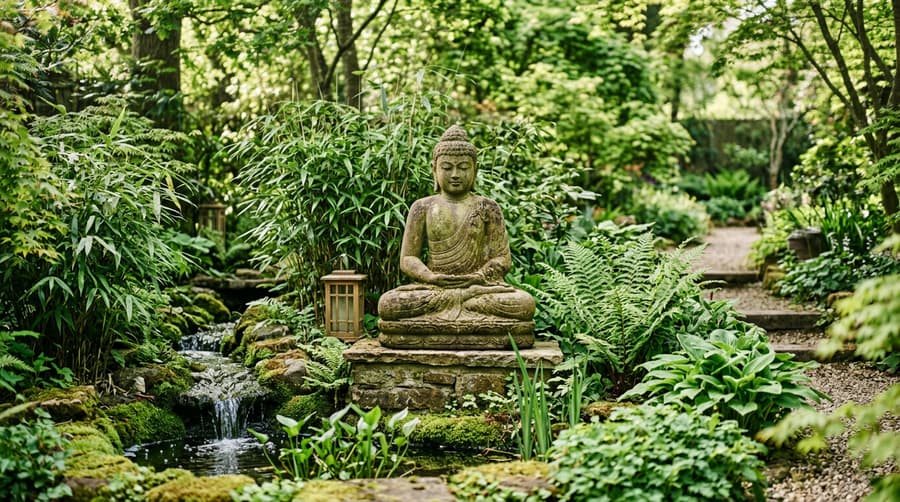
Buddha statues are the most popular feng shui garden ornament. The placement rules are specific. Get them right and the statue becomes a genuine focal point. Get them wrong and it can feel off without you knowing why.
Face the home. A Buddha statue should always face toward the house, not away from it. This is said to draw positive energy (chi) into the home. In practical terms, it also creates a better sightline from your kitchen or living room window.
Raise it up. Never place a Buddha directly on the ground. In feng shui, ground-level placement is considered disrespectful. Use a stone plinth, raised platform, or flat boulder. A height of 300-600mm above ground works well for most garden settings. Browse our range of Buddha garden statues to find pieces that suit a raised position.
Choose the right zone. The east zone (family and health) is the traditional spot for a Buddha. The northeast zone (knowledge and wisdom) is the second-best option. Avoid placing Buddha statues in the south (fire element) as stone conflicts with fire energy.
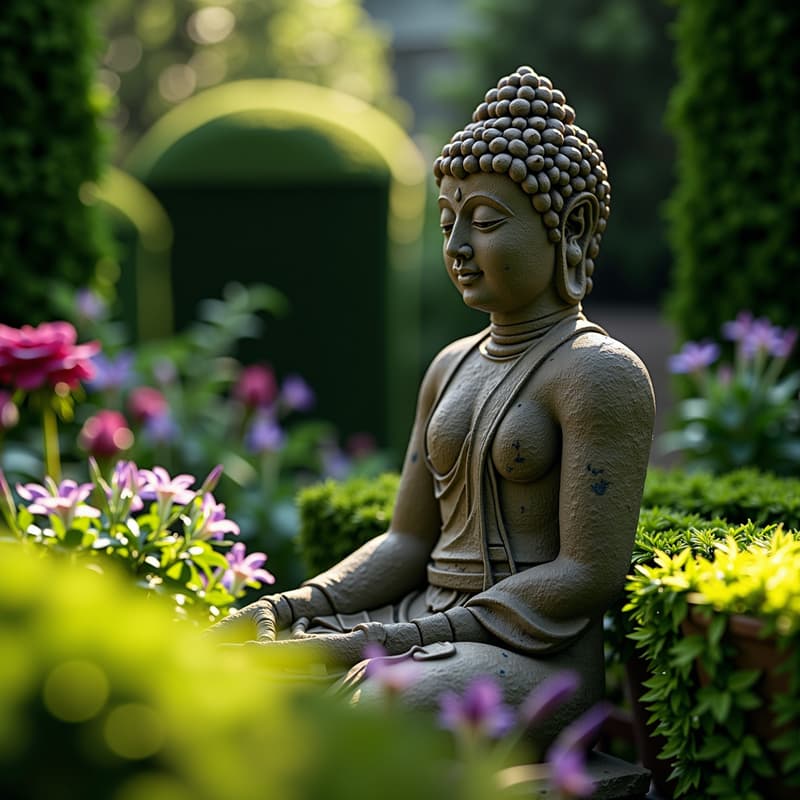
Shop the Stone Buddha Head Statue →
Matt's tip: the kitchen window test
Before you fix a statue in position, go inside and look at the spot from your most-used window. If you eat breakfast at the kitchen table, that is the view you will see every morning. Position the statue so it looks right from there. I have repositioned dozens of pieces after customers said "it looked right outside but wrong from the house." Check both angles first.
How to use water features in feng shui gardens
Water represents wealth and career in feng shui. The north zone of your garden is the water element's home. A water feature placed here is considered the strongest feng shui enhancement you can make outdoors.
The water must flow. Stagnant water traps negative energy. A recirculating fountain, bubbling urn, or cascading feature all work. A still pond does not, unless it has a pump keeping the surface moving. A Buddha water feature in the north zone, facing the house, gives the strongest effect.
Keep the water clean. Algae-covered water features have the opposite of the intended effect in feng shui. Check the pump weekly and top up water levels in summer. Our guide on water feature maintenance covers the practical side.
Where to place stone ornaments using the Bagua
Stone is an earth element in feng shui. Earth zones are the centre, northeast, and southwest of your garden. Placing stone ornaments in these zones strengthens the energy. Placing them in the north (water) or east (wood) zones creates elemental conflict.
The centre of your garden is the health zone. A large stone ornament here acts as an anchor point. It grounds the entire garden's energy. If your garden is rectangular, measure the midpoint and place your most substantial piece there. Our range of large stone garden ornaments includes pieces designed for this kind of focal point.
The southwest zone governs relationships. Paired ornaments work best here. Two matching statues, two stone planters, or a pair of stone animals. The pairing symbolises partnership. Single figures in the southwest zone work against the relationship energy.
Five common feng shui garden mistakes
- Statue on the ground. Always raise it. A plinth, rock, or platform of at least 300mm prevents this.
- Buddha facing away from the home. This sends energy outward instead of drawing it in. Face it toward your back door.
- Stagnant water. A still pond with no pump traps negative chi. Add a fountain or bubbler to keep water moving.
- Stone in the east zone. The east is wood element. Stone (earth) conflicts with wood. Use wooden planters or bamboo here instead.
- Cluttered zones. Feng shui needs clear sight lines. Too many ornaments in one area blocks energy flow. One strong piece per zone works better than three.
Browse our Large Stone Garden Ornaments →
How to map your garden with a compass
You need a compass (your phone's compass app works). Stand at your back door facing out into the garden. Note which direction you are facing. That is your garden's primary orientation.
Divide the garden into a 3x3 grid. Map the compass directions onto each square. North goes at the far end if you face north. If your back door faces south, north is behind you (the house end). South is the far end of the garden.
Mark each zone with a small stake or mental note. Then place ornaments according to the Bagua table above. You do not need to be precise to the degree. Within a metre or two of the correct zone is close enough to follow the principles.
Our guide on positioning stone garden ornaments covers siting and levelling once you know where a piece should go.
Choosing the right statue for each zone
| Zone | Best statue type | Why |
|---|---|---|
| Centre (health) | Large stone figure or natural boulder | Earth element anchors the garden's core energy |
| Northeast (knowledge) | Seated Buddha or meditating figure | Earth zone, contemplation theme matches knowledge |
| Southwest (relationships) | Paired ornaments or animal couples | Pairing symbolises partnership in the earth zone |
| North (career) | Water feature with flowing water | Water element feeds career energy |
| East (family) | Wooden or bamboo features | Wood element zone. Avoid stone here. |
| West (creativity) | Metal garden ornaments | Metal element zone. Wind chimes work well. |
Not sure which material suits your garden? Our stone vs resin comparison covers the practical differences. Browse our full collection of garden ornaments for more ideas.
Frequently asked questions
Which direction should a Buddha statue face in the garden?
A Buddha statue should face toward the house. This draws positive chi inward. In feng shui, east-facing is the traditional preference for wisdom and enlightenment. Avoid facing a Buddha north, as this is considered inauspicious in most feng shui schools.
Can you place a Buddha statue on the ground?
No. Ground-level placement is disrespectful in feng shui. Always raise a Buddha on a stone plinth, flat boulder, or raised platform. A height of 300-600mm above ground level is standard for garden settings.
Where should a water feature go in a feng shui garden?
The north zone of your garden is the water element's home. Place fountains and water features here for the strongest feng shui effect. The water must flow, not sit stagnant. Southeast (wealth zone) is the second-best option for a water feature.
What is the Bagua map in feng shui?
The Bagua divides any space into nine zones by compass direction. Each zone governs a life area (career, relationships, health) and has an associated element (water, wood, fire, earth, metal). Matching ornament materials to zone elements is the foundation of feng shui placement.
Can I put stone ornaments anywhere in the garden?
Stone suits the centre, northeast, and southwest zones. These are all earth element zones where stone strengthens the energy. Avoid the east, southeast (wood zones), and north (water zone). Stone conflicts with these elements.
Further reading
- How to position stone garden ornaments
- How to care for stone garden ornaments
- Top 10 stone garden ornament ideas for UK gardens
- Stone vs resin: which material is best?
- Garden water feature ideas and maintenance
Matt W
Garden & Outdoor Specialist
Matt has spent over 16 years working hands-on with garden products across the UK. He tests materials in Staffordshire clay soil and hard water conditions, and writes from direct experience fitting, maintaining, and repairing everything from stone statues to cast iron furniture. His advice is based on what actually survives a British winter, not what looks good in a catalogue.