
How to Choose a Garden Water Feature: Types, Costs and Running Expenses
Written by Matt W on 3rd Mar 2026.
A self-contained garden water feature costs £135-£450 to buy and £4-20 per year to run on a timer. Solar models cost nothing to run. The pump in a typical cascading fountain draws 5-10 watts, roughly the same as a phone charger. This guide covers types, running costs at the current 24.50p/kWh Ofgem rate, noise levels, materials, and what to look for when buying, based on selling water features across the UK since 2012.
Key Takeaways
- ✓ Self-contained water features need no plumbing -- plug in and fill with water
- ✓ A 10W pump on a timer costs £7.16/year at the current electricity rate
- ✓ Solar features cost £0/year to run but need 4-5 hours of direct sun
- ✓ A £10 plug-in timer cuts electricity bills by 67% -- the best £10 you will spend
- ✓ Noise ranges from whisper-quiet (30 dB) to conversation-level (60 dB) depending on drop height
- ✓ All self-contained features recirculate water -- they use no mains water supply
Installer's Note
The number one question customers ask us is "how much does it cost to run?" The answer is almost nothing. We ran the numbers on every pump we sell and the highest annual cost for a self-contained feature on a timer is about £20. People expect water features to be expensive to run because they think of swimming pool pumps or central heating. A garden fountain pump draws 5-10 watts. Your kettle draws 3,000 watts. The running cost is not a reason to hesitate.
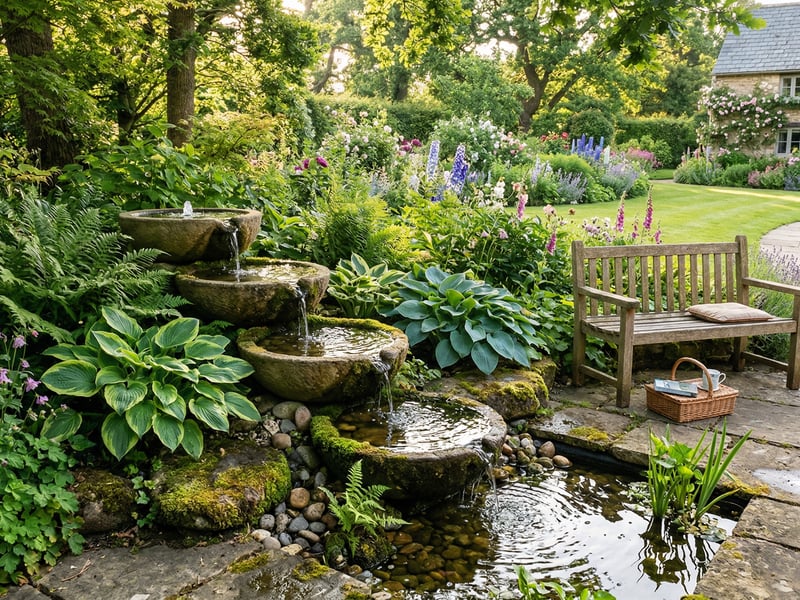
Browse our Cascading Water Features →
How much does a garden water feature cost to run?
This is the question everyone asks first. The answer depends on one thing: pump wattage. Here are the actual costs calculated at the current Ofgem price cap rate of 24.50p/kWh, for both 24/7 operation and the 8 hours/day we recommend.
| Pump Wattage | Feature Type | Cost per Day (8hrs) | Cost per Year (8hrs) | Cost per Year (24/7) |
|---|---|---|---|---|
| 5W | Small fountain, bird bath | 1p | £3.58 | £10.72 |
| 10W | Medium self-contained fountain | 2p | £7.15 | £21.46 |
| 25W | Large cascading feature | 5p | £17.89 | £53.66 |
| 50W | Large waterfall or pond pump | 10p | £35.77 | £107.31 |
The formula is simple: pump watts × hours × 365 ÷ 1000 × 24.50p = annual cost. A 10W pump running 8 hours a day: 10 × 8 × 365 ÷ 1000 × £0.245 = £7.15 per year. That is less than 2p per day.
Every self-contained water feature we sell recirculates the same water through a closed loop. You do not need a mains water connection. You fill the reservoir once, top it up when evaporation drops the level (roughly every 2-3 weeks in summer), and the pump does the rest. Water costs are effectively zero.
Matt's Tip: Buy a Timer
A £10 plug-in timer is the single best accessory for any mains-powered water feature. Set it to run 8 hours during the day (say 9am to 5pm, or noon to 8pm if you are home in the evening). You cut electricity costs by 67%, the pump lasts longer because it rests overnight, and you still hear the water during every waking hour you are in the garden. There is no reason to run a fountain at 3am when nobody is listening.
Solar vs mains: which power source is better?
This depends on your garden. Neither is universally better.
| Factor | Mains Powered | Solar Powered |
|---|---|---|
| Running cost | £4-20/year | £0 |
| Installation | Needs outdoor socket within cable reach (typically 10m) | No electrics. Place and fill. |
| Flow consistency | Constant, same flow day and night | Varies with sunlight. Weak on cloudy days. |
| Evening use | Yes, with LED lights too | Battery-backup models run 3-4 hours after dark |
| Winter performance | Runs year-round (drain before hard frost) | Minimal flow in UK winter. Store indoors Nov-Mar. |
| Pump lifespan | 3-5 years (replaceable) | 2-3 years (integrated, harder to replace) |
| Best for | Shaded gardens, evening use, year-round | Sunny spots, no socket access, eco preference |
If your garden gets 4-5 hours of direct sun and you mainly enjoy it during the day, a solar water feature is the obvious choice. Zero running costs, no installation, and you can reposition it whenever you want. If your feature spot is shaded, or you want water running in the evening, mains is the practical option -- and at £7/year for a medium fountain, the running cost is negligible.
Types of water features and what they actually cost
Water features fall into a few clear categories. Each has different price points, space requirements, and maintenance levels.
| Type | Price Range | Space Needed | Maintenance | Best For |
|---|---|---|---|---|
| Self-contained cascading | £135-£450 | 60cm x 60cm | Low -- top up water, clean pump quarterly | Most gardens. Plug-and-play, no digging. |
| Solar cascading | £145-£330 | 60cm x 60cm + panel | Low -- same as above | Sunny gardens without outdoor sockets |
| Wall fountain | £250-£400 | Wall space only | Low -- self-contained, same care | Courtyards, patios, small gardens |
| Stone fountain (with reservoir) | £300-£900+ | 1m x 1m (incl. reservoir) | Medium -- reservoir cleaning, pump care | Formal gardens, focal points |
| Natural stone monolith | £400-£1,200+ | 1m x 1m (incl. reservoir) | Medium -- same as stone fountain | Modern/Japanese gardens, statement pieces |
| Corten steel sphere/blade | £350-£800 | 1m x 1m (incl. reservoir) | Low -- rust finish is self-maintaining | Contemporary gardens, architectural spaces |
| Garden pond | £600-£4,500+ | 2m x 1.5m minimum | High -- filtration, plants, algae, wildlife | Large gardens, wildlife, dedicated hobbyists |
For most buyers, a self-contained cascading water feature is the right starting point. No digging, no plumbing, no reservoir to install. Lift it into position, fill with water, plug in. Done in 10 minutes.
What does a water feature actually sound like?
People buy water features for the sound as much as the look. But "soothing water sounds" means different things depending on the feature. Here is what to expect.
| Feature Type | Approx dB Level | Comparable To | Neighbour Friendly? |
|---|---|---|---|
| Gentle bubble fountain | 30-40 dB | Whisper, quiet library | Yes -- inaudible beyond 3m |
| Small cascading feature (2-3 tiers) | 40-50 dB | Light rain on a window | Yes -- pleasant background sound |
| Large cascading feature (4+ tiers) | 50-60 dB | Normal conversation | Usually fine -- check at night |
| Large waterfall (1m+ drop) | 60-70 dB | Shower running | May carry -- use a timer |
As a rule: the higher the water drops, the louder it gets. A gentle bubble feature 2 metres from your patio door creates a subtle backdrop you barely notice consciously but that masks road noise and creates calm. A large waterfall across a small courtyard can dominate conversation. If you have close neighbours, stick to features under 50 dB or use a timer to stop the flow at night.
Water features also reduce the perception of traffic and urban noise. A feature producing 45 dB of water sound can mask 5-10 dB of background noise, roughly equivalent to a solid 2m garden fence. If road noise bothers you, a water feature closer to your seating area (not at the far end of the garden) gives the best masking effect.
Which material lasts longest outdoors?
Water features take more punishment than static ornaments because they hold water, run pumps, and face constant moisture. Material choice matters more here than anywhere else in the garden.
| Material | Lifespan | Frost Proof? | Weight | Appearance Over Time |
|---|---|---|---|---|
| Natural stone (granite/basalt) | 50+ years | Yes, to -25°C | Heavy (30-150kg) | Develops moss/lichen patina. Improves with age. |
| Cast stone (reconstituted) | 30+ years | Yes, to -20°C | Medium-heavy (15-60kg) | Natural patina within 6-18 months. Ages like real stone. |
| Corten steel | 30+ years | Yes | Medium (15-40kg) | Develops rust-orange patina. Self-protecting surface. |
| Polyresin (GRP) | 5-10 years | Partial (drain before frost) | Light (5-15kg) | Fades with UV. May crack in hard frost. |
Polyresin features dominate the budget end because they are light, cheap to produce, and look convincing when new. But they degrade. UV fades the colour within 2-3 summers, and frost cracks the shell if any water remains inside during a hard freeze. If you want something that lasts, look at stone water features or corten steel. The upfront cost is higher, but spread over 30 years versus 5, stone is cheaper per year of use.
For more on how stone compares to other materials, our stone vs resin comparison breaks down the numbers.
Choosing a water feature by garden style
The right feature matches your garden. Putting a corten steel sphere in a cottage garden looks wrong. A weathered stone urn in a minimalist courtyard looks wrong too. Here is a rough guide.
| Garden Style | Best Feature Type | Materials | Our Range |
|---|---|---|---|
| Cottage / traditional | Cascading bowls, tiered fountain, bird bath | Cast stone, natural stone | Cascading features |
| Modern / contemporary | Corten sphere, blade waterfall, cube fountain | Corten steel, polished stone, stainless steel | Modern features |
| Japanese / zen | Basalt column, tsukubai basin, bamboo spout | Granite, basalt, natural stone | Stone features |
| Small courtyard / balcony | Wall fountain, tabletop feature, solar bubble | Any lightweight material | Solar features |
| Formal | Tiered stone fountain on plinth | Natural or cast stone | Stone fountains |
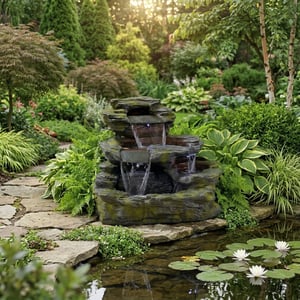
Shop the Como Falls Water Feature →
Safety, children, and wildlife
If you have young children, depth is the consideration. Any accessible water deeper than 30cm is a drowning hazard for toddlers. Self-contained cascading features are the safest option -- the reservoir is hidden beneath pebbles and the visible water is a thin film flowing over stone. There is no standing water a child can fall into.
For wildlife, moving water is better than still water. Birds prefer shallow, flowing water for bathing and drinking. Frogs and newts colonise pond features within a season if you add some planting around the edges. Add a few pebbles to any open water surface so insects and hedgehogs can climb out if they fall in. Our bird bath guide covers wildlife attraction in more detail.
Moving water also prevents mosquitoes. Mosquitoes need still, stagnant water to breed. A pump running 4+ hours a day keeps the surface moving enough to prevent egg-laying. No chemicals needed.
Do you need planning permission for a water feature?
Almost certainly not. Self-contained water features and fountains are classed as permitted development in England and Wales. You do not need planning permission unless the feature covers more than 50% of your garden area, or you live in a listed building or conservation area (in which case, check with your local council first).
The Wildlife and Countryside Act 1981 protects any wildlife that takes up residence in a garden pond. If frogs or newts move in, you cannot drain or destroy the pond without taking steps to relocate them. This does not apply to self-contained features with no open pond area.
Winter care for water features
The rules are simple. Before the first hard frost (usually late October in England, early October in Scotland):
- Drain the water. Empty the reservoir and all bowls. Standing water that freezes expands and cracks stone, resin, and even some metals.
- Remove the pump. Disconnect, clean the filter, and store indoors. Pumps last years longer when they are not sitting in freezing water all winter.
- Cover if needed. Cast stone and corten steel can stay uncovered. Cover polyresin features with breathable fabric (never plastic). For a full winter protection guide, read our weatherproofing guide.
- Store solar panels indoors. Cold does not damage them, but snow weight and ice can crack the glass. Fully charge the battery before storing.
In spring, clean the feature with warm water and a soft brush, reassemble the pump, fill the reservoir, and you are running again within 15 minutes. For a detailed maintenance schedule, see our stone ornament care guide.
|
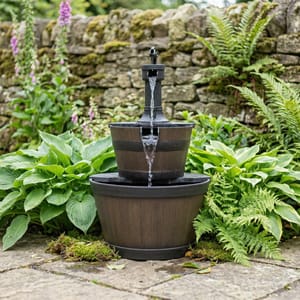
Matt's Pick for Best Value Water FeatureBest For: First-time buyers who want a proper cascading feature without the £300+ price tag Why I Recommend It: Three cascading bowls, 5W pump included, 10m cable, self-contained so no plumbing needed. Costs about £3.50/year to run on a timer. The aged stone finish looks convincing from day one. It is the feature I point customers towards when they ask "what should I start with?" Price: £135 |
Budget guide: what to expect at each price point
| Budget | What You Get | Materials | Example |
|---|---|---|---|
| Under £150 | Small-medium self-contained cascading feature or solar feature. Pump and cable included. Lightweight. | Polyresin, some cast stone | Aged Bowls (£135), Tumbling Pots Solar (£145) |
| £150-£300 | Larger cascading features with LED lighting. Better build quality. Heavier, more stable. | Polyresin with stone effect, cast stone | Ballanced Falls with LEDs (£295), Gretten Spring wall fountain (£269) |
| £300-£500 | Premium cascading features, stone fountains, corten steel pieces. Statement centrepieces. | Cast stone, corten steel, natural stone | Gilded Cascade with LEDs (£429) |
| £500+ | Large stone fountains, natural basalt/granite monoliths, multi-piece installations. | Natural stone, hand-carved stone | Stone fountains range |
The sweet spot for most gardens is £150-£300. At this price you get a substantial feature with LED lighting, a reliable pump, and build quality that will last 5-10 years for resin or 30+ years for stone. Below £150 is perfectly fine for a first feature or a small space. Above £500 you are buying a permanent garden centrepiece that becomes part of the property. Browse our full collection of garden ornaments for more ideas.
Frequently asked questions
How much does a garden water feature cost to run UK?
A typical self-contained garden fountain costs £4-20 per year to run on a timer. The pump draws 5-25 watts depending on size. At the current Ofgem rate of 24.50p/kWh, a 10W pump running 8 hours a day costs £7.15 per year. Solar models cost nothing to run. Running 24/7 instead of on a timer roughly triples the cost, but there is no benefit to running a fountain overnight.
Are solar water features any good UK?
Solar water features work well in UK gardens that receive 4-5 hours of direct sunlight per day. Battery-backup models store enough charge for 3-4 hours of operation after dark. In winter, flow is minimal on most days due to low sun angle. Models with a separate remote panel perform better year-round because you can angle the panel towards the low winter sun. For a year-round feature in a shaded garden, mains power is the better option.
Do I need a water supply for a water feature?
No. Self-contained water features recirculate the same water in a closed loop. You fill the reservoir with a watering can or garden hose when you set it up, then top it up every 2-3 weeks in summer as evaporation drops the level slightly. There is no connection to mains water. The pump pulls water from the bottom, pushes it to the top, and it flows back down.
Are water features safe for children?
Self-contained cascading features are the safest option for families with young children. The reservoir is hidden under pebbles with no open standing water. Visible water is a thin film flowing over stone. Any feature with accessible water deeper than 30cm is a drowning hazard for toddlers and should be fenced or avoided until children are older.
Do water features attract mosquitoes?
No, if the pump is running. Mosquitoes need still, stagnant water to lay eggs. A pump running 4 or more hours per day keeps the surface moving enough to prevent egg-laying. Standing water that is not circulated (a switched-off feature in summer, for example) can attract mosquitoes within days. Use a timer but keep the pump running during daylight hours.
Do I need planning permission for a garden water feature UK?
No, most garden water features fall under permitted development and need no planning permission. This applies to self-contained features, fountains, and small ponds. The feature must not cover more than 50% of your garden area. If you live in a listed building or conservation area, check with your local council before installing anything permanent.
What do I do with my water feature in winter?
Drain all water, remove the pump, and store the pump indoors before the first hard frost. Standing water that freezes will crack bowls and reservoirs. Cast stone and corten steel features can stay outside uncovered. Cover polyresin features with breathable fabric. Store solar panels indoors. In spring, clean, reassemble, and refill -- it takes about 15 minutes.
Further reading
Matt W
Garden & Outdoor Specialist
Matt has spent over 16 years working hands-on with garden products across the UK. He tests materials in Staffordshire clay soil and hard water conditions, and writes from direct experience fitting, maintaining, and repairing everything from stone statues to cast iron furniture. His advice is based on what actually survives a British winter, not what looks good in a catalogue.