
Solar and Self-Contained Water Features: Setup, Running Costs and Best UK Picks
Written by Matt W on 4th Mar 2026.
Key takeaways
- ✓ Solar water features cost nothing to run. A 10W mains feature costs about £8 per year at current Ofgem rates
- ✓ Self-contained means a built-in reservoir with recirculating pump. No pond, no plumbing, no mains water
- ✓ Solar features need 4+ hours of direct sun. North-facing or heavily shaded gardens should use mains
- ✓ Battery backup solar models run 2-4 hours after sunset. Standard solar stops when the sun drops
- ✓ No electrician needed for solar. Mains hardwired features require Part P certified installation
Solar water features run on free energy. No wiring, no electrician. A self-contained unit with built-in reservoir takes 15-30 minutes to set up. Running costs at 2026 Ofgem rates are £0 for solar and £8-40 per year for mains 10-50W pumps. Battery backup models extend running time 2-4 hours past sunset. Solar performance drops in winter, with roughly three times less usable daylight between November and February compared to summer.

Garden ornament specialist with 15 years experience. Has installed and tested solar and mains water features across hundreds of UK gardens.
Matt's experience
I sell both solar and mains water features, so I have no reason to push one over the other. What I will say is this: the number one question I get asked is "will it work in my garden?" and the honest answer is "it depends on how much sun you get." I have seen solar features work on south-facing patios and barely dribble in shaded north-facing gardens ten miles away. The technology has improved hugely, but physics is physics. If your garden gets less than four hours of direct sun, go mains.
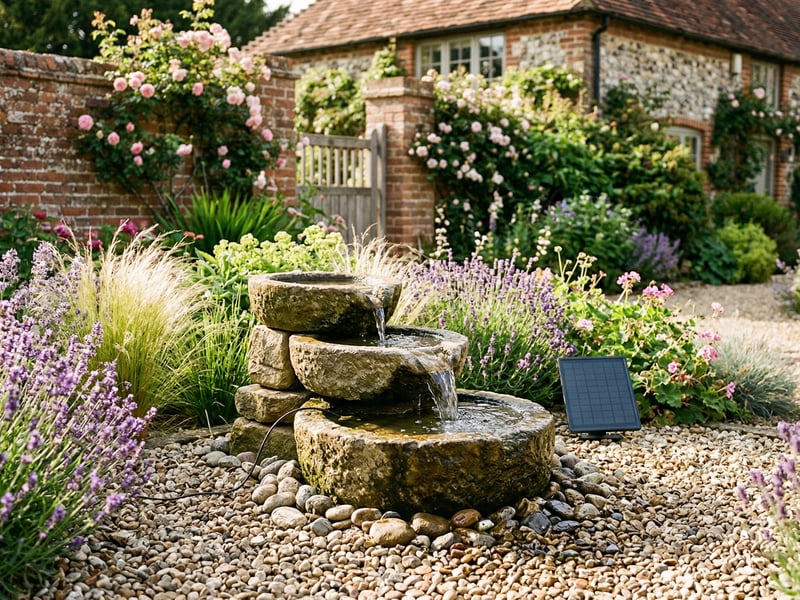
What does "self-contained" actually mean?
A self-contained water feature is a standalone unit with its own water reservoir, pump, and decorative body. Water circulates in a closed loop: the pump draws water from the reservoir (called a sump), pushes it up through the feature, and gravity returns it to the reservoir. No pond, no external plumbing, no mains water connection.
You fill it with tap water from a watering can or hose. Water evaporates over time (faster in summer, slower in winter) and you top it up every week or two. That is the only ongoing maintenance besides occasional cleaning. We stock 37 self-contained water features from £145 to £899.
The alternative is a "plumbed-in" or pond-based feature. These connect to external water sources, need drainage, and usually require professional installation costing £500-5,000+. For most gardens, a self-contained unit does the same job with a fraction of the hassle. You can move it, store it over winter, and take it with you if you move house.
Solar vs mains: running costs at 2026 electricity prices
At current Ofgem rates (24.5p per kWh from April 2026), a typical 10W self-contained water feature costs £7.16 per year to run on mains electricity. Solar costs nothing. The maths is straightforward, and no competitor publishes these actual calculations, so here they are.
| Feature type | Pump wattage | Daily hours | Annual kWh | Annual cost (mains) | Annual cost (solar) |
|---|---|---|---|---|---|
| Small tabletop | 5W | 8 | 14.6 | £3.58 | £0 |
| Self-contained cascade | 10W | 8 | 29.2 | £7.16 | £0 |
| Medium tiered feature | 25W | 8 | 73 | £17.89 | £0 |
| Large cascade/wall | 50W | 8 | 146 | £35.77 | £0 |
| Pond pump (24/7) | 80W | 24 | 700.8 | £171.70 | N/A |
Calculation: watts × hours × 365 ÷ 1000 = kWh. Multiply by 24.5p. Solar features have zero running costs because the panel generates all the electricity the pump needs. The trade-off is that solar only runs when the sun shines, which brings us to the question everyone asks.
Do solar water features work in winter?
Solar water features produce significantly less flow between November and February because UK daylight drops from 16 hours in June to under 8 hours in December. Cloud cover increases by roughly 50% during winter months. A solar pump that runs strongly on a July afternoon may only produce a weak trickle on a grey January day.
I am honest with customers about this. If you want your water feature running year-round at full strength, mains is the safer choice. Solar is brilliant from March to October. Outside that window, performance varies wildly depending on your location, your garden's orientation, and the weather.
Battery backup models help. These charge a rechargeable battery during daylight and keep the pump running for 2-4 hours after sunset. Some newer models store enough charge to run through overcast mornings. But no battery backup will keep a solar feature running all day in a December fog. Our frost protection guide explains how to winterise any outdoor water feature.
Total cost of ownership: solar vs mains over 5 years
When you add up the purchase price, installation, running costs, and replacement parts over five years, solar is cheaper for features under 25W. Mains catches up on larger features where you need consistent flow regardless of weather.
| Cost element | Solar self-contained | Mains self-contained | Mains hardwired |
|---|---|---|---|
| Purchase price | £145-329 | £210-899 | £300-1,200+ |
| Installation | £0 (DIY) | £0 (plug-in) | £150-400 (electrician) |
| Electricity (5 years, 10W) | £0 | £36 | £36 |
| Pump replacement (year 3) | £20-40 | £20-40 | £30-60 |
| Battery replacement (year 2) | £15-25 | N/A | N/A |
| 5-year total | £180-394 | £266-975 | £516-1,696 |
Solar panels themselves last 10+ years with minimal degradation. The pump motor is the weak point, lasting 2-4 years depending on usage. Replacement pumps cost £20-40 and take 10 minutes to swap. We stock solar replacement pumps separately if you need one.
How to set up a self-contained water feature
Most self-contained features take 15-30 minutes to set up with no tools. The steps are the same whether it is solar or mains powered. I have done this hundreds of times and it genuinely is that simple.
- Choose a level spot. Use a spirit level. Even a slight tilt changes where water flows and can make one side overflow. Gravel, paving slabs, and compacted earth all work. Avoid soft lawn, the feature will sink and tilt over time.
- Assemble the feature. Stack tiers or connect sections as per the instructions. Most slot or screw together.
- Connect the pump. Thread the pump cable through the feature and place the pump in the reservoir. Solar models: position the panel where it gets the most direct sun. Some have attached panels; others have remote panels on a 3-5 metre cable.
- Fill with water. Use a watering can or hose. Fill the reservoir completely, the pump must be fully submerged or it will burn out.
- Switch on. Solar: point the panel at the sun. Mains: plug into an RCD-protected outdoor socket. The water should start flowing within seconds.
For solar models with remote panels, angle the panel at 25-35 degrees facing south for maximum UK performance. Some customers cable-tie the panel to a fence post or garden stake. It does not look elegant, but it catches more sun than laying it flat on the ground.
Choosing between solar feature types
We stock 14 solar water features from £145 to £329. Here is how the range breaks down.
Tiered cascades
Water flows down two or three bowls, creating a gentle trickling sound. The Traditional Solar 3 Tier at £309 is the classic choice. These need the most sun because gravity fights the pump at every level. Place them in the sunniest spot you have. The Floral Tiered Solar at £279 suits cottage garden settings.
Bowl and rock features
A single level with water bubbling up and flowing over the sides. Lower pump demand means they work in slightly less sun than tiered models. The Stone Bowls Solar at £145 and Cubed Solar at £145 are our entry-level options. Both work well on a patio table or low wall.
Character and themed features
Water combined with a sculptural element. The Calming Buddha Solar at £229 is our bestselling solar model. The Froggy Falls at £175 appeals to families with children. These blur the line between ornament and water feature, which is why they work well in gardens that already have sculptures. Our animal ornaments guide has more ideas for mixing sculptural pieces with functional features.
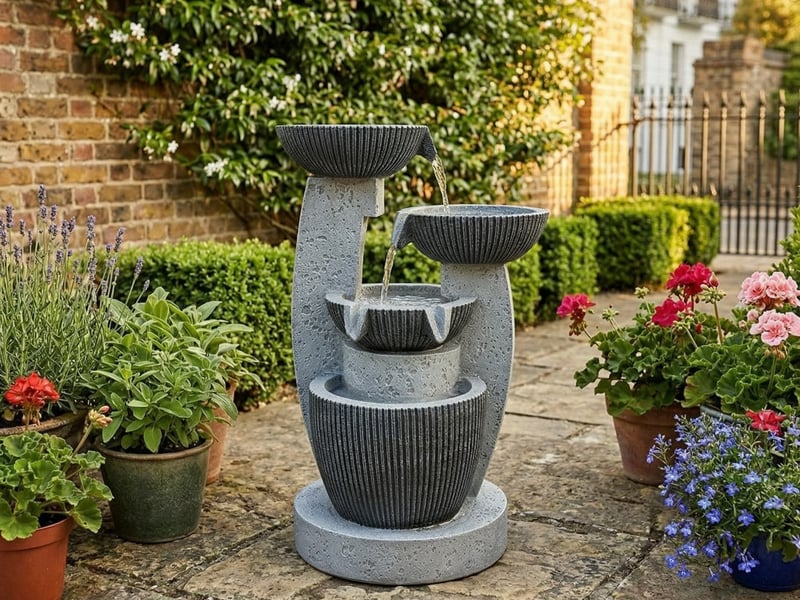
When mains is the better choice
Mains-powered self-contained features cost more to run but work regardless of weather or garden orientation. If your garden faces north, sits in tree shade, or you want water sounds after dark, mains is the practical choice.
Plug-in mains features need an outdoor socket with RCD protection. If you already have one (most modern houses do), there is no electrician needed and no Part P paperwork. Just plug in and go. Hardwired features, where the pump connects directly to the electrical supply, are a different matter. These must be installed by a Part P registered electrician under the Building Regulations. Expect to pay £150-400 for installation.
Our self-contained mains range runs from the Ancient Fern at £225 to the Highland at £899. The mid-range Peaceful Buddha at £349 is popular with customers who want a larger water flow than solar can deliver.
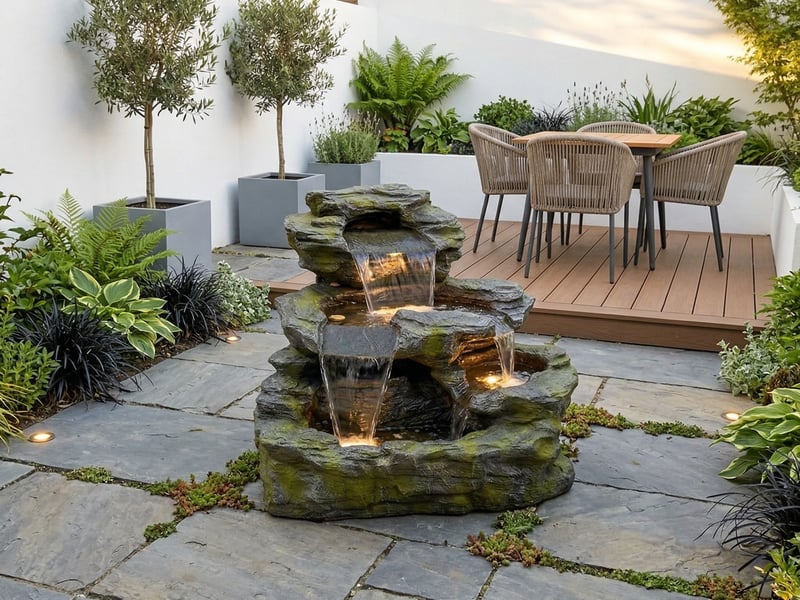
Matt's tip: the shadow test
Before you buy a solar feature, go outside at 10am, noon, and 2pm on a sunny day. If your chosen spot is in shadow at any of those three times, you will not get full pump performance. I tell customers to lay a white piece of paper on the ground where they want the feature. If the paper is in full sun at all three checks, solar will work. If not, save yourself the disappointment and go mains. This five-minute test has stopped a lot of returns.
Maintenance and common problems
The most common water feature problem is algae, and it happens to both solar and mains units. Warm sun heats the water in the reservoir, and algae blooms turn the water green. This is not a fault with the feature. It is biology.
Clean the reservoir every 4-6 weeks in summer. Empty the water, scrub the inside with white vinegar (wildlife-safe), rinse, and refill. Avoid bleach or chemical algaecides if birds drink from the feature. A tablespoon of white vinegar per litre of water slows regrowth without harming wildlife.
Other common issues and fixes:
- Pump not running (solar): Check the panel is in direct sun. Clean dust or bird droppings off the panel surface. Check the cable connection is dry and seated properly.
- Weak flow: The pump intake is clogged with debris. Remove the pump, pull off the intake cover, and rinse under a tap. Takes two minutes.
- Water level dropping fast: Normal in hot weather. Top up. If it drops overnight, check for a crack or leak where sections join. Silicone sealant fixes most small leaks.
- Pump buzzing but no flow: Air lock. Submerge the pump completely, tilt it to release trapped air, and it should restart.
For winter, drain the feature completely before the first frost. Trapped water freezes, expands, and cracks stone and resin. Remove the pump and store it indoors in a bucket of water (keeping the seals wet extends pump life). Our materials guide explains frost resistance by material type.
|
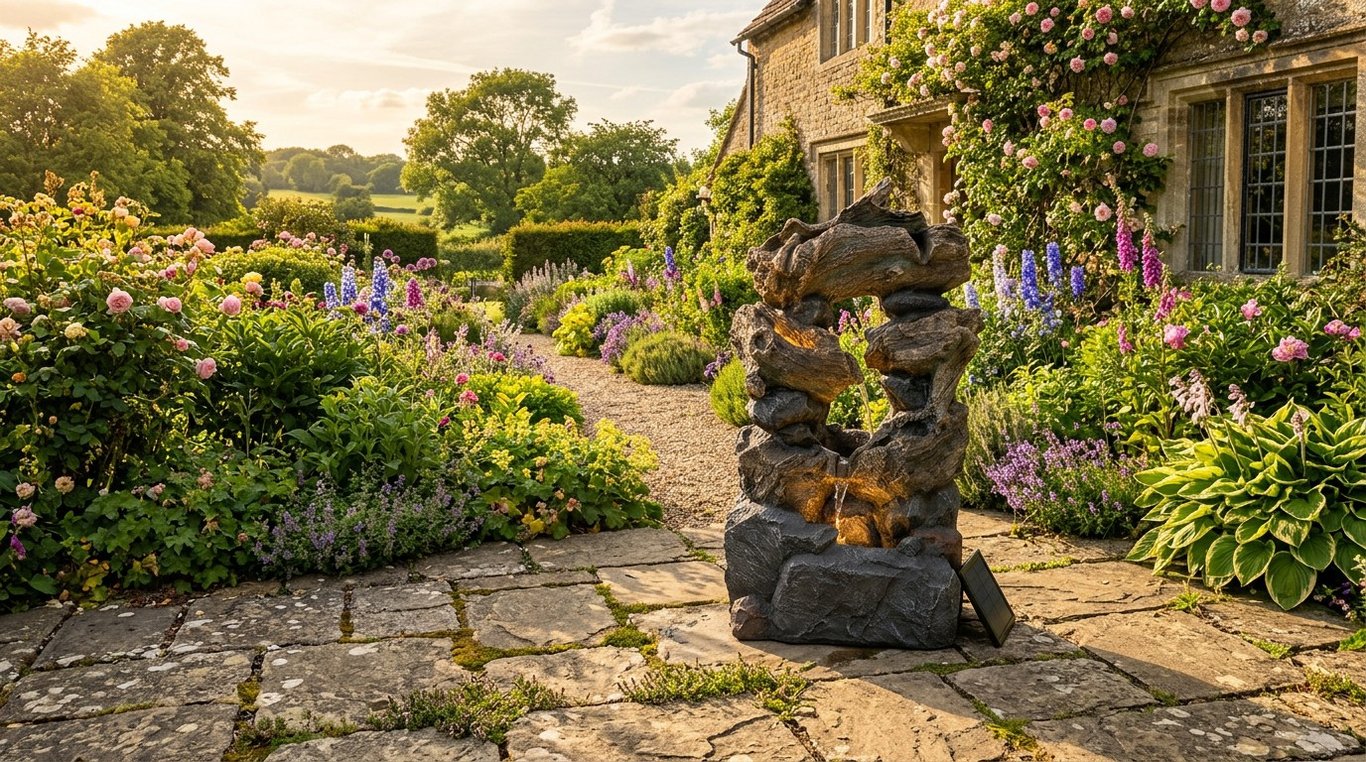
Matt's pick for best all-round solar water featureBest for: South-facing patios and gardens wanting natural stone-effect sound Why I recommend it: The Forest Springs has the strongest pump of our solar range and the most natural water sound. Customers tell me it sounds like an actual stream. The stone-effect finish ages well and the integrated solar panel means no separate panel to position. Price: £329 |
UK regulations: what you can and cannot do
Solar self-contained water features have zero regulatory requirements. No planning permission, no Building Regulations notification. You buy one, set it up, and that is it.
Mains plug-in features (plugging into an existing outdoor socket) also need no special permissions, provided the socket has RCD protection. Most outdoor sockets installed since 2005 have this. If yours does not, an electrician can add RCD protection for around £80-120.
Mains hardwired features fall under Part P of the Building Regulations. This means the electrical work must be done by a registered electrician (NICEIC, NAPIT, or equivalent) or signed off by Building Control. Outdoor electrical equipment must meet IP66 rating minimum. Submersible pumps need IPX7. Ignoring Part P is illegal and invalidates your home insurance if something goes wrong.
Planning permission is not needed for standard domestic water features. The exception is properties in conservation areas or listed buildings, where external changes may need consent. Check with your local planning authority if you are unsure.
Placement tips for solar water features
Solar features need their panel facing south with no shade between 9am and 3pm. This is non-negotiable in UK gardens. The further north you are, the more critical the panel angle becomes. Our sculpture placement guide covers general positioning principles; here are the solar-specific rules.
Features with integrated panels (panel built into the feature body) must be positioned in full sun. This limits your placement options because the feature itself must be in the sunniest spot, which may not be the best visual position.
Features with remote panels (panel on a cable, separate from the feature) give you more freedom. Place the feature wherever it looks best and run the panel cable to the sunniest spot within 3-5 metres. The panel can go on a fence, a stake, or flat on a south-facing bank.
Avoid placing any water feature directly under trees. Falling leaves block the pump intake and sap stains the surfaces. Bird droppings from overhanging branches foul the water faster than you would expect. A spot 2-3 metres from the nearest tree canopy edge is the minimum safe distance. Our securing guide covers fixing features in exposed or windy positions. Browse our full collection of garden ornaments for more ideas.
Further reading
- How to choose a garden water feature: types, costs and running expenses
- The complete guide to garden ornament materials
- How to weatherproof garden statues and ornaments
- Where to place garden sculptures: layout, lighting and centre pieces
- Best garden ornaments 2026: expert picks by material and style
Frequently asked questions
Do solar water features work on cloudy days?
They work at reduced capacity on cloudy days. A light overcast sky provides enough UV for a weak flow, but thick cloud cover can stop the pump entirely. Battery backup models store charge during sunny spells and continue running for 2-4 hours without direct sun, which helps bridge cloudy periods.
How much electricity does a water feature use?
A typical 10W self-contained feature running 8 hours daily uses 29.2 kWh per year. At the April 2026 Ofgem rate of 24.5p per kWh, that costs £7.16 annually. Larger pond pumps at 80W running 24/7 cost around £172 per year. Solar features cost nothing to run.
Do self-contained water features need a water supply?
No plumbed water supply is needed. Fill the reservoir with tap water from a watering can or hose and top up every 1-2 weeks as water evaporates. In hot weather, you may need to top up more often. The water recirculates in a closed loop.
Can you leave a solar water feature out in winter?
You can leave the structure outside if it is made from frost-proof stone or metal, but drain all the water first. Remove the pump and store it indoors in a bucket of water. Trapped water that freezes will crack stone, resin, and plastic components. Refill and reconnect the pump in spring after the last frost.
Do solar water features work at night?
Standard solar features stop when the sun goes down. Battery backup models charge during the day and run the pump for 2-4 hours after sunset, depending on how much charge they stored. No solar feature runs all night. If you want evening water sounds, choose a mains-powered feature.
Do I need an electrician to install a water feature?
Not for solar or plug-in mains features. Solar needs no electricity at all. Plug-in mains features use a standard outdoor socket with RCD protection. Only hardwired mains features (wired directly into your electrical supply) need a Part P registered electrician, which typically costs £150-400 for installation.
How long do solar water feature pumps last?
Solar pump motors last 2-4 years with regular use. The solar panel lasts 10+ years. Battery backup batteries last 1.5-3 years before needing replacement. Replacement pumps cost £20-40 and swap in about 10 minutes. Storing the pump in water over winter extends its life by keeping the seals from drying out.
Matt W
Garden & Outdoor Specialist
Matt has spent over 16 years working hands-on with garden products across the UK. He tests materials in Staffordshire clay soil and hard water conditions, and writes from direct experience fitting, maintaining, and repairing everything from stone statues to cast iron furniture. His advice is based on what actually survives a British winter, not what looks good in a catalogue.