
Japanese Garden Ornaments: Lanterns, Pagodas & Water Basins for UK Gardens
Written by Matt W on 9th Mar 2026.
Japanese garden ornaments for UK gardens include stone lanterns (toro) from £99 and pagodas from £230 to £480. Bronze cranes start at £115 and decorative pebbles at £35. Traditional design follows three core principles: asymmetry, odd-number groupings, and wabi-sabi (beauty in imperfection). Cast stone versions withstand UK winters to -20°C. A basic Japanese corner needs just a lantern, gravel, and three plants.
Matt W | Garden Ornament Specialist
Key takeaways
- ✅ Pagodas cost £230 to £480 across our 9-piece range, from single-tier to five-tier cast stone models
- ✅ Stone lanterns start at £99 and are the single most versatile Japanese ornament for UK gardens
- ✅ Group ornaments in odd numbers (1, 3, 5) following the Japanese principle of asymmetry
- ✅ A 2m x 2m corner is enough to create an authentic Japanese garden with gravel, a lantern, and three plants
- ✅ Cast stone survives UK frost to -20°C and develops natural moss patina within 6-12 months
- ✅ Five Japanese terminology terms explained: toro, tsukubai, ishi-doro, shishi-odoshi, miegakure
Matt's experience
Japanese ornaments are some of the most satisfying pieces we sell. A single stone lantern next to a gravel path changes the entire feel of a garden. I have seen customers transform a dull 3m x 3m patio corner into something from Kyoto. The trick is restraint. Japanese garden design is about what you leave out, not what you put in. We carry 9 pagodas, 4 lanterns, 3 crane figures, bamboo screens, and decorative pebbles. Between those categories, you can build anything from a simple lantern-and-gravel corner to a full tea garden layout.
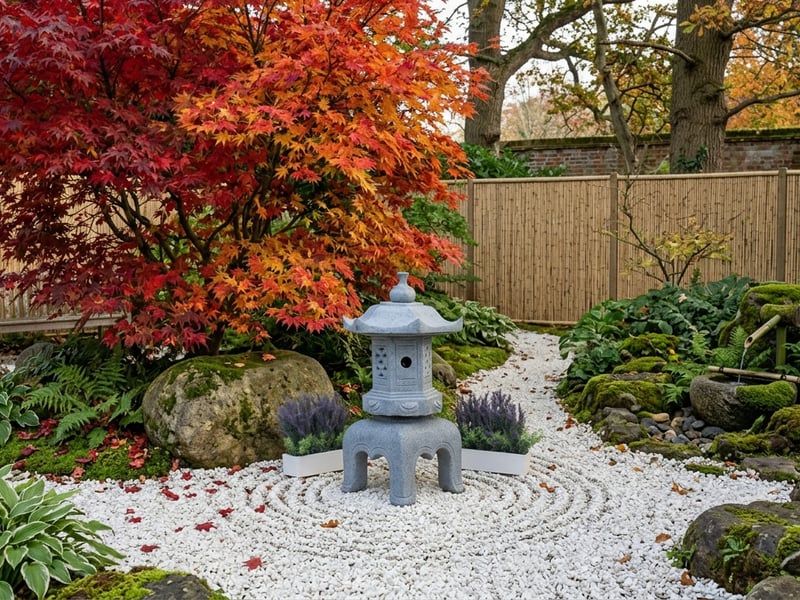
Shop the Pagoda Garden Ornament in Grey →
What ornaments belong in a Japanese garden?
Traditional Japanese gardens use a small number of ornament types, each with a defined purpose. Unlike Western gardens where decoration is the goal, every object in a Japanese garden serves a symbolic or practical function. The five main categories are stone lanterns, pagodas, water basins, animal figures, and natural stone arrangements.
Stone lanterns (toro) originally lit the paths to tea houses and Shinto shrines. They remain the single most recognisable element of Japanese garden design. Pagodas represent the five elements of Buddhist cosmology: earth, water, fire, wind, and void. Water basins (tsukubai) are ritual hand-washing stations placed near tea houses. Cranes symbolise longevity and good fortune. Foo dogs (komainu) are temple guardians placed in pairs at entrances.
The key difference from Western garden ornament collections is quantity. A Japanese garden rarely uses more than 3-5 ornamental pieces in total. Each piece occupies its own space with room to breathe. Overcrowding is the most common mistake buyers make when they first discover the category.
What is the difference between a toro, tsukubai, and ishi-doro?
Japanese garden ornaments use specific terminology that can be confusing at first. Understanding the names helps you choose the right piece for the right spot. Here are the five terms you will encounter most often when shopping for Japanese-style pieces in the UK.
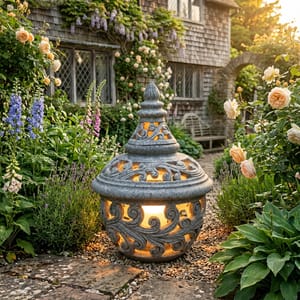
Toro is the general term for a stone lantern. All stone lanterns in Japanese gardens are toro. Ishi-doro means "stone lantern" more literally and is used interchangeably with toro. Our Garden Lantern in Grey at £99 is a classic ishi-doro design with a hexagonal cap and open fire chamber.
Tsukubai is a stone water basin used for ritual hand-washing before a tea ceremony. It sits low to the ground so visitors must crouch (tsukubau means "to crouch"). Shishi-odoshi is the bamboo deer scarer that fills with water, tips, and clacks against a stone. Miegakure is the design principle of hide-and-reveal, where the garden is never visible all at once. Paths curve, screens block, and each turn reveals a new view. This principle should guide where you place your ornaments.
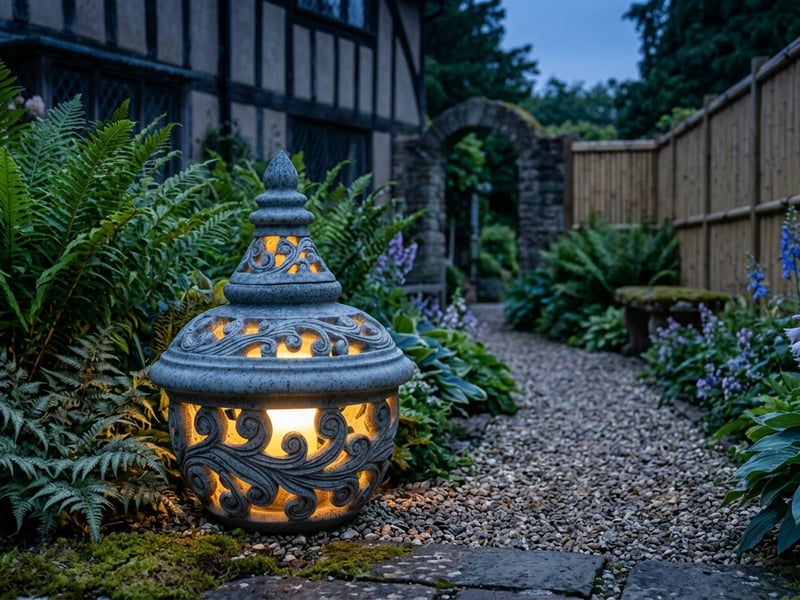
Shop the Garden Lantern in Grey →
How much do Japanese garden ornaments cost in the UK?
Prices for Japanese-style ornaments vary widely depending on the type, material, and height. Decorative pebbles and bamboo screens are the most affordable way to start. Stone lanterns and pagodas are the statement pieces that anchor a design.
Our pagoda range runs from £230 for a single-tier grey model to £480 for the five-tier white. The largest stands over a metre tall. Stone lanterns start at £99 for the Garden Lantern in Grey. Bronze cranes are £115 for a pair in verde bronze finish. Bamboo screens range from £75 to £155 depending on width. Decorative pebbles are £35 per bag.
For a complete Japanese corner, expect to spend £250-£400. That covers a lantern or single pagoda, decorative pebbles, a bamboo screen, and weed membrane. For a larger scheme with a five-tier pagoda, crane pair, and multiple plantings, budget £700-£900 before plants.
| Ornament type | UK price range | Typical height | Best placement | Material |
|---|---|---|---|---|
| Stone pagodas | £230-£480 | 45cm-110cm | Gravel beds, island focal points | Cast stone |
| Stone lanterns (toro) | £99-£289 | 40cm-65cm | Path edges, beside water | Cast stone |
| Buddha statues | £45-£729 | 20cm-90cm | Zen corners, meditation areas | Cast stone / resin |
| Foo dogs (komainu) | £150-£250 | 35cm-50cm | Pairs at entrances or gates | Cast stone |
| Bronze cranes | £115 | 80cm-100cm | Pond edges, gravel beds | Metal (verde bronze) |
| Bamboo screens | £75-£155 | 180cm | Backdrop, boundary screening | Natural bamboo |
| Decorative pebbles | £35 per bag | N/A | Ground cover, dry streams | Natural stone |
How to design a Japanese garden in a small UK space
Japanese gardens are inherently suited to small spaces. The traditional tea garden (roji) was often no larger than a narrow passageway. A 2m x 2m patio corner or a 3m-long side passage is enough to create something authentic. The principles work in your favour: fewer ornaments, cleaner lines, and more open space.
Start with the ground. Lay a weed membrane and cover it with light-coloured gravel or decorative pebbles. Rake the gravel into gentle curves to suggest flowing water. This is the karesansui (dry garden) approach used in famous Zen gardens like Ryoan-ji in Kyoto. Place a single stone lantern off-centre. Never in the middle. The Japanese principle of asymmetry means the focal point should sit roughly one-third of the way across the space.
Add one structural plant behind the lantern. A Japanese maple (Acer palmatum) is the classic choice, fully hardy in the UK. Frame the edges with low ferns, Hakonechloa grass, or clipped box shaped into cloud forms (niwaki). A bamboo screen across the back wall hides the fence and creates the illusion of depth. For more small-space ideas, read our small garden design ideas guide.
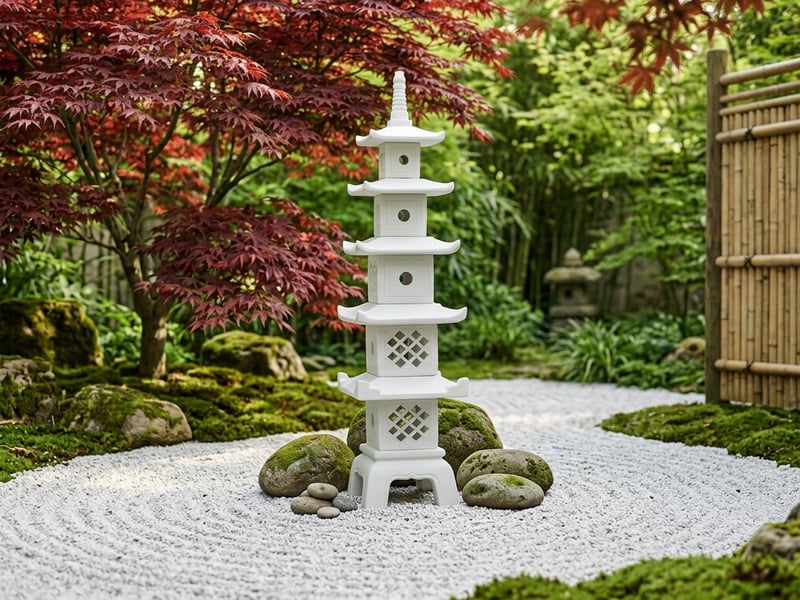
Shop the 5 Tier Pagoda in White →
What are the key design principles of a Japanese garden?
Japanese garden design follows rules that have been refined over 1,200 years. You do not need to follow all of them slavishly. Understanding the core principles helps you avoid common mistakes. The three that matter most for UK gardeners are asymmetry, odd-number groupings, and miegakure (hide-and-reveal).
Asymmetry means nothing is centred or mirrored. In Western gardens, we instinctively put things in the middle and balance both sides. Japanese design deliberately avoids this. Place your pagoda one-third from the left. Angle your lantern slightly. Let one side of the gravel bed be wider than the other. The effect feels more natural than forced symmetry.
Odd-number groupings apply to everything: rocks, plants, and ornaments. Groups of 1, 3, or 5 are traditional. Even numbers create a sense of completion that Japanese aesthetics deliberately avoid. Three rocks of different sizes arranged in a triangle is more pleasing than four in a square.
Wabi-sabi is the acceptance of imperfection. Moss on a stone lantern is not damage; it is beauty. A slightly weathered pagoda is more valuable than a pristine one. This principle is one reason cast stone works so well for Japanese ornaments in the UK climate. Our damp weather accelerates the patina that Japanese gardeners prize.
Which plants work best with Japanese garden ornaments?
Plant choice is as important as ornament choice in a Japanese garden. The wrong plants undermine the design no matter how good the ornaments are. Japanese gardens use a limited palette of species chosen for form, texture, and seasonal interest rather than flower colour.
Japanese maples (Acer palmatum) are the signature tree. They are fully hardy in UK gardens down to -15°C. Hundreds of cultivars exist, from compact 1m varieties to 5m specimens. Atropurpureum (purple leaf) and Dissectum (lace-leaf) are the two most popular for small gardens. Place them behind or beside a pagoda where their autumn colour provides a backdrop.
At ground level, Hakonechloa macra (Japanese forest grass) is the best ornamental grass for the style. It flows like water around the base of stone ornaments. Ferns, hostas, and moss fill shaded corners. For structure, clip box (Buxus) or yew into cloud shapes (niwaki). Bamboo works as a screen but use clumping varieties only, such as Fargesia murielae. Running bamboo will take over your garden within two seasons. The RHS Japanese garden design guide covers plant choices in more detail.
| Plant | Role | UK hardiness | Best near |
|---|---|---|---|
| Japanese maple (Acer palmatum) | Canopy, autumn colour | Hardy to -15°C | Pagodas, lanterns |
| Hakonechloa macra | Flowing ground cover | Fully hardy | Stone bases, gravel edges |
| Fargesia bamboo | Screening, sound | Hardy, clumping | Boundaries, backdrops |
| Ferns (Dryopteris) | Shade texture | UK native | Shaded corners, water features |
| Moss | Ground cover, ageing effect | Thrives in UK damp | Around ornament bases |
| Iris ensata (Japanese iris) | Waterside colour | Hardy to -15°C | Pond edges, tsukubai |
| Box (Buxus) niwaki | Cloud-pruned structure | Evergreen, hardy | Focal points, corners |
How to place Japanese ornaments for the best effect
Placement makes or breaks a Japanese garden. The same lantern can look stunning or out of place depending on where you put it. Japanese tradition has specific rules for ornament positioning that translate well to UK gardens of any size.
Stone lanterns traditionally sit beside water or at a path junction. If you have no pond, place the lantern beside a gravel "dry stream" or where a path changes direction. The lantern should be partially obscured by planting on one side, following the miegakure principle. Never place it in the centre of an open space.
Pagodas work best as a mid-distance focal point. Place them in a gravel bed or island planting where they can be viewed from a seated position. The ideal viewing distance is 3-5 metres. Too close and you lose the sense of scale. Too far and the detail disappears. Cranes belong near water or at the edge of a gravel bed suggesting a shoreline. Our sculpture placement guide covers general positioning principles in detail.
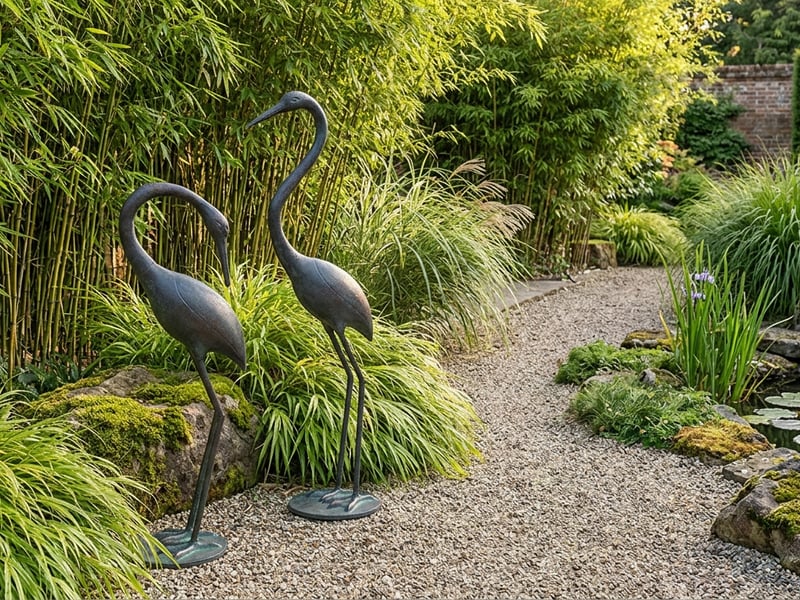
Shop the Elegant Cranes Metal Ornament →
Do Japanese stone ornaments survive UK frost?
Cast stone Japanese ornaments are frost-proof to -20°C and can stay outside year-round in any part of the UK. The material is a dense limestone aggregate that repels moisture and resists freeze-thaw cycles. Our entire pagoda and lantern range carries a frost guarantee.
The UK climate actually benefits Japanese stone ornaments. Damp conditions encourage moss and lichen growth on the surface within 6-12 months. This natural patina is highly prized in Japanese aesthetics. A lantern with a cap of soft green moss looks decades old even when it was placed last spring. You can speed up the process by brushing yoghurt or buttermilk onto the stone surface.
Metal ornaments like our bronze cranes have a verde (verdigris) finish that is designed to weather. They do not rust. The patina deepens over time and suits the wabi-sabi principle perfectly. Bamboo screens have a shorter outdoor lifespan of 3-5 years in exposed positions. Treat them with a clear outdoor wood preservative annually to extend this. For full winter care advice, see our frost protection guide.
Japanese garden ornaments vs zen garden ornaments
The terms "Japanese garden" and "zen garden" are often used interchangeably, but they describe different things. A zen garden (karesansui) is one specific type of Japanese garden. Knowing the difference helps you choose the right ornaments for the look you want.
A karesansui is a dry garden that uses raked gravel or sand to represent water. It is deliberately austere: rocks, gravel, and maybe a single tree. Ornaments are minimal. A stone lantern or low pagoda is appropriate. Cranes, bamboo features, and water basins are not. The most famous example is Ryoan-ji in Kyoto, which contains fifteen rocks and raked gravel. Nothing else.
A broader Japanese garden includes water, bridges, paths, and a wider range of ornaments. Tea gardens, stroll gardens, and courtyard gardens all fall into this category. These designs accommodate pagodas, lanterns, tsukubai, cranes, and foo dogs. If you want a varied ornament collection, aim for a Japanese garden style rather than a strict zen design. Buddha statues also work naturally in both styles. Our Buddha placement guide covers positioning rules that align with Japanese aesthetics.
How to build a Japanese garden on a budget
A Japanese garden is one of the most budget-friendly garden styles because it requires fewer items than most designs. The philosophy rewards simplicity. A single well-chosen ornament in a clean setting is more effective than a cluttered space full of cheaper pieces.
The most affordable start is a Garden Lantern in Grey at £99 and a bag of decorative pebbles at £35. Add a weed membrane roll at around £15 from any garden centre. Total cost: under £150. Lay the membrane, spread the pebbles, place the lantern off-centre, and add a single potted Japanese maple behind it. That is a complete Japanese corner for less than the price of a weekend dinner out.
The next step up adds a bamboo screen (£75-£155) behind the planting. Add a small pagoda at £230 as a second piece. At this level you have a scheme that looks intentional and designed. Browse our full range of garden ornaments to find pieces that work with your space and budget.
How to add water to a Japanese ornament garden
Water is one of the four essential elements in Japanese garden design alongside stone, plants, and ornamental features. You do not need a pond. A self-contained water feature, a tsukubai-style basin, or a dry stream of gravel all satisfy the principle.
A tsukubai is the most authentically Japanese option. It is a low stone basin fed by a bamboo spout (kakei). Water trickles in and overflows into a drain bed of pebbles. In the UK, a recirculating pump hidden beneath the pebbles keeps the water flowing without a mains connection. Place the tsukubai beside a path or near a seating area where the sound of water is audible.
If a water feature is not practical, create a dry stream (karenagare). Dig a shallow channel, line it with membrane, and fill with smooth river pebbles. Graduate the pebble size from larger at the edges to smaller in the centre to mimic a natural stream bed. Place a stone lantern at a bend in the stream for a natural composition. Our self-contained water features guide covers pump sizing and running costs.
Matt's Tip: Start with one ornament
The biggest mistake I see is people buying five or six pieces at once. They place them all in one area. Japanese design is the opposite of that. Buy one piece. Live with it for a month. Walk past it every day. Then decide if the space needs anything else. Nine times out of ten, you will realise the single lantern or pagoda was enough. The empty space around it is doing the work. If you do add a second piece, place it at least 2 metres away and at a different height.
|
Matt's Pick for a first Japanese garden ornamentBest for: Small to medium UK gardens, path edges, and gravel beds Why I recommend it: The Garden Lantern in Grey is the single most versatile Japanese ornament we sell. The hexagonal cap and open fire chamber are an authentic ishi-doro shape that works in any setting. At £99 it is the best entry point into Japanese garden design. I have seen it look equally good in a 2m patio corner and a 20m country garden. It develops moss within months in the UK climate. Price: £99 |
Further reading
- How to Choose a Garden Water Feature: Types, Costs and Running Expenses
- The Complete Guide to Garden Ornament Materials: Stone vs Resin vs Metal
- How to Stop Garden Statues Falling Over: Bases, Adhesives and Fixing Methods
- The Best Places to Position Garden Statues for Feng Shui
- Top 10 Cast Stone Garden Statues and Ornaments in the UK
Frequently asked questions
What ornaments are traditional in a Japanese garden?
Stone lanterns, pagodas, water basins, and crane figures are the four traditional types. Stone lanterns (toro) lit paths to tea houses and shrines. Pagodas represent the five Buddhist elements: earth, water, fire, wind, and void. Tsukubai (water basins) are ritual hand-washing stations. Foo dogs guard entrances in pairs. Japanese gardens use fewer ornaments than Western designs, with each piece serving a symbolic or practical purpose.
How much do Japanese stone lanterns cost in the UK?
Japanese stone lanterns in the UK cost between £99 and £289 for cast stone models. Our Garden Lantern in Grey starts at £99 and is the most popular entry point. Larger ornate designs with multiple tiers reach £289. Cast stone lanterns are frost-proof and designed for year-round outdoor use. Imported natural stone versions from Japan cost £500-£2,000 but are rarely available in the UK market.
What is a tsukubai and where should I place one?
A tsukubai is a low stone water basin used for hand-washing in Japanese tea gardens. The name comes from tsukubau, meaning "to crouch," because the basin sits low so visitors must bow to use it. Place a tsukubai beside a garden path or near a seating area where the sound of trickling water is audible. Surround it with pebbles to catch overflow. Position it away from overhanging trees that drop leaves into the water.
Can I create a Japanese garden in a small UK space?
A 2m x 2m corner is enough for an authentic Japanese garden feature. Japanese tea garden paths (roji) were often narrower than a hallway. Lay weed membrane, spread light gravel, and place a stone lantern off-centre. Add one potted Japanese maple behind it. The total cost is under £150. Small spaces suit Japanese design because the philosophy values empty space and restraint over abundance.
What plants work best with Japanese garden ornaments?
Japanese maples, bamboo, ferns, and ornamental grasses are the four core plant groups. Acer palmatum varieties provide canopy and autumn colour. Fargesia bamboo (clumping, not running) creates sound and screening. Hakonechloa macra flows around ornament bases like water. Moss grows naturally on cast stone in UK conditions and is prized in Japanese aesthetics. All of these plants are fully hardy in the UK.
Do Japanese stone ornaments survive UK frost?
Cast stone Japanese ornaments are frost-proof to -20°C and stay outside year-round. The dense limestone aggregate resists freeze-thaw cycles that crack lesser materials. UK damp benefits the ornaments by encouraging moss and lichen growth. This creates the weathered patina (wabi-sabi) that Japanese tradition prizes. Metal crane ornaments have a verde bronze finish that deepens with age. Bamboo screens last 3-5 years outdoors with annual preservative treatment.
Matt W
Garden & Outdoor Specialist
Matt has spent over 16 years working hands-on with garden products across the UK. He tests materials in Staffordshire clay soil and hard water conditions, and writes from direct experience fitting, maintaining, and repairing everything from stone statues to cast iron furniture. His advice is based on what actually survives a British winter, not what looks good in a catalogue.