
Garden Sundials and Armillary Spheres: Positioning, History and Buying Guide
Written by Matt W on 9th Mar 2026.
Key takeaways
- ✓ Sundials must face true north (not magnetic north) on a flat, unshaded surface to tell accurate time
- ✓ Armillary spheres were invented by Hellenistic Greeks in the 3rd century BC. Most garden versions are ornamental
- ✓ Our sundials range from £219 to £345. Armillary spheres range from £375 to £629
- ✓ Brass dials develop a dark green-brown patina within 12-18 months. Do not polish it off
- ✓ Adjust for BST between April and October by reading one hour behind the dial
Garden sundials and armillary spheres are among the oldest garden ornaments still in regular use. Sundials tell the time using a brass gnomon that casts a shadow onto a calibrated dial face. Armillary spheres model the celestial rings of the sky and are primarily sculptural centrepieces. We stock 27 sundials from £219 and 15 armillary spheres from £375, all mounted on hand-finished stone pedestals from Lucas Stone, Melmar, and Enigma. Correct positioning facing true north in full sun is essential for accuracy.
By Matt W | 9 March 2026
Garden ornament specialist with 15 years experience. Has positioned and installed sundials and armillary spheres in gardens across the UK.
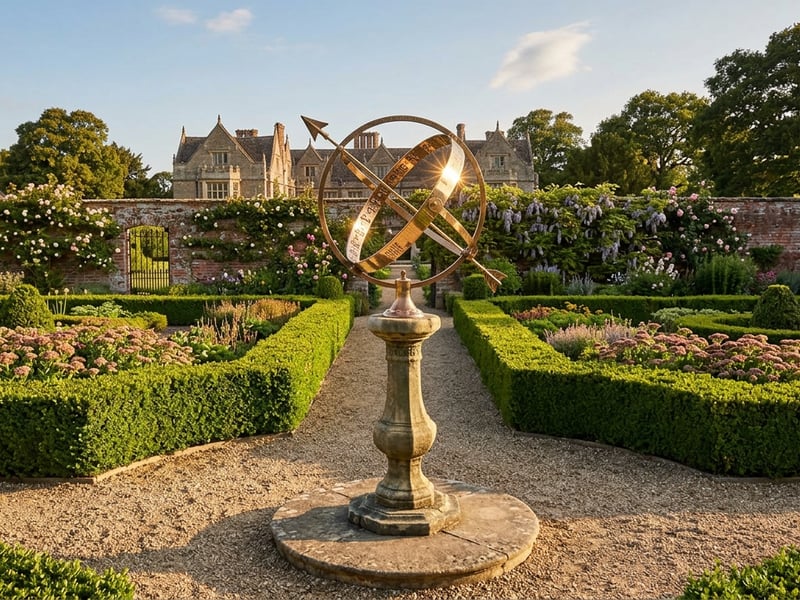
Shop the Large Armillary on Stone Garden Pedestal →
Matt's experience
I have sold and positioned sundials for over 15 years. The question I hear most often is "does it actually work?" The answer is yes, provided you set it up correctly. Most people point the gnomon vaguely southward and wonder why the time is wrong. True north, a level surface, and unshaded sun from 9am to 3pm are the three non-negotiable requirements. Get those right and a brass sundial will tell the time to within five minutes on a clear day. I find the process of calibrating one genuinely satisfying.
What is the difference between a sundial and an armillary sphere?
A sundial uses a flat brass dial and a triangular gnomon to cast a shadow that indicates the hour. The gnomon must point towards the celestial pole (true north in the UK) at an angle matching your latitude. When sunlight hits the gnomon, the shadow falls across hour lines engraved on the dial face. It is a working timepiece that has told the time in gardens since the 16th century.
An armillary sphere is a three-dimensional model of the celestial sky. Nested brass rings represent the equator, tropics, and meridian lines. Some armillary spheres include a central arrow that functions as a gnomon and can indicate the hour. Most garden versions, however, are purely ornamental. The rings catch light from every angle and look good even on overcast days.
Both sit on stone pedestals, typically 60-90cm tall for sundials and 80-120cm for armillaries. The pedestal raises the piece to a comfortable viewing height and gives it visual weight in the garden. Browse our full collection of garden ornaments to see the full range of pedestals available.
A brief history of sundials and armillary spheres
The armillary sphere was invented by Hellenistic Greek astronomers in the 3rd century BC. Eratosthenes of Cyrene, the mathematician who calculated the circumference of the Earth, is widely credited with its development. The instrument was used for astronomical observation, not garden decoration. It mapped the positions of stars and planets using concentric rings that could be rotated to simulate celestial movement.
Flat sundials are older still. Ancient Egyptian obelisks cast shadows used for timekeeping as early as 1500 BC. The Romans brought portable sundials across their empire. But the garden sundial as we know it, a brass dial on a stone column surrounded by planting, dates from the 17th and 18th centuries. English country houses used them as both practical timepieces and status symbols. The British Sundial Society records over 4,000 historic sundials across the UK.
By the Victorian era, sundials had become purely decorative in most gardens. Pocket watches made them redundant for timekeeping. But people kept buying them because a weathered brass dial on aged stone just looks right in an English garden. Our materials guide explains why brass and stone age so well together.
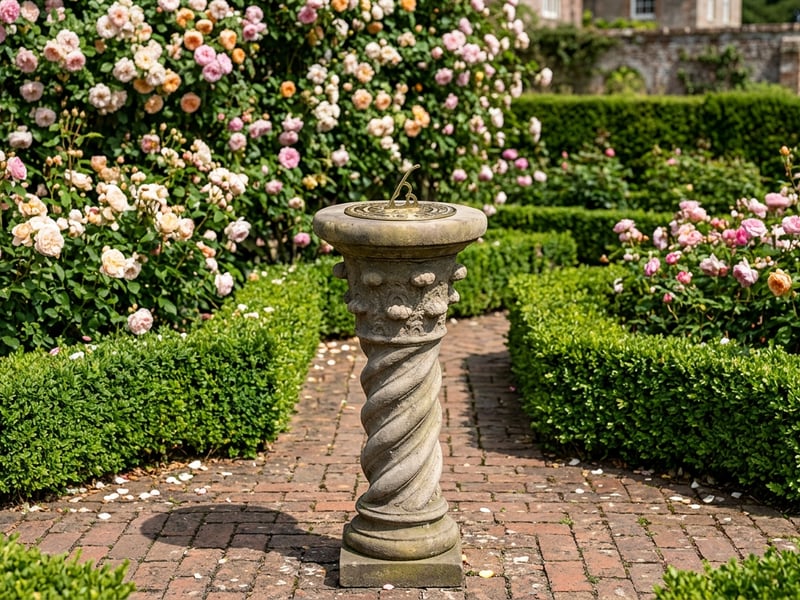
Shop the Brass Sundial on Roman Stone Pedestal →
How to position a sundial in a UK garden
The gnomon must point towards true north, not magnetic north, on a perfectly level surface in full sun. Magnetic north in the UK currently sits around 1-2 degrees west of true north, depending on your location. This small difference matters less than ensuring the dial receives unbroken sunlight from at least 9am to 3pm. Any shadow from a building, fence, or tree during those hours makes the reading unreliable.
To find true north using the shadow pole method, push a straight stick vertically into the ground on a sunny morning. Mark the tip of its shadow at 10am. Mark it again at 2pm. Draw a line between the two marks. That line runs east-west. True north is perpendicular to it, pointing away from the sun. Alternatively, use a compass and subtract the current magnetic declination for your postcode (around 1.5 degrees west in 2026).
Set the gnomon angle to match your latitude. London is roughly 51.5 degrees. Manchester sits at 53.5 degrees. Edinburgh is 56 degrees. Most commercially made sundials are pre-set for approximately 52 degrees, which works well across England and Wales. Our sculpture placement guide covers general positioning principles for all garden ornaments.
Do armillary spheres actually tell the time?
Some armillary spheres tell the time, but most garden versions are ornamental only. A functional armillary has a central rod or arrow (the gnomon) aligned to the celestial pole. The shadow cast by this rod onto the equatorial ring indicates the solar hour. If the rings are correctly aligned and the sphere is positioned facing true north, it works on the same principle as a flat sundial.
Most decorative armillary spheres lack a properly calibrated gnomon. The rings are arranged for visual appeal rather than astronomical accuracy. This is not a flaw. An armillary sphere 80-120cm tall on a stone pedestal is hard to miss from anywhere in the garden. The interlocking brass rings catch sunlight and create moving shadows throughout the day. As a garden focal point, accuracy matters far less than presence.
If you want a timepiece, choose a sundial. If you want a sculptural centrepiece visible from across the garden, an armillary sphere is the stronger choice. Both develop the same attractive brass patina over time. Our large garden ornaments guide covers other statement pieces that work as focal points.
What is the gnomon and how does it work?
The gnomon is the raised triangular piece on a sundial that casts the shadow onto the hour lines below. Its name comes from the ancient Greek word for "indicator." On a horizontal sundial (the most common garden type), the gnomon sits at an angle equal to the latitude of the location. In central England, that is roughly 52 degrees from the horizontal.
The shadow moves clockwise as the sun crosses the sky from east to west. Hour lines on the dial face are spaced unevenly because the sun's apparent speed changes throughout the day. Morning and evening hours are wider apart. Midday hours are closer together. This is why sundial faces look different from clock faces, and why hand-engraved brass dials with correctly calculated lines are more accurate than mass-produced versions.
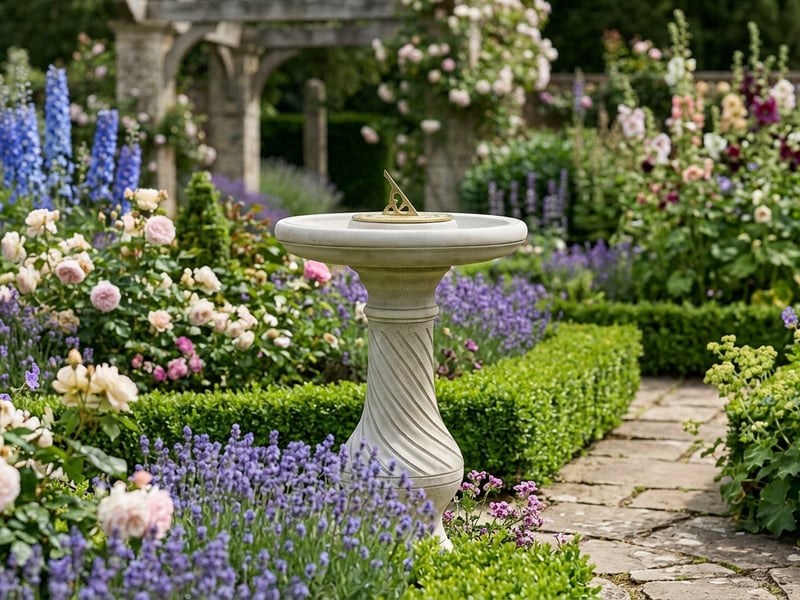
Shop the Georgian Sundial in Stone →
BST adjustment: reading your sundial April to October
Between late March and late October, British Summer Time is one hour ahead of solar time. Your sundial reads solar time, which means it will show 11am when your phone says noon during BST. This is not a fault. The sundial is correct. The clocks have changed, not the sun.
Some owners scratch a second set of hour marks offset by one hour for summer reading. I would not recommend this. It clutters the dial face and looks wrong. Simply remember to add one hour to the sundial reading between the last Sunday in March and the last Sunday in October. After a week or two, you do it automatically without thinking.
Sundials vs armillary spheres: which should you choose?
| Feature | Sundials | Armillary Spheres |
|---|---|---|
| Price range | £219-£345 | £375-£629 |
| Tells time? | Yes, with correct calibration | Some do, most are ornamental |
| Typical height | 60-90cm on pedestal | 80-120cm on pedestal |
| Materials | Brass dial + stone pedestal | Brass sphere + stone pedestal |
| Best placement | Open lawn or path junction, full sun | Garden centrepiece or focal point |
| Visual impact | Subtle, traditional | Bold, sculptural |
| Maintenance | Polish brass annually (optional) | Polish brass annually (optional) |
For smaller gardens under 100 square metres, a sundial on a 60cm pedestal fits the scale better. The flat dial does not overwhelm a modest space. For larger gardens or positions where you need a piece visible from 15 metres or more, an armillary sphere has the three-dimensional presence to hold its own. Either way, the stone pedestal weathers and develops character within a year.

|
Matt's Pick for best value garden sundialBest For: Cottage gardens, herb garden centrepieces, path junctions Why I Recommend It: The Roman-style stone pedestal has the most traditional look in our range. The brass dial is properly calibrated for UK latitudes and develops a rich patina within 18 months. At this price, it is genuinely hard to beat for quality. Price: £219 |
Materials and maintenance for brass sundials
Brass is the traditional material for sundial faces and armillary rings because it resists corrosion and engraves cleanly. New brass starts bright gold. Within 6-12 months outdoors, it develops a dark brown-green patina caused by oxidation. This patina is protective and most owners leave it. Polished brass requires annual maintenance with a metal polish and soft cloth. Patinated brass requires nothing.
The stone pedestals are reconstituted stone, hand-finished in the UK by makers including Lucas Stone and Melmar. Reconstituted stone weathers like natural stone, developing lichen and moss within a year. It is frost-resistant when properly cured. Our weatherproofing guide covers winter care for all stone pieces.
Clean the dial face once a year with warm soapy water and a soft brush to remove leaf debris. Never use wire wool or abrasive cleaners on engraved brass. The hour lines and numerals are shallow and wire wool will erase them over time. If you want to preserve the bright brass look, apply a thin coat of yacht varnish after polishing. This slows oxidation for 6-12 months.
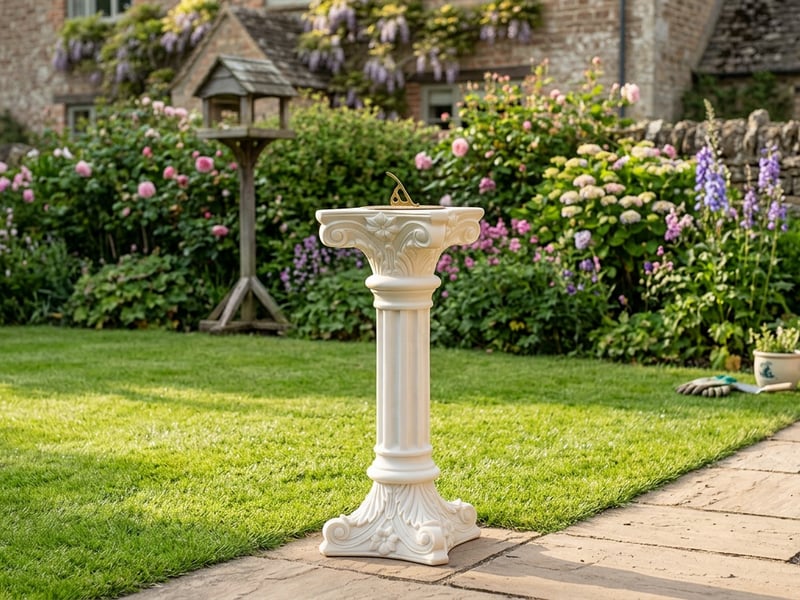
Shop the Column Stone Sundial →
Where to place a sundial in different garden styles
The position depends on your garden layout, but the sun requirement overrides all other considerations. No amount of good design sense will make a sundial work in shade. Check the position receives direct sun between 9am and 3pm in both summer and winter. Shadow lines change dramatically between June and December in the UK.
In cottage gardens, place a sundial where paths meet or at the centre of a herb garden. Surround the pedestal base with creeping thyme and chamomile. These release scent when brushed and stay low enough not to shade the dial. In formal gardens, a sundial works on the central axis as a symmetrical focal point. A pair of matching armillaries flanking a main path makes a strong statement in larger formal layouts.
For modern gardens, a sundial provides an interesting contrast against clean lines and hard surfaces. Place it on gravel or paving rather than lawn. The traditional form against a contemporary backdrop creates visual tension that draws the eye.
Matt's Tip: The shadow test
Before buying a sundial, test your chosen position. Put a stick in the ground where you want the pedestal and photograph its shadow at 9am, noon, and 3pm on a sunny day. If the shadow is interrupted by a building, fence, or tree at any of those times, the position will not work. I have had customers install a sundial in a beautiful spot only to discover that their garage casts a shadow across it every afternoon from October to March. Five minutes with a stick saves a lot of disappointment.
Further reading
Frequently asked questions
How do you position a sundial in the UK?
Point the gnomon towards true north on a level surface in full sun. True north is approximately 1.5 degrees east of magnetic north in the UK in 2026. Use the shadow pole method or a compass with declination correction. The position must receive unbroken sunlight from 9am to 3pm. The gnomon angle should match your latitude: roughly 52 degrees for central England.
What is the difference between a sundial and an armillary sphere?
A sundial tells the time using a flat dial and shadow-casting gnomon. An armillary sphere is a three-dimensional model of celestial rings, usually brass on a stone pedestal. Some armillary spheres can indicate the hour via a central rod, but most garden versions are purely ornamental focal points. Sundials cost £219-£345; armillary spheres cost £375-£629.
Do sundials work in British Summer Time?
Sundials read solar time, which is one hour behind BST. Between late March and late October, add one hour to the sundial reading to get the correct clock time. The sundial itself is accurate year-round. The discrepancy comes from the clocks changing, not from any fault with the dial.
How do you find true north without a compass?
Use the shadow pole method on a sunny day. Push a stick vertically into the ground. Mark the shadow tip at 10am and again at 2pm. Draw a line between the two marks. This line runs east-west. True north is perpendicular to it, pointing away from the midday sun. This method is accurate to within 1-2 degrees.
What maintenance does a brass sundial need?
A brass sundial needs minimal maintenance once positioned. Clean the dial face once a year with warm soapy water and a soft brush. If you want to keep the bright brass finish, polish with metal polish and apply yacht varnish. Most owners prefer the dark green-brown patina that develops naturally and simply leave it untouched.
Can you leave a sundial outside all winter?
Yes, brass and reconstituted stone are fully frost-resistant. The brass dial will not be damaged by frost, rain, or snow. The stone pedestal is designed for year-round outdoor use and will not crack in UK winter temperatures. Simply brush off any leaf debris in autumn. There is no need to cover or move the sundial seasonally.
Matt W
Garden & Outdoor Specialist
Matt has spent over 16 years working hands-on with garden products across the UK. He tests materials in Staffordshire clay soil and hard water conditions, and writes from direct experience fitting, maintaining, and repairing everything from stone statues to cast iron furniture. His advice is based on what actually survives a British winter, not what looks good in a catalogue.