
Classical Garden Statues: Greek, Roman and Renaissance Figures
Written by Matt W on 13th Apr 2026.
Classical garden statues bring 2,500 years of Western art into UK gardens. Greek goddesses, Roman busts, Renaissance cherubs and Michelangelo's David are all available in frost-resistant cast stone and crushed marble resin from £150 to £559. We stock over 20 classical figures from two specialist manufacturers, in heights from 60cm tabletop busts to 160cm full-size garden centrepieces. Every statue is hand-finished and designed to weather naturally in British conditions.
Key takeaways
- ✓ Greek goddesses (Venus, Hebe, Diana) and Roman figures (Flora, Hercules) range from £150 to £559
- ✓ Two materials: Lucas Stone cast reconstituted limestone (Cotswold/Burnt Umber) and Enigma crushed marble resin (white alabaster)
- ✓ Heights from 60cm (Bust of David) to 160cm (Extra Large Hebe). Choose based on garden scale
- ✓ Formal gardens suit symmetrical pairs on plinths. Cottage gardens suit single figures among planting
- ✓ Every figure in this guide is frost-resistant and designed for permanent outdoor display in the UK
A note from the team
We have sold classical garden statues for over a decade and handled every figure in this guide. The quality difference between a £30 garden centre Venus and a proper cast stone or marble resin version is obvious from across the garden. Weight, texture, proportions: none of it is the same. The figures below are the ones we recommend because they look right after five years outdoors, not just on delivery day.
What are classical garden statues?
Classical garden statues are reproductions of figures from three periods of Western art: ancient Greece (800-31 BC), the Roman Empire (31 BC-476 AD) and the Italian Renaissance (1400-1600). The tradition of placing these figures in gardens dates back to Roman villa gardens, where statues of gods and heroes lined pathways and courtyards. English country houses adopted the practice in the 17th century after the Grand Tour brought Italian aesthetics to Britain.
Today, the term covers Greek goddesses like Venus, Hebe and Diana, Roman busts of heroes like Hercules, Renaissance masterpieces like Michelangelo's David, and cherubs (putti) inspired by Raphael and Donatello. Modern reproductions use frost-resistant materials that survive British winters. Browse our full collection of stone garden statues and our dedicated classical garden statues range.
Which greek goddess statues work best in UK gardens?
Greek goddess statues are the most popular classical garden figures we sell. The three best sellers are Venus (goddess of love), Hebe (goddess of youth) and Diana (goddess of the hunt). Each has a distinct pose and proportions that suit different garden settings. Venus works as a border centre piece. Hebe suits a courtyard or patio centrepiece. Diana, with her forward stance and bow, adds movement to a static garden corner.
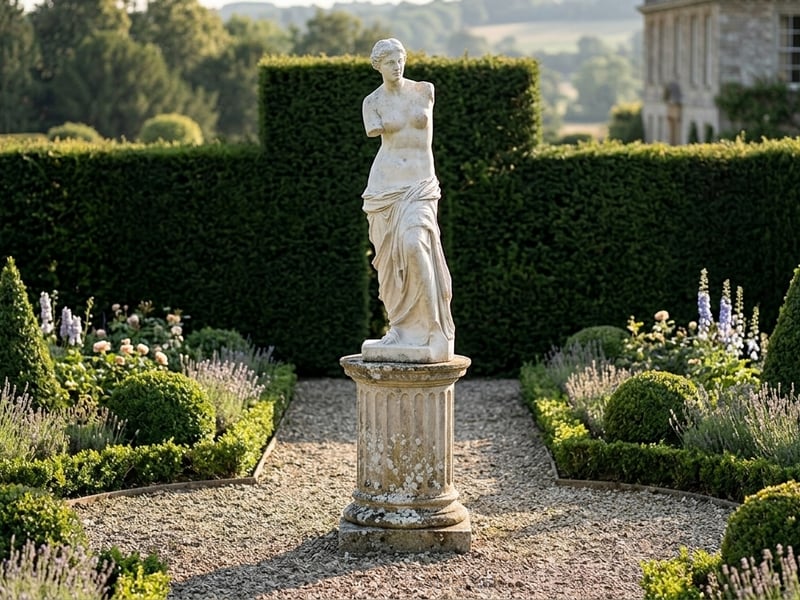
Shop the Venus De Milo Garden Statue - £179 →
The Venus De Milo at £179 is 85cm tall in white crushed marble resin. The original stands in the Louvre and dates to around 100 BC. Our reproduction captures the contrapposto pose and draped lower half that made it the most recognisable sculpture in Western art. The white finish looks striking against dark evergreen hedging or a brick wall.
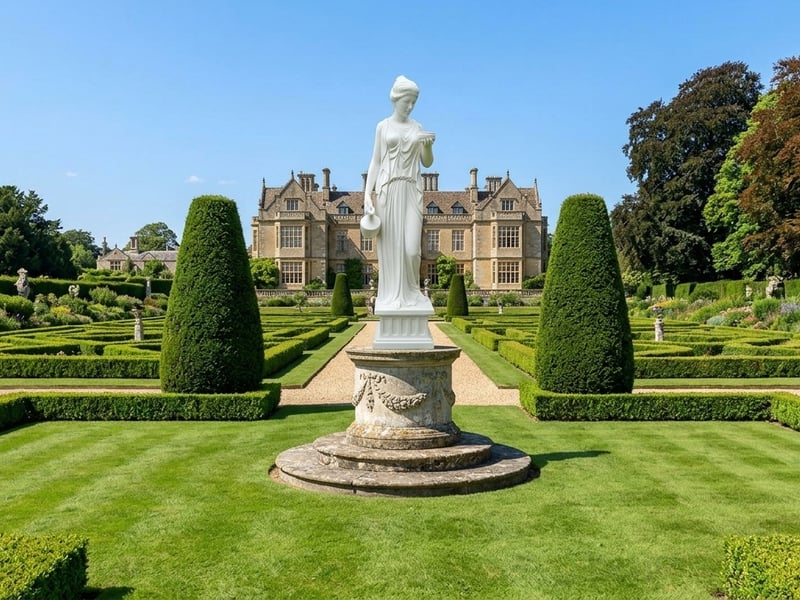
Shop the Extra Large Hebe Goddess - £449 →
Hebe was the Greek goddess of youth who served nectar to the gods on Mount Olympus. Our Extra Large Hebe stands 160cm tall, making her a genuine garden centrepiece visible from a distance. At £449, she is one of the largest classical figures we stock. A matching stone pedestal or plinth raises her further and frames the figure properly. For a smaller budget, the Small Hebe at 60cm costs £150.
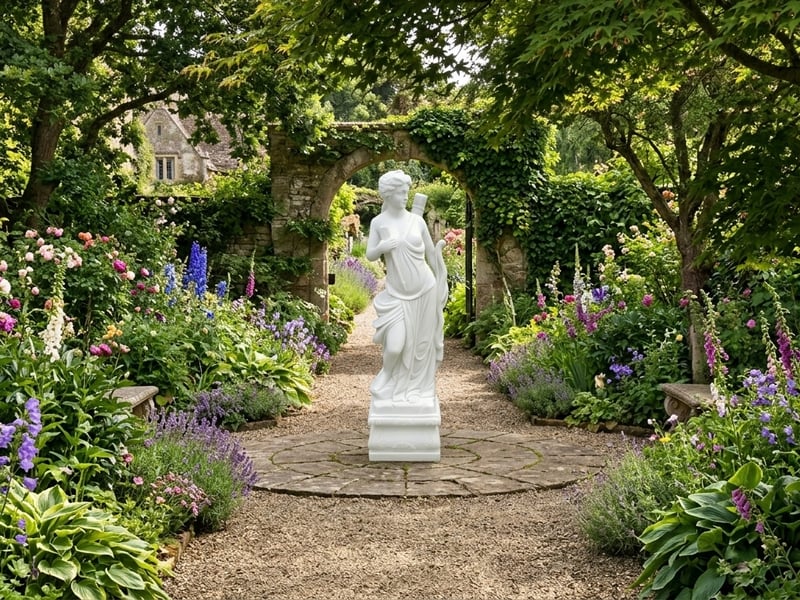
Shop Diana the Hunter Statue - £189 →
Diana (Artemis in Greek mythology) was the goddess of the hunt, the moon and wild animals. The striding pose with a hunting bow creates natural movement in a garden. At 85cm and £189, Diana is one of the best-value classical statues in the range. She works well positioned at the end of a garden path or at a junction between borders, where the forward lean draws the eye along a sight line.
The venus de milo: why it is the most popular classical garden statue
The Venus de Milo outsells every other classical figure in our range by a clear margin. The combination of instant recognition, elegant proportions and a height that works in most garden sizes makes it a safe choice for customers new to garden statuary. We stock three versions at different price points.
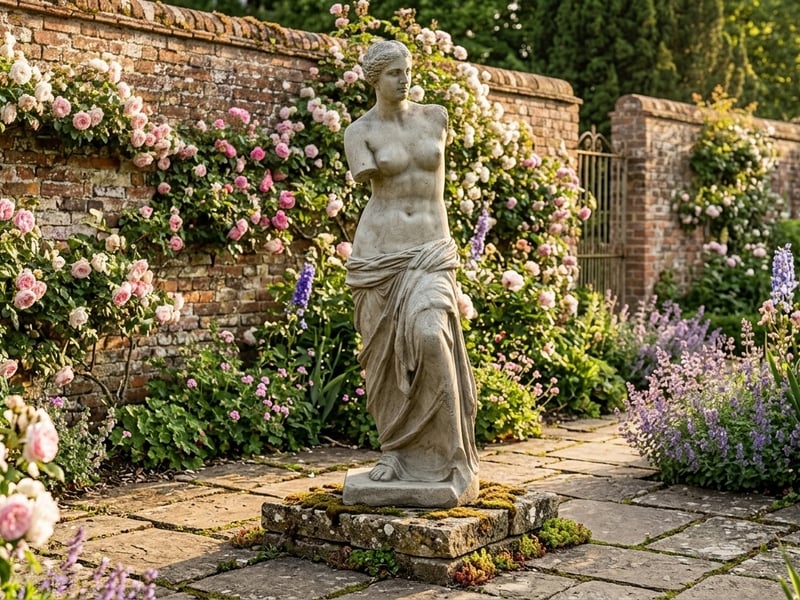
Shop the Large Venus Di Milo (Lucas Stone) - £339 →
The Lucas Stone version at £339 stands 114cm tall in hand-finished Cotswold or Burnt Umber cast reconstituted limestone. It weighs substantially more than the resin versions and develops a natural patina of moss and lichen over time. If you want a Venus that looks like it has been in your garden for decades, this is the one. For tips on encouraging that aged look, read our guide on how to age a garden statue.
| Venus de Milo version | Height | Material | Weight | Price |
|---|---|---|---|---|
| Enigma Venus De Milo | 85cm | Crushed marble resin | ~12kg | £179 |
| Dinova Venus De Milo (White) | 82cm | Crushed marble resin | ~14kg | £210 |
| Lucas Stone Large Venus | 114cm | Cast reconstituted limestone | ~45kg | £339 |
Renaissance figures: michelangelo's david and cherubs
Renaissance statuary brought classical Greek and Roman forms back to life in 15th-century Florence. Michelangelo's David (1504) and the cherubs (putti) that decorate countless Italian churches and palaces are the two most reproduced Renaissance figures in garden design. David represents human achievement and perfection. Cherubs add warmth, playfulness and a distinctly romantic character.
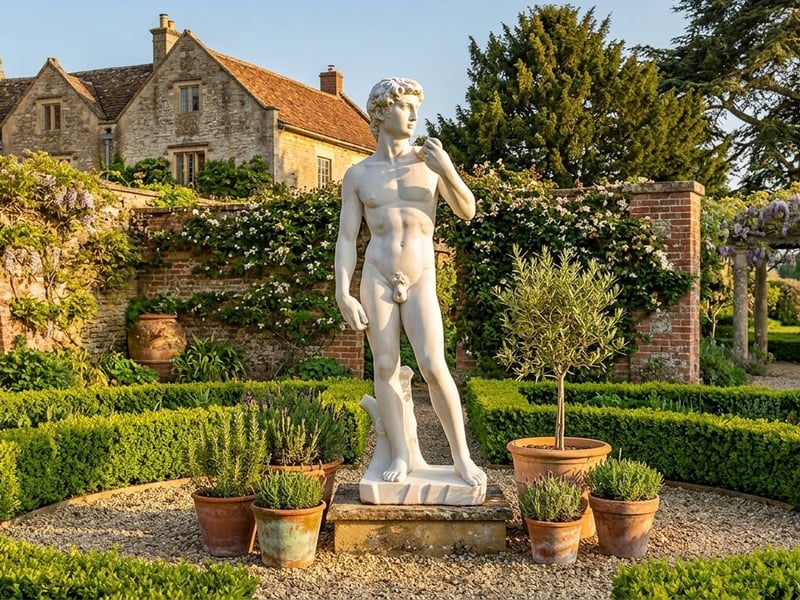
Shop the David Garden Ornament - £189 →
Our Enigma David at £189 stands 85cm tall and reproduces the original's contrapposto stance, muscular tension and focused gaze. The white crushed marble finish catches light in a way that changes through the day. Position David where afternoon sunlight reaches him for the best effect. The original stands 5.17 metres tall in the Galleria dell'Accademia in Florence.
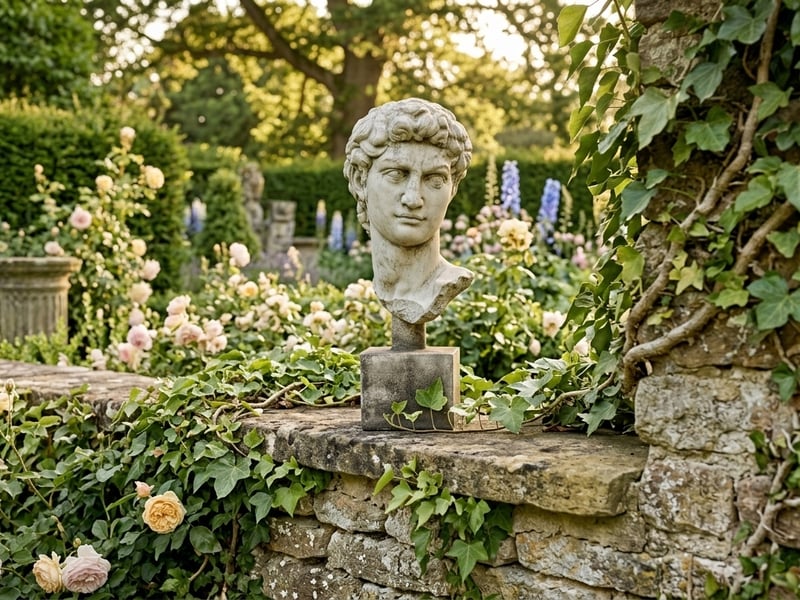
Shop the Bust of David (Cotswold Stone) - £229 →
The Bust of David from Lucas Stone costs £229 and stands 62cm in Cotswold stone finish. Busts work on garden walls, gateposts, conservatory shelves and outdoor dining tables where a full-size statue would overpower the space. The Cotswold stone colour weathers and suits traditional UK garden architecture. Pair it with a proper care routine and it will last decades.
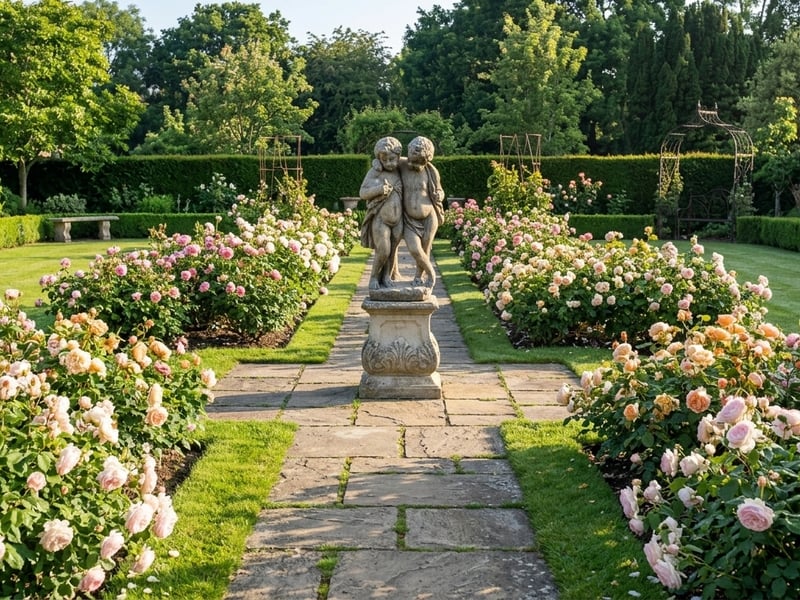
Shop the Twin Standing Cherub Statue - £559 →
The Twin Standing Cherub from Lucas Stone is the most premium piece in this guide at £559. Two cherubs stand 102cm tall on an integrated base, each holding a drape of fabric. Cast in reconstituted limestone, these weigh approximately 50kg and need a solid, level surface. Cherubs suit rose gardens, formal parterre layouts and courtyard fountains. Italian Renaissance gardens often placed cherubs at water features, which is why so many cherub designs incorporate bowls or spouts.
Roman busts and heroes for formal gardens
Roman busts and hero figures bring gravitas to formal garden settings. They work best on plinths flanking doorways, at the end of gravel paths, or positioned in alcoves against walls. The Hercules bust and Flora (goddess of flowers) are our two most popular Roman-inspired figures.
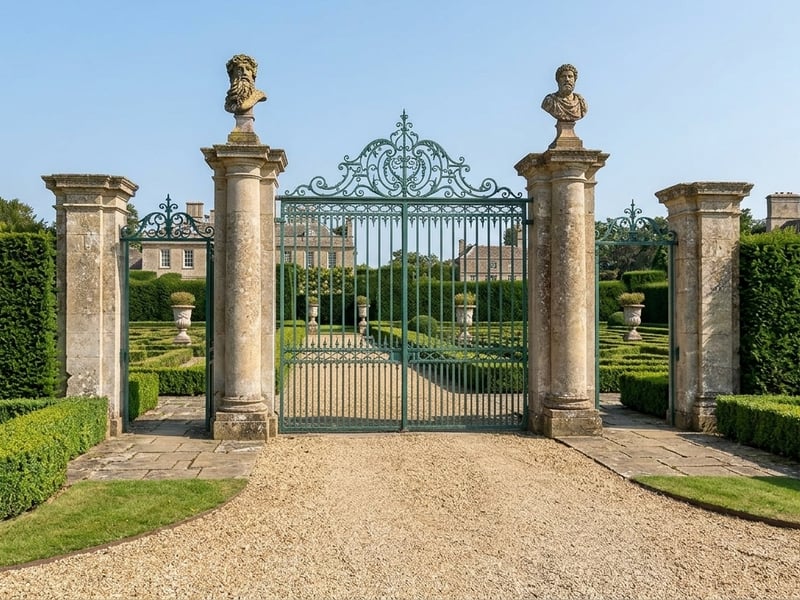
Shop the Hercules Bust - £269 →
The Hercules Bust stands 68cm tall in Lucas Stone's cast reconstituted limestone. Hercules (Heracles in Greek mythology) was the divine hero famous for his twelve labours. The bust captures the intense expression and powerful neck and shoulders of the original Farnese Hercules. At £269, it sits at the mid-range price point and makes a strong statement on a gatepost or garden wall. Roman villa owners placed Hercules busts at entrances to signal strength and protection.
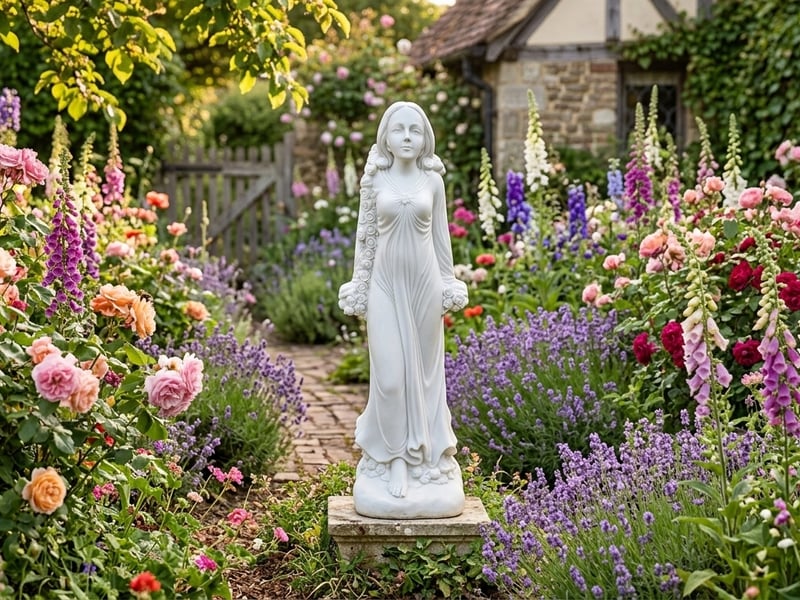
Shop Flora Goddess of Flowers - £495 →
Flora was the Roman goddess of flowers and spring. Our Extra Large Flora stands 155cm tall at £495 and is the natural choice for a flower garden, herbaceous border or walled garden. The figure holds flowers and wears a garland, reinforcing the connection between the statue and its planted surroundings. Romans celebrated the Floralia festival each spring in her honour, which is where the English word "floral" comes from. Position Flora where she is surrounded by planting rather than isolated on a lawn.
The spring maiden: a classical figure for cottage gardens
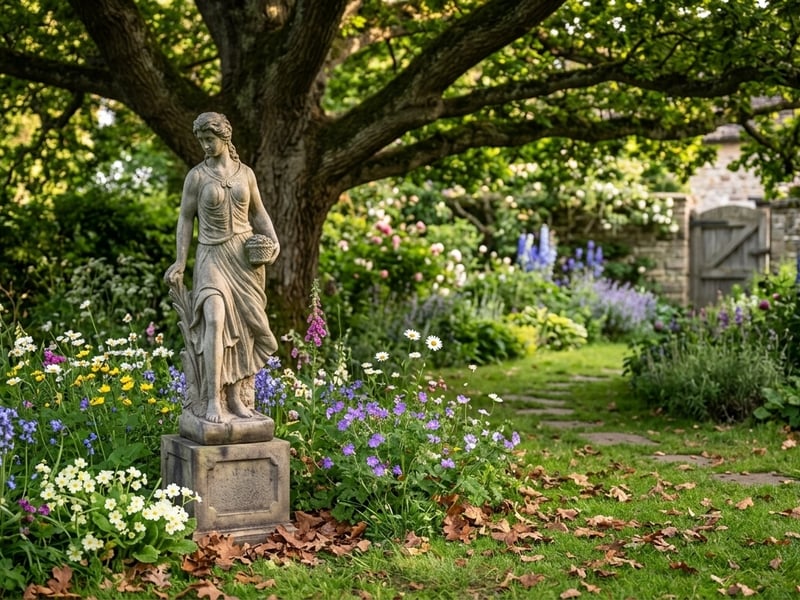
Shop the Spring Maiden Statue - £549 →
Not every classical statue needs a mythological backstory. The Spring Maiden from Lucas Stone at £549 stands 116cm tall and depicts a draped female figure in a gentle contrapposto pose. She suits cottage gardens, informal borders and partly shaded spots under trees where a Greek goddess might feel too formal. The cast stone develops moss and lichen naturally, and within two or three British winters she will look like she has been there for generations. Read more about why stone garden ornaments get better with age.
Which classical statue suits which garden style?
The wrong statue in the wrong garden looks awkward. A 160cm white Hebe on a tiny patio overwhelms the space. A 60cm bust in the middle of a half-acre lawn disappears. Use this table to match figures to garden styles.
| Garden style | Best figures | Display method | Budget from |
|---|---|---|---|
| Formal parterre / walled | Venus de Milo, Hercules bust, Flora | Symmetrical pairs on stone plinths | £269 |
| Cottage / informal | Spring Maiden, Draped Maiden, Small Hebe | Single figure among planting | £150 |
| Courtyard / patio | Bust of David, Hercules bust, Small Hebe | On wall, pedestal or table | £150 |
| Italian-inspired | David, Twin Cherubs, Flora | Centrepiece with gravel surround | £189 |
| Large lawn / estate | Extra Large Hebe, Flora, Large Venus | On tall plinth as centre piece | £339 |
| Rose garden | Twin Cherubs, Flora, Diana | Central feature among beds | £189 |
| Entrance / gateway | Hercules bust, David bust (pair) | Flanking gateposts or doorway | £229 |
The general rule: white marble resin figures stand out against dark foliage and hedging. Cotswold stone and Burnt Umber figures blend into traditional UK garden architecture. Choose based on whether you want the statue to contrast with its surroundings or settle into them. For more advice on getting positioning right, see our guide on where to place garden sculptures.
Classical statue comparison: all 10 figures at a glance
| Figure | Origin | Height | Material | Maker | Price |
|---|---|---|---|---|---|
| Small Hebe Goddess | Greek | 60cm | Marble resin | Enigma | £150 |
| Venus De Milo | Greek | 85cm | Marble resin | Enigma | £179 |
| David Garden Ornament | Renaissance | 85cm | Marble resin | Enigma | £189 |
| Diana the Hunter | Roman | 85cm | Marble resin | Enigma | £189 |
| Bust of David (Cotswold) | Renaissance | 62cm | Cast stone | Lucas Stone | £229 |
| Hercules Bust | Greek | 68cm | Cast stone | Lucas Stone | £269 |
| Large Venus Di Milo | Greek | 114cm | Cast stone | Lucas Stone | £339 |
| Extra Large Hebe ★ Our Pick | Greek | 160cm | Marble resin | Enigma | £449 |
| Flora Goddess | Roman | 155cm | Marble resin | Enigma | £495 |
| Spring Maiden | Classical | 116cm | Cast stone | Lucas Stone | £549 |
| Twin Standing Cherub | Renaissance | 102cm | Cast stone | Lucas Stone | £559 |
How to display classical garden statues
Positioning is everything with classical statuary. The Italians who invented garden statue placement followed three rules that still hold today: sight lines, framing and proportion.
- Sight lines. Place statues at the end of paths, through arches, or visible from key windows. The eye should be drawn to the figure naturally. Roman villa owners positioned statues so they were the first thing guests saw on entering the garden.
- Framing. Use hedging, walls, or planting behind and around the statue. A figure against an open sky looks lost. A figure framed by dark yew hedging or set in a niche looks intentional. Tall figures (over 100cm) need vertical framing. Busts need horizontal framing at eye level.
- Proportion. Match statue height to garden scale. A 160cm Hebe needs at least 3 metres of clear space around her. A 62cm bust can sit on a 90cm pedestal against a wall in a 2-metre courtyard.
A stone pedestal or plinth raises the figure to eye level and separates it from ground-level planting. We stock a range of stone pedestals and plinths from £69 to £299 that pair well with every figure in this guide. For security, use exterior-grade adhesive between statue base and plinth. Our guide to stopping garden statues falling over covers all the fixing methods.
Cast stone vs crushed marble resin: which material for classical statues?
Our classical range comes in two materials. Each has strengths depending on your priorities.
| Feature | Cast stone (Lucas Stone) | Crushed marble resin (Enigma) |
|---|---|---|
| Look | Natural stone colours (Cotswold, Burnt Umber). Ages and weathers like real limestone. | Bright white alabaster. Stays clean longer. |
| Weight | Heavy (30-50kg for full figures). Feels solid. Harder to move once placed. | Lighter (10-15kg). Easier to reposition. |
| Frost resistance | Excellent. Designed for permanent UK outdoor display. | Excellent. Crushed marble resin is non-porous. |
| Patina | Develops moss and lichen naturally. Looks aged within 2-3 years. | Stays white. Needs manual ageing if you want a weathered look. |
| Price range | £229 to £559 | £150 to £499 |
| Best for | Traditional gardens wanting an established look | Modern or Mediterranean-style gardens wanting contrast |
Both materials survive UK winters without cracking or flaking. For more detail on material choices, read our stone vs resin comparison guide. Browse our full garden ornaments collection for figures in both materials.
Frequently asked questions
How much do classical garden statues cost in the UK?
Prices range from £150 for a 60cm Small Hebe to £559 for a 102cm Twin Standing Cherub in cast stone. Most full-size classical figures (85cm+) cost between £179 and £339. Premium extra-large figures over 150cm cost £449 to £499.
What material are classical garden statues made from?
The two main materials are cast reconstituted limestone and crushed marble resin. Cast stone from Lucas Stone weighs 30-50kg and ages naturally with moss and lichen. Crushed marble resin from Enigma weighs 10-15kg, stays white, and is lighter to move. Both are frost-resistant and safe for permanent outdoor display in the UK.
Will classical garden statues survive a british winter?
Yes, every statue in our classical range is frost-resistant. Cast reconstituted limestone from Lucas Stone is made in Nottinghamshire specifically for UK weather. Enigma's crushed marble resin is non-porous, so water cannot enter and freeze. We have sold these statues for over a decade and replacement requests due to frost damage are virtually non-existent. Read our frost protection guide for extra precautions.
What is the most popular classical garden statue?
The Venus de Milo is our best seller across all sizes and materials. She outsells every other classical figure by a clear margin. After Venus, the David Garden Ornament and Diana the Hunter are the next most popular.
Do I need a plinth for a classical garden statue?
You do not need one, but a plinth improves the display significantly. It raises the figure to eye level, protects the base from ground moisture, and separates the statue from soil and planting. A 90cm stone pedestal under a 85cm statue puts the face at roughly 175cm, which is natural viewing height for most people.
Which classical statue suits a small garden?
The Small Hebe Goddess at 60cm and £150 is the best entry point. Busts (Hercules at 68cm, David at 62cm) also work well in small spaces because they sit against walls or on tables without taking up floor area. Avoid figures over 100cm in gardens under 5 metres wide.
How do I clean a classical garden statue?
Soft brush and clean water for routine cleaning. For algae and moss, use a diluted algae remover (not bleach). Never use a pressure washer, which damages fine detail on faces and hands. For a full walkthrough, see our stone garden ornament cleaning guide.