
How to Position Stone Garden Ornaments
Written by Matt W on 4th Mar 2025.
Stone garden ornaments transform outdoor spaces when positioned correctly. Place statues at the end of paths, centre of courtyards, or against boundary walls for maximum impact. Large pieces work in small gardens if you respect sightlines. We have placed hundreds of ornaments across UK gardens and find that checking the view from your house windows first prevents the most common positioning mistakes.
In This Guide
- 7 positioning techniques from focal points to water features
- How to handle large ornaments in small gardens (the "one big piece" approach)
- Winter viewing angles most people forget
- Contrast vs harmony: which approach suits your garden style
- Practical tips: stability, frost protection, and testing before you commit
- Matt's Pick: a 117cm classical statue that works as a centrepiece in any setting
How to Create Focal Points with Stone Ornaments
The classic positioning is at the end of a path or centre of a courtyard. This draws the eye and gives your garden a sense of purpose. I always tell customers to stand at their garden gate and ask: where does my eye go? That spot is where your first ornament belongs.
A Corinthian Column Stone Garden Pedestal works as a strong vertical anchor. At 76cm tall, it creates height without blocking sightlines to what sits beyond it.
Forgotten corners are opportunities. I placed a small statue at the far end of a customer's narrow side passage. It turned a wasted strip into a destination. They now call it their "secret garden" and walk past it every morning.
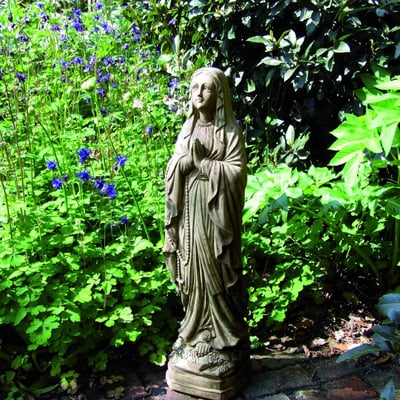
Shop the Novice Nun Garden Statue →
Can Large Ornaments Work in Small Gardens?
Yes, and often better than you expect. One bold piece looks more intentional than six small ones scattered about. I have seen a single 100cm statue transform a 3m x 5m courtyard, while a customer with the same space filled it with small figurines and it looked cluttered.
For compact spaces, try these approaches:
- Position a larger piece against a boundary wall where it does not block sightlines
- Use a wall-mounted feature like the Stone Buddha Relief Wall Plaque that takes zero floor space
- Choose pieces with open designs that let light through
- Place taller pieces where they can be viewed from multiple angles
The key is visual weight, not physical weight. An airy 120cm sculpture often feels lighter in a small garden than a squat 40cm piece with a heavy base.
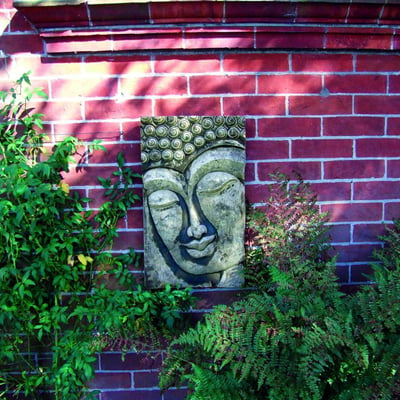
Shop the Stone Buddha Relief Wall Plaque →
Why You Should Position Ornaments for Indoor Viewing
This is the step most people skip, and I think it is the most important one. You spend more time looking at your garden through windows than standing in it. In winter, when deciduous plants drop their leaves, stone ornaments become the stars of the show.
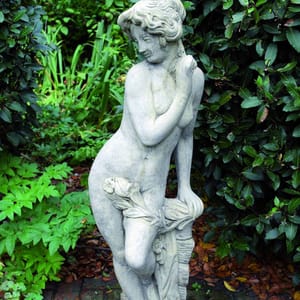
I always ask customers to sit in their favourite chair and look out. That sightline is where your best piece should go. A classical figure like the Grecian Girl at 117cm catches low winter sun beautifully. I have one visible from my kitchen window and it looks different every morning depending on the light.
Practical checks for indoor viewing:
- Check the view from your kitchen, living room, and bedroom windows
- Note where the sun hits at different times (morning light versus afternoon light changes everything)
- Position detailed pieces closer to windows so you can appreciate the craftsmanship
- Use taller pieces to create silhouettes against the sky on grey days
If you want more ideas on getting garden design right in limited space, our guide to small garden design ideas covers layout principles that apply to ornament positioning too.
Using Stone Ornaments as Punctuation Points in Borders
Beyond single focal points, ornaments work as "punctuation marks" along a border. They add rhythm and structure to planting schemes and give the eye somewhere to rest.
In summer, ornaments add architecture among billowing plants. In winter, they hold the border together when perennials die back. A Terracotta Warrior Statue placed mid-border creates year-round presence.
I learned the hard way to check how planting interacts with ornaments across the seasons. I once placed a beautiful stone urn where it got completely hidden by phlox from June to September. Now I mark ornament positions on a plan and cross-reference with plant heights at maturity.
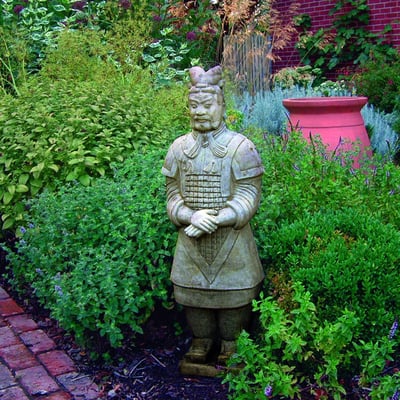
Shop the Terracotta Warrior Statue →
Matt's Tip: The Odd Number Rule
When grouping ornaments, always use odd numbers. Three small statues look natural. Four look like they are waiting for a bus. I group ornaments in threes with varying heights and spacing: one tall at the back, one medium to the left, one small at the front right. This creates a triangle that feels balanced without looking arranged.
Should You Create Contrast or Harmony?
Both work. The question is what mood you want. Contrast creates drama. Harmony creates calm.
For contrast:
- Place formal, geometric pieces among loose cottage-style planting
- Position light-coloured stone against dark evergreen foliage (yew hedging is perfect)
- Use ornate classical pieces in otherwise modern, minimalist settings
For harmony:
- Echo materials used elsewhere in your garden (match your paving stone tone)
- Choose ornaments that reflect your garden's style: formal pedestals for formal gardens, natural pieces for cottage gardens
- Select pieces that complement your planting palette
Our article on stone vs resin garden ornaments covers how different materials create different effects. Reconstituted stone weathers naturally, which helps it blend into established gardens faster than resin alternatives.
How to Choose a Theme for Your Garden Ornaments
A theme creates cohesion. Without one, a garden fills up with impulse purchases that compete rather than complement. Pick a direction:
- Animals and wildlife (birds, woodland creatures, hares)
- Classical mythology (Grecian figures, columns, urns)
- Religious or spiritual figures (Buddhas, saints, angels)
- Abstract and contemporary forms
- Eastern influence (warriors, Buddhas, lanterns)
An Armillary on a Cherub Pedestal pairs naturally with classical figures. It would look odd next to a modern abstract piece. Stick to one theme per garden zone, though you can have different themes in separate "rooms" if your garden is large enough.
When building a collection, vary heights and sizes while keeping materials consistent. Three pieces in the same stone finish look curated. Three pieces in different finishes look like a car boot sale.
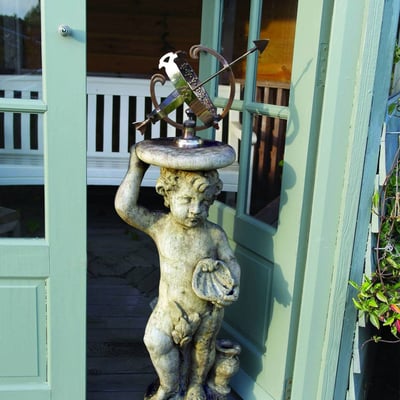
Shop the Armillary on Cherub Pedestal →
Positioning Garden Ornaments Near Water Features
Water and stone have a natural affinity. The reflection of a sculpture in still water doubles its visual impact. If you have a pond, stream, or even a large bowl, position at least one ornament where it catches the reflection.
Good positions near water:
- At the pond edge where the reflection is visible from your main viewing point
- As a central feature on a small island or raised plinth
- On adjacent paving where it frames the water
- Integrated as a water spout or fountain
A St Francis of Assisi Bird Feeder beside a wildlife pond is one of my favourite combinations. The statue attracts birds, the pond gives them water, and you get to watch it all from your window. Our water feature ideas guide has more on combining water with garden ornaments.
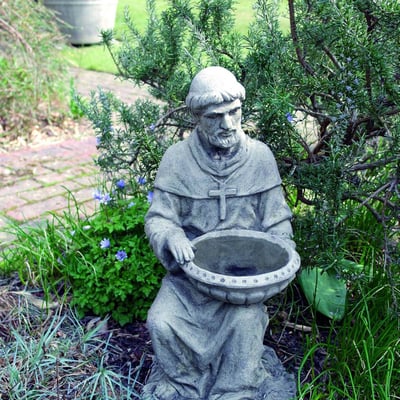
Shop the St Francis Bird Feeder Statue →
|
Matt's Pick for Garden Focal PointsBest For: Path ends, courtyard centres, and views from house windows Why I Recommend It: At 117cm tall with 260mm depth, it creates a strong silhouette without dominating the garden. The aged Cotswold finish weathers beautifully and blends into established planting within months. I have one in my own garden. Price: £339 |
Practical Placement: Stability, Frost, and Testing
Before you commit to a position, consider these practical factors:
- Stability: Level the ground properly. A 60kg statue on uneven soil will lean within weeks. I use a hidden paving slab underneath for any piece over 30kg
- On grass: Always place a hidden paving stone underneath. It prevents sinking, makes mowing easier, and protects the base from moisture
- Frost protection: Move delicate hollow pieces under cover in winter, or wrap in breathable fleece. Solid reconstituted stone handles UK winters well
- Seasonal growth: Check plant heights at maturity. A 90cm statue behind a perennial that grows to 120cm will vanish from June to October
- Tall pieces: Secure anything over 100cm in exposed positions. A concrete footing or ground anchors stop wind from toppling tall columns
For care and cleaning guidance, our stone ornament maintenance guide covers cleaning, weathering, and long-term protection in detail.
Testing Positions Before You Commit
Stone ornaments are heavy. Moving them twice is no fun. Test first:
- Cut a cardboard silhouette to the same height and width. Place it in each candidate spot
- Photograph each position from your main viewing points (house windows, patio, garden gate)
- Check at different times of day. Morning sun and afternoon sun create completely different moods
- Leave the cardboard in place for a week. You will know quickly if a position works
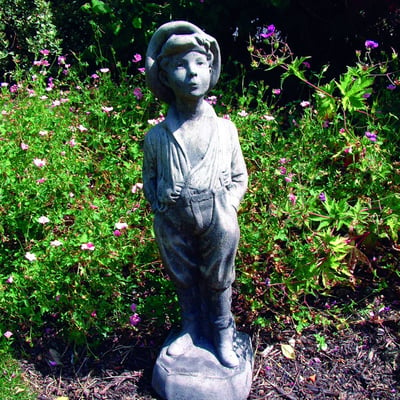
Shop the Whistling Urchin Garden Statue → Browse our full collection of garden ornaments for more ideas.
Frequently Asked Questions
Spacing depends on size: 1.5 to 3 metres apart for medium pieces. For collections, vary the distances so some pieces sit closer together and others stand alone. This creates a natural rhythm rather than a regimented line. I group ornaments in odd numbers (threes or fives) and leave at least 2 metres between each grouping.
Yes, but always use a hidden paving slab underneath. This prevents the ornament from sinking into soft ground, makes mowing easier, and protects the stone base from constant moisture. Dig out a slab-sized area, lay the paver flush with the soil, and set your ornament on top.
Solid reconstituted stone handles UK frost well without protection. The main risk is hollow pieces that trap water, which then expands as it freezes. Move delicate or hollow pieces under cover in November, or wrap with breathable garden fleece. Ensure water drains away from the base to prevent ice forming underneath.
No, moss and lichen add character and are a sign of quality stone. Only clean off bird droppings with a soft brush and water. Never use a pressure washer or bleach. The natural patina that develops over months makes cast stone look like genuine antique pieces. Our ornaments are designed to encourage this aging.
Secure anything over 100cm in exposed or family gardens. For pedestals and columns, use a concrete footing below the surface. For statues on plinths, apply exterior stone adhesive between the base and plinth. In very windy gardens, ground anchors provide additional security. Weight alone is not enough in an exposed position.
Uplighting from below creates the most dramatic effect. Place a small LED spotlight 30 to 50cm from the base, angled upward. This casts interesting shadows and highlights texture. Solar spike lights are the easiest option and cost nothing to run. Avoid floodlighting, which washes out detail. For larger pieces, two lights from different angles create depth.
Reconstituted stone ornaments typically weigh 15 to 80kg depending on size. A 40cm figurine weighs around 15kg. A 100cm statue weighs 50 to 80kg. Our Grecian Girl at 117cm weighs 80kg. Always check product dimensions before ordering and plan how you will move the piece into position. Two people can handle most ornaments under 60kg.
Further Reading
- How to Age a Garden Statue — speed up the natural weathering process
- Top 10 Stone Garden Ornament Ideas for UK Gardens — our best-selling styles
- Best Places to Position Garden Statues for Feng Shui — Eastern positioning principles
- Sustainable Garden Ornaments — eco-friendly materials and sourcing
- How to Choose Stone Garden Ornaments for UK Gardens — the complete buying guide
Matt W
Garden & Outdoor Specialist
Matt has spent over 16 years working hands-on with garden products across the UK. He tests materials in Staffordshire clay soil and hard water conditions, and writes from direct experience fitting, maintaining, and repairing everything from stone statues to cast iron furniture. His advice is based on what actually survives a British winter, not what looks good in a catalogue.