
Corner Sofa Sets: 5 Layouts for Awkward UK Garden Shapes
Written by Matt W on 8th Jun 2026.
A mini corner sits on a 3x3 block of 600mm flags
A single-return L needs a 1.8m-deep strip
Allow 50cm clear on two sides for access
A curved set follows a bay or round patio
By Matt W | Updated 8th June 2026 | Garden furniture specialist, 14+ years on UK retail, Garden Ornaments
A garden corner sofa set UK buyer almost never has a neat square lawn to drop it on. Real British gardens are awkward: a narrow side-return, a tight new-build courtyard, a splayed boundary fence, or a split-level patio with a step in the wrong place. The corner sofa wins here because its L or U shape pushes seating into the boundary and frees the middle of the space. The trick is matching the layout to your garden shape before you buy. After 14 years delivering outdoor furniture to UK homes, the single most common reason a set goes back is not quality. It is size: the corner that looked fine in the showroom photo never had room to breathe on the customer's actual paving.
This guide gives you five corner sofa layouts mapped to five awkward UK garden shapes, with real footprints, paving sizes and clearance figures. Browse our full range of garden corner sofa sets to see what we stock, or look at our metal garden furniture for the powder-coated aluminium frames that handle British damp best.
Key Takeaways
- Measure your patio in slabs first. A standard UK paving flag is 600mm. A mini corner set sits on a 3x3 flag block (1.8 x 1.8m); a full corner needs roughly 4x4 flags clear.
- Narrow side-return: a single-return L corner fits a strip as tight as 2.6m long by 1.8m deep and still seats four.
- Square courtyard: a U-shape wraps three sides and seats 7-9 in about 2.6 x 2.6m, the most seats per square metre of any layout.
- Tight pocket corner: a mini corner tucks into the 90-degree angle of a new-build patio, freeing the centre for a table or planter.
- Curved or bay-shaped space: a curved corner sofa follows the arc of a round patio or a splayed fence line where a square set leaves dead triangles.
- Split-level garden: a modular set breaks into pieces you can carry up or down a step and reconfigure around a fire-pit table.
- Always leave a 50cm walkway on at least two sides. Furniture you have to climb over gets used less and looks cramped.
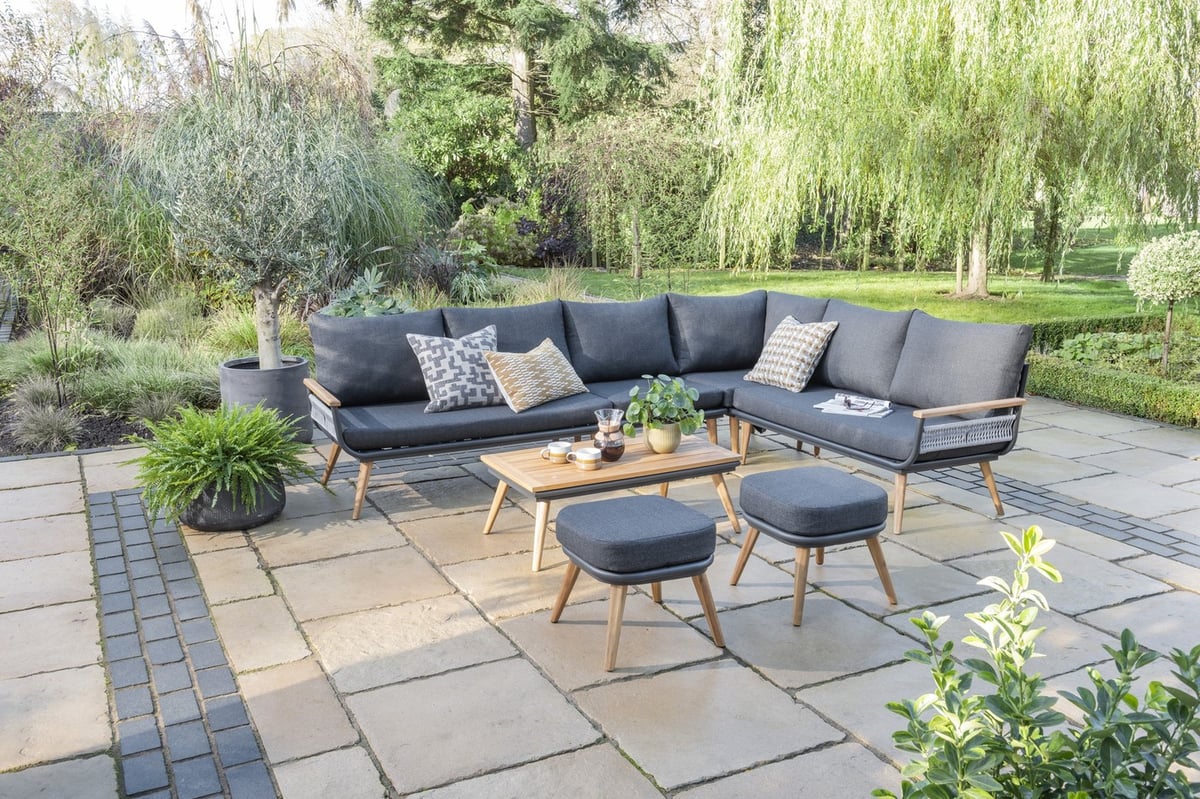
Garden Specialist's Note
The conversation I have most often in spring starts with a photo of an awkward garden and the question, "will a corner sofa even fit?" Nine times out of ten the answer is yes, but only if you pick the right layout for the shape. I ask three things before recommending anything: how long and how deep is the usable paved area, is it a true square or an L-shaped strip, and is there a step or change of level. Get those three answers and the right corner set picks itself. This guide is that whole conversation, written down once.
How to measure an awkward garden before you buy
Measure the usable paved area, not the whole garden, and count it in 600mm slabs. Most UK patios are laid in 600mm or 450mm flags. A 600mm flag is exactly 0.6m, so you can pace out a footprint without a tape measure: a mini corner set covers a 3x3 block of 600mm flags, a full corner needs a 4x4 block clear, and a U-shape needs around 5x5. This slab trick is the fastest way to sanity-check a set against a real garden.
Then take three numbers: the longest straight run against a boundary, the depth from that boundary to the first obstacle (path, step, border), and the width of the narrowest pinch point the furniture has to pass through to be delivered. That last one catches people out. We have turned up with a 2.2m sofa section and found a 900mm side gate as the only access. Measure your gate and any tight corners before ordering a single large piece.
Finally, mark the footprint out on the ground with string or a hosepipe before you commit. Sit a kitchen chair at each corner of the shape and walk around it. If you cannot pass comfortably on two sides, size down. For a broader walk-through of fitting furniture to different garden sizes, our garden dining sets by garden size guide covers the same measuring method for dining layouts.
Layout 1: The single-return L for a narrow side-return
A single-return L corner fits a narrow strip as tight as 2.6m long by 1.8m deep and still seats four to five. This is the layout for side-return gardens, terraced-house strips and any space where one long wall or fence is the only place furniture can sit. The long arm of the L runs along the boundary; the short return tucks across one end. The open side faces into the garden, so nobody sits with their back to the view.
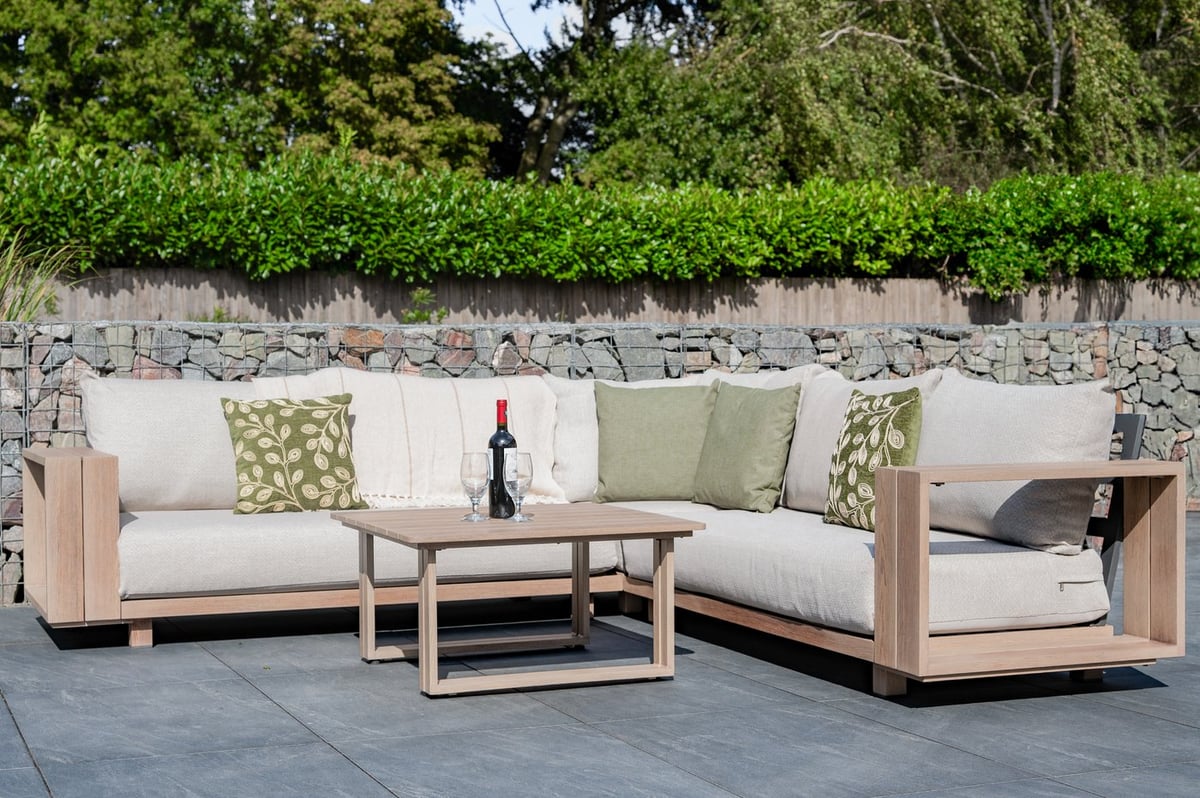
Keep the coffee table small in a narrow run. A full-size table eats the legroom you do not have. We usually pair narrow-strip corners with a slim polywood-topped table you can slide aside. The Darlington above runs a heat-transfer oak-effect aluminium frame, which matters in a side-return: these strips are often shaded and damp, and aluminium does not rot or rust the way a timber-framed set will against a north-facing wall.
Watch the depth. A standard corner seat is 80-90cm deep. In a 1.8m strip that leaves under a metre of walkway once the cushions are on, which is fine for access but tight for a second row of pots. If your side-return is under 1.6m deep, drop to a bench-and-bistro arrangement instead; our bistro sets for small gardens guide covers the under-2m options.
Layout 2: The U-shape for a square courtyard
A U-shape wraps three sides of a square and seats seven to nine people in roughly 2.6 x 2.6m. It is the most seats per square metre of any corner layout. In a square courtyard, a U-shape uses the two boundary walls plus the back wall, leaving only the entry side open. The middle holds a dining-height or coffee table, so the same set works for evening drinks and Sunday lunch.
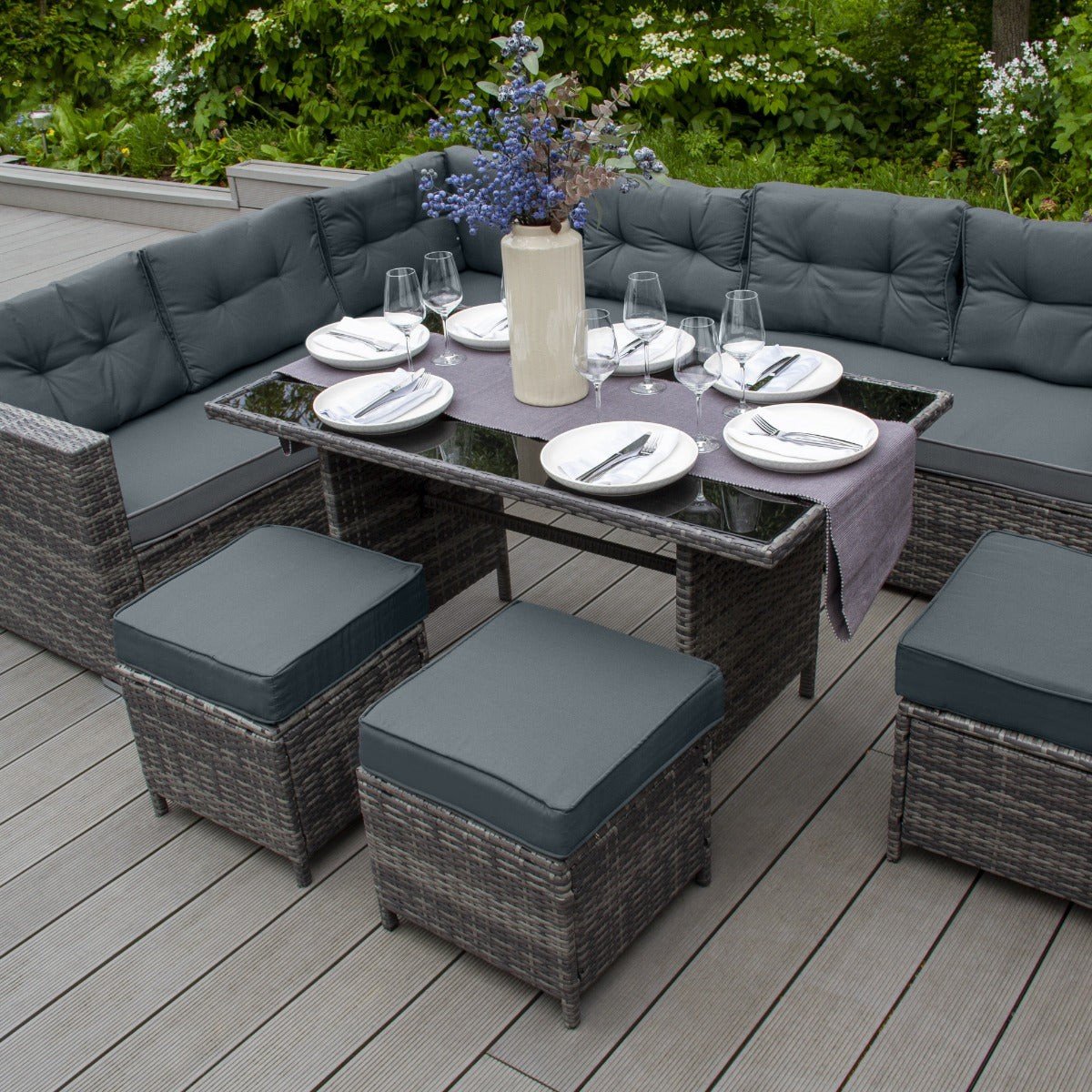
A U-shape needs a genuine square to work. In a rectangle it leaves an awkward gap at one end and the proportions look wrong. Measure both diagonals of your paved area; if they match to within 10cm, you have a true square and a U-shape will sit cleanly. The Jardi above is a nine-seater that includes tuck-under stools, so the footprint stays compact when the stools are stowed and expands when you have guests.
The trade-off is access. A U-shape has only one open side, so everyone enters and leaves the same way. Keep that entry aligned with the path back to the house. And because a U-shape carries more cushions than any other layout, factor in storage: that is six to ten cushions to bring in when the forecast turns. A storage box on the courtyard wall solves it.
Layout 3: The mini corner for a tight pocket patio
A mini corner set tucks into the 90-degree angle of a small patio in a 1.8 x 1.8m footprint and seats three to four. This is the new-build courtyard layout: the back-corner pocket where two fences meet is usually dead space, and a mini corner turns it into a usable seating zone while leaving the centre of the patio clear for a planter, a barbecue or a path.
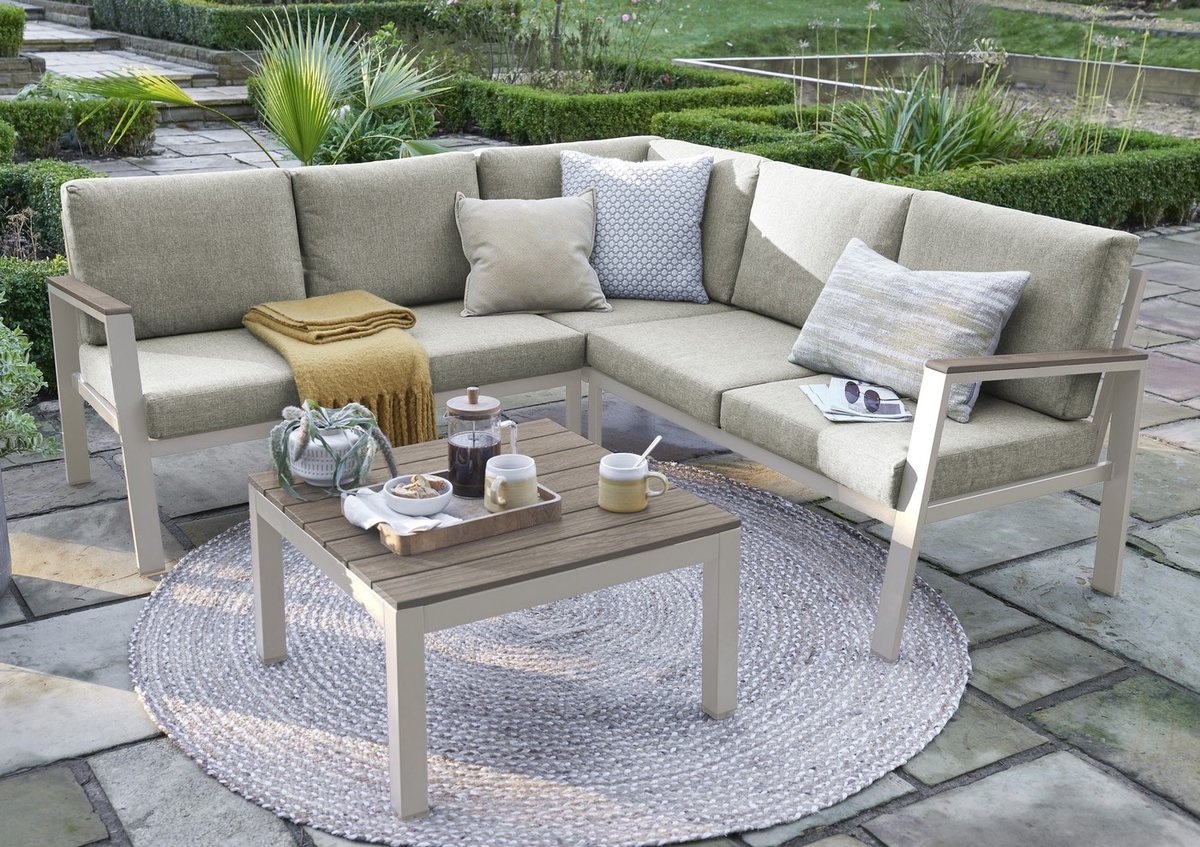
Mini corner seats sit slightly more upright than full corners. That suits evening conversation and a glass of wine over all-day lounging, which is exactly how most small patios get used. The lighter beige cushions on the Easton above brighten a north-facing pocket, though they show grit sooner than anthracite and want a wipe-down each week to stay sharp. On a shaded or coastal patio, choose the darker colourway.
In a true pocket, push the set right into the corner and angle the table 45 degrees across the open mouth of the L. That opens up the diagonal sightline and makes a small patio feel larger than a square table parked dead centre. For more on squeezing usable zones out of a small plot, see our small garden design ideas.
Layout 4: The curved corner for a bay or round patio
A curved corner sofa follows the arc of a round patio, a bay window or a splayed fence where a square set leaves dead triangles. Awkward gardens are full of curves: a circular paved area, a boundary that kinks at an angle, a bay that bulges into the garden. A straight-armed L fights those shapes and leaves wedge-shaped gaps. A curved set hugs them.
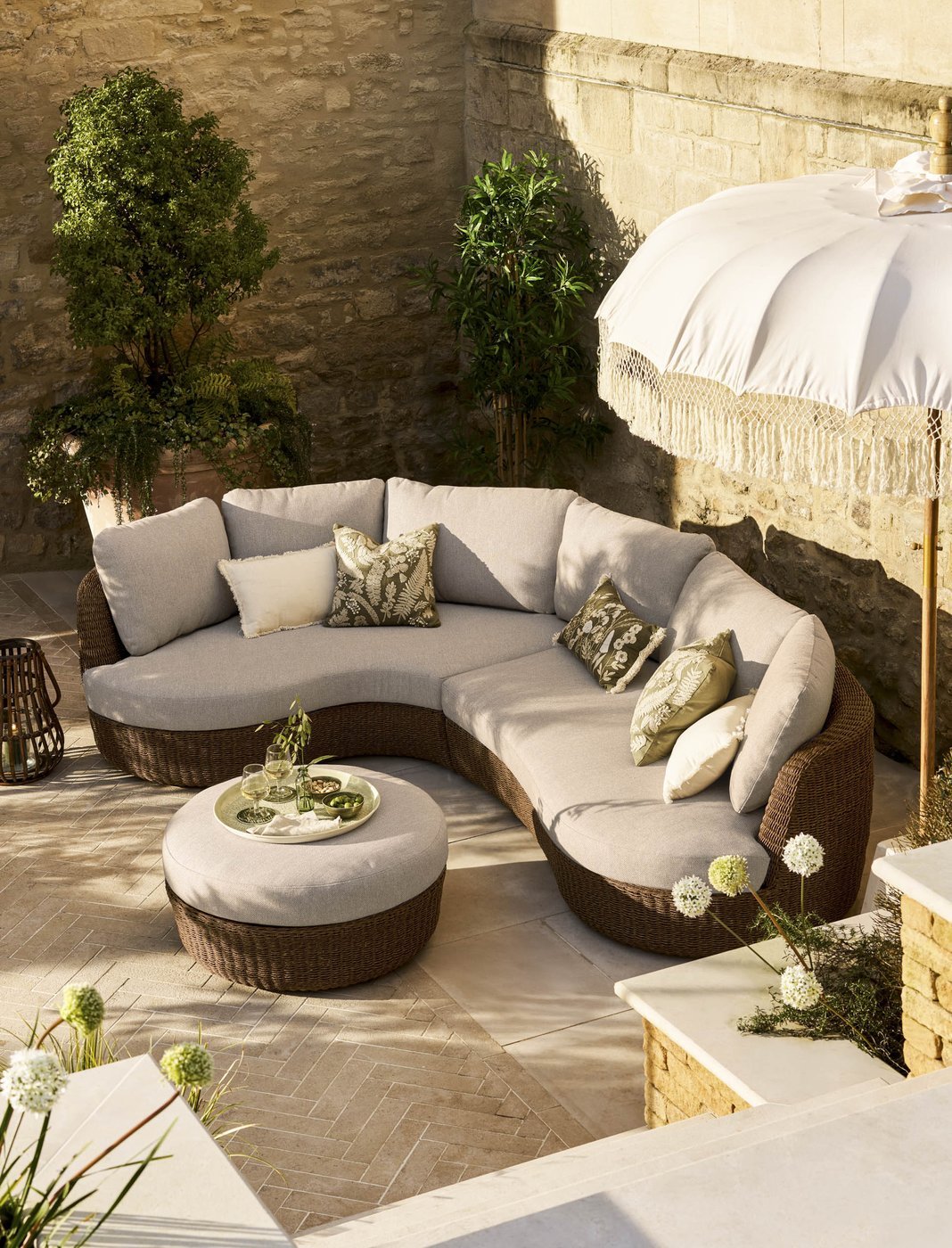
A curved set reads as the centrepiece rather than a row of seating against a wall, so it suits a garden where the seating area is the destination, not an afterthought against the fence. The Hambridge above pairs a banana-palm weave with an aluminium frame and a matching ottoman that slides in to complete the circle or pulls out as an extra seat or footrest.
Allow a bit more room than the bare footprint suggests. A curved sofa needs clearance behind the arc as well as in front, because the back is convex and will not sit flush against a straight wall. Reckon on a 3m clear circle for a four-to-six-seat curved set. It is the most space-hungry layout per seat, but in a round or splayed garden it is the only one that does not waste the corners.
Layout 5: The modular set for a split-level or multi-use garden
A modular set breaks into separate pieces you can carry over a step and reconfigure around a fire-pit table. Split-level gardens, gardens with an awkward step mid-patio, and gardens that have to do several jobs all suit modular over a fixed corner. You build an L on the lower level in summer, split it into facing sofas around a fire pit in autumn, and shuffle a piece up to the top terrace for a party.
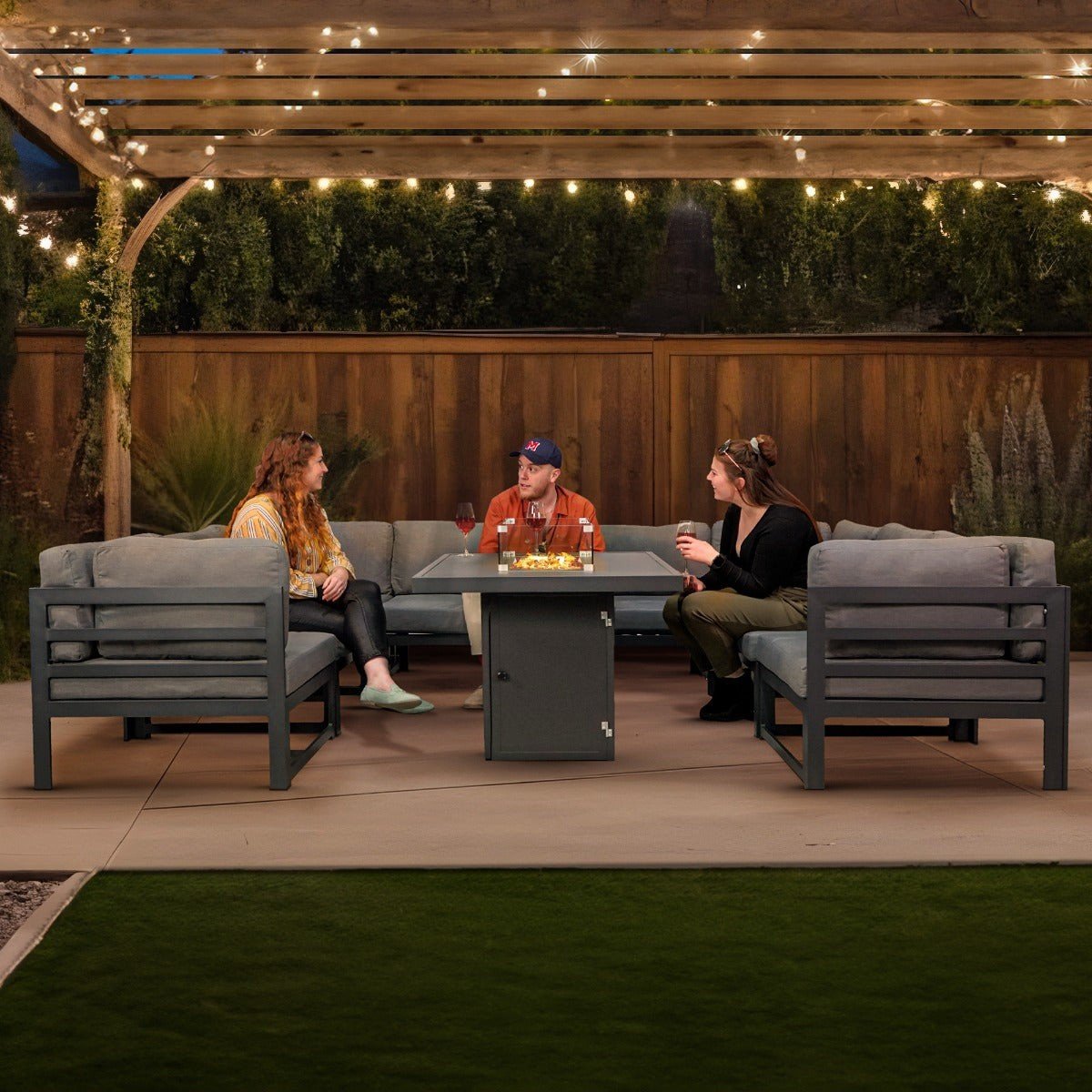
The fire-pit table is what makes a modular set earn its keep in a British garden. It extends the usable season by a couple of months either side of summer, and it gives the layout a natural centre to arrange around. The anthracite aluminium frame on the Jardi above shrugs off the wet and the dark finish hides leaf debris, which matters when the set lives outside under a pergola through autumn.
Modular is also the layout to choose if you might move house or rework the garden later. Separate pieces re-home into a new garden far more easily than a single bonded corner, and they hold their resale value better as individual units. If you are weighing a fire-pit table against a standalone fire pit, our garden fire pit buying guide compares the freestanding options.
Five layouts compared: footprints, paving and seats
| Garden shape | Layout | Footprint | Clear paving needed | Seats |
|---|---|---|---|---|
| Narrow side-return | Single-return L | 2.4 x 1.6m | 2.6m long x 1.8m deep | 4-5 |
| Square courtyard | U-shape | 2.6 x 2.6m | 3.2 x 3.2m | 7-9 |
| Tight pocket patio | Mini corner | 1.6 x 1.6m | 1.8 x 1.8m (3x3 flags) | 3-4 |
| Round / bay / splayed | Curved corner | 2.6 x 2.2m arc | 3m clear circle | 4-6 |
| Split-level / multi-use | Modular + fire pit | Reconfigurable | 3 x 3m main level | 6-8 |
Matt's Tip: Lay the footprint out in cardboard first
Before any large set leaves the warehouse, I tell customers to cut the footprint out of flattened cardboard boxes and tape it down on the actual paving overnight. It costs nothing and it has saved more orders from going wrong than any tape measure. You see immediately whether the door still opens, whether you can get past with the bin, and whether the table leaves you any legroom. If the cardboard mock-up feels tight, the real set will feel worse once it has cushions and people on it. Size down a layout rather than squeezing the biggest set into the space.
Which frame material survives an exposed UK garden
Powder-coated aluminium frames outlast synthetic rattan by five to ten years in the UK and handle exposed, damp or coastal gardens best. Aluminium does not rust, does not absorb water, and only fails if the coating is physically chipped. Synthetic rattan is a UV-stabilised plastic ribbon over a metal frame: it fades from year three or four and strands work loose at the corners by year eight. In an awkward garden that is often shaded or wind-funnelled, frame choice matters more than in an open, sunny plot.
Whatever the frame, the cushions are the weak point. Even shower-proof covers absorb water through repeated rain cycles and grow mildew if left out. Bring them in when rain is forecast, strip them for winter, and they will outlast two seasons of neglected ones. For the full material breakdown across aluminium, rattan, polywood and steel, see our garden furniture buying guide, and for the corner-versus-lounge decision our lounge sets and corner sofas comparison goes deeper on durability.
Matt's Pick: the best all-round corner set for an awkward UK garden
Matt's Pick for Awkward Gardens
Best For: narrow side-returns, shaded strips and any awkward UK garden where the set lives outside year-round
Why I Recommend It: the heat-transfer oak-effect aluminium frame gives you the warm look of timber with none of the rot, the polywood table top will not warp, and the single-return L footprint slots into a tight strip without crowding it. It is the set I point most awkward-garden customers towards.
Price: £1,749
A corner sofa is only part of the picture. Dress the space around it with the rest of our outdoor range and a few garden ornaments to give an awkward shape a focal point.
Frequently asked questions
What size garden do I need for a corner sofa set?
A mini corner set needs a 1.8 x 1.8m clear footprint, a full corner needs about 2.5 x 2.5m, and a U-shape needs 3.2 x 3.2m. Count it in 600mm paving slabs: a mini corner sits on a 3x3 block. Always add a 50cm walkway on at least two sides for access.
What is the best corner sofa layout for a narrow garden?
A single-return L corner is best for a narrow garden. The long arm runs along the boundary and the short return tucks across one end, fitting a strip as tight as 2.6m long by 1.8m deep while still seating four. Keep the coffee table small to protect legroom.
Can a corner sofa fit a round or curved patio?
Yes, a curved corner sofa is made for round and bay-shaped patios. It follows the arc where a straight-armed L leaves wedge-shaped gaps. Allow a 3m clear circle and leave room behind the sofa, because the convex back will not sit flush against a straight wall.
How many people does a corner sofa set seat?
Between three and nine, depending on the layout. A mini corner seats three to four, a single-return L four to five, a curved set four to six, a modular set six to eight, and a U-shape seven to nine. The U-shape gives the most seats per square metre.
Is aluminium or rattan better for a corner sofa set in the UK?
Powder-coated aluminium lasts five to ten years longer than synthetic rattan in UK weather. Aluminium does not rust or absorb water; rattan fades from year three and frays at the corners by year eight. For shaded, damp or coastal gardens, choose aluminium. Rattan suits drier spots and tighter budgets.
What is a modular corner sofa set?
A modular set is built from separate pieces you can rearrange rather than a single fixed corner. You can carry sections over a step, split them into facing sofas around a fire pit, or move a piece to another part of the garden. It suits split-level gardens and anyone who may rework the garden later.
How do I stop my corner sofa set blocking the path?
Mark the footprint out in cardboard on the paving before you buy. Tape flattened boxes down overnight and check you can still reach the door, the bin and the shed. Leave a 50cm walkway on at least two sides. If the mock-up feels tight, drop down a layout rather than forcing the biggest set in.
Do corner sofa cushions need to come inside in winter?
Yes, strip the cushions and store them dry from November to March. UK winter is too wet and cold for outdoor cushions to dry between rain events, so foam breaks down and mildew sets in. The aluminium or rattan frame can stay out under a cover; the cushions should not.
Related articles
- Lounge Sets vs Corner Sofas: Which Garden Set Wins for British Weather
- Garden Furniture Buying Guide: Aluminium vs Rattan vs Polywood vs Steel
- Bistro Sets for Small Gardens: 9 Best 2-Seater Patio Sets
- Garden Dining Sets: How to Choose by Garden Size
- Small Garden Design Ideas 2026: Trends, Layouts & Plans