
About our self-contained water features
We stock 62 self-contained water features priced from £135 to £899. Self-contained means the pump, reservoir, and all plumbing are built into the unit. No digging, no external pipework, no mains water connection. Fill with water, plug in (or position the solar panel), and the feature runs. Setup takes 10–20 minutes for most models.
The collection spans four material types. Poly resin models are lightweight (8–25kg), weather-resistant, and arrive with LED lighting and low-voltage pumps. Composite concrete and glassfibre reinforced concrete (GRC) models look and feel like natural stone but weigh less and resist frost better. Natural stone pieces from Lucas Stone are the heaviest and most traditional. Browse the full water features collection to see every type we carry.
How do self-contained water feature types compare?
| Type | Material | Power | LED | Price Range | Best For |
|---|---|---|---|---|---|
| Cascading Bowls | Poly resin / GRC | Mains (10–17W) | Yes | £135–£629 | Patios, decking, courtyard corners |
| Column & Pillar | Poly resin / composite | Mains (10–17W) | Yes | £175–£499 | Narrow spaces, beside doorways |
| Figure & Sculpture | Poly resin / stone | Mains (17–30W) | Most | £349–£899 | Garden centrepieces, focal points |
| Solar Powered | Poly resin | Solar + battery | Yes | £145–£229 | No socket nearby, eco-friendly gardens |
| Matt's Pick | Composite concrete | Mains (17W) | No | £599 | Cottage gardens, traditional settings |
|
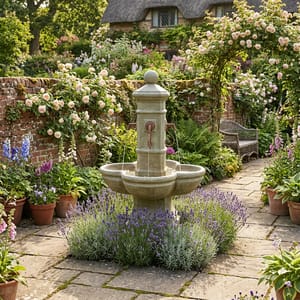
Matt's Pick for Self-Contained Water FeaturesBest For: Cottage gardens and traditional patios that need a proper statement piece Why I Recommend It: The Piazza stands 133cm tall with four copper-effect taps cascading water down a stone-effect column. It looks like an old village fountain but sets up in 15 minutes. The composite concrete finish weathers naturally and feels solid — not plasticky like some cheaper resin models. At 17W it costs about £1.30 a month to run. Price: £599 |
Mains vs solar: which power type should I choose?
Mains-powered models run all day regardless of weather and produce a stronger, more consistent water flow. They use 10–30W — roughly the same as one or two LED light bulbs. Running costs are £0.80–£2.50 per month at current UK electricity rates. All 48 mains models include a low-voltage outdoor transformer with 10m of cable. You need an outdoor socket within reach — if you do not have one, an electrician can install one for £80–£120.
Solar models cost nothing to run and need no wiring at all. The 14 solar water features in this collection include a solar panel with battery backup that stores 4–6 hours of charge. They run during daylight and continue into the evening on stored power. The trade-off is weaker flow on cloudy days and a shorter running season in winter. Place the panel in a south-facing spot with at least 4 hours of direct sun. Our water feature buying guide compares running costs in detail.
Matt's Installation Tip
Place your water feature on a level surface before filling — once full, most weigh 20–50kg and are awkward to reposition. Check the cable reaches your outdoor socket with slack to spare. A cable stretched tight across a path is a trip hazard. If you are putting a feature on decking, place a paving slab underneath to spread the weight and stop the decking boards bowing. I have seen a 40kg feature push through old decking after one wet winter.
Why we chose this range
"We tested over forty self-contained water features before selecting these sixty-two. Pump quality is the thing that separates a good feature from a bad one. Cheap pumps buzz, vibrate, and fail within a season. The pumps in our Easy Fountain and Altico models are designed for continuous outdoor use — quiet, reliable, and easy to access for cleaning. We also rejected anything where the finish flaked, cracked, or faded after six months outdoors. Every piece in this range has survived at least one full UK winter in our test garden."
— Matt, Garden Ornaments
How to maintain a self-contained water feature
Top up the water every 1–2 weeks in summer, more often in hot or windy weather. Low water burns out pumps quickly — it is the most common cause of pump failure we see. Add a capful of fountain water treatment monthly to prevent algae. Clean the pump filter every 4–6 weeks by pulling it out and rinsing under a tap. A blocked filter reduces flow and makes the pump work harder.
Before the first hard frost, disconnect the pump and drain all standing water. Store the pump indoors over winter. The feature itself can stay outside — poly resin, GRC, and composite concrete all handle frost. In spring, reconnect the pump, fill with fresh water, and the feature is ready for another season. Our water feature maintenance guide covers the full seasonal routine. Browse our full collection of garden ornaments to find the perfect piece for your garden.
Frequently asked questions
What does self-contained mean for a water feature?
Self-contained means the pump, reservoir, and plumbing are all built into the unit. No external tanks, no mains water connection, no digging. Fill the built-in basin with water, plug in the low-voltage transformer (or position the solar panel), and the feature recirculates the same water continuously.
How much electricity does a self-contained water feature use?
Mains models use 10–30W, costing £0.80–£2.50 per month to run 8 hours a day. That is roughly the same as running one or two LED light bulbs. Solar models cost nothing to run. Every product page lists the exact pump wattage.
Can I use a self-contained water feature indoors?
Yes, smaller models work well in conservatories, hallways, and living rooms. Place the feature on a waterproof tray to catch any splashes. Mains models are quieter than solar because the pump receives consistent power. Keep the feature away from soft furnishings and electronics.
How long do self-contained water feature pumps last?
A well-maintained pump lasts 3–5 years. Clean the filter every 4–6 weeks, keep the water topped up, and store the pump indoors over winter. Replacement pumps are available from our water feature pumps collection and fit all our models.
Do self-contained water features attract wildlife?
Yes, moving water attracts birds, bees, hedgehogs, and dragonflies. Birds use the feature for drinking and bathing. Bees and butterflies drink from the wet edges. Place the feature near planting rather than in the middle of bare paving to give visiting wildlife cover.
Can I leave a self-contained water feature outside in winter?
The feature itself can stay outdoors year-round. Poly resin, GRC, and composite concrete all handle UK frost. Drain standing water before a hard freeze to prevent ice expanding inside the reservoir. Remove and store the pump indoors — freezing damages pump seals and impellers.
What surface should I put a self-contained water feature on?
Any flat, level surface that can take the filled weight. Paving slabs, concrete, and compacted gravel are ideal. On decking, place a paving slab underneath to spread the load. On grass, lay a 600mm slab first to stop the feature sinking. Avoid slopes — even a slight tilt makes the water flow unevenly and can expose the pump.
Related collections
Browse more from our range: All Water Features • Solar Water Features • Cascading Water Features • Buddha Water Features • Modern Water Features • Garden Fountains • Water Feature Pumps